Last Wednesday the Fed raised rates for the first time in three years. The 10-year Treasury yield went sideways for four sessions.
This morning a private survey came out and the 10-year broke above 5%.
That ordering is the story, and it answers what yesterday's issue left open. If the Fed doesn't set the long end, what does?
Four sessions of nothing, then a jump
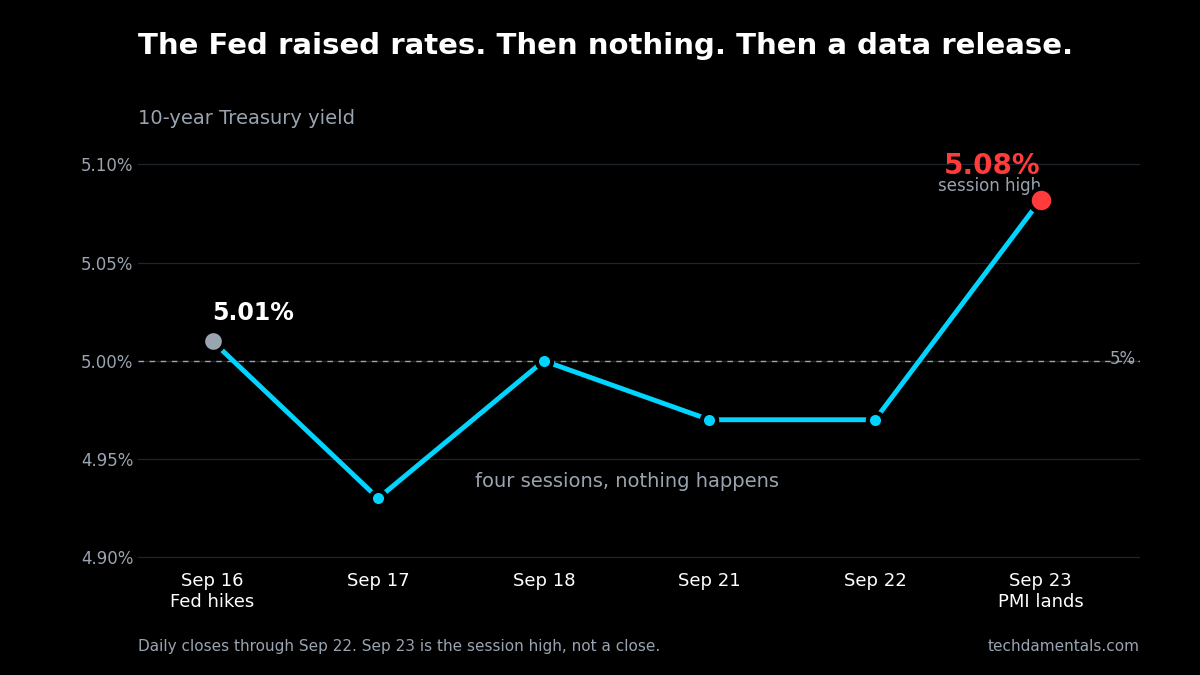
The hike landed on the 16th. The 10-year closed at 5.01%, then drifted: 4.93, 5.00, 4.97, 4.97. Four days of chop inside seven basis points.
Today it pushed to 5.08%, the highest since 2007. The Fed did nothing today.
What was in the report
S&P Global publishes a flash PMI, a survey asking purchasing managers whether business is better or worse than last month. Above 50 means growing. It lands weeks ahead of the official numbers, which is why the bond market watches it.
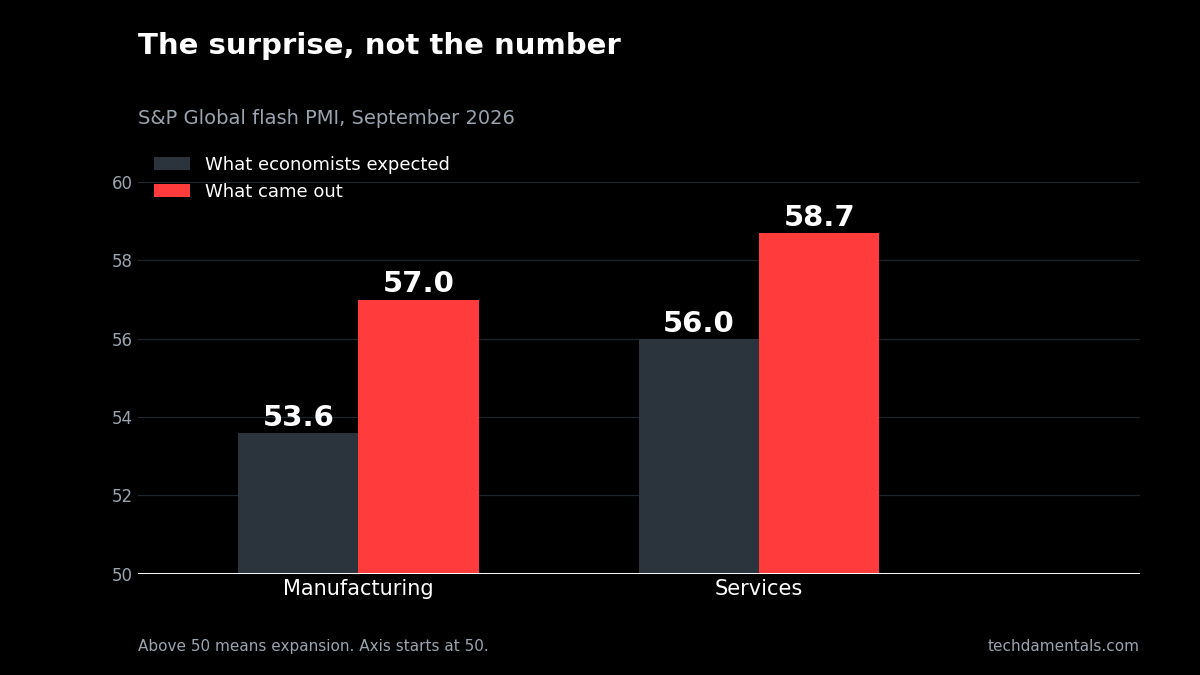
Manufacturing came in at 57.0 against 53.6 expected. Services hit 58.7 against 56.0 expected. The composite was 58.4, the fastest US expansion since July 2021.
Growth wasn't the part that moved rates, though.
Both halves of the Fed's problem
The same survey said input costs jumped at the steepest rate in four years. S&P Global's chief economist named the cause: fuel and transport costs spiking higher.
Employment rose at the fastest pace in over four years, with manufacturing hiring the most since February 2021.
One report, three things. An economy accelerating, a labor market tightening, and costs climbing fastest in four years.
Here's why that combination matters. The Fed has two jobs, holding prices down and keeping people employed, and they pull against each other. Raising rates fights inflation by slowing the economy, and a slower economy costs jobs. So when growth is weak, every increase means putting people out of work on purpose to bring prices down. That's the kind of call that makes a central bank wait.
This report says growth isn't weak. It's the fastest in five years, hiring the fastest in four. Tightening doesn't cost what it usually costs, which is why nothing here makes waiting easier to justify. Futures moved toward another increase as soon as October.
A rate decision is one number. A survey like this shifts what people expect from the next several, and that expected path is what the 10-year prices.
How it reaches what you own
Not through the sector read. Semis sit in the manufacturing survey, software and banks in services, but the panel represents the economy, not the stock market. A 57 in manufacturing says almost nothing about any particular chipmaker.
It reaches you two other ways, pointing opposite directions.
Costs land on physical businesses. Fuel and freight are real line items for anything running a plant or shipping product. Software barely notices.
Rates land on distant profits. A dollar arriving years from now is worth less than one today, and a higher rate deepens that discount the further out it sits. Raise the rate a point and $100 arriving next year loses under 1% of its value. The same $100 in ten years loses about 9%. We ran that math in an earlier issue.
Software keeps more of its value in those far years than semis do. Same rate move, bigger hit.
What this doesn't tell you
A flash PMI is a survey, not a count. It asks how business feels, it gets revised, and one month isn't a trend. It gives the direction of change, not the size of it.
Today isn't over either, and a number quoted midday is not a close.
The fuel line is worth sitting with. Diesel hit a record $6.53 a gallon this week. It shows up in a business survey as input costs, in the inflation data weeks later, then in what the Fed does about it.
There's a version of this in every valuation. The number gets the attention, and the assumptions underneath do the work. Techdamentals shows every input behind a fair value, including the growth rates and the discount rate, so what drives the answer isn't buried inside it.