Oracle filed a legal notice this morning saying it might not be able to hold up its end of a data center deal. The stock dropped. The reason wasn't AI demand, or chips, or anything you'd expect.
It was a natural gas pipeline that New Mexico wouldn't approve.
What actually happened
First, the jargon. Force majeure is a clause in most big contracts. It says that if something outside your control stops you from delivering, you don't get punished for it. Hurricanes, wars, a regulator saying no. You invoke it when you think you're going to miss a deadline and you don't want to pay for missing it.
Oracle invoked it on Project Jupiter, a data center campus in New Mexico. The campus is part of Stargate, the AI infrastructure push involving OpenAI and SoftBank, and the announced investment runs up to $165 billion. It needs 2.45 gigawatts of power.
That power was going to come from a new gas pipeline. Not Oracle's pipeline, and not part of the campus. Separate infrastructure, built by someone else, that the campus depends on.
In March, a federal permit application for it was denied. In July, New Mexico regulators rejected the extension outright.
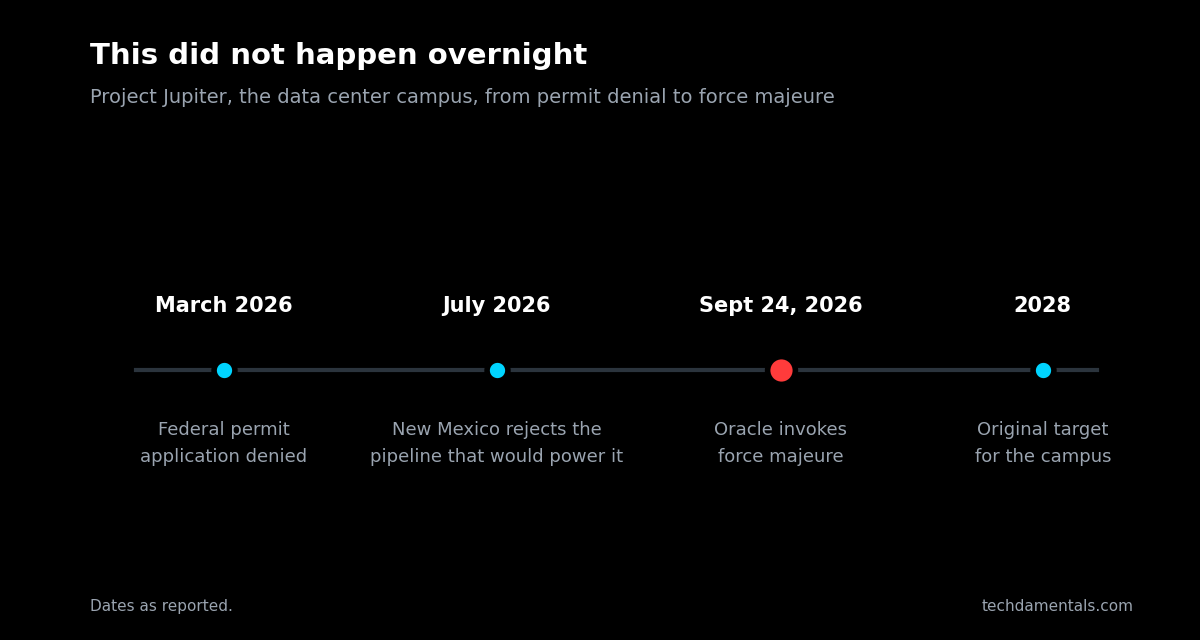
No pipeline, no power. No power, no 2028 opening. Oracle's notice went to Blue Owl Capital, whose subsidiary Stack Infrastructure is building the thing, and it gives Oracle room to delay payments rather than walk away from the campus. Oracle says publicly that the project "remains on our planned schedule."
Why a permit becomes a market story
Here's the part worth understanding, because it's the shape of a lot of what's being built right now.
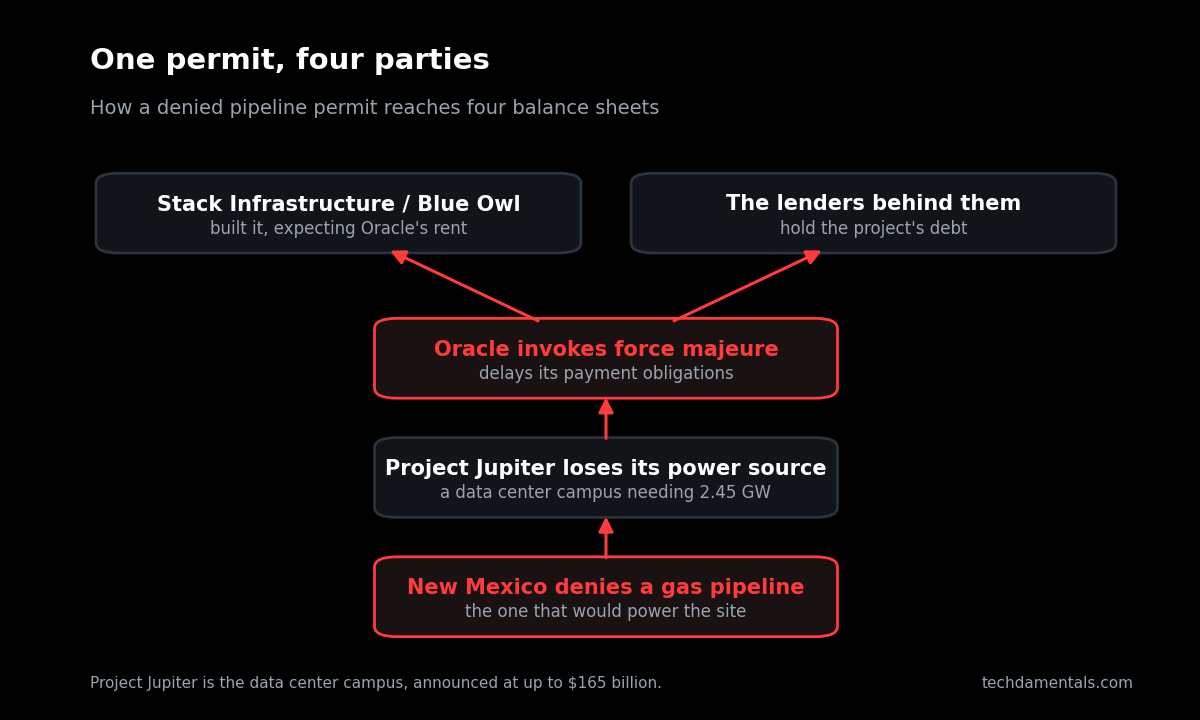
Oracle is the tenant. Stack and Blue Owl built the campus expecting Oracle's rent to cover it. Lenders put up money against that expected rent. Everybody in that chain is counting on the same stream of payments, and Oracle just told them the stream might be late.
That's why one permit reaches four balance sheets. The project's debt has reportedly been trading below 90 cents on the dollar, which is the bond market saying it's no longer confident the money comes back in full.
What this could mean
A few things, and none of them are predictions.
The AI buildout is a credit story now, not just a technology one. Companies in this space have issued over a trillion dollars of debt this year. That money assumes the buildings get built and the tenants pay. Today one of the largest tenants said a building might not get built on time.
The binding constraint is power, not chips. Everyone watches semiconductor orders. The thing that stopped this campus was a state regulator and an electricity supply, and there are only so many places you can put 2.45 gigawatts.
And private credit is closer to this than most people realize. Blue Owl isn't a bank. It's a private credit firm, which means the exposure sits outside the part of the financial system that gets stress-tested and reported on every quarter.
What this doesn't tell you
Nobody outside the deal has read the contract. Force majeure notices are opening positions in a negotiation, not verdicts, and this one may well be resolved quietly. Oracle's own statement says the schedule holds.
The debt price is secondhand reporting rather than something you can look up, so treat it as directional. And one campus is one campus. New Mexico said no to a pipeline; that isn't evidence about anyone else's project.
What it does tell you is that a company's value depends on things that never appear in its financials. A permit, a power line, a regulator. Techdamentals shows every input behind a fair value, including the growth it assumed, so you can see which parts of an answer rest on things going according to plan.