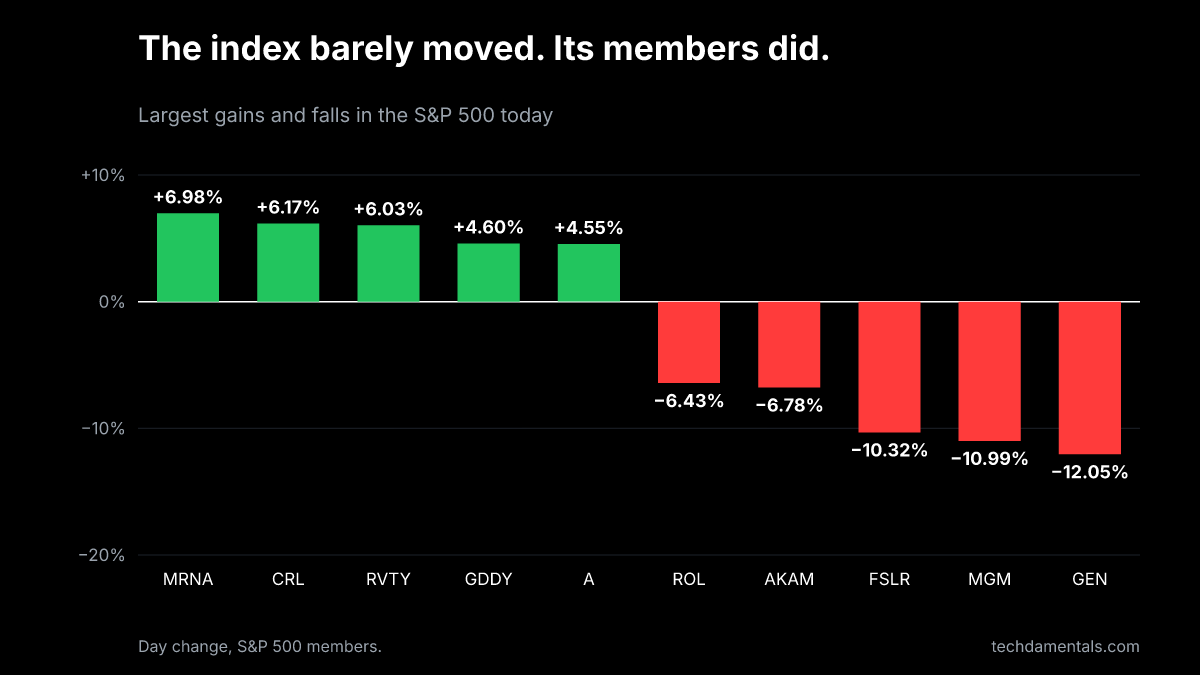
The S&P 500 finished at 7,704.13, down 0.02%. Inside that flat number, one stock fell 12.05% and another rose 6.98%.
A still index is not a quiet day. Here's what was moving underneath it.
A flat close covering a wide day
An index is a weighted average of its members, so a big drop in one name can be cancelled by a big gain in another. Today it mostly was. The Dow closed down 0.31%, the Nasdaq up 0.01%. Three of the eleven sector funds rose, with communications up 1.27% and materials down 1.19%. A sector fund is a basket holding just one slice of the market, which is how you read where money moved without checking hundreds of tickers.
Health care supplied three of the five largest gains: Moderna up 6.98%, Charles River Laboratories up 6.17%, Revvity up 6.03%. The VIX, which measures how large a swing options traders expect in the S&P 500 over the next month, closed at 15.67, up 3.23%. That is a low reading for a day with this much single-stock movement.
Borrowing costs reached solar first
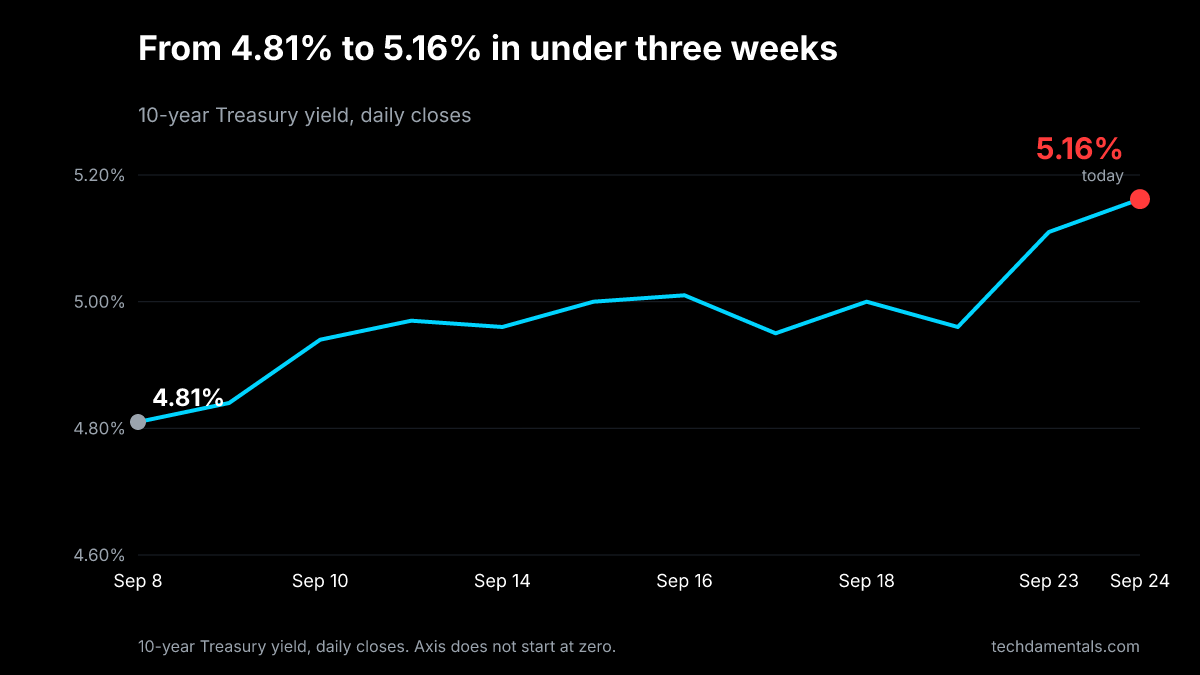
The 10-year Treasury yield closed at 5.16%, up 5 basis points. A basis point is a hundredth of a percentage point, so that is a small step on top of a steep few weeks: the yield was 4.81% on September 8. An earlier issue covers why long-term yields move without the Fed touching anything.
Solar took the hit. First Solar closed down 10.32%, and Stocktwits reported the stock hit a fresh 52-week low, citing cuts to analyst targets and less visibility on bookings. 24/7 Wall St. reported the broader group slid as high borrowing costs weighed on project financing.
That phrase is worth unpacking. A solar farm costs nearly all of its money upfront and returns it slowly, over decades of electricity sales. Almost none of it is paid for in cash, so the interest rate on the debt is a main input to whether a project works at all. When the 10-year rises, lenders reprice off it, and projects that penciled out last quarter stop penciling out. Oil rising 3.16% to $95.07 doesn't change that arithmetic.
Two deals, four stocks
The two largest declines in the index were both about mergers. Barron's reported that a major software player has its eyes on GoDaddy, and Investor's Business Daily named Gen Digital as the one making the offer. Gen Digital closed down 12.05%; GoDaddy closed up 4.60%. That split is normal. An acquirer usually pays above the market price and absorbs the risk of combining two companies, so its own shareholders often mark it down.
The mirror image showed up at MGM Resorts, down 10.99%, after Moby reported that Barry Diller dropped his $18.8 billion bid. When a bid goes away, the premium that came with it goes away too.
What this doesn't tell you
Headlines explain some moves and not others. Akamai closed down 6.78% on a day it announced an $11.6 billion multi-year agreement with Anthropic, reported right around the close. Today's news doesn't account for the decline, and pretending otherwise would be inventing a reason.
One session is also not a trend. Five basis points on the 10-year is a small move; the story is the level, not the day. And after-hours trading is thin, so Zscaler being down 4.04% after the close may look different tomorrow.
Meta Platforms rose 4.50% to $777.59 and closed 20.6% below Techdamentals' fair value estimate of $979.52, with that gap narrowing by 3.4 points on the day. Fair value is what the cash a business is expected to produce is worth today, and Techdamentals treats anything within 10% either side as fair value, because an estimate this far out is not a precise number. You can see every input behind Meta's and watch how the gap shifts when the discount rate does.