Gold is down about 7% over the past month. Silver is down about 6%. Both are still up over the year, but the last few weeks went the wrong way.
The usual explanation is that yields rose. That's close, but it points at the wrong number.
Why gold hates a high interest rate
Gold pays you nothing. No dividend, no interest, no rent.
A Treasury bond pays you. So every time you pick gold, you give up what that bond would have paid. Economists call it opportunity cost, the price of what you didn't pick.
When bonds pay 2%, picking gold costs a little. When they pay 5%, it costs more. The gold didn't change. The alternative got better.
But 5.17% is not the number that matters
If a bond pays 5.17% and prices rise while you hold it, you didn't really earn 5.17%. You earned what's left after inflation took its share. That leftover is the real yield, and it's what you take to the store.
There's a kind of Treasury called TIPS, short for Treasury Inflation-Protected Securities. What you get back adjusts with the consumer price index, so rising prices can't eat your principal. Because that protection is built in, whatever yield it pays sits on top of inflation. TIPS is the bond, the real yield is what it quotes, and Friday that was about 2.84%.
Now you have both halves. A normal 10-year pays 5.17%. An inflation-protected one pays 2.84%. Subtract one from the other and the 2.33% left over is what the market expects inflation to average over the next decade.
Inflation right now is running 3.4% a year. The market expects it to cool and settle near 2.33% for the next ten years.
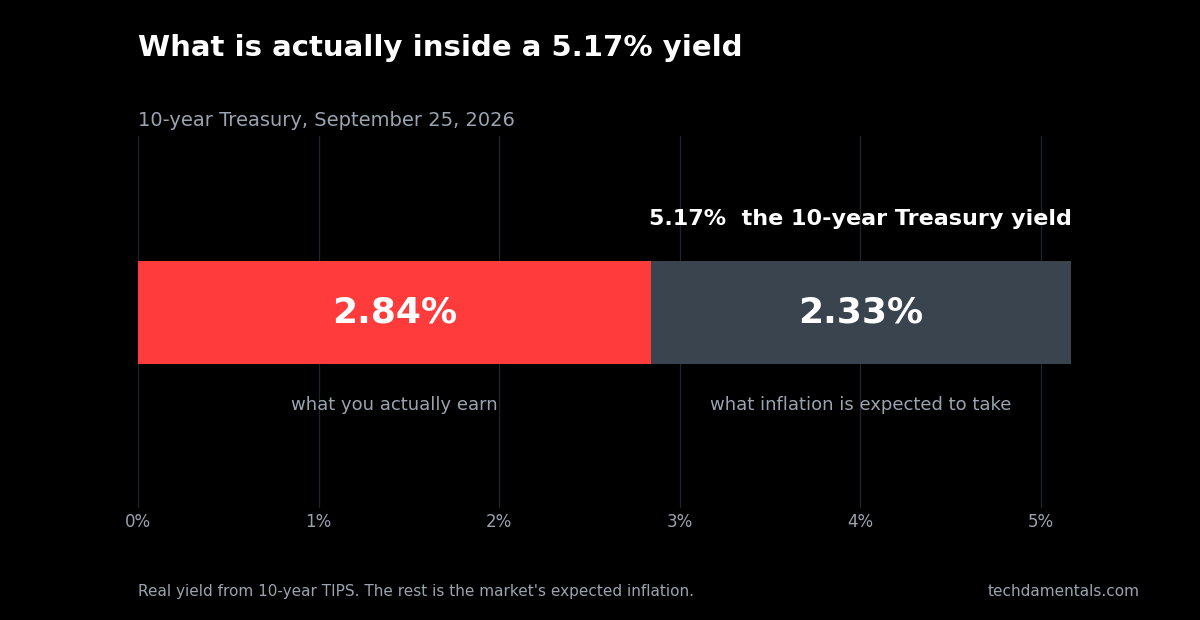
That 2.33% isn't money anyone hands you. It's the extra a regular bond pays to cover ten years of rising prices, and it's where real money stopped betting either way.
Now here's gold's problem. Gold does protect you from rising prices, that part is true. But a Treasury does too, and hands you 2.84% a year on top. Same protection, plus a payment. So why hold the one that pays nothing?
Gold never had to beat 5.17%. Only the 2.84%. And it has nothing to beat it with.
That isn't money moving from gold into bonds. Bonds fell this month too, which is what a rising yield means. What rose is the 2.84% gold has to beat.
Where the last month actually went
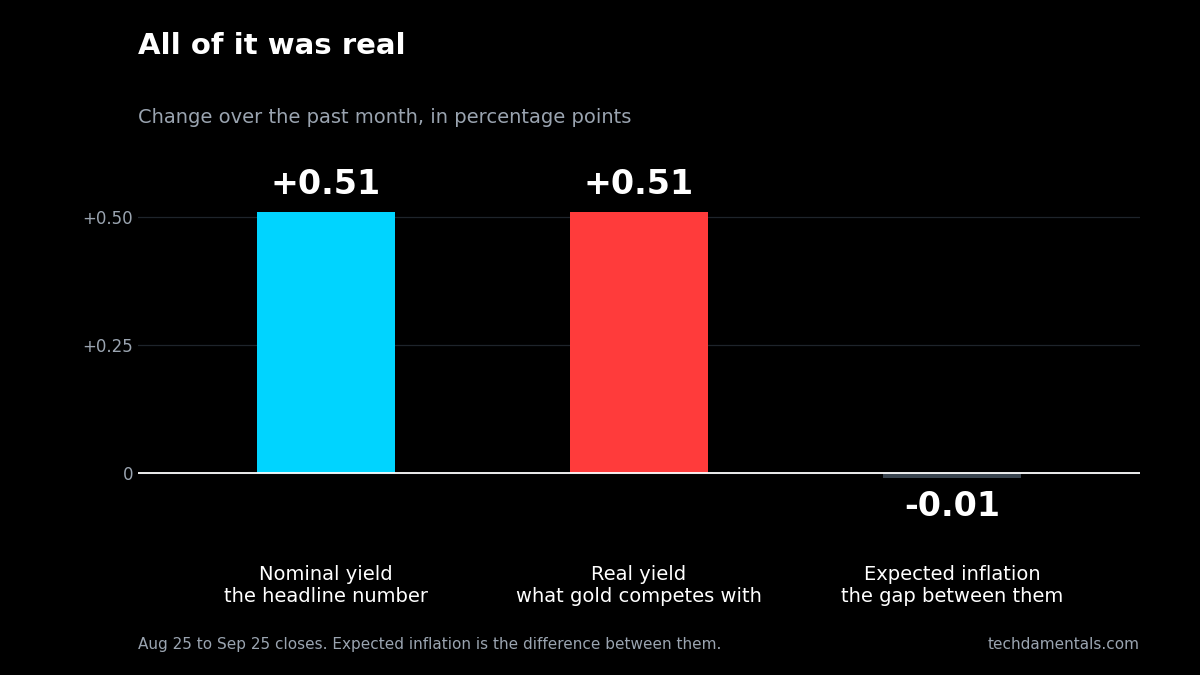
Between August 25 and Friday, the 10-year rose 0.51 points. Over the same stretch, the real yield rose 0.51 too.
Which means the gap between them, expected inflation, went from 2.34% to 2.33%. It didn't move.
Every basis point of the month's rise was real.
That flips the story people are telling. The common read is that a 5% yield means the bond market fears inflation. It doesn't. It expects prices to cool, same as a month ago. What changed is how much real return it demands to lend for ten years.
And a rising real return is what hurts gold. Not the scary headline. The quiet number underneath it.
What this doesn't tell you
Real yields explain part of gold, not all of it. Central banks kept accumulating regardless of rates, and a stronger dollar pushed the same way.
Silver is a different animal. Roughly half its demand is industrial, including solar panels, so it's part precious metal and part factory input. That's why it swings harder both ways.
And expected inflation is what the market expects, not what arrives. It's been wrong before.
This is how a valuation works underneath. A model turns future money into today's money using a rate, and which rate you pick changes the answer. Techdamentals shows every input behind a fair value, including that one, so the assumption sits in the open instead of buried in the number.
Try Techdamentals for seven days, no card needed