On Tuesday a company almost nobody outside South Korea had heard of started trading in Seoul. By the time New York opened, CoreWeave and Nebius were falling.
On Wednesday morning in Seoul, a server maker in San Jose put out a revenue number, and the Korean market went up more than 4%.
Two days, two directions, one trade. Here is how that actually works.
The company nobody had heard of
Elice was founded in 2015 by three doctoral students from KAIST, Korea's main science and engineering university. It started as a coding education platform. It is now an AI cloud infrastructure company, which means it supplies the physical guts of artificial intelligence: servers, liquid-cooled chips, networking gear, and prefabricated data center modules that get assembled around clusters of AI processors.
In other words, it does roughly what CoreWeave does, in a different country, at a fraction of the size.
Its listing was small. The company offered about 201 billion won of stock, call it $152 million, priced at 90,500 won a share, the very top of the range it had advertised.
Then the demand number came in.
Korean retail investors put in orders worth about 408 times the stock available. The deposits backing those orders came to roughly 10.3 trillion won, which is about $7.8 billion of money chasing $152 million of shares.
On the first day of trading, the stock fell as much as 32%, to 61,400 won. The company's market value went from over a trillion won to around 700 billion. It was the worst first-day performance a major Korean listing has had.
The following session it rose by the daily limit.
Why Seoul moved New York
Here is the part that matters, and it has nothing to do with Korea.
Elice is a small company. Its listing was tiny by the standards of a global market. And yet on the same day, CoreWeave and Nebius both fell in US trading, with several outlets pointing directly at the Seoul debut as the reason.
A $152 million listing in another hemisphere does not move American companies because of its size. It moves them because of what it answers.
Every company in this corner of the market is asking investors the same question: will anyone pay enough for AI computing to justify what it costs to build. Nobody knows yet. The buildings are going up now, the revenue arrives later, and most of the gap in between is financed with borrowed money.
When no one knows the answer, every new piece of evidence counts for more than its size suggests. A listing is a test. Several hundred thousand people were handed a chance to price an AI cloud company from scratch, with no history to anchor to, and the price they settled on was a third below where the company had sold it to them hours earlier.
That is information, and it is portable. It travels to every other company in the same business, in any country, immediately.
The backdrop made it land harder. CoreWeave was already down more than half from its May high and nearly 30% in October alone, and one of its dollar bonds maturing in 2031 briefly yielded over 16% in mid-October. We wrote about what that bond price means last week. Elice did not create that worry. It arrived in the middle of it and gave it a fresh number to point at.
Then New York moved Seoul back
On Tuesday evening, Super Micro Computer told the market what its September quarter looked like before the full results arrive on November 3.
Its own guidance had been $14.5 billion to $15.5 billion. Analysts were around $15 billion. The preliminary figure came in at $18.5 billion to $19.5 billion, roughly $4 billion above where everyone had it.
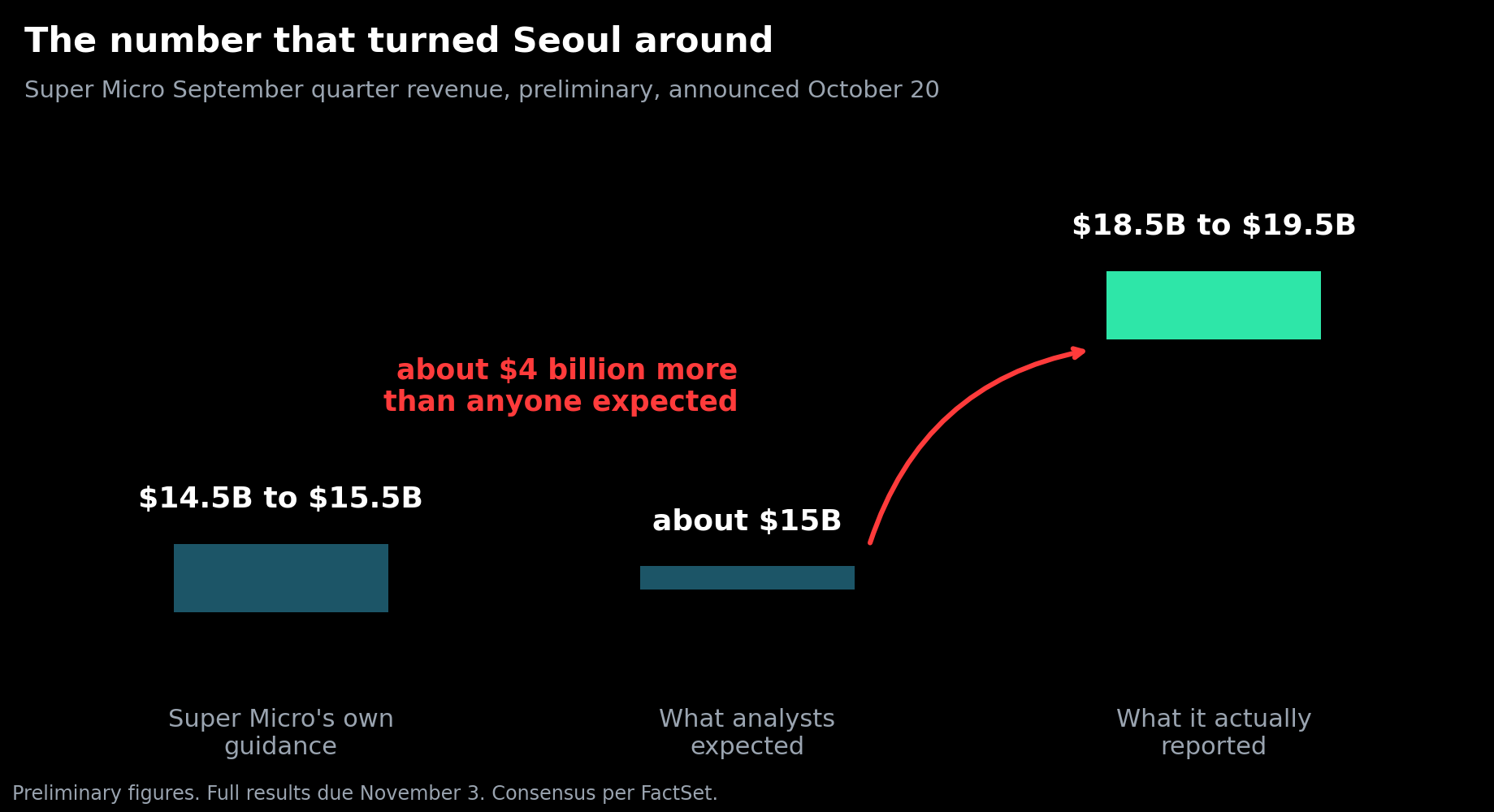
Super Micro rose about 14% after hours. Dell rose about 6%, HPE about 5%.
Then Korea opened.
The Kospi opened up 2.05%, ran as high as 4.50%, and by late morning sat at 5,790.58, up 4.28%. Samsung Electronics and SK Hynix were both up more than 7%. At 10:51 in the morning, the Korea Exchange triggered a sidecar, which is a five-minute freeze on automated program orders designed to slow a violent move. This one fired on the way up, the first of its kind since August 20. The two before it, on October 13 and 15, had fired on the way down.
Nothing changed in Korea overnight. What changed is that a company in California sold about $4 billion more AI server equipment than anyone expected, which is the single most direct evidence available that somebody is in fact paying for all this.
Who was actually on each side
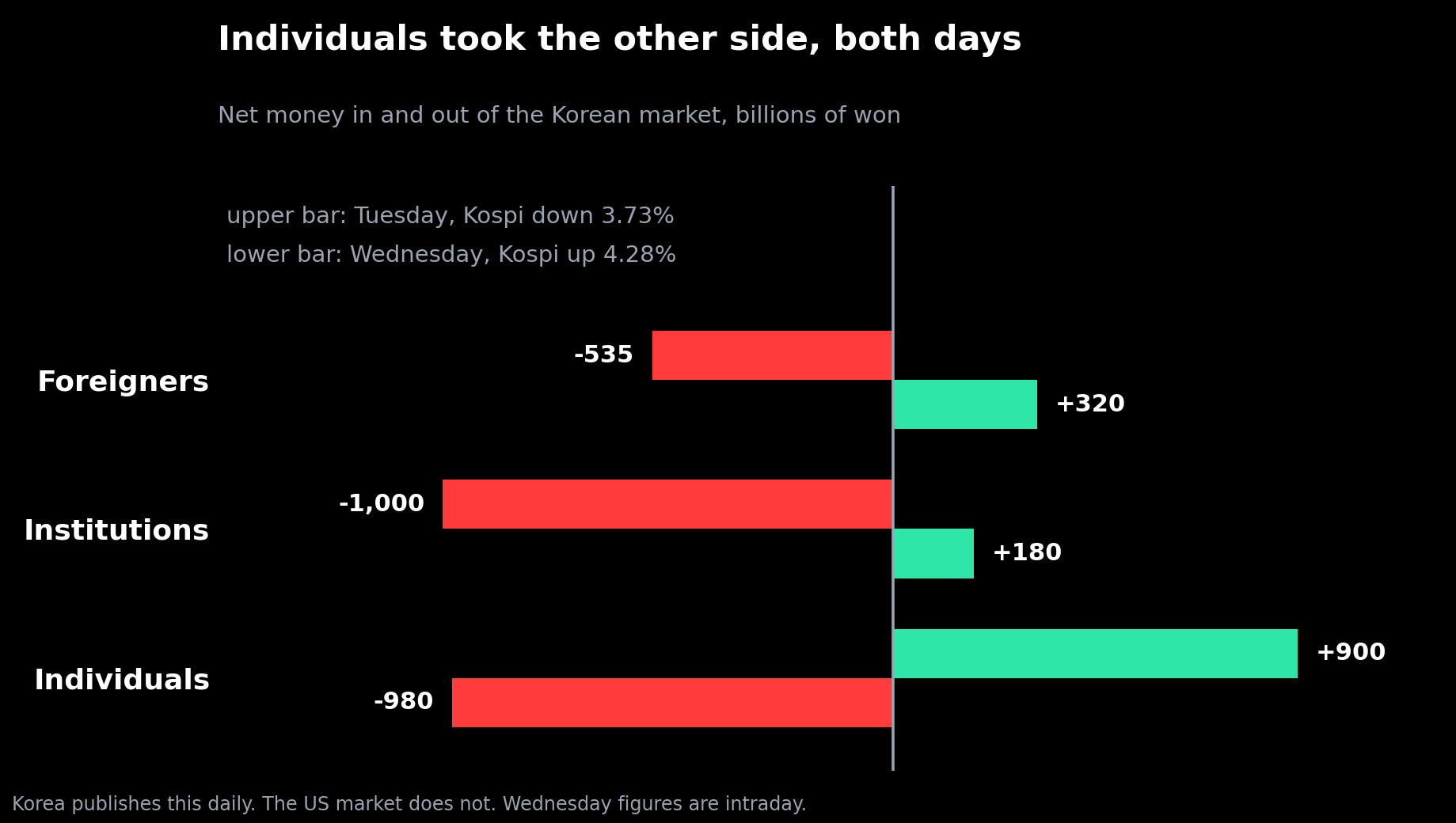
Korea's exchange publishes something the US market does not: a daily breakdown of who is trading. Foreign investors, domestic institutions, and individuals, with the net figure for each.
Lay the two days next to each other.
| Foreigners | Institutions | Individuals | |
|---|---|---|---|
| Tuesday, Kospi down 3.73% | took out 535 billion won | took out 1,000 billion won | put in 900 billion won |
| Wednesday, Kospi up 4.28% | put in 320 billion won | put in 180 billion won | took out 980 billion won |
Individuals were on the opposite side from everyone else on both days, in close to the same amount. Tuesday they absorbed what institutions were offloading. Wednesday they handed stock back into a rising market.
Those are the same people who put in 408 times the available stock for the Elice listing the week before.
What this does not tell you
It does not tell you who was right. Two sessions is noise. Anyone who was on either side of those trades could be running a strategy that plays out over a year, and a flow table cannot see intent. Plenty of institutional money has been wrong in public for long stretches, and plenty of individuals rebalancing on schedule will show up in that table looking like they made a call when they did not.
It also does not settle the thing everyone actually wants settled. Super Micro's number is one quarter, preliminary, from one company, and the full results are not out until November 3. Elice's first two days are two days. Neither one answers whether AI buildouts will earn back what they cost. They are both just evidence, pointing opposite directions, arriving 18 hours apart.
And the Korean figures here are intraday, not final. Markets were still open when this was written.
One more worth saying plainly. The flow table is a genuinely useful thing that American investors simply do not get. In the US there is no daily published figure telling you whether individuals or institutions were on the other side of your trade. That absence is easy to forget about, and worth remembering the next time someone tells you confidently what "the market" was doing. In Korea that is partly a measured fact. In the US it is almost always a guess.
A company like Elice is the hardest kind to put a number on. No trading history, no settled business model, profits that may be years away or may never arrive. That is exactly where a single confident valuation does the most damage. Techdamentals runs four separate methods and shows the range they span, and when a method cannot run on a company it says so rather than inventing a figure. On a company this young, the honest output is a wide range and a lot of visible assumptions.