SpaceX reported on Tuesday evening. The segment that makes the most money is no longer rockets, and it is no longer Starlink either.
It is computers.
The three businesses, ranked
The company reports in three pieces. Here is the September quarter.
| Segment | Revenue | What happened |
|---|---|---|
| AI, which the company now calls Super Intelligence | $7.56B | was $2.56B three months earlier |
| Connectivity, mostly Starlink | $5.25B | up 69% from a year ago |
| Space | $1.77B | up 6% from a year ago |
Add the second and third rows together and you get $7.02 billion. The AI segment on its own is larger than both of the others combined.
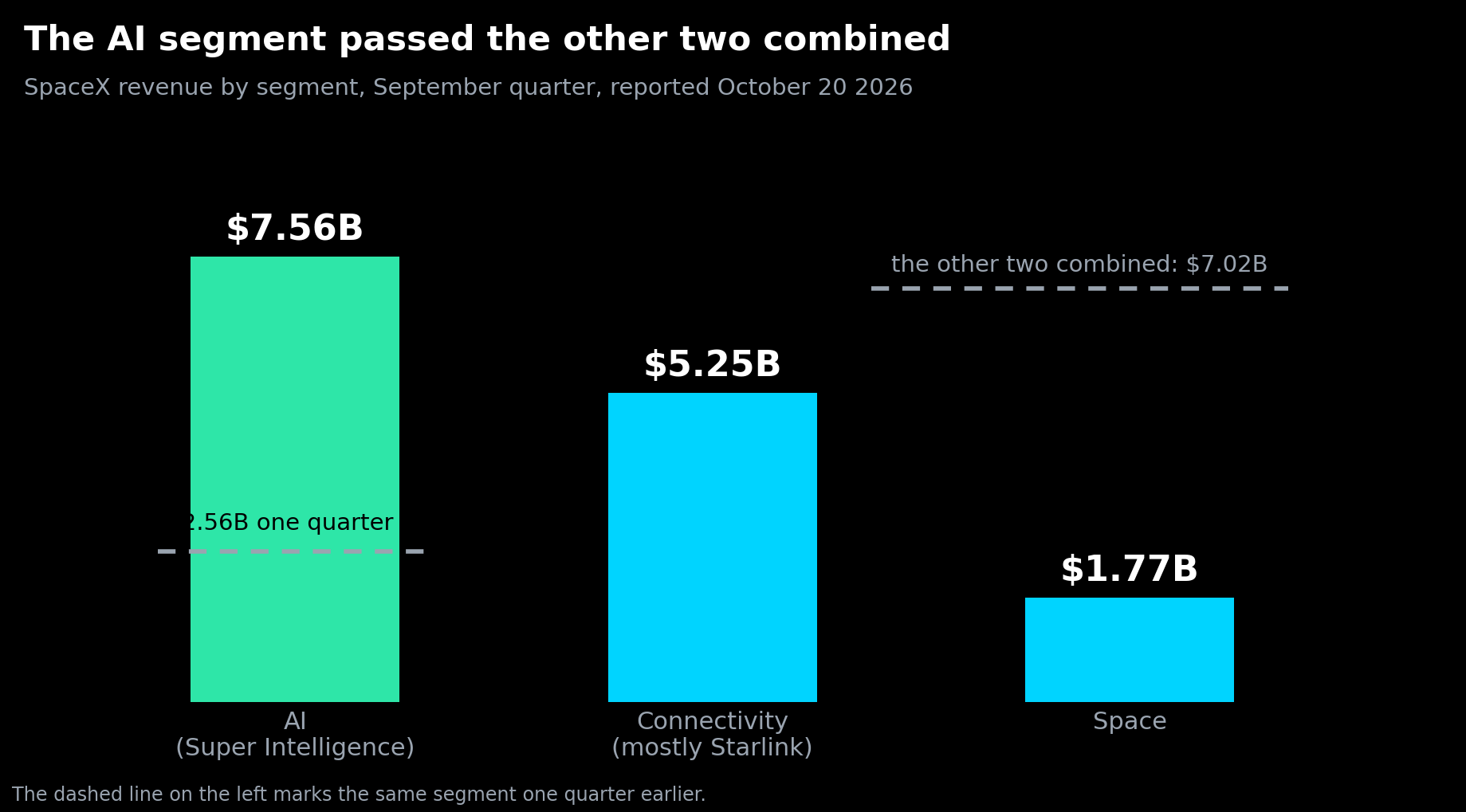
Three months ago it was not. In the June quarter that segment did $2.56 billion, which made it the smallest of the three. It nearly tripled in a single quarter, and in doing so it changed what kind of company this is.
What the segment actually provides is computing capacity, rented out to companies that train and run artificial intelligence. It is a landlord business for machines.
The rest of the numbers
Revenue was $14.58 billion, up 161% from a year earlier and ahead of the roughly $12.9 billion analysts expected.
Earnings came in at $0.35 a share against about $0.10 expected. A year ago the same quarter lost $0.36 a share. Net income was $4.4 billion, against a $1.1 billion loss a year ago. Adjusted earnings before interest, taxes, depreciation and amortisation, which strips out financing and accounting charges to show the raw operating cash generation, came to $8.8 billion, up 306%.
Operating income was $2.79 billion. Last quarter the same line was a $143 million loss. This was the company's first operating profit since it listed.
The shares closed the regular session at $147.79, essentially unchanged on the day, and traded at $159.70 in the extended session afterwards, up about 8%.
One piece of the quarter did not go to plan. Starlink added 1.6 million consumer subscribers against the 2.29 million analysts had penciled in. Its revenue still rose 69% and its operating income nearly doubled to $2.37 billion, so the business got substantially more profitable while signing up substantially fewer people than expected. Those two facts are both true and they are worth holding next to each other.
The number underneath the profit
Now the part that the headline figures do not show.
The company spent $19.6 billion on capital expenditure in the quarter. That is the money that goes into physical things: satellites, launch infrastructure, and above all the data centers and chips that the AI segment rents out.
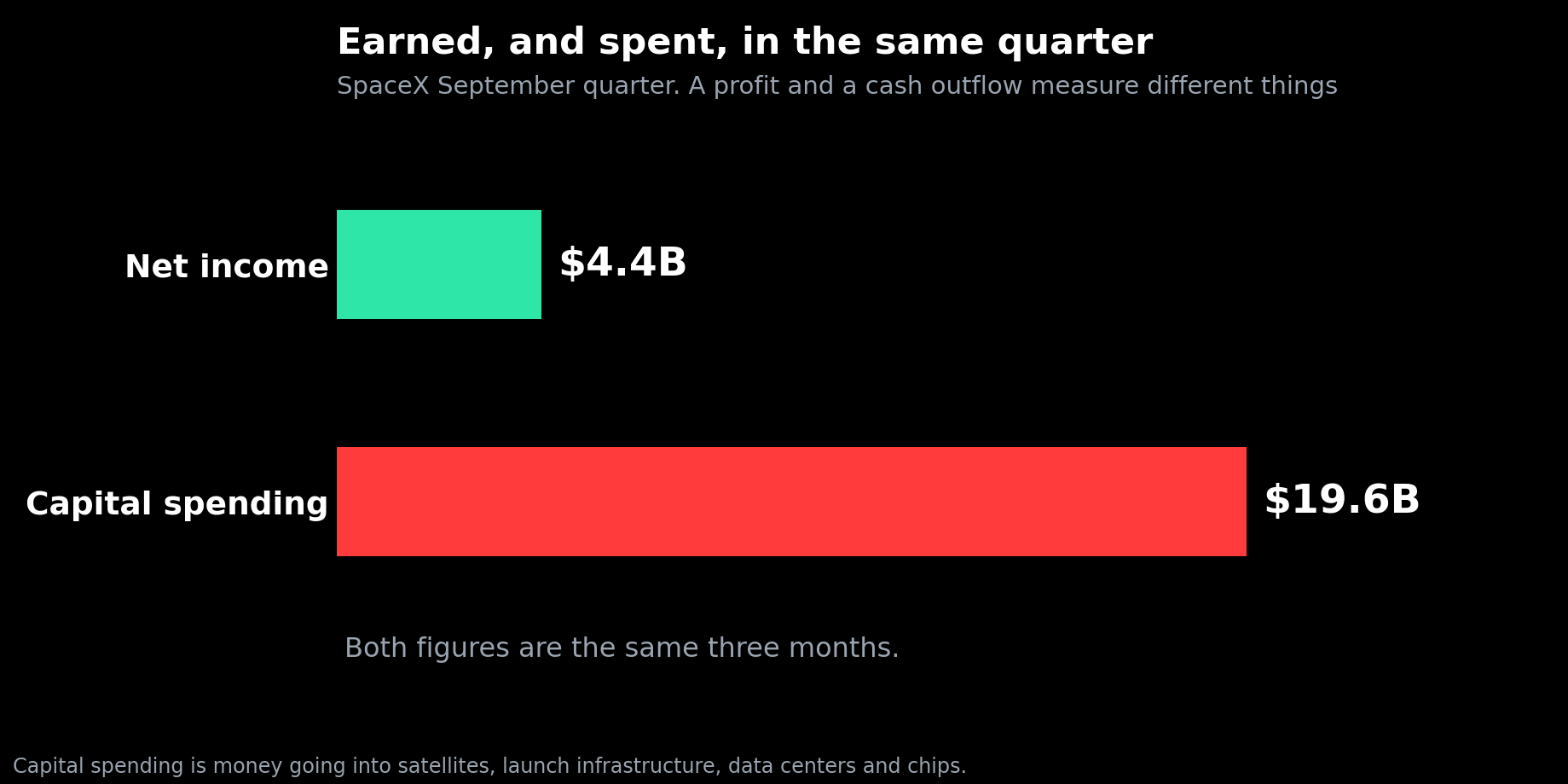
Set that against the $4.4 billion of net income from the same three months. The business earned $4.4 billion and spent $19.6 billion building. That gap is not a mistake or a warning sign on its own. It is what a company looks like when it is constructing the thing it intends to rent out for the next twenty years, and it is the same shape as a utility laying cable or a railroad laying track.
The question is how the gap gets funded, and for how long.
Analysts tracking the company project capital spending rising from roughly $70 billion this year to about $197 billion in fiscal 2028, and total debt rising from $50.7 billion at the end of 2025 to around $350 billion by 2029. Those are outside estimates rather than company guidance, and the company did not publish a full-year capital spending forecast.
If those numbers sound familiar, they should. Last week we wrote about a much smaller company in the same business whose cost of borrowing moved sharply when investors started asking that exact question about roughly $35 billion of debt. The projections above describe ten times that, at a company with a far larger and more diversified revenue base. Different scale, different balance sheet, same mechanism. Borrowed money builds the capacity, and the capacity has to earn enough, soon enough, to service the borrowing.
During the quarter the company also agreed to acquire 800 megahertz spectrum licences from Grain Management to improve indoor service for Starlink Mobile, subject to regulatory approval. Terms were not disclosed, though one newspaper put the figure at $8 billion.
What this does not tell you
One quarter is one quarter. A segment that nearly triples in three months is a striking number and a thin sample. Some of that is genuine new capacity coming online, and some of it is the timing of when contracts start and revenue gets recognised. The June quarter and the December quarter will say more about the trend than this one can on its own.
A profit is not the same as cash. The company earned $4.4 billion and spent $19.6 billion on construction in the same three months. Both figures are real, they measure different things, and reading only the first one gives you a picture that the second one complicates considerably.
The projections are not the company's. The capital spending and debt figures reaching into 2028 and 2029 come from analysts, not from management, and forecasts that far out have a poor history in any industry. Treat them as a sketch of what the buildout implies if it continues at the current pace, not as a plan anyone has committed to.
And the subscriber miss is unresolved. Starlink made more money from fewer additions than expected. That can mean pricing power, or a shift toward higher-value customers, or simply that the forecast was too high. Nothing in a quarterly release distinguishes between those, and anyone telling you which one it is this week is guessing.
A company like this is genuinely hard to put a single number on, because three businesses with completely different economics sit inside it. A launch business, a subscription business and a capacity rental business do not share a growth rate, a margin or a useful comparison. That is the situation where one tidy valuation does the most damage. Techdamentals runs four separate methods and shows the range they span rather than blending them into one confident figure, and when the methods disagree the page says so rather than picking the flattering one.