On Thursday, ServiceNow closed down 26.53% at $110.30. It was the worst day in the company's fourteen years as a public company.
In the release that caused it, the company raised its full-year subscription revenue guidance, raised its free cash flow margin guidance, raised its artificial intelligence contract target for the third time this year, maintained its operating margin guidance, and reported a 98% renewal rate.
Not one Wall Street firm changed its recommendation on the stock. Eleven or more trimmed their twelve-month value estimates. Every single one kept the rating it already had.
And there is a detail that makes this stranger still. ServiceNow's second-worst day ever was April 23, 2026, six months earlier, when it fell 17.7%. That release also beat the company's own guidance.
So the two worst sessions in the company's history happened six months apart, in the same year, both after quarters where it delivered more than it had promised.
Something is going on here that the headline does not capture, and it is worth understanding, because it explains a great deal about how the market is currently pricing software.
We wrote this week about why the faster-growing company fell and the slower one did not. This is the same disconnect inside a single company.
What actually changed
Almost nothing in the reported quarter went wrong.
Subscription revenue came in at $3.99 billion, up 21%, above the top of the company's own guidance. Operating margin on an adjusted basis was 32.5%, which beat its guidance by 1.5 percentage points. Customers paying more than $5 million a year grew to 680 from 553, a rise of 23%. Deals worth over $5 million in new business were up 135%.
One line in the release moved the wrong way, and it is not a revenue number or a profit number. It is a forecast of a metric most people have never heard of.
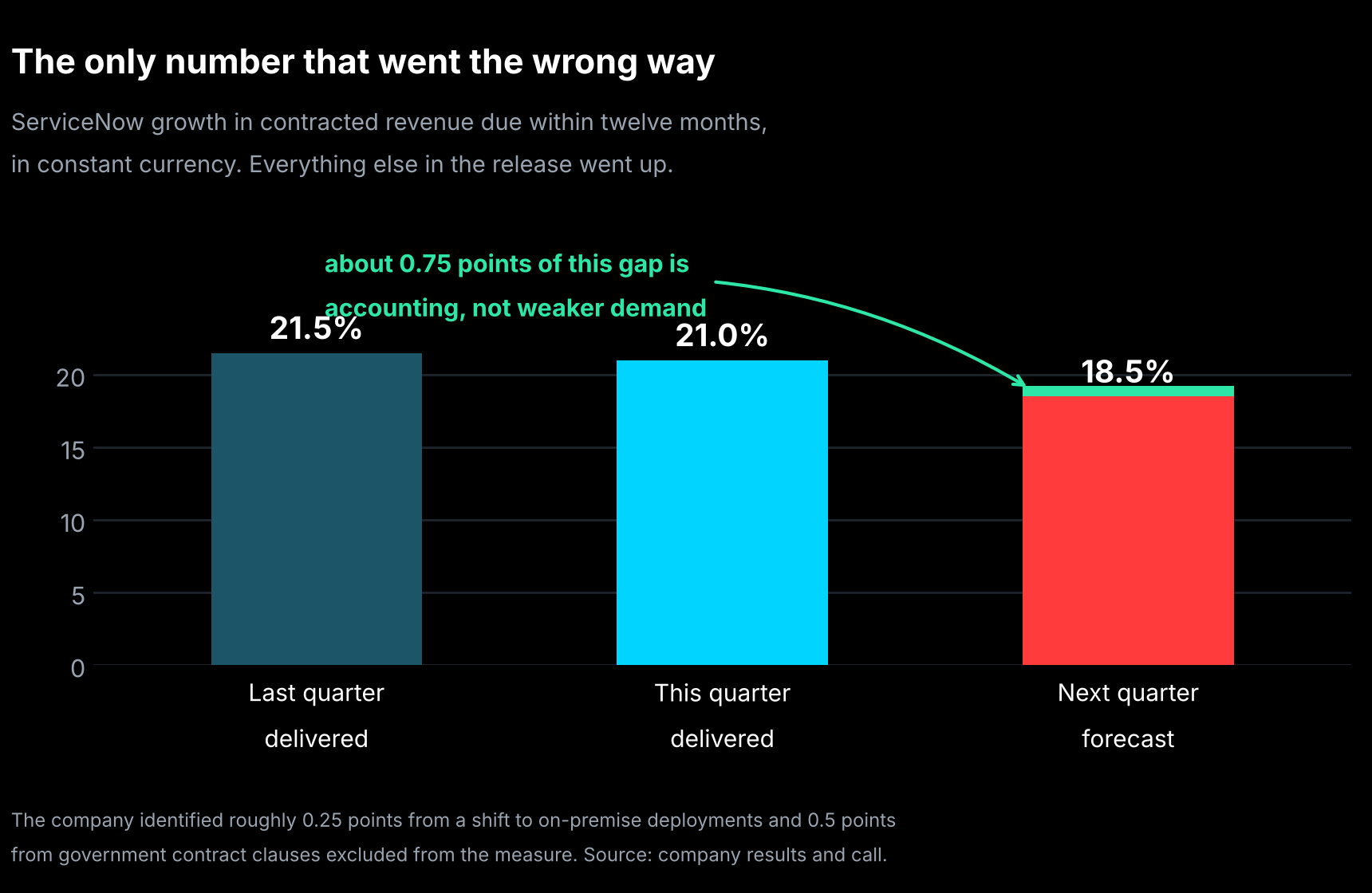
ServiceNow guided next quarter's cRPO growth to 18.5%, down from the 21% it had just delivered.
That is the whole event. One forecast, for one metric, 2.5 percentage points lower than the quarter that had just finished. A quarter of the company's value went with it.
A correction worth making, because a lot of coverage has it backwards: the 21% is what ServiceNow actually achieved last quarter, not an earlier forecast it abandoned. The company did not cut a number it had previously given. It delivered 21%, beat its own guidance doing it, and then said the next three months would run at 18.5%.
What cRPO is, and why investors watch it more than revenue
This requires a short detour, and it is the most useful thing in the piece.
Companies like ServiceNow do not hand you software. They rent you access to software running on their computers, usually under a multi-year contract. A customer signs for three years at a million dollars a year. The signature happens once. The revenue arrives slowly, month by month, as the service is actually delivered, because accounting rules do not let a company book three years of revenue the day the pen comes off the page.
That creates a gap that matters enormously.
Revenue this quarter is mostly the slow release of contracts signed one, two or three years ago. It tells you how well the sales force was doing in 2024. It tells you very little about last Tuesday.
So investors look at the backlog instead. Remaining performance obligations is all the contracted revenue a company has signed and not yet recognized. Current remaining performance obligations, cRPO, is the slice due within the next twelve months.
Two things make cRPO valuable. It reflects what was sold recently, so it leads revenue rather than lagging it. And it is a defined accounting disclosure rather than a number management invented, so a company cannot quietly redefine it when the figure gets uncomfortable.
That is why a company can beat on revenue, raise its full-year outlook, and still lose a quarter of its value in a session. The market was not repricing the quarter that just happened. It was repricing 2027 and 2028.
There is a second concept sitting underneath the whole story, and you need it for the rest of this piece.
Seat-based pricing means you pay per person using the software. A thousand employees at a hundred dollars a year. Revenue scales with headcount.
Consumption-based pricing means you pay for what you use. Queries run, data stored, actions taken. Revenue scales with activity.
That distinction is the single most contested question in enterprise software right now, and we will come back to it.
The part that is accounting rather than demand
Here is what almost nobody reported, and it came straight from the chief financial officer on the call.
Of that 2.5 point deceleration, roughly three quarters of a percentage point is mechanical, identified and quantified by the company. Not softer demand. Accounting.
About half a point comes from something called termination for convenience. Government contracts frequently let the customer cancel without cause, at any time, for no reason. Under the accounting rules, contract value a customer can walk away from at will does not count as a performance obligation. So it gets excluded from cRPO, even though it still shows up in revenue as the work is delivered.
Read that again, because it inverts the story. ServiceNow won more government business this quarter, and the chief executive called the public sector's performance its best quarter of the year, with federal deals over a million dollars growing more than 30%. Winning more of that business made the backlog metric look worse, not better.
About a quarter of a point comes from a shift toward on-premise deployments, which is a different accounting treatment again, and which the finance chief described as "a great result" driven by public sector demand.
And then there is a third effect, which the company flagged but did not quantify. ServiceNow saw unusually strong early renewals during the quarter, which it said contributed about half of its beat. In her words: "that has a negative impact in Q4 because we pulled those deals out of Q4 and into Q3."
So part of the reason next quarter looks slower is that this quarter borrowed from it. The company beat partly by pulling business forward, and the forward number is lower partly because that business already happened.
Her summary was blunt: "cRPO is a very nuanced accounting metric, and it doesn't necessarily capture all of the momentum in the business."
She is right, and the market was also not obviously wrong. Three quarters of a point is explained. The remaining point and three quarters is not. For a company priced on durable growth above 20%, an unexplained deceleration in the metric that leads revenue is genuinely bad news. Both of those things are true at once.
One more correction to the record, because "missed on profit" is doing a lot of misleading work this week.
Adjusted earnings came in at $1.00 a share against $1.02 expected. A two cent miss. But adjusted operating margin beat the company's own guidance by 1.5 points. Those two facts look contradictory until you look below the operating line.
Interest expense rose to $81 million from $6 million a year earlier. Interest income fell to $69 million from $115 million. That is a swing of roughly $120 million, and the reason is that ServiceNow spent around $9.2 billion on acquisitions in the first nine months of this year, most of it on a cybersecurity company.
So the operating business got more profitable than promised. The earnings miss came from the cost of money borrowed to acquire something else. Those are completely different problems, and only one of them says anything about whether the software is finding customers.
What the analysts actually did
This is the most under-reported fact of the day, and it is worth understanding what the two actions mean, because people conflate them constantly.
A rating is a recommendation. It answers "should you own this?" A twelve-month estimate is a fair-value figure. It answers "what do I think it is worth?"
Cutting the estimate while keeping the rating usually means: this is worth less than I thought, the reasoning still holds, and it just got less demanding to own. Mechanically it is often simple arithmetic. Lower the forward growth assumption in the model and a smaller number comes out the other end.
A downgrade means the reasoning itself broke.
On Thursday, at least eleven firms cut their numbers. Not one downgraded. Two firms, including one that was already bearish on the stock, actually raised their figures.
For an event being written up as a referendum on the future of enterprise software, that is a striking disconnect. The people who build the models trimmed their assumptions and kept their conclusions. The market took off a quarter of the company.
The story everyone is telling, and what is behind it
Here is the explanation you have read all week: artificial intelligence reduces the number of software seats a company needs, so seat-based software businesses are in structural trouble, and ServiceNow is the first visible casualty.
It is a coherent argument. It may eventually be right. I went looking for the evidence, and what I found is worth laying out carefully.
What exists. Gartner published an estimate in July that up to $234 billion of enterprise application software spending is exposed to this shift by 2030, roughly a fifth of the market. Its analyst put the mechanism well: this "breaks the link between user growth and revenue growth for many enterprise software vendors."
Three things about that figure. "Up to" is a ceiling, not a forecast. The release discloses no methodology, survey or sample. And it does not say seat counts are falling anywhere. It says the link between users and revenue weakens. Several outlets converted that into a prediction that AI "will redirect" $234 billion, which is not what it says.
What does not exist, as far as I can find: a single published measurement of seat counts actually declining at any named enterprise software company. No company disclosure. No analyst dataset. No survey of realized losses. The thesis is a hypothesis with one top-down exposure ceiling attached to it.
The famous example recanted. The most-cited case of a company replacing software with AI is Klarna, which dropped Salesforce and Workday during an AI overhaul. Its chief executive later clarified: "So no, we did not replace SaaS with an LLM." He said the company consolidated onto fewer vendors, moved its people systems to a different provider, built some functions in-house, and kept using others. He also described himself as "tremendously embarrassed" by how the Salesforce story was received. That is a procurement decision, not AI eliminating software.
And the measurable things point the other way. A Morgan Stanley survey of chief information officers has software budgets growing about 3.8% this year, slightly faster than last. ServiceNow's renewal rate is 98%. Its customers above $5 million grew 23%. Its AI contract value target has been raised from $1 billion to $1.7 billion over the course of one year. One firm's positive note after the crash cited seat growth specifically.
Management addressed the pricing question directly when an analyst asked. The chief executive said customers "like the predictability of the seat-based pricing model for their budgeting purposes." The finance chief said customers "are not asking at all for outcome pricing."
But there is real evidence of a different problem, and it is in the numbers. Subscription gross margin fell to 80.0% from 83.0%. Professional services gross margin swung to negative 20% from positive 11%. The company noted that customers getting hands-on help adopted AI twice as fast.
Put those together and the measurable story is not that AI is destroying demand for software. It is that delivering AI is costly, it requires people on site, and it compresses the margins that made software such an attractive business in the first place. That is a smaller claim than the headline one. It is also supported by actual figures rather than a hypothesis.
Did one company really reprice the whole sector?
Partly, and the exceptions are what make it interesting.
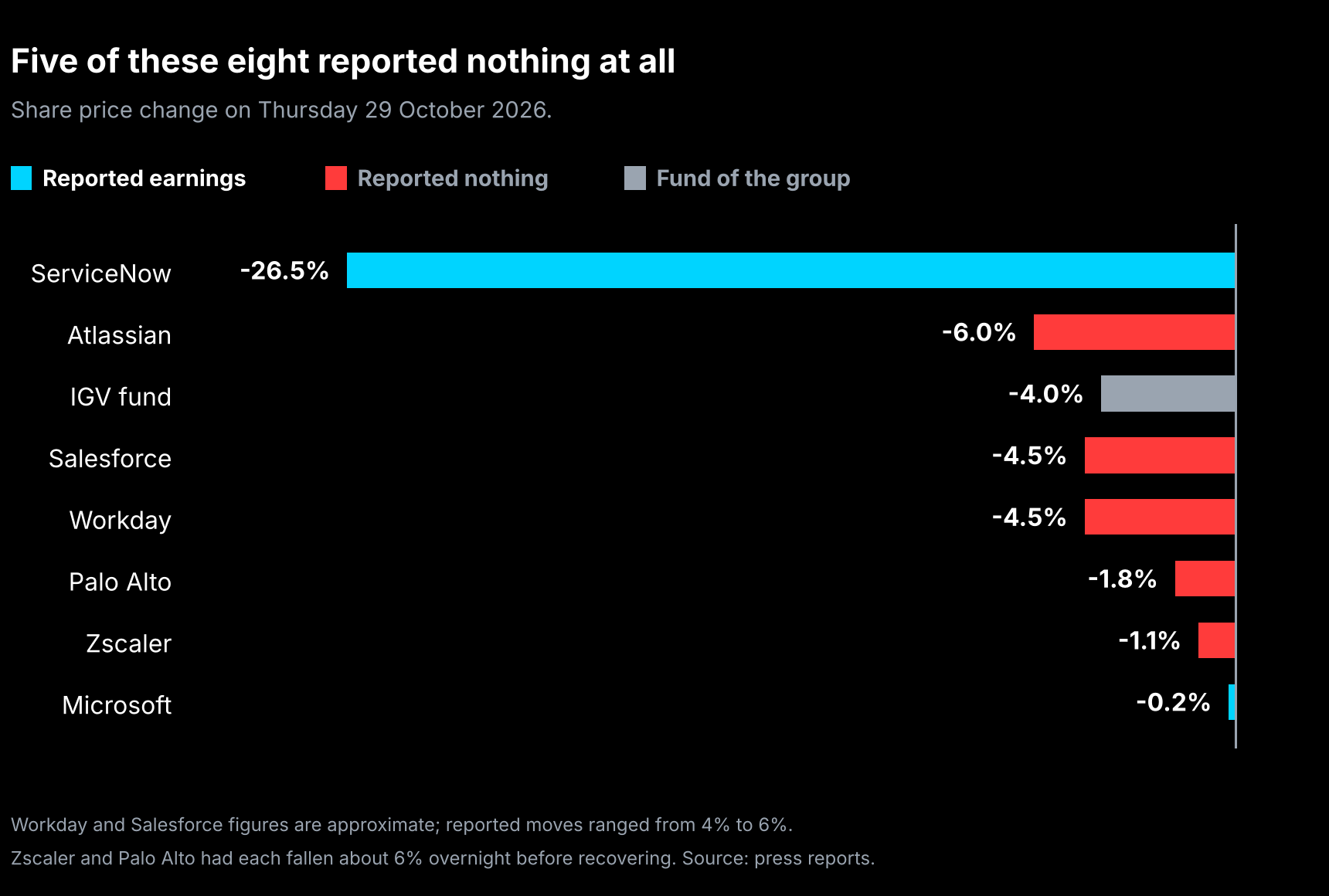
Companies that reported nothing at all fell anyway. Atlassian, which does not report until November 5, closed down about 6%. Salesforce, which does not report until December, fell about 4.5%. Workday, similar. IGV, the exchange-traded fund that holds a basket of these software companies, dropped around 4%. If you want one number for how the whole group did on a given day rather than chasing a dozen tickers, that fund is the shorthand most people use.
Others named among the day's decliners, without figures I could verify, include Snowflake, HubSpot, Monday.com, Oracle, SailPoint, SentinelOne and Check Point. If you want to see the pattern yourself rather than take my word for it, those are the tickers to pull up.
One name you may see grouped with them belongs in a different bucket. Twilio fell sharply too, but it reported its own results after Thursday's close and guided its own growth lower. That is a company being judged on its own numbers, not on somebody else's.
That is read-across: investors applying one company's information to companies that have not provided any.
But the market discriminated, and you can see exactly where. Palo Alto Networks, Zscaler, CrowdStrike and Okta all dropped roughly 6% in after-hours trading on Wednesday, alongside ServiceNow and a disappointing forecast from Fortinet, which went on to be the worst performer in the entire S&P 500 on Thursday.
Then look at where those four finished. Palo Alto closed down 1.8%. Zscaler closed down 1.1%. They gave back almost the whole overnight move. Investors looked at the drop in security names, decided it was Fortinet's problem rather than the sector's, and reversed most of it within a single session.
They did not do the same for enterprise software. Salesforce, Workday and Atlassian stayed down.
Whether that distinction holds gets tested soon, and the calendar is unusually clean. Atlassian reports November 5. Then Salesforce and Snowflake both report on the evening of December 2, which is close to a controlled experiment: Salesforce is the seat-based company everyone is worried about, and Snowflake is consumption-based, where more AI activity means more revenue, not less. If the thesis has substance, those two should diverge sharply. If both are fine, Thursday was a ServiceNow accounting story wearing a sector-wide costume.
What this does not tell you
It does not tell you ServiceNow had a bad quarter. It beat its own revenue guidance, beat its own margin guidance, raised three separate forecasts, and renewed 98% of what came up for renewal. The only number that disappointed was a forecast of a backlog metric one quarter out.
It does not tell you the market was irrational. A company priced for growth above 20% guiding a leading indicator to 18.5%, with only part of the gap explained, is a real change in what investors can see. Repricing that is a defensible response, even if the size of it was not.
It does not tell you AI is reducing software seats. Nobody has measured it. There is one top-down exposure ceiling, no observed decline anywhere, and a flagship example that the company involved has publicly corrected. Treat it as a hypothesis under test rather than a finding.
It does not tell you the analysts agreed with the market. Eleven or more trimmed their estimates and none changed their recommendation. That is a disagreement worth noticing, not a confirmation.
It does not tell you the sector is broken. Palo Alto and Zscaler gapped down overnight and closed nearly flat. Microsoft, which reported cloud growth of 48% on Wednesday evening and beat on both lines, finished Thursday down 0.2% after being up more than 2.5% during the day. If artificial intelligence were visibly eating enterprise software on Thursday, Microsoft is a strange survivor. The decline was not indiscriminate.
And it does not tell you what happens next. That arrives on November 5 and then December 2, when three more companies either confirm this pattern or embarrass it.
What this week offers is a reminder that an earnings report has two halves, and they are not equally important. The reported quarter is a record of the past, and it is the part that gets the headline. The forward figures are an estimate of the future, and they are the part that moves the price. When those two disagree sharply, the headline will almost always tell you about the wrong one.
That gap between what is reported and what it means is the whole reason we show our workings. Techdamentals runs four separate valuation methods and displays the full range, because a single number tells you where somebody landed and nothing about what they assumed to get there.