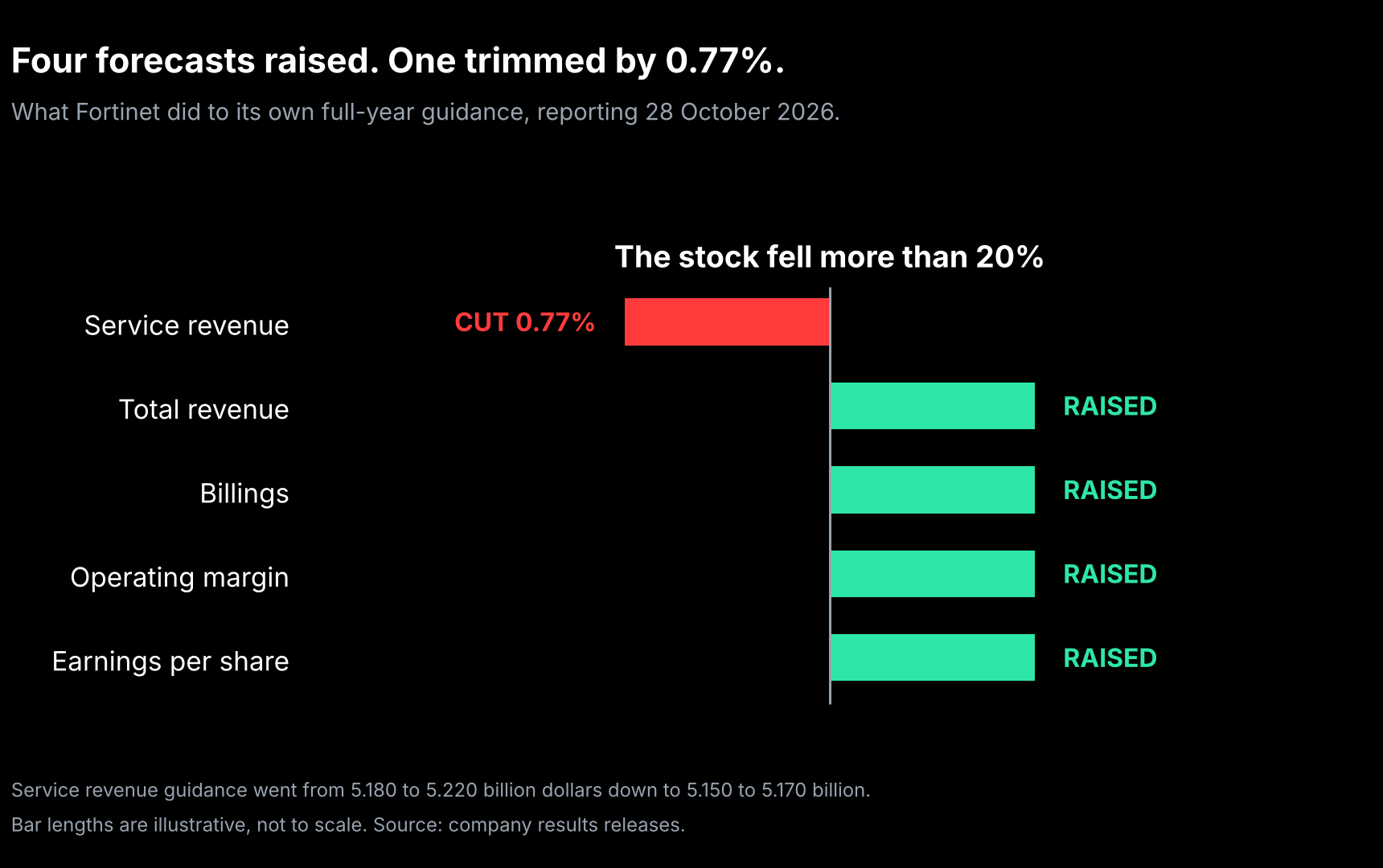
On Wednesday evening, a cybersecurity company called Fortinet reported its quarter. It raised its full-year revenue guidance. It raised its billings guidance. It raised its operating margin guidance. It raised its earnings guidance.
And it trimmed one line, its forecast for service revenue, from a range of $5.180 billion to $5.220 billion down to $5.150 billion to $5.170 billion.
That is a reduction of about 0.77% at the midpoint. Roughly forty million dollars on a company doing more than eight billion.
The stock fell more than 20% the following day.
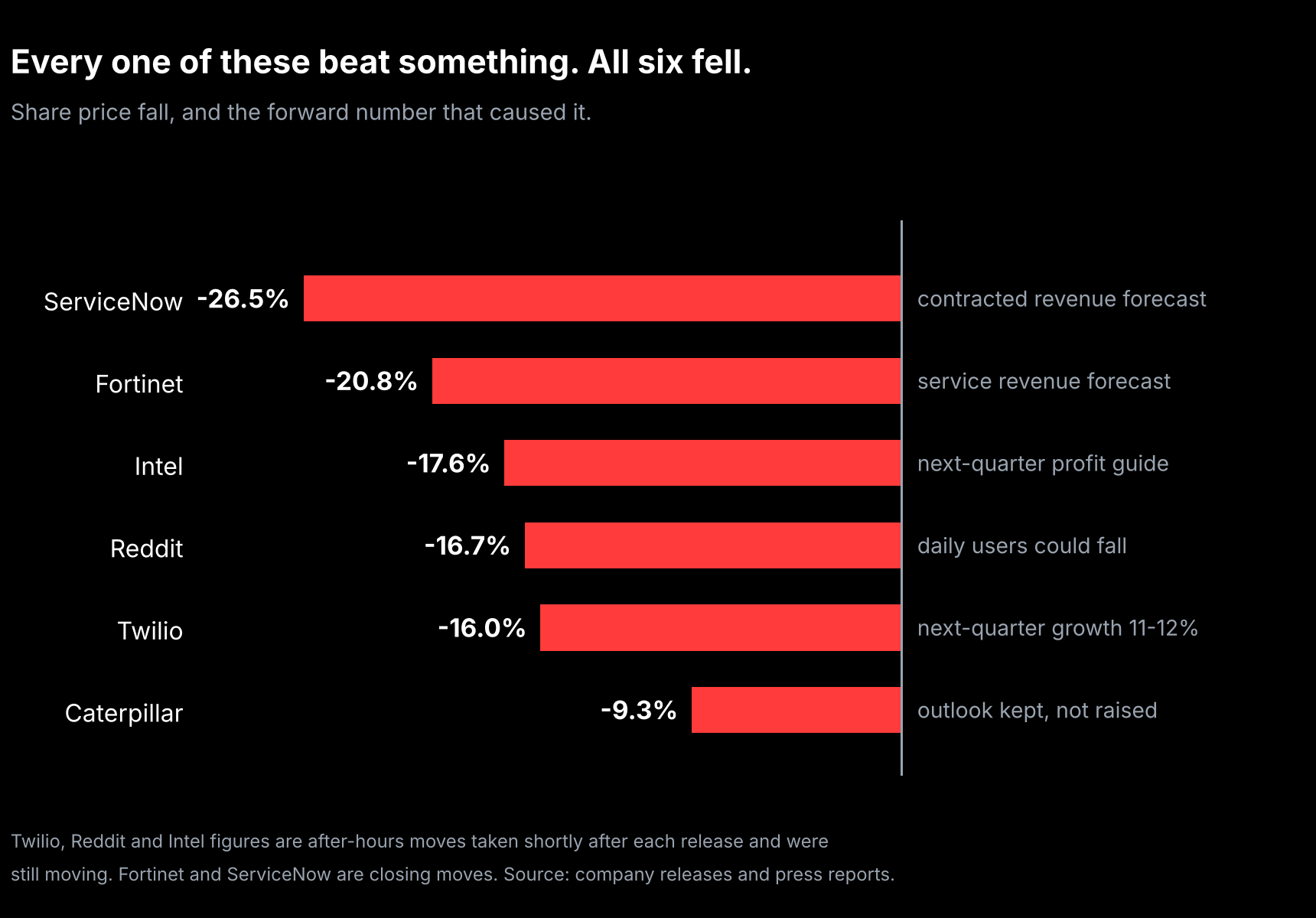
It was not alone. Over roughly twenty-four hours this week, a run of companies reported results that beat what Wall Street expected and then got taken apart anyway.
- ServiceNow, enterprise software, beat on revenue and raised its full-year outlook. Fell about 27%, the worst day in its history.
- Reddit, social media, grew revenue 53% and earnings per share 75%. Fell about 17% after hours.
- Intel, semiconductors, beat on revenue and adjusted earnings. Fell about 18% immediately after the release and kept going.
- Twilio, business communications, beat earnings by roughly 11% and raised its full-year guidance twice over. Fell about 16% after hours.
- Caterpillar, heavy machinery, beat on earnings with a record order book. Fell about 9%, its worst day since March 2020.
Security software. Enterprise software. Social media. Chips. Communications. Excavators.
If this were only the software companies you could tell a story about artificial intelligence. Caterpillar makes bulldozers. Something else is going on, and it is one of the most useful things a beginner can understand about how earnings actually work.
We wrote this week about one of those companies in detail. This is the pattern behind all of them.
Who decides what "expectations" are
Start here, because almost everyone gets this backwards.
When a headline says a company "beat expectations," those expectations did not come from the company. They came from analysts at banks and research firms, each of whom builds a model, produces a forecast, and submits it. A data provider collects those forecasts and averages them. That average is consensus.
So consensus is a crowd-sourced guess assembled by people outside the business, and "beating expectations" means the company did better than a group of outsiders predicted.
Three things follow from that, and they explain most of this week.
Consensus moves. It is not fixed at the start of the quarter. Analysts revise as new information arrives, and if a stock has run up, those estimates tend to drift up with it. A company can deliver exactly what it planned and still "miss," because the bar rose while it was working.
Consensus can be wrong in both directions. It is an average of forecasts, not a measurement of anything.
And a company has its own number, which is usually different. Most companies publish their own forecast, called guidance. So there are always two bars, and a company can clear one while failing the other.
That distinction matters enormously this week, and we will come back to it.
What guidance actually is, and why it is the part that moves the price
Here is the thing nobody tells you: a company does not have to tell you anything about the future.
It is legally required to report what already happened. Revenue, costs, profit, cash. All of that is history, audited and filed.
Guidance is voluntary. No rule compels a company to say what next quarter looks like. Many choose to, because investors reward predictability and punish surprises, and because a management team that forecasts well builds credibility over years.
But that creates an asymmetry that explains everything above.
The reported quarter is a fact about the past. The guidance is the only forward-looking thing in the entire document.
A share price is not a verdict on what a company did last quarter. It is an estimate of everything the company will earn from here. So when a report contains a backward-looking number that is good and a forward-looking number that is worse than hoped, the market does not split the difference. It trades the forward number, almost entirely, because that is the one carrying information it did not already have.
The headline writes up the past. The market prices the future. That gap is why "beat expectations, stock plunges" looks insane and is not.
The four numbers that did the damage
What makes this week genuinely instructive is that four different companies got hit by four completely different forward metrics. Same mechanism, four disguises.
Fortinet: a service revenue forecast. Fortinet ships security hardware and then charges for ongoing subscriptions and support on top of it. The hardware is lumpy and one-off. The service revenue is recurring, which makes it the more valuable half. Product revenue grew 37% in the quarter. Service revenue grew 13%, and the full-year forecast for it came down slightly.
The chief financial officer called it "really a timing issue," explaining that large new enterprise customers take time to activate their service contracts, so the revenue arrives later rather than never.
Then an analyst asked about next year, and her answer is the most quotable thing anyone said all week: service revenue will "grow at a higher rate compared to 2026," but, she added, "I would say I haven't used the word acceleration. I've used the word improved growth rates."
A chief financial officer publicly declining to use a specific word is not a small thing. The market heard it.
Twilio: organic growth. Twilio reported revenue up 20%. Its own "organic" figure, which strips out certain items, was 16%. And it guided next quarter's organic growth to 11% to 12%.
The gap between 20% and 16% is worth understanding, because it is a trap. It is not acquisitions, which contributed less than two million dollars out of more than $1.5 billion. It is mostly carrier fees: the charges mobile networks levy on business text messaging, which Twilio collects from customers and passes straight through. That money appears as revenue but the company does not really earn it.
So the reported 20% flatters the business. The market priced off the 16%, then off the 11% to 12%, and the stock fell about 16%.
What makes Twilio the purest case this week: it raised its full-year guidance on both measures, from 18% to 20% reported and from 13% to 15% organic, and still lost roughly a sixth of its value on one line about the next ninety days.
Reddit: daily users. Reddit's quarter was excellent on every historical measure. Revenue up 53%. Earnings per share up 75%.
Its guidance for the current quarter came in light, and the company said its daily user count could fall. For a business whose revenue comes from advertising, the number of people showing up is the raw material. A backward-looking revenue figure cannot reassure anyone about that.
Intel: next quarter's profit. Intel beat on revenue and adjusted earnings. Then it guided the current quarter to adjusted earnings of about 25 cents a share against the roughly 43 cents analysts expected, and revenue of $15 billion to $16 billion against roughly $17 billion.
That is not a small shortfall. It is a guide more than 40% below the expected profit. No quarter already in the books offsets that.
The company that missed everything, and beat anyway
Now the case that makes the whole thing click, because it runs the other way.
Amazon missed. Earnings came in at $1.89 a share against roughly $1.96 expected. Revenue came in at $201.9 billion against roughly $202.3 billion. Both short. Headlines said so.
And yet operating income was $28.1 billion, which is above the top end of Amazon's own guidance range of $22.5 billion to $26.5 billion, at the highest operating margin in the company's history.
So which is it? Did Amazon have a good quarter or a bad one?
Both answers are correct, and they are measured against different bars. Against the forecasts of outside analysts, it fell short. Against what the company itself told investors to expect three months earlier, it did better than promised.
This is the single most useful habit in the piece. When you read that a company beat or missed, ask one question: beat whose number? Wall Street's crowd-sourced average, or the company's own published plan? Those are different tests and they regularly disagree. The word "beat" on its own carries almost no information until you know which one it means.
Caterpillar is the other shape of this. It beat on earnings, with revenue roughly in line depending on whose consensus you use, and an order backlog the company called a record. What it did not do was raise its full-year growth outlook. It kept it where it was, and described the current quarter's sales growth as "moderate."
Nothing went wrong. The company simply declined to promise more than it already had, and the stock had its worst day in more than six years.
For completeness, because a lot of coverage got this backwards: Caterpillar's problem was not weak demand for the power generation equipment that data centers need. That business grew 30% in the quarter and the company has reciprocating engine orders booked into 2029. The pressure came from construction equipment, where dealers are working down inventory, and from the plain fact that the outlook did not move.
What the analysts actually did
Here is a detail that cuts against every one of these stories.
Across all of these companies, exactly one rating downgrade is confirmed: Bank of America lowered its recommendation on Fortinet, writing that it "reflects less confidence in the timing of the next leg of earnings upside."
Everything else was a cut to a twelve-month value estimate while keeping the recommendation unchanged. At least fifteen firms trimmed their numbers on Fortinet alone. On Caterpillar, after a 9% fall, I could not find a single rating change. Three large firms cut their estimates and all three kept their recommendations exactly where they were.
Those two actions mean very different things. A rating answers "should you own this?" A twelve-month estimate answers "what is it worth?" Cutting the estimate while keeping the rating is usually arithmetic: lower a growth assumption in a spreadsheet and a smaller number comes out. A downgrade means the reasoning broke.
So the people who build the models mostly trimmed their assumptions and kept their conclusions, while the market removed a fifth or a quarter of several companies in a day. That is a disagreement, and it is worth noticing rather than assuming the market and the analysts were saying the same thing.
What this does not tell you
It does not tell you these companies are in trouble. Fortinet raised four separate guidance figures. Twilio raised its full-year outlook twice over. Reddit grew revenue 53%. Caterpillar reported a record backlog. A falling share price is a change in what people will pay, not a diagnosis.
It does not tell you the market was wrong. A forward number is the most informative thing in an earnings release, and when several of them come in soft at once, repricing is a reasonable response. Whether the size of these moves was reasonable is a separate question and nobody can settle it today.
It does not tell you guidance is reliable. Companies set forecasts they expect to beat, because beating is rewarded. A conservative guide can look alarming and mean nothing. That cuts both ways and it is why management credibility, built over many quarters, is worth so much.
It does not tell you the reported quarter is worthless. It is the raw material for everything else, and it is the only audited part of the document. It just is not the part that was news.
And it does not tell you this is an AI story. That framing is everywhere this week and it does not survive contact with the list. Caterpillar builds machinery. Its power generation business grew 30% on data center demand, which is the opposite of artificial intelligence hurting it. What these companies share is not a technology. It is a market that is currently paying a great deal for growth and reacting violently when the forward number softens by even a little.
What this week actually offers is a question to carry into every earnings season from here. When you see "beat expectations" in a headline, ask three things: beat whose number, what did they say about next quarter, and did anyone who follows the company change their mind? Those three answers will tell you more than the headline figure ever will.
That habit of asking what a number is measured against is the entire method. Techdamentals runs four separate valuation methods and shows the full range rather than one figure, for exactly this reason: a single number tells you where somebody landed and nothing about the bar they were clearing.