The company formerly known as MicroStrategy reported on Thursday evening. Operating income was $20.91 billion.
Revenue from its actual business, which is enterprise software, was $125.4 million, down 3% from a year earlier.
Those two numbers are in the same release, and the gap between them is not an error. Essentially all of that $20.91 billion is an accounting gain on the bitcoin the company holds. The software business is a rounding error inside its own income statement.
But that is not the interesting part, and it is not why this report matters.
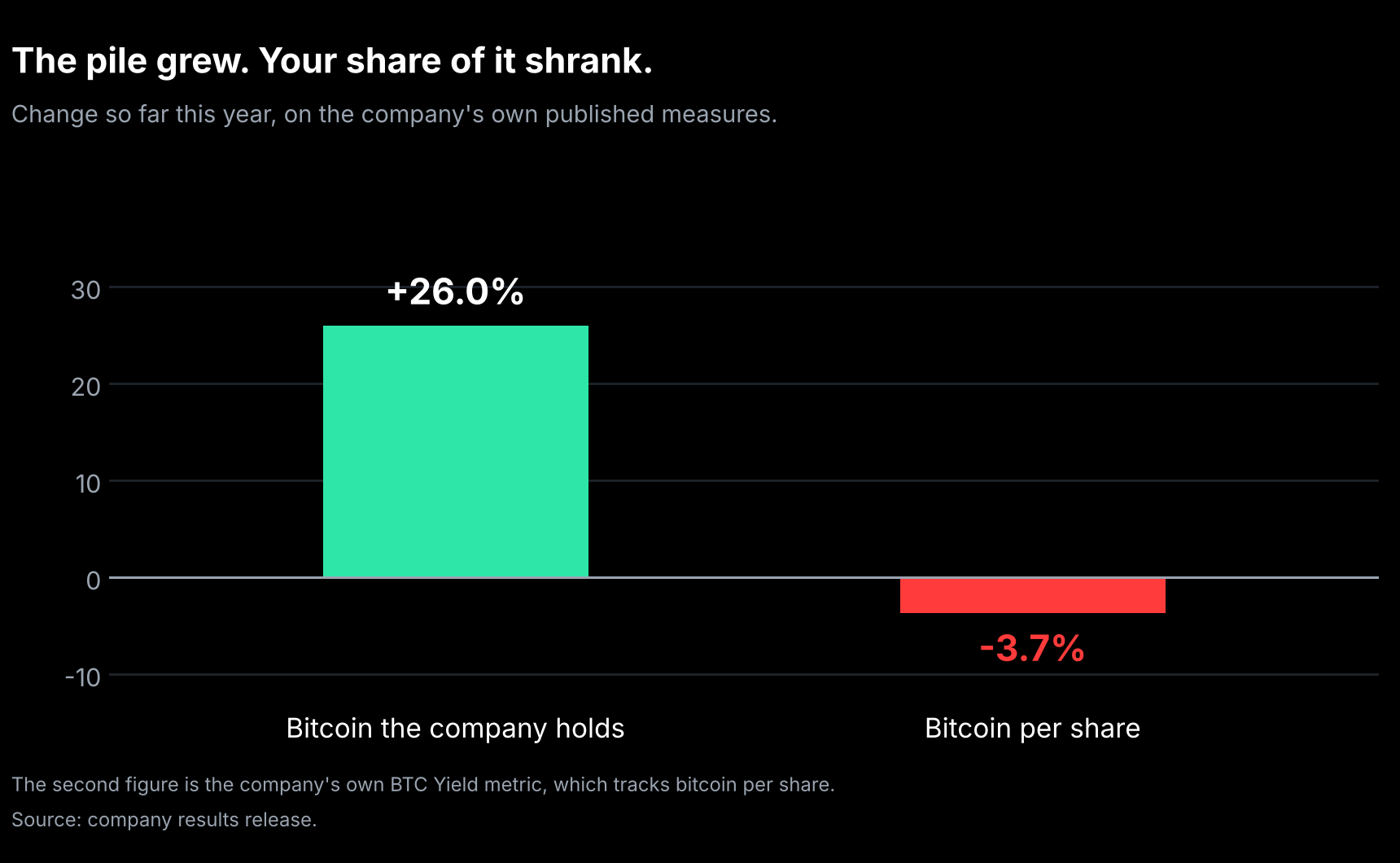
Buried in the same document is the company's own measure of whether its strategy is working. It is called BTC Yield, it tracks bitcoin per share, and for this year it reads negative 3.7%.
The company's bitcoin holdings grew 26% in that period. Bitcoin per share fell anyway.
That is the machine running backwards, disclosed by the company that built it, in a metric the company invented to prove the machine works.
We wrote this week about why a single number cannot carry a verdict. This is the clearest example of that idea anyone is going to hand you.
What the company actually is
Strip away the software and the mechanics are simple.
The company holds 848,517 bitcoin. It paid $64.02 billion for them, an average of $75,446 each. At roughly $77,800 a coin, where bitcoin sat on Thursday evening, those holdings are worth about $66 billion. Bitcoin moves constantly, so check that number before you rely on it.
To acquire that pile, the company raised money. A great deal of it. $21.23 billion this year alone, including $5.41 billion in the most recent quarter by issuing ordinary shares.
It also borrowed. There is roughly $6.7 billion of net debt, mostly convertible notes. And it created several series of preferred stock, which total something on the order of $20 billion in claims.
Preferred stock is worth understanding, because it is doing most of the work here and most people have never had it explained. It sits between debt and ordinary shares. Like debt, it pays a fixed rate and ranks ahead of ordinary shareholders, so preferred holders get paid before you do. Unlike debt, it usually has no maturity date, so the company never has to repay the principal. It just owes the dividend forever.
That combination is why companies reach for it. It raises money without a repayment deadline and without technically counting as borrowing. The cost of that convenience is the rate. One of this company's preferred series pays 12.00% a year, which tells you roughly what investors required to supply money on those terms.
So the structure is: a very large pile of bitcoin, funded by a mixture of new shares, convertible debt and high-paying preferred stock, sitting on top of a small software business that is shrinking slightly.
The flywheel, and why the premium was everything
Here is the mechanism that made this work for years, and it is genuinely clever.
Suppose the company holds $10 of bitcoin for every share outstanding, and the shares trade at $12. Investors are paying a premium of 20% over the value of the underlying bitcoin.
Now the company issues new shares at $12 and uses the proceeds to acquire more bitcoin. Each new share brings in $12 and adds $12 of bitcoin to the pile, but it only has to share the pot with holders who own $10 of bitcoin per share.
Every existing shareholder now owns slightly more bitcoin per share than before. The company did not have to be right about anything. It just had to issue shares above the value of what it holds, and arithmetic did the rest.
That is why the premium mattered more than the bitcoin price. A premium is the fuel. The wider it is, the faster bitcoin per share compounds.
Now run it the other way. If the shares trade at or below the value of the bitcoin they represent, issuing stock to acquire more bitcoin does the opposite. New shareholders bring in $10 and get a claim on $10, but existing holders have to share with more people. Bitcoin per share falls.
The premium is not a nice-to-have. It is the difference between the engine running forwards and backwards.
Right now the premium is roughly gone. Depending on which measure you use, the company's market value sits at approximately parity with the value of the bitcoin it holds, and by one calculation slightly below it. For scale, that premium reached around four times the underlying bitcoin at the peak of the last cycle.
And the company's own metric confirms what happened next. BTC Yield of negative 3.7% for the year. A companion figure the company also publishes, measuring the same thing in coins, reads negative 24,947 bitcoin.
The company discloses both. Nobody is hiding this. Almost nobody is reporting it.
The obligation the software business cannot pay
This is the part of the structure that deserves the most attention, and it has nothing to do with the bitcoin price.
Preferred stock dividends are a cash obligation. They are not optional in the way ordinary dividends are. In the most recent quarter those dividends came to $419.6 million.
Revenue from the software business in the same quarter was $125.4 million.
That is not close. The operating business cannot cover the dividend bill. It is short by a factor of more than three on revenue alone, before any costs.
So where does the money come from? Three places, and the company is explicit about all of them.
New capital. Issue more shares or more preferred. This works while investors are willing, and it is precisely the mechanism that dilutes bitcoin per share when the premium is gone.
The bitcoin. And here is the disclosure that got almost no coverage: the company has disposed of roughly $431.8 million of bitcoin this year to fund preferred dividends and repurchases of its own preferred stock. Its board has formally authorized doing so.
Read that slowly. A company whose entire identity is acquiring and holding bitcoin is now parting with some of it to meet a cash obligation.
And third, it can stop acquiring. In the week to October 25, the company acquired no bitcoin at all. Instead it spent over $2.04 billion repurchasing its own preferred stock at an average of $97.39, a small discount to the $100 it is nominally worth. Its chief executive described this as a commitment to "returning STRC to health."
Capital that used to go into bitcoin is now going into defending the preferred.
Where the cushion sits
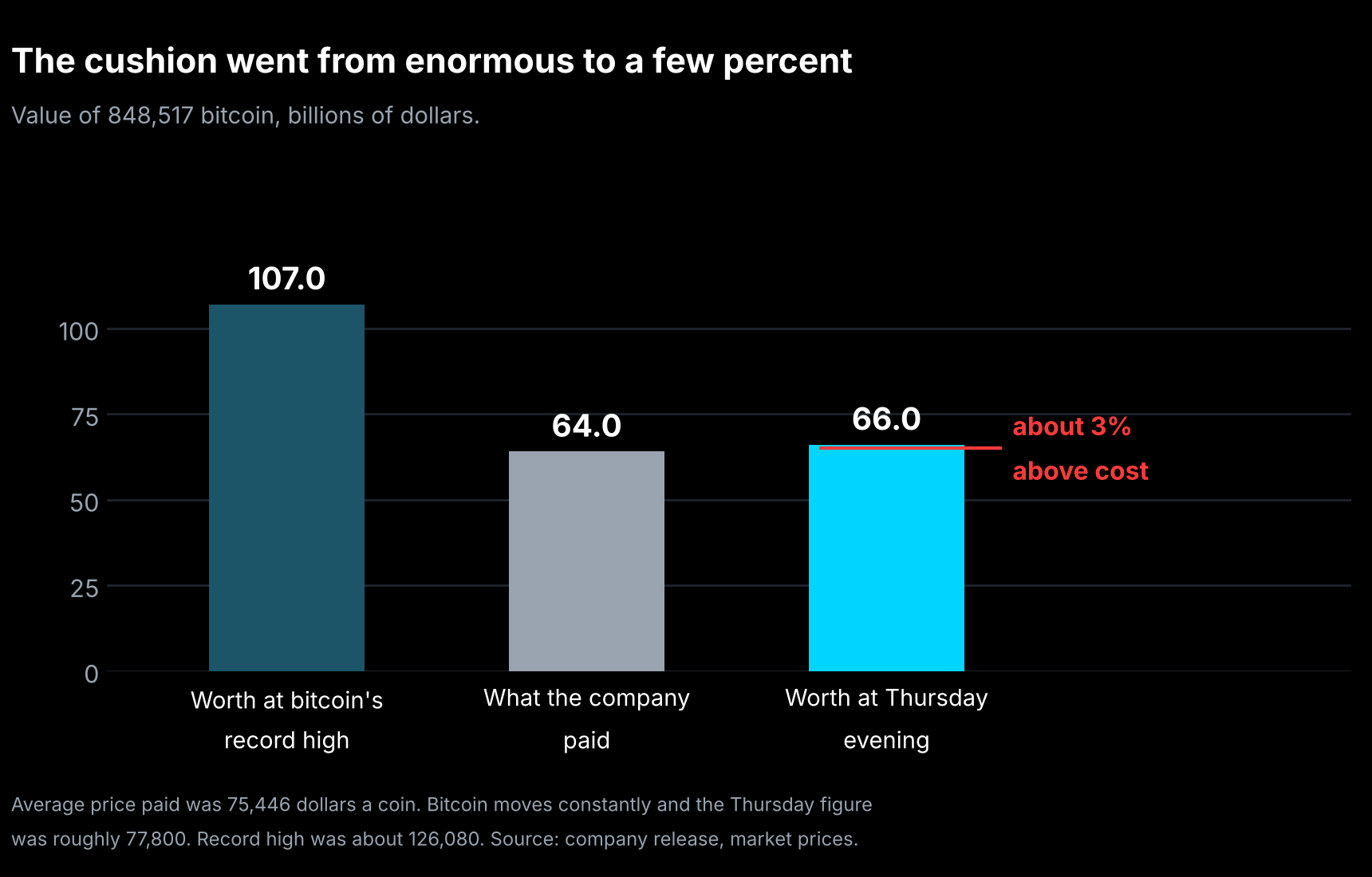
The average price paid across all 848,517 coins is $75,446.
At roughly $77,800, the holdings are worth about $66 billion against a cost of $64.02 billion. The company is ahead by around two billion dollars, which sounds like a lot until you express it as a percentage: roughly 3%.
At bitcoin's record high of about $126,080, reached in late 2025, the same holdings would be worth about $107 billion. Bitcoin is currently around 38% below that level.
So the cushion between what this company paid and what its holdings are worth has gone from enormous to a few percent in roughly a year.
What this does not mean, and I want to be very clear, is that something is forced to happen at a particular price. I looked for a bitcoin level that triggers a margin call, a collateral requirement, or a covenant breach, and I could not find one from the company, from its filings, or from any credible analyst. Nobody has published one.
The constraint, on the evidence available, is not a sudden forced sale. It is a slow cash-flow problem: a recurring dividend obligation that the operating business cannot fund, met by issuing securities or parting with bitcoin, in a period when issuing securities no longer adds bitcoin per share.
Those are very different risks. A margin call happens in an afternoon. A funding squeeze happens over quarters, and it is visible in disclosures the whole way down.
One more thing I could not verify and therefore will not speculate about: the maturity schedule and covenant terms on the convertible notes. The release names one series and does not itemize the rest. If you want to form a view on refinancing risk, that requires the quarterly filing rather than the press release.
One more detail, which may be nothing
The company announced on the same evening that its chief financial officer is stepping down on November 5, remaining as an adviser through the end of December, with a successor starting January 1.
His quoted line in the release was: "Q3 operating income of $21 billion was the largest ever in Strategy's history."
A finance chief departing in the same announcement as a record headline profit, a negative bitcoin-per-share figure, and bitcoin 3% above the company's average cost is worth noticing. It is also, very possibly, a coincidence. Executives leave for ordinary reasons constantly and there is nothing in the disclosure suggesting otherwise. File it, do not conclude from it.
The other way to own this, and the same accounting trick
Coinbase also reported on Thursday, and it rhymes in an instructive way.
Net income was $719 million. Of that, $715 million was a gain on crypto the company holds as an investment. Strip out the investment gains and adjusted net income was about $78 million.
So two of the largest crypto-linked companies in the market both reported profits on Thursday that were overwhelmingly the result of marking assets up, rather than the result of operating.
That does not make either number fake. Mark-to-market accounting is a rule, not a choice, and the gains are real in the sense that the assets really are worth more than they were. But it does mean the profit figure tells you about the price of an asset, not about how the business performed, and those drift apart badly when the asset is volatile.
The honest read on Coinbase's quarter is in the figures that strip the marks out: adjusted earnings before interest and other items of $333 million, up 60% from the prior quarter but down 58% from a year earlier. Subscription and services made up 49% of net revenue, which is the company's long-running attempt to depend less on trading activity. Its prediction markets business passed $200 million in annualized revenue.
That last item is the one worth watching, because it is the piece of the business least tied to the price of anything.
What this does not tell you
It does not tell you the company is in trouble. Its bitcoin is worth more than it paid. It has access to capital markets and has raised over twenty billion dollars this year. No credible source has identified a level at which anything is forced. What is documented is a funding structure that has become harder to run, not one that has broken.
It does not tell you the strategy failed. Over several years it converted a small software company into one of the largest bitcoin holders on earth, and anyone who held through that did extremely well. The question on the table is whether the mechanism still works from here, and on the company's own metric, this year, it did not.
It does not tell you what bitcoin does next. Nobody knows, including the people whose job description is knowing. The chief executive's view is that "we're at the beginning of the next bitcoin bull market." That is a position, not a forecast with evidence attached.
It does not tell you the preferred dividends are at risk. They have been paid. Cumulative preferred dividends paid now total $1.48 billion. The observation is only that the operating business does not generate the cash to pay them, so something else has to, every quarter, forever.
And it does not tell you what the shares are worth. That is the genuinely hard question, and it is why this company is so instructive. You are not valuing a software business. You are valuing a pile of bitcoin, minus about $20 billion of claims that rank ahead of you, plus or minus whatever premium other people are willing to pay for the convenience of owning it this way. Change your view on the premium and you change your answer by billions without changing your view on bitcoin at all.
What this week offers is a reminder that a headline profit figure and a working business are different things, and that the gap between them is sometimes the entire story. A company can report the largest operating income in its history, in the same document in which its own chosen measure of success reads negative.
That is why we show the workings rather than a single figure. Techdamentals runs four separate valuation methods and displays the full range, because one number tells you where somebody landed and nothing about what they counted to get there.