Alphabet's cloud business grew 103% last quarter. Microsoft's cloud business grew 48%.
Both companies reported on Wednesday evening, within about ninety minutes of each other, covering the identical three months ending September 30.
Microsoft rose. Alphabet dropped roughly 10% after hours, was down about 11% before the open on Thursday, and was down 12.18% at the opening bell. By mid-morning the decline had widened to around 13%, erasing more than $500 billion of market value in a single session.
The company growing its cloud business twice as fast was the one that got punished.
The explanation you will read everywhere is that Alphabet is spending too much on data centers. That explanation is wrong, and it is wrong in a way that is easy to check. Alphabet spent 40.3% of its revenue on capital projects last quarter. Microsoft spent 42.7% in cash, and 49.0% once you include its leases.
Microsoft spent the larger share. It was rewarded for it.
So the difference is somewhere else, and it sits in one line of a financial statement that most people have never read. We wrote this week about where all this data center money goes. This is about what it does to the company writing the cheque.
What free cash flow actually is
Start with the definition, because it is short. This is Alphabet's own wording from Wednesday's release:
"We define free cash flow as net cash provided by operating activities less capital expenditures."
Two numbers, subtracted. That is the whole thing.
One term in there needs unpacking, because it does most of the work in this story. Capital expenditure is money spent on things the company will still own in several years: land, buildings, electrical gear, servers, chips, cooling systems. It is deliberately separate from day-to-day costs like salaries and electricity. The distinction is not about size, it is about lifespan. Pay a programmer and the money is gone and the benefit is this year. Pour a concrete floor and the money is gone and the benefit is spread over decades. Accountants treat those two completely differently, and that difference is the entire reason free cash flow and profit can point in opposite directions.
The reason it matters is that a company reports three different versions of how it did, they routinely disagree, and each one is measuring something real.
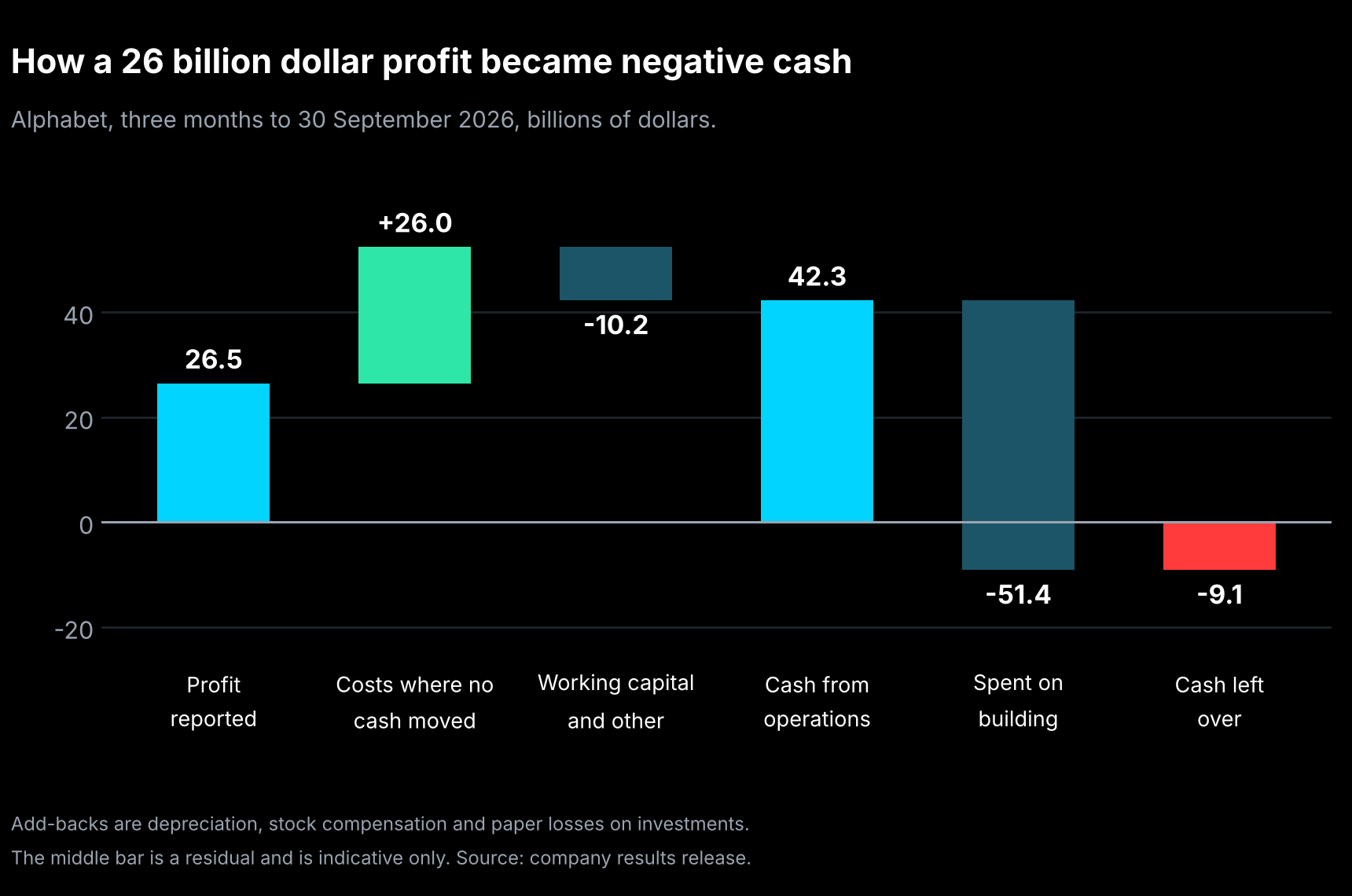
Net income is the profit line. Revenue minus every expense the accountants assign to the period. It includes things no money moved for: an oven wearing out a bit, stock handed to employees, a stake in another company changing value on paper. Alphabet's net income was $26.5 billion, down 24% from a year ago. Sitting inside that number was an $8.2 billion paper loss on investments nobody sold. Not a dollar left the building for it.
Operating cash flow is money that actually moved. Start with net income, add back the expenses that were never cash, then subtract the cash that genuinely left but was not counted as an expense. Did customers pay their bills? Did you pay your suppliers? Did you build something you have not sold yet? Alphabet's operating cash flow was $42.3 billion, which is higher than its profit, because the $8.2 billion paper loss got added straight back, along with $8.4 billion of depreciation and $8.6 billion of stock compensation.
Free cash flow is what survives the building. Operating cash flow minus the money spent on things that last: land, buildings, servers, chips, cooling. Alphabet's was $42.3 billion minus $51.4 billion, which comes to negative $9.1 billion.
Profit of $26.5 billion. Cash flow of negative $9.1 billion. Same company, same three months, both numbers correct.
So why does anyone watch the cash number rather than just the profit? Because profit is an opinion about timing and cash is a fact about this week. Free cash flow is the money genuinely available after the lights are kept on and the buildings are paid for, and it is what funds everything a company does with its own resources: repurchasing its own shares, paying dividends, retiring debt, acquiring something. When free cash flow is positive, those come out of the business. When it is negative, the company covers the gap from savings, by borrowing, or by issuing new shares. None of those three is a crisis. All three are a change in how the company is financed, and that is what people are reacting to when the number flips.
Why a profitable company can post negative cash
Because accounting and cash keep different calendars, and capital spending is where they disagree most.
Pay $51 billion for a server farm and the cash leaves immediately, all of it, this quarter. The expense does not. Accounting says those servers will be useful for years, so it charges the cost against profit a slice at a time, as depreciation.
In the quarter the money leaves:
- The cash flow statement shows the full amount gone, right now
- The income statement shows a small slice of depreciation
- Profit looks fine. Cash looks awful.
Then it reverses. For years afterward the depreciation keeps grinding against profit long after the money is gone. Profit looks worse. Cash looks fine, because nothing more is leaving.
That is exactly where Alphabet is standing. $8.4 billion of depreciation this quarter against $51.4 billion of cash out the door. The depreciation bill from this one quarter of spending will follow the company for years, which is precisely why its finance chief warned about margin pressure ahead. The cash hit arrives first and all at once. The profit hit arrives later and slowly.
What actually separated the two companies
Here is the comparison that explains Wednesday night. Both figures are for the same three months.
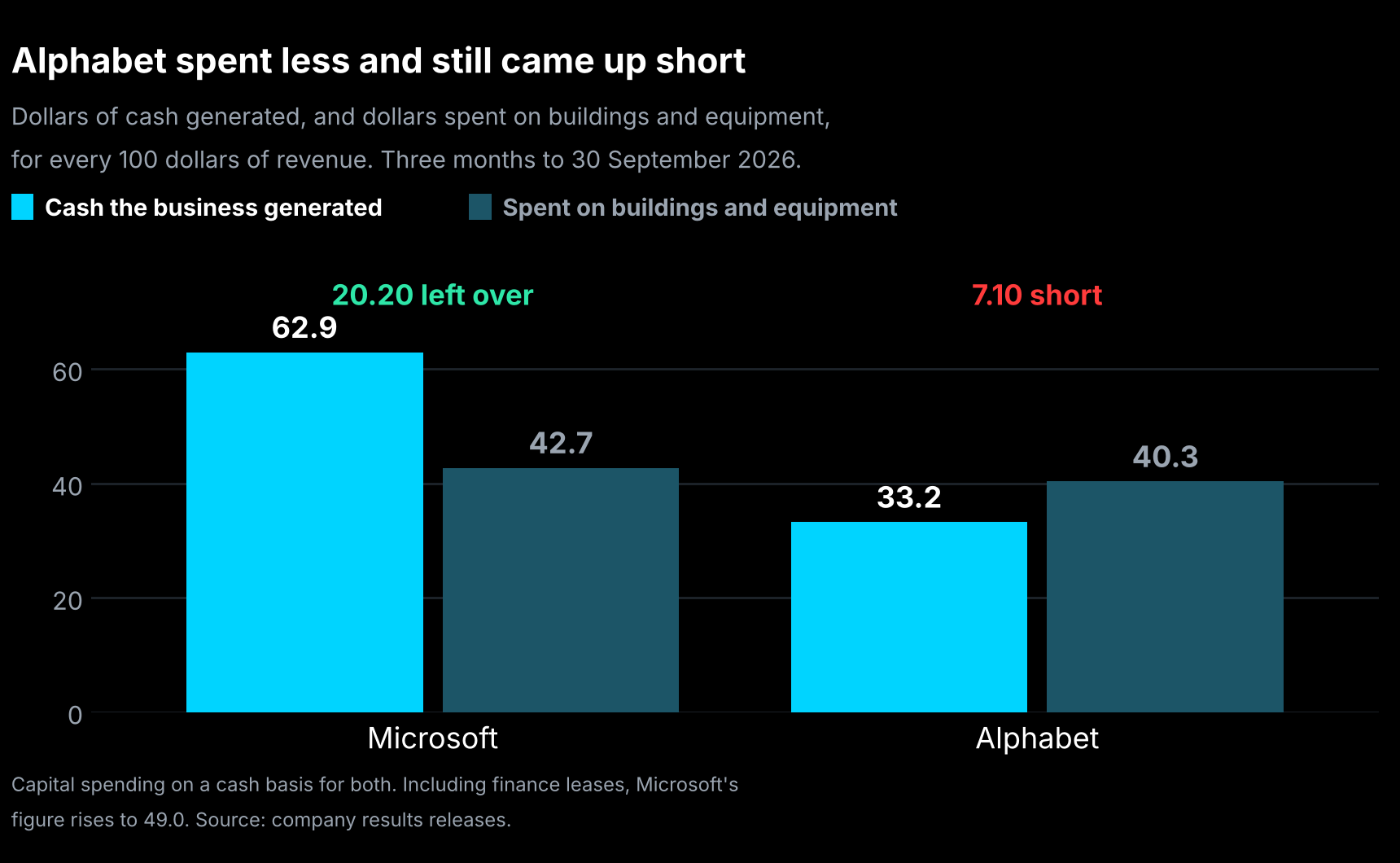
Think of it as two households with similar mortgage payments and very different paychecks that month.
Microsoft's business put about $63 of cash in the till for every $100 of sales. It then spent roughly $43 of that on construction. Left over: about $19 of every $100. Positive.
Alphabet's business put about $33 of cash in the till for every $100 of sales. It then spent $40 on construction. It spent $7 more than it took in. Negative.
That is the entire story, and notice what is not in it. Neither company is spending recklessly relative to the other. The spending is roughly comparable. What differs by nearly two to one is how much cash each business generated before the spending started.
And the more interesting half of that is the direction of travel. Alphabet turned 47.3% of revenue into operating cash a year ago. This quarter it turned 33.2%. Microsoft went the other way, from 58.0% to 62.9%.
Alphabet's revenue was 38% larger than Microsoft's. Its operating profit was slightly smaller, about $40.6 billion against roughly $46 billion. But its operating cash was $15.7 billion smaller, and that gap is far wider than the profit gap. Something is pulling Alphabet's cash well below its profit.
Where the cash actually went
Three things, and two of them are timing rather than trouble.
It paid an old bill. $5.2 billion of cash went out to settle a European Commission fine levied in 2018, after the appeal process finally ran out. The expense was recognised years ago. The money left this quarter. That is a cash timing event, not a new charge, and it does not repeat.
It built hardware it has not sold yet. Alphabet is now manufacturing and shipping its own chip systems, and a meaningful piece of that 103% cloud growth is hardware sales rather than rented computing. Hardware has to be built and paid for before a customer is ever billed. The finance chief put it plainly: "We build the inventory ahead of getting the revenue stream in." She said most of that revenue lands in 2027. Cash out now, revenue later. Microsoft does not have this problem, because it rents computing rather than shipping boxes.
Customers owe it more money. Receivables rose by roughly $3.9 billion and other assets by about $7.8 billion. The revenue was booked. The cash has not arrived.
Add it up and working capital consumed about $17.4 billion of cash this quarter, against contributing $3.8 billion a year earlier. That is a swing of roughly $21 billion before you get anywhere near the data centers.
One honest limit on this section: the detailed line items come from reading the quarterly filing rather than the headline release, and I could not make them reconcile exactly to the $42.3 billion total. Treat the breakdown as indicative. The three drivers are company-stated. The precise split is not.
Three of the four big spenders have now gone negative
This is the part almost nobody is framing properly, and it is bigger than one bad night.
Amazon went first. Its quarterly free cash flow was negative $17.2 billion in the first quarter of this year, and its rolling twelve-month figure turned negative in the second, at negative $7.6 billion against positive $18.2 billion a year earlier.
Alphabet posted negative $5.9 billion in the second quarter, described as its first negative quarter in twenty-two years as a public company, then negative $9.1 billion in this one. Two in a row, and the second was worse.
Meta reported on October 21 with free cash flow of negative $2.12 billion, its capital spending of $34.9 billion having edged past the $32.8 billion its operations generated.
Microsoft is the only one of the four still positive. At $18.6 billion, comfortably so.
Amazon reports tonight, after the close. The expectation is around $202 billion of revenue and cloud growth near 38%, and the company has signalled roughly $220 billion of capital spending for the full year. Its chief executive has already said the quiet part out loud: "We'll spend a lot of capex and encounter free cash flow headwinds until these data centers come online." That is the clearest statement any of the four has made about when the cash comes back, and the answer is: when the buildings start earning.
What this does not tell you
It does not tell you free cash flow is why the stock fell. This is the most important caveat in the piece and it cuts against the framing you will see everywhere. Read what named analysts actually wrote on Thursday and they are overwhelmingly talking about Search, not cash. Search revenue grew 12% and missed expectations by roughly $1.5 billion, with management attributing part of the slowdown to greater use of its AI answer mode, where advertising is still being tested. One analyst: "In a market worried about AI cannibalizing the franchise, investors need to see search accelerating, not decelerating." Another's note was titled "Is This the Quarter We Feared?" One major firm's full published note on Thursday does not mention free cash flow once. The "Wall Street now tests you on cash" framing is headline writers describing a mood. It is real as a mood. It is not what the analysts said.
It does not tell you the spending guidance spooked anyone. Alphabet's 2026 capital spending range was held unchanged at $195 billion to $205 billion. No 2027 figure was given at all. If you see one printed, somebody is guessing.
It does not tell you the profit miss and the cash figure are the same event. They are two separate things in one release, and conflating them is the single most common error in this story. The earnings miss was driven mostly by that $8.2 billion non-cash investment mark-down. It hit reported profit. It had essentially no effect on cash.
It does not tell you the two cash figures are measured the same way. Microsoft's headline capital spending of $45.2 billion includes $7.4 billion of finance leases, which are real commitments to pay for capacity. Its free cash flow calculation does not subtract them. Meta's does. Subtract them from Microsoft too and its free cash flow is closer to $11 billion than $19 billion. Still positive, but the gap to Alphabet narrows by about 40%. Free cash flow is not a standardised, audited line like revenue. Always check what got taken out.
It does not tell you Microsoft was more disciplined. Its capital spending came in roughly $5 billion below its own guidance, and its finance chief said why: "some third-party capacity deliveries we expected in Q1 were delayed." That money moves into later quarters. Its own free cash flow also fell 27% year over year. It won the comparison. It did not have a good cash quarter in absolute terms.
And it does not tell you Microsoft's quarter was clean. Commercial bookings fell 12%, and the backlog of contracted future revenue was essentially flat against July at $677 billion versus $678 billion. Almost no coverage led with either.
Most of all, it does not tell you negative free cash flow is bad. Negative cash means one of two very different things. Either the business cannot cover its own upkeep, which is serious, or the business is generating plenty of cash and deliberately spending more than it earns to build something it expects to earn more from. Alphabet generated $42.3 billion of cash and chose to spend $51.4 billion. Its operating profit grew 30%. Its cloud margin went from 23.7% to 36.2%. Its cloud backlog stands at $561 billion of signed future revenue. Its trailing twelve-month free cash flow is still positive $19.7 billion.
The question is never "is free cash flow negative?" It is "will the thing you built earn more than it cost?" Alphabet's answer is that it expects returns "meaningfully above our cost of capital." That is a promise, not a result, and nobody can check it yet. That uncertainty is what the share price spent Thursday arguing about.
Which is the honest reason to look at more than one number. A company can report record revenue, 30% profit growth, a doubling cloud margin, a profit miss driven by paper losses, and negative cash, all in the same release, all true. Techdamentals runs four separate valuation methods and shows the full range rather than one figure, for the same reason: a single number tells you where somebody landed, not how they got there.