Anthropic spent $482 million on its own property and equipment in the first half of this year.
In the same six months it spent $8.9 billion on computing power that belongs to somebody else, and at the end of June it was holding leases on capacity that has not been built yet worth another $321 billion.
It is starting to build. Its first data center became operational this year, construction in progress on its books went from $63 million to $536 million in six months, and in March it signed a twenty-year lease on a data center that does not exist yet.
But read how the filing describes these arrangements and one word keeps reappearing. Lease. Third parties procure the land, the power and the buildings. Anthropic leases capacity inside them and hires specialist firms to run them. Its own total lease cost for the half year was $89 million, against that $8.9 billion of computing bought from other people.
That $321 billion is worth slowing down on, because it is the strangest number in the filing and almost nobody has explained it.
Accountants call it leases not yet commenced. It means contracts are signed, the rent is agreed, and the clock has not started, because the thing being rented does not exist. You cannot occupy a building that has not been built. So the obligation sits off to one side of the balance sheet, waiting, until somebody hands over the keys.
Six months earlier that figure was $50.2 billion. It is now $321.4 billion. Which tells you that an enormous amount of construction has been promised to somebody, by somebody, and has not happened yet.
Which raises the question almost nobody is asking. Who are the other people? And who gets the money?
We went through the commitments themselves earlier this week. This is about the other end of them.
The first stop is four names
The filing lists its largest commitments, and the order surprises people.
| Broadcom, equipment leases | $161.2 billion |
| Google Cloud | $114.5 billion |
| Amazon | $110.0 billion |
| Microsoft | $44.9 billion |
Broadcom is the largest, and it is the one worth pausing on, because it is a different kind of agreement from the others. Google, Amazon and Microsoft are renting out computing. Broadcom is leasing physical equipment, the chips themselves, which the company then has to put somewhere.
AMD is in there too, at more than $20 billion, though that one is an expectation rather than a promise, because the agreement sets no fixed dollar amount at all. And then three companies most readers have never heard of: SpaceX's AI unit at up to $120.5 billion, Nscale at about $44.6 billion, and Lambda at about $41.3 billion.
Two of those carry escape hatches worth knowing about. Either side can walk away from the SpaceX arrangement on ninety days' notice once the initial periods end early next year. And roughly $34.9 billion of the Lambda commitment, about 85% of it, can be terminated by either party if Lambda fails to secure the lease on the building it needs.
Those last three matter more than their obscurity suggests, so let us go there next.
The landlords nobody has heard of
Nscale and Lambda belong to a group of companies the industry calls neoclouds. They do one thing: they secure land and electricity, fill buildings with computers, and rent the result to whoever needs it. They are landlords with substations.
A surprising number of them used to do something else entirely. They mined bitcoin.
It makes more sense than it sounds. Mining required exactly what AI training requires: low-cost power at scale, a site already connected to the grid, and the industrial skill to cool a room full of machines running flat out. When AI demand arrived, those companies already had the hardest part.
And the hardest part is the middle one. A site that is already wired into the electrical grid is worth far more than empty land with a good price on it, for reasons we get to further down. These companies spent years acquiring exactly that asset for a completely different purpose, and then the purpose changed under them.
And because several of them are publicly listed, they have to disclose their leases. Which is how we know anything at all about where Anthropic's money goes, since Anthropic itself has never publicly named a single location.
TeraWulf announced a Kentucky campus of up to 401 megawatts, worth roughly $19 billion over twenty years, with Anthropic named as the tenant.
Riot Platforms disclosed a 191 megawatt Texas lease worth $9.1 billion, rising to as much as $16.5 billion with extensions. Riot described the tenant only as "one of the world's leading frontier AI labs." Bloomberg named Anthropic, citing unnamed sources.
Hut 8 has around 350 megawatts committed at a Texas site under an arrangement worth roughly $35 billion, arranged through Lambda.
And one more, which comes from the filing rather than from a landlord. Fluidstack appears in it by name, under an agreement to provide data center development and operations services. Somebody has to actually run these buildings once they exist, and in at least one case that company has a name.
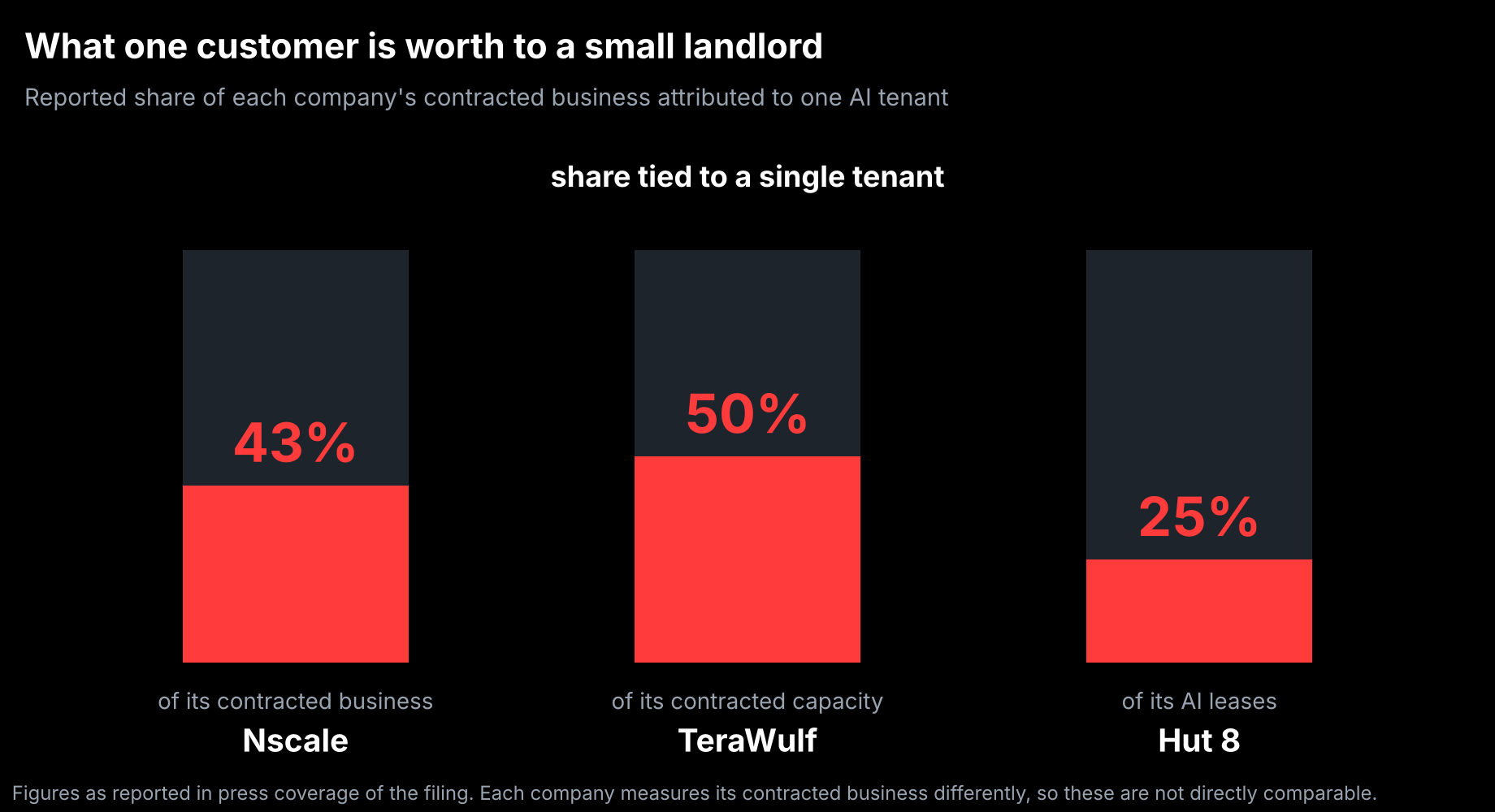
Hold those numbers next to the companies carrying them. A $19 billion twenty-year lease is not a contract win for a company that size. It is the company.
And the concentration runs both ways. Anthropic reportedly accounts for about 43% of Nscale's contracts, nearly half of TeraWulf's contracted capacity, and roughly a quarter of Hut 8's AI leases. The tenant depends on the landlords to build. The landlords depend on one tenant to pay.
Anthropic is not the only tenant
Which would be a frightening place for a landlord to stand if Anthropic were the only company signing. It is not.
OpenAI has committed to $250 billion of Microsoft cloud services, a figure Microsoft disclosed itself, and $138 billion with Amazon over eight years, announced by both companies together. Oracle is reported to hold a $300 billion agreement with OpenAI, though neither company has ever confirmed that number, so treat it as reporting rather than disclosure.
Then the companies spending their own money instead of committing somebody else's. Meta told investors this month it will spend $135 to $145 billion on capital projects this year. Alphabet has guided to $195 to $205 billion. Amazon to roughly $220 billion. Oracle's order book of work sold but not yet delivered reached $664 billion.
So the landlord holding one enormous lease is not staring at an empty building if that tenant walks. There is a queue.
That is the optimistic reading, and it deserves its honest limit. A queue of interest is not a queue of signatures.
Ohio's utility regulator gave us a way to measure the difference. It made a rule: a new data center has to pay for at least 85% of the electrical capacity it reserves, whether it ends up using that capacity or not.
Think about why a rule like that exists. Reserving power costs nothing if nobody charges you for reserving it, so a company with a vague plan books far more than it needs, just in case. Meanwhile the utility builds for a customer who may never arrive, and if that customer does not arrive, everybody else's bill covers the equipment. The rule puts a price on the reservation itself.
Then the bill arrived. The state's largest utility reported more than 30 gigawatts of preliminary interest, about 13 gigawatts that paid for engineering studies, and 5.6 gigawatts that actually signed.
Roughly a fifth of the interest survived contact with a bill. That is the most concrete measure anyone has of how much announced demand is real, and it is the number I would hold onto out of this entire piece.
What a landlord then has to go and purchase
A signed lease is a promise to deliver a building full of working computers. Someone has to supply the parts.
Power equipment. Transformers, switchgear, circuit breakers, backup generation. GE Vernova, Eaton, Powell Industries, Hubbell, nVent all sit here.
Cooling. AI racks run far hotter than anything data centers were built for, which is why liquid cooling went from niche to standard in about two years. Vertiv, Modine, Trane and Johnson Controls are in this layer, and the growth rates are the steepest anywhere in the chain.
The connections. Switches, optical transceivers, fibre. Arista, Coherent, Corning, Amphenol, Ciena.
And the electricity itself, which increasingly comes through twenty-year agreements signed directly with power producers rather than bought from the grid as needed.
Here is the part that makes this layer interesting rather than just a list. This is where the real constraints are.
Start with a transformer, because it is the piece almost nobody can picture. A transformer changes the voltage of electricity between the grid and a building. The grid moves power at very high voltage because that wastes less of it over distance, and a server cannot use power at that voltage. Without a transformer, a data center is just a shed with a power line running past it.
Large power transformers currently run about 128 weeks, which is nearly two and a half years, and in some cases past four. High-voltage circuit breakers are at 125 weeks, up from 77 in 2023. Gas turbine makers are taking reservations for 2031 delivery.
Then there is the part that has nothing to do with manufacturing. Before you connect anything large to the grid, you need permission, and you wait in line for it. That line has a name, the interconnection queue, and in the largest American grid region AI projects that came online in 2025 took an average of more than seven years from start to switch-on. Over three of those years were spent waiting for permission rather than building anything.
Which is why a site that is already connected is worth so much, and why the bitcoin miners turned out to be sitting on something valuable.
New transformer factories are under construction in Virginia, North Carolina and South Carolina. They open in 2027 and 2028.
So the money moves fast and the hardware does not.
The companies that actually build it
Now the finding that surprised me most, and it is the reason this piece exists.
You mostly cannot own them.
The largest data center builders in the United States are either employee-owned or foreign-parented. Turner Construction did over $28 billion of construction work last year and belongs to a German company. Kiewit, DPR, Holder, Hensel Phelps, Mortenson, Rosendin, all private. Skanska's American arm answers to Stockholm, Balfour Beatty's to London.
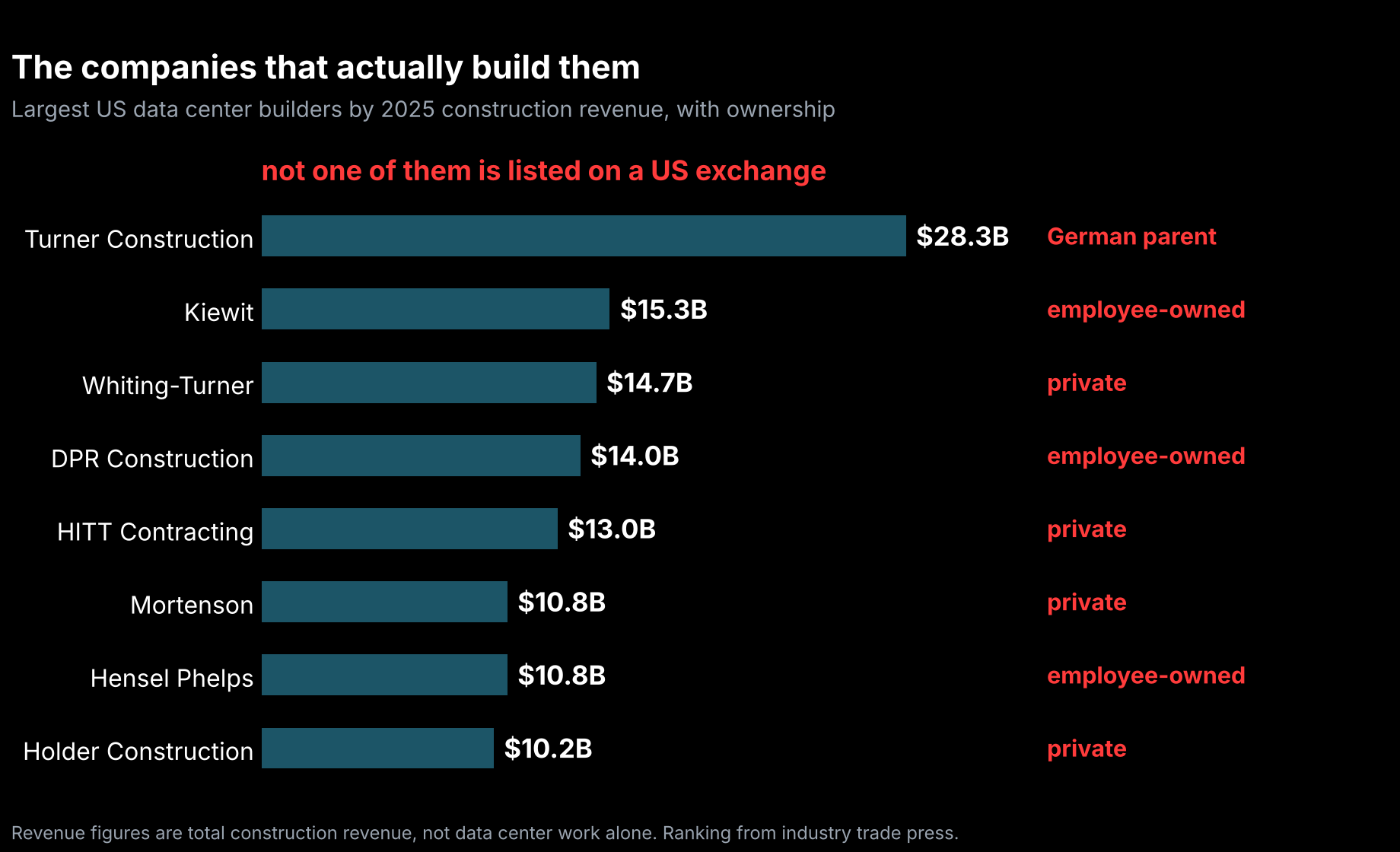
There is no listed pure-play data center general contractor. The people physically putting up these buildings are, almost without exception, not available to public investors.
What is available is the layer just beneath them, and it needs a definition first, because the distinction is the whole reason this section works.
The companies above are general contractors. A general contractor runs the job. It holds the contract with the owner, schedules the work, and carries the risk that the building gets finished. Underneath it sit the specialty trades, which are the firms the general contractor hires to do the specific physical work. The electricians who wire the building. The mechanical contractors who install the cooling. The site-development firms that clear and grade the ground and lay the power infrastructure before anything goes up.
So the general contractors are mostly closed to outside investors. The trades they hire are not. And unlike the builders, several of these disclose their exposure clearly.
Comfort Systems now books 59% of its revenue from technology work, with a backlog that nearly doubled in a year and now stretches 18 to 24 months out, against a historical norm of about nine. EMCOR's management put the economics plainly: an AI data center generates roughly one and a half to two times the mechanical work of a conventional building, and project sizes have gone from about 20 megawatts in 2019 to 100 or 200 megawatts and beyond. Sterling Infrastructure reports that mission-critical work is 92% of its site-development backlog.
What this does not tell you
It does not tell you these are good investments. Nothing here is a view on price. A company can have an enormous backlog and still be a poor holding if the market already decided that years ago, which is a thing that happens constantly.
It does not tell you the chain stays strong. There is a real bear case inside the same disclosures. One mechanical contractor says competition for skilled labour and materials in data center markets is actively compressing its margins. Another large contractor's chief executive said on the record that data center work "at some point in time probably won't be there, at least not as strong as it is now." One of the largest engineering firms in the country is deliberately stepping back from building data centers, saying power is the better business. And a major steel supplier told investors that data centers are under 10% of its joist and deck business and the share has levelled off, which is a useful corrective to a lot of loose talk.
It does not tell you the link to Anthropic specifically. This is the important one. The four counterparties are named in the filing. The landlords disclosed their own leases. Everything below that is the industry chain, not Anthropic's chain. Nobody has disclosed which transformer maker supplies which campus, and claiming otherwise would be inventing it.
And a backlog is not revenue. It is a promise to do work. Promises get renegotiated, delayed and cancelled, and a large share of announced American capacity has never broken ground, as the Ohio numbers above show.
What this does give you is a way to think about any spending announcement, in any industry. A very large number gets reported as though it lands in one place. It never does. It travels through a chain of companies, each taking a slice, each with a different exposure to whether the thing actually gets built. Working out who is in that chain and how much of their business depends on it is most of the work.
That is the same problem a valuation has to solve. Techdamentals runs four separate methods and shows the full range rather than a single figure, because the width of that range tells you how much of a company's value rests on things that have not happened yet.