In July, Amazon told investors it would spend about $200 billion on capital projects this year.
Three months later it raised that to $220 billion. Andy Jassy gave the reason in a single clause on the earnings call: "The higher cost of memory pushing this number up from our prior estimate of about $200 billion."
One component. Twenty billion dollars.
We have written before about where this spending lands. This is about the one input that decides how much of it there has to be.
This morning the company on the other side of that sentence reported its quarter. SK hynix made an operating profit of 83.3 trillion won, up 632% on a year earlier, on an operating margin of 80%.
Eighty percent. For every dollar of revenue, eighty cents was operating profit. That does not happen in manufacturing.
First, what the part actually is
The component is called high bandwidth memory, usually shortened to HBM, and the reason it exists is a mismatch.
An AI chip can process data far faster than ordinary memory can hand it over. The limit is physical. Standard computer memory talks to a processor over a channel 64 bits wide, and each of those bits needs its own physical wire. You cannot simply widen the road, because wires take up space along the edge of the chip package and burn power travelling any distance.
HBM solves it by going upwards instead of sideways. Memory chips are stacked vertically, up to sixteen of them, and placed millimetres from the processor on a shared slab of silicon. Because the connection runs straight down through the stack rather than out across a board, you can run far more wires in parallel.
How many more. The current standard specifies an interface 2,048 bits wide per stack, against 64 for a conventional channel. That is thirty-two times the width, and it delivers up to two terabytes of data per second from a single cube.
The wires that make it work are called through-silicon vias: thousands of copper columns drilled vertically through each chip so signals pass down the stack instead of out to the side.
Why they cannot simply make more
This is the part that explains the price, and it is physics rather than economics.
There is a height limit, and it is not negotiable. The industry standard caps an HBM package at 775 micrometres thick. That number is not arbitrary. It is the thickness of the processor wafer sitting next to it. Data centers cool these chips by clamping a cold plate across the top of the whole assembly, so if the memory cube stands taller than the processor, the cooling plate no longer touches both. An engineer at SK hynix put it plainly at a conference this August: that is the limit they can go up to, because the logic wafer is also 775 micrometres.
So more layers means thinner layers. Twelve-high stacks are in production. Sixteen-high stacks, which hold 48 gigabytes, are in customer testing with each memory die ground down to about 50 micrometres, and the gaps between them half what they were. For scale, a human hair is roughly 70 micrometres across. They are stacking sixteen sheets of silicon thinner than a hair and filling the gaps between them without the whole thing warping.
And heat compounds as they do it. Thinning the silicon means proportionally more insulating oxide in the stack, and oxide conducts heat poorly. Pin speeds have risen eightfold across the generations while stack heights double every two. SK hynix puts the thermal burden at roughly 2.2 times higher across the span.
There is a fix in development, called hybrid bonding, which eliminates the tiny solder bumps between layers entirely. It is at research stage for the twenty-layer stacks it is needed for, and the earliest credible production estimates are around 2029 to 2030.
Then there is the part nobody mentions. HBM is made in the same factories, on the same silicon wafers, as the ordinary memory in your laptop. Every additional HBM chip therefore subtracts from the supply of normal memory. And it is far hungrier: estimates put HBM at roughly three to four times the production capacity per unit of output compared with conventional memory, depending on how you measure it.
So the shortage is not confined to AI parts. Making more of the costly thing actively makes less of the ordinary thing.
Finally, a finished chip is not the end. The stacked memory does not become an HBM device until a separate advanced packaging step assembles it. A memory factory can run flat out and still produce nothing usable if the packaging capacity is not there, and packaging is its own constraint with its own waiting list.
Amazon said it. The other three did not.
Worth pausing on how unusual that sentence from Jassy was.
Four companies dominate this spending. Alphabet raised its capital guidance this year from $180 to $190 billion up to $195 to $205 billion, and attributed it to accelerating the delivery of capacity rather than to components. Meta narrowed its range rather than raising it. Microsoft gave a quarterly figure above $50 billion without naming a cause.
Only Amazon named memory. That makes the $20 billion a finding rather than an industry trend, and it is exactly the detail that gets flattened when a story becomes "AI spending is rising." One company told you which input moved, and it happens to be the one that cannot be manufactured faster.
A caveat with a short shelf life: Microsoft and Alphabet report within hours of this going out, and either could say something similar.
What that did to prices
The memory industry does not publish a price. Contracts are negotiated privately, and the two firms that track them license their data by subscription. So there is no public index anyone can audit, which is worth knowing before you read any figure about memory prices, including ours.
What does get published are quarterly estimates, and the shape they describe is dramatic.
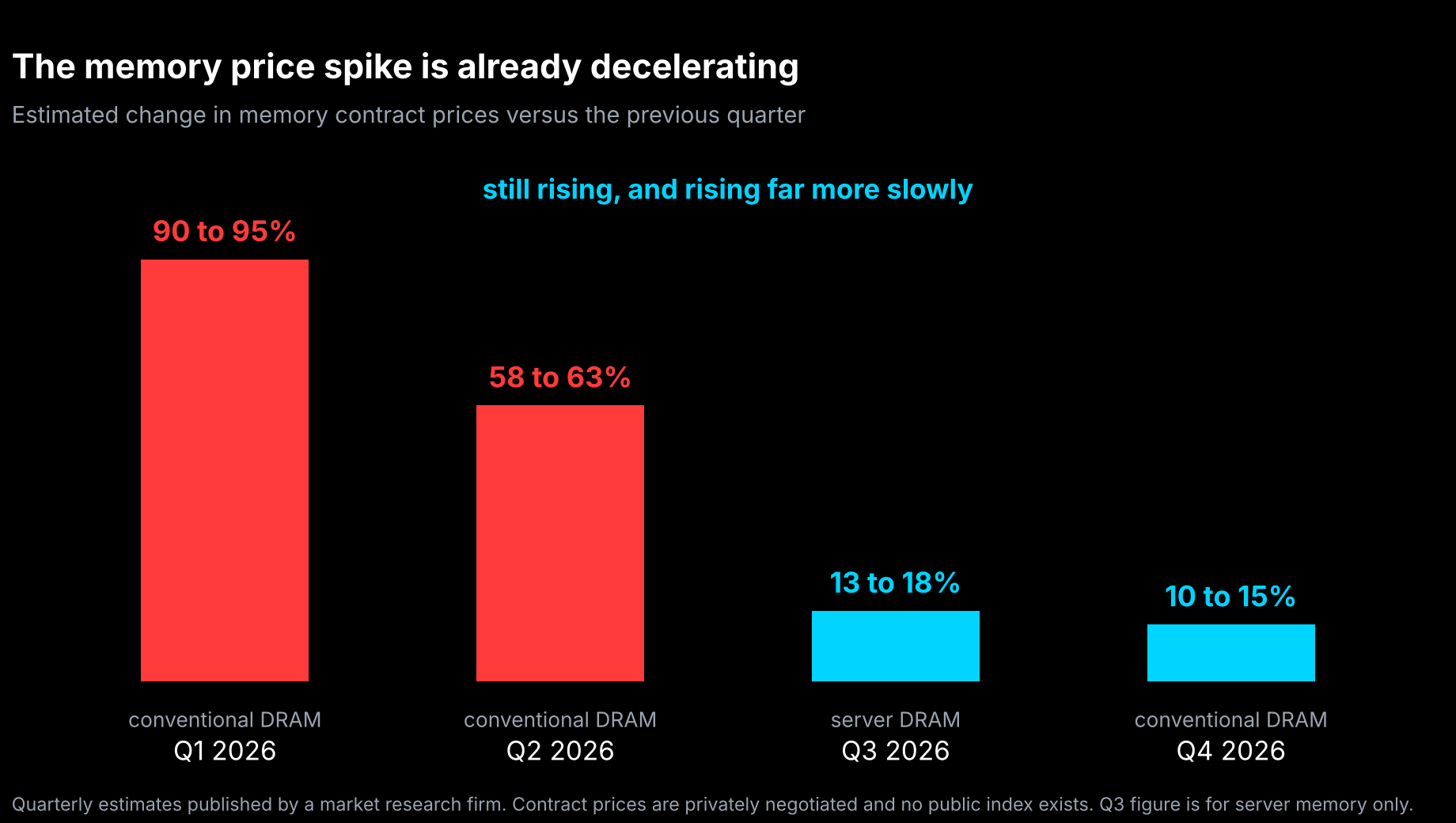
In the first quarter of this year, conventional memory contract prices rose an estimated 90 to 95% in three months. Memory for personal computers rose over 100%, described by the firm tracking it as a record for a quarterly increase. The second quarter added another 58 to 63%.
Then look at what happened next. Server memory in the third quarter: up 13 to 18%. The fourth quarter forecast: up 10 to 15%.
Still rising. Rising far more slowly. That deceleration is the most important thing in the price series and almost nobody is reporting it.
Micron's own disclosed figures tell the same story from the inside. Its memory prices rose in the low-60% range in one quarter earlier this year, then in the "high-teens percentage range" in the quarter ended September. Its finance chief told investors to expect "a more moderate rate of price increases" ahead.
And this does not stay inside data centers. Memory's share of the parts cost in a television has gone from roughly 2.5 to 3% up to 6 to 7%. One tracking firm cut its 2026 notebook shipment forecast from a 5.4% decline to a 9.4% decline, because manufacturers are facing a component they cannot source at the price they planned for. Micron's chief executive flagged the possibility of double-digit unit declines in both personal computers and phones.
So the same squeeze that added $20 billion to one company's construction budget is also making the laptop you were thinking about dearer, and there is nothing AI-specific about that half of it.
The part where everyone is sold out
Here is what the suppliers say about the next three years.
SK hynix's chief executive said this morning that between signed long-term agreements and volumes still under negotiation, its memory and HBM are effectively sold out through 2029. It has agreements with 14 major customers, covering more than half its total production capacity for 2027 and 2028.
Its head of HBM gave the shortage a number: customer requests for HBM volume are more than double what the company can supply.
Micron said in September that it has completed agreements for the vast majority of its 2027 HBM supply, that it holds $32 billion of customer financial commitments, the vast majority as cash deposits, and that 26 strategic customer agreements cover an estimated more than 35% of its revenue through 2030.
Two things to be careful about with the phrase "sold out."
First, it means volume is committed, not that revenue is banked. Both companies describe pricing mechanisms inside those contracts, floors and ceilings in Micron's case, an agreed range in SK hynix's. A sold-out year is not a fixed-price year in either direction.
Second, a signed contract is a promise from a customer who may themselves be guessing. Which brings us to the part of this story that history keeps repeating.
What this does not tell you
It does not tell you this lasts. Memory is the most violently cyclical business in semiconductors, and the record is not ambiguous.
In 2008, memory spot prices fell by nearly half over twelve months and the industry collectively lost $7 billion. Qimonda went bankrupt in 2009. In 2011, a common memory part lost about 85% of its price. Elpida went bankrupt in 2012.
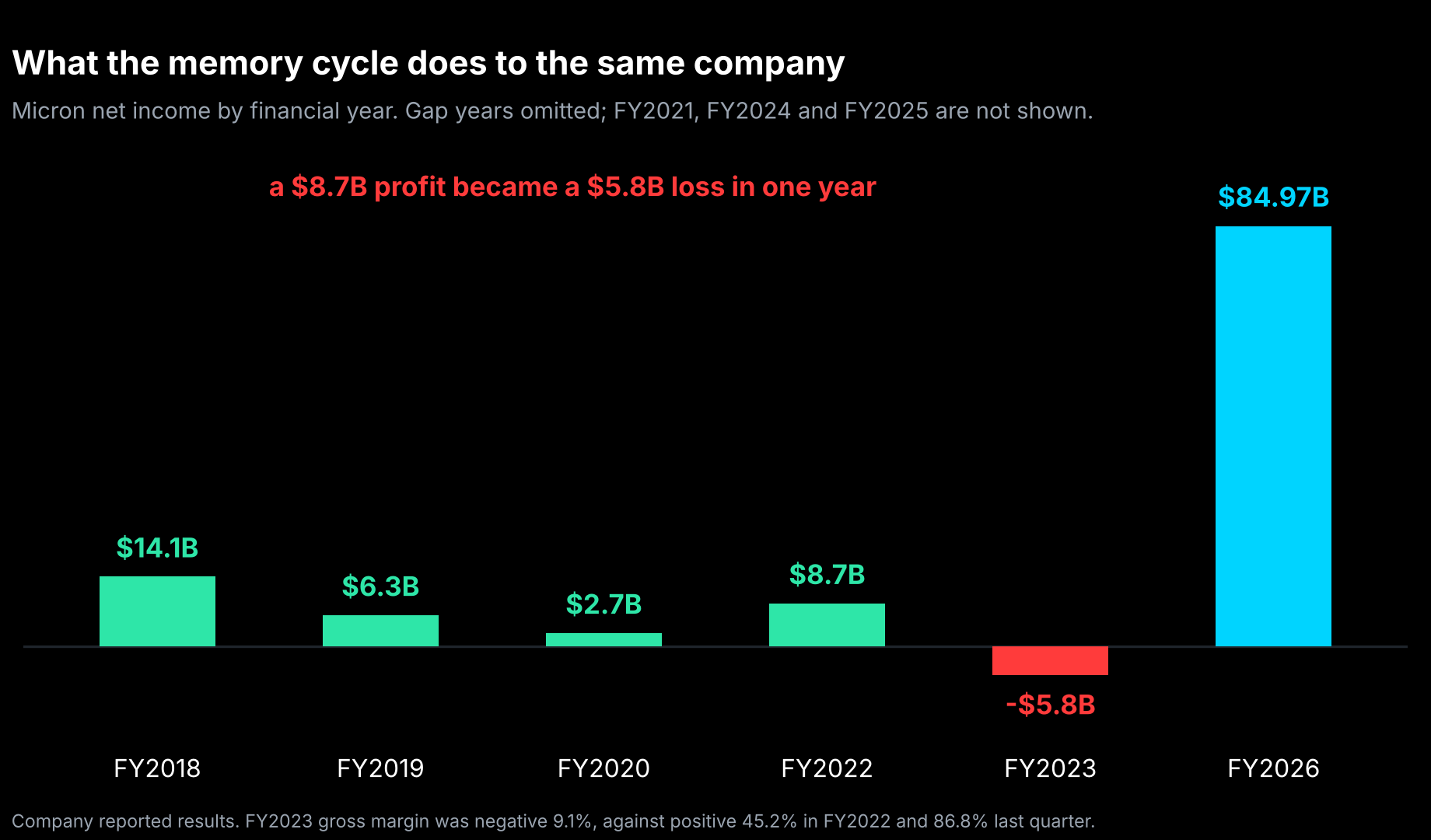
The most recent one is the one to sit with, because it is the same company reporting today's numbers. Micron earned $8.7 billion in its 2022 financial year at a 45.2% gross margin. The following year it lost $5.8 billion, revenue fell 49%, and its gross margin went from positive 45.2% to negative 9.1%.
One year. A fifty-four point swing in margin.
Micron's gross margin last quarter was 86.8%.
It does not tell you the orders are all real. The three large memory makers have reportedly started requiring customers to disclose their own end customers and order volumes, specifically to stop customers inflating orders to secure allocation. The fact that an industry built a process to detect over-ordering is itself the evidence that over-ordering is happening.
It does not tell you the supply arrives soon. SK hynix has committed about 54 trillion won to two new sites. The DRAM facility at Yongin breaks ground in July 2027 and its first cleanroom opens in June 2029. The flash facility at Cheongju opens its first cleanroom in December 2028. Micron's new Boise fab expects first wafers in the second half of 2027. A memory factory costs $15 to $20 billion and takes two to three years, minimum.
And the chief executive of SK hynix said the quiet part out loud this morning: "more investment or more fabs does not necessarily mean more supply."
It does not tell you which way the reversal runs. This is the mechanism that should worry anyone extrapolating. Because HBM consumes three to four times the capacity of ordinary memory per unit, the shortage is severe. But run it backwards. If HBM demand softens and that capacity gets reallocated to conventional memory, it releases a disproportionate flood of supply. The same ratio that makes the squeeze tight makes the glut enormous.
And it does not tell you anyone is predicting a downturn. None of the three large memory makers has forecast one. All three guide to continued shortage. The case against is history and arithmetic, not company guidance, and you should weigh it accordingly.
One more data point, which is the most honest thing in this piece. SK hynix shares fell 18.8% in the eight weeks before this morning, into what turned out to be a record quarter. The market was already pricing the cycle before the results landed.
What this does give you is a way to read any shortage story. The useful questions are not how high the price went. They are what physically limits the supply, when new supply actually arrives, and what happens to the price when it does. Here the answers are a 775 micrometre height limit, June 2029, and nobody knows.
That last one is the problem a valuation has to solve. Techdamentals runs four separate methods and shows the full range rather than a single number, because for a business whose margin swung fifty-four points in a year, the width of that range is the only honest answer.