On Monday, Microsoft offered about 60,000 employees a voluntary way out of the company. That is roughly 27% of its global workforce.
Two days later, today, it reports a quarter in which it expects to have spent over $50 billion on capital projects in three months, the largest such figure in its history.
We have written this week about where that capital spending goes. This is about where the money supposedly comes from.
Every headline you have read this week put those two facts in one sentence. So will this one. The difference is that this piece is going to tell you what Microsoft actually said, which is that they are not connected, and then show you why that denial is harder to dismiss than it sounds.
What was actually announced
The program is called the Voluntary Exit Offer. It was published on Monday, October 26, on Microsoft's own blog, under the name of Amy Coleman, its chief people officer. It is a company announcement, not a leaked memo.
Eligible employees are at internal level 70 and below, which runs up to roughly vice president, in four countries: Canada, India, the United Kingdom and the United States. Not every division is taking part. In Microsoft's words, "some organizations are providing the Voluntary Exit Offer, and some are not," and participation "varies based on each business's priorities, customer commitments and workforce needs."
That last detail explains where 60,000 comes from, and it is worth being precise because most coverage is not. It is not a plan or a goal. Each organisation's leader decided whether to take part. The 60,000 is the resulting headcount of everyone at level 70 and below inside the divisions that opted in. Microsoft has set no target number and says it expects a lower acceptance rate than its previous programme.
What is in the package is almost entirely undisclosed. Microsoft's public description is "financial support and career planning resources." A spokesperson said it is comparable to standard severance, which varies by market. Specific terms circulating in press reports are not from Microsoft and should be treated accordingly.
Employees have until early December to decide. Those who accept leave at the end of the year.
What Microsoft said the reason was
Here is the thing almost nobody has reported. The announcement does not mention artificial intelligence. It does not mention capital spending. It does not mention data centers. It does not use the word layoffs.
The stated reason is twofold. It gives employees who may already be considering leaving a supported way to do it now, and it gives participating organisations "another way to adapt their workforce to changing needs."
Asked directly whether "changing needs" meant AI, Microsoft told one publication that it does not. A spokesperson separately told public radio reporters that AI is not driving the programmes. And when Microsoft cut roles in July, Coleman wrote that the eliminated positions were "not being replaced by AI."
That is three separate denials, on the record, from the company.
No Microsoft executive has publicly linked the exit offers to AI, to capital spending, or to funding data centers. Not in the announcement, not on an earnings call, not to any reporter I could find.
So where is the link coming from
From the coverage. And this is the useful part of the story, because it is a clean example of something that happens constantly and is almost invisible once you know to look for it.
Read this week's headlines closely and the AI connection is always in the headline, the framing sentence, or the context paragraph. It is never in a quotation. One outlet frames it as an AI-led efficiency push. Another describes a tension between operating costs and heavy AI investment. A third says all fingers point to data centers and that the money has to come from somewhere. A fourth sets the offer against the capital spending figure.
Every one of those is the publication talking, not the company.
None of them is dishonest. Setting two true facts beside each other is what journalism does. But a reader finishes the paragraph believing a causal claim that nobody made and nobody has demonstrated, and that belief arrived without a single false sentence being written.
That is the mechanism worth taking away from this piece, and it works on any story.
The case against the AI explanation
Now the part that makes the denial credible rather than just corporate. There are four pieces of evidence, and the first one is the strongest.
The chief financial officer said it six months ago. On the April earnings call, Amy Hood told investors: "we expect headcount will decrease year-over-year." That was before this offer existed, in a setting where executives are legally careful, and the reason given was working with more pace and agility. Microsoft told its investors headcount was coming down half a year before it told its employees.
The hiring it is undoing happened in 2022. Microsoft added about 40,000 people in a single financial year, going from 181,000 to 221,000. Headcount then sat flat for two years and has since fallen to about 223,000 from 228,000. Over that same stretch revenue roughly doubled. Revenue per employee went from about $959,000 to about $1.49 million. You can call that an AI story if you want, but it is equally a story about a company that hired for a pandemic that ended.
The divisions tell on themselves. Microsoft has guided that Windows and devices revenue will decline in the high teens this financial year. Its Xbox business is losing about 3,200 roles, roughly a fifth of the division, with studios sold and spun off. Those are shrinking businesses being resized. Neither has anything to do with data centers.
And the ones excluded are the wrong ones. Data center teams are reportedly among the divisions not participating, which is the opposite of what you would expect if the point were to move money from people into buildings.
The three capital spending numbers, which are not the same number
This is where the reporting genuinely goes wrong, and it is worth untangling because these figures appear in every AI story now.
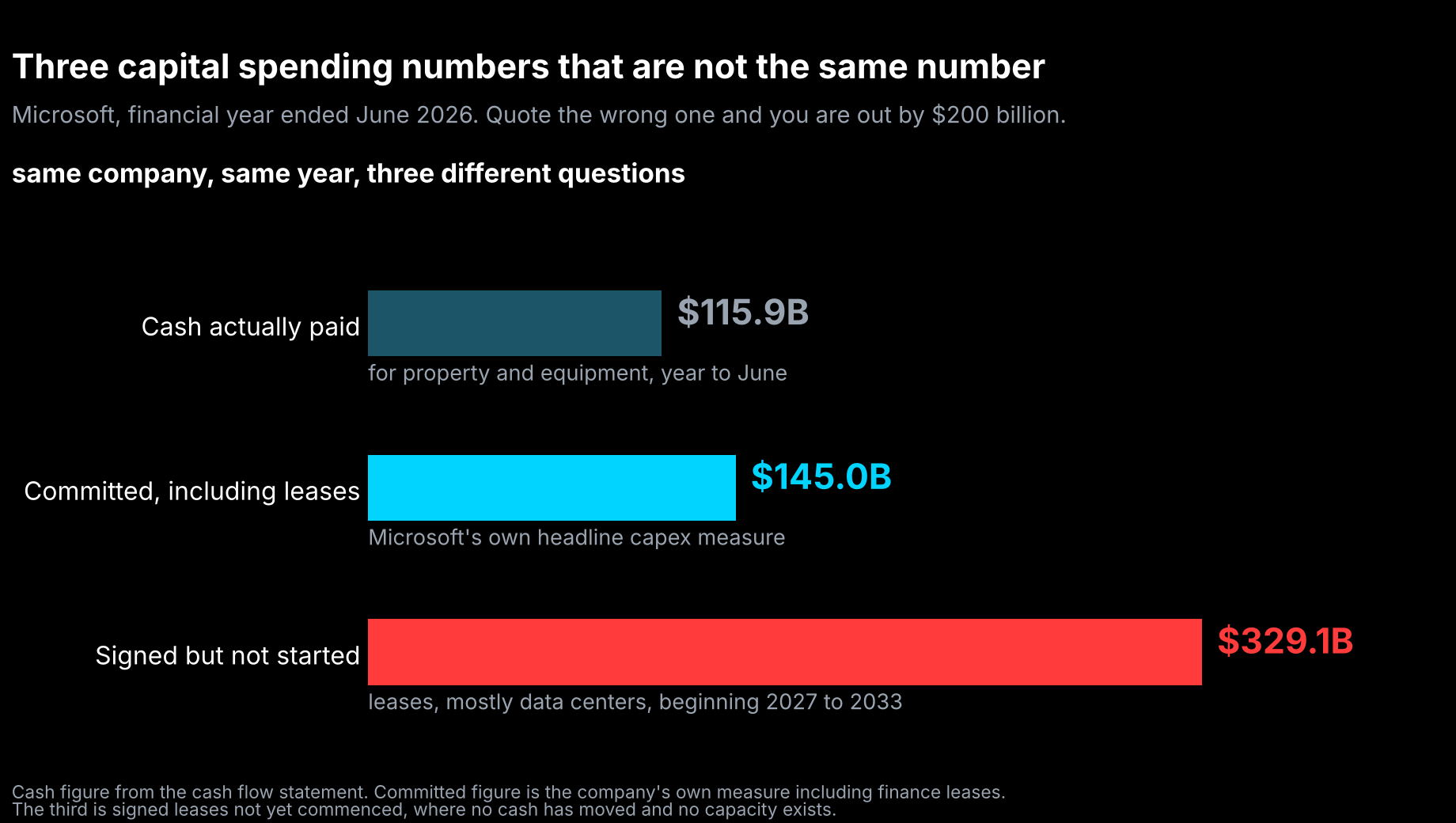
$115.9 billion is what Microsoft actually paid in cash for property and equipment in the year to June. It comes from the cash flow statement. It excludes leases entirely.
About $145 billion is Microsoft's own headline capital spending measure for the same year, which adds finance leases and counts commitments as they are incurred rather than when the cash leaves. The roughly $30 billion gap is mostly leases plus about $20 billion of equipment Microsoft had committed to but not yet paid for.
$329.1 billion is something else entirely, and it is the most misread number in this entire subject. It is the value of leases Microsoft has signed, primarily for data centers, that have not yet commenced. Nothing is on the balance sheet. No cash has moved. No capacity exists. They begin between 2027 and 2033.
Three numbers, one company, one year, and they measure the money paid, the money committed, and the money promised for buildings that do not exist yet. Quote the wrong one and you are out by $200 billion.
One more trap. Microsoft's calendar 2026 capital spending expectation moved from roughly $190 billion down to about $175 billion, and several outlets reported that as a spending cut. It is not. Microsoft extended the assumed useful life of its data centers from 15 years to 25, which changes how future leases are classified, and finance leases count inside the capex measure while operating leases do not. Hood said explicitly that underlying investment plans are unchanged. The number moved. The spending did not.
What the wider numbers say
If AI capital spending were quietly being funded by payroll across the industry, you would expect to see it in the layoff data. What you actually see is two things pointing opposite ways.
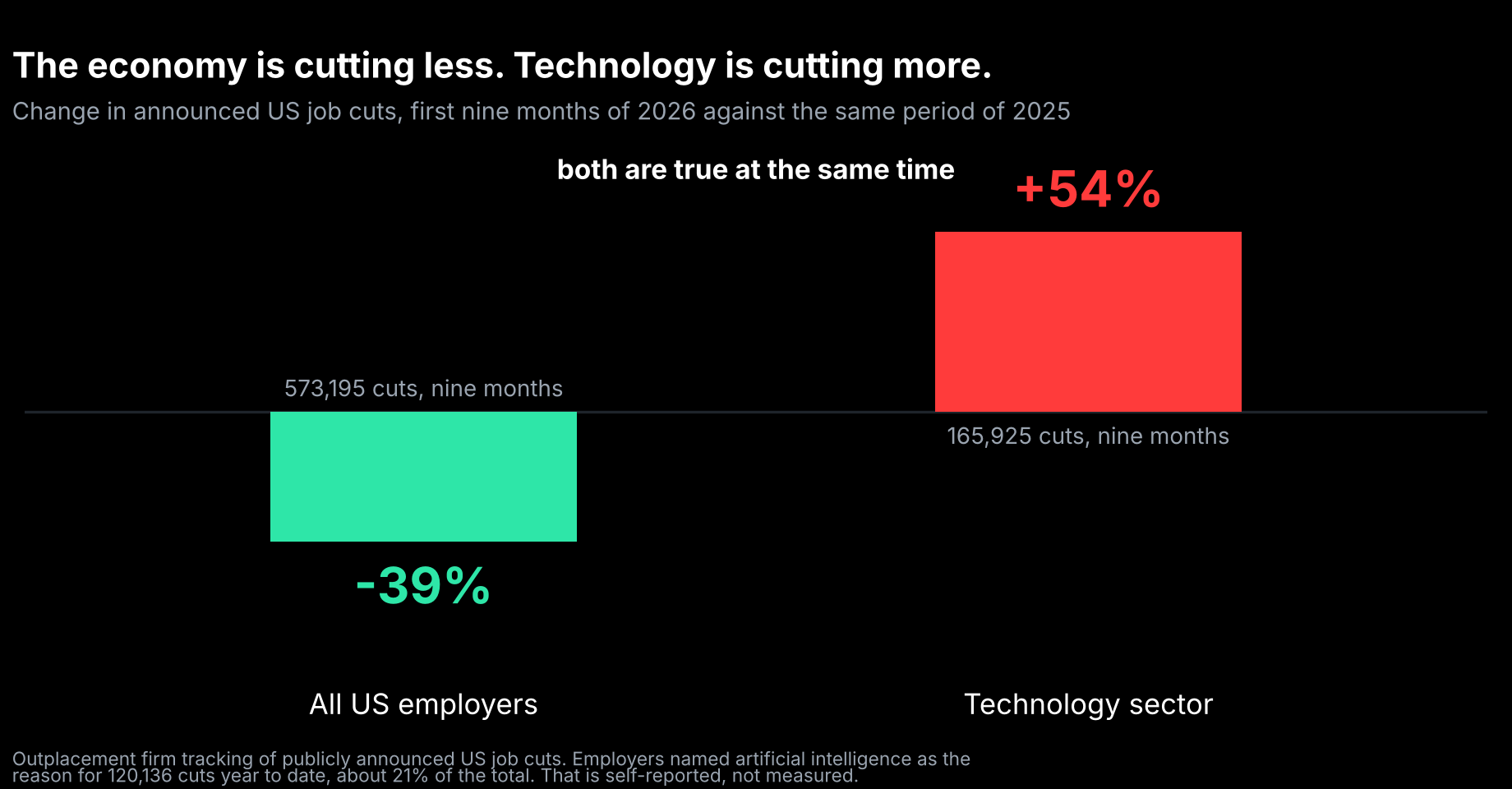
Announced job cuts across the whole US economy in the first nine months of this year came to 573,195, which is down 39% on the same period last year. There is no economy-wide wave.
But technology sector cuts over the same period were 165,925, up 54%, the largest of any sector. And artificial intelligence is now the single most cited reason employers give, at 120,136 cuts year to date, about 21% of the total.
Both of those are true at once. The economy is cutting less. Technology is cutting more. And employers are increasingly naming AI when they do it.
One important limit on that last figure: it records the reason the employer stated. It is self-reported, not measured. Nobody has produced an estimate isolating AI capital spending as a cause of job reductions, and I could not find an economist who claims to have done it.
One thing changes tonight that nobody is previewing
Separately from all of this, the way Microsoft reports itself changes with today's results, and it affects what anyone can see from the outside.
It is moving from three reporting segments to two. One holds the cloud, productivity and business software. The other holds Windows, Xbox and search advertising. On a restated basis the first was about 81% of revenue last year and 88% of operating profit.
More usefully, Microsoft will now report its cloud revenue every quarter rather than annually, and it has redefined what goes into that figure, moving some businesses out and a healthcare unit into a new industry grouping.
Both halves of that matter. More frequent reporting means more visibility. A redefinition in the same quarter means the growth rate you read is not comparable to the one you remember, and for a while almost nobody quoting it will say which definition they used. When a company changes a measure and its frequency at the same time, the first few quarters of commentary are worth discounting.
What this does not tell you
It does not tell you Microsoft is not reducing headcount. It plainly is, and has said so. Four separate reduction actions in eighteen months, two voluntary programmes in one calendar year, and a CFO who guided to lower headcount in April. The question is only whether data center spending is the reason, and on that nobody has evidence.
It does not tell you how many people will leave. Microsoft's previous voluntary programme in April had 8,750 eligible and saw just over 30% accept, roughly 2,600 people. That package included up to five years of continued healthcare. The new one reportedly does not, and Microsoft expects lower uptake. Published scenarios range from about 2,000 to about 18,000 departures. That range is wide enough that any single figure you see is somebody's guess.
It does not tell you what it costs. Microsoft has disclosed nothing. The April programme was guided at roughly $900 million. A detail worth knowing for tonight's results: under the accounting rules, the cost of a voluntary programme is recorded when employees irrevocably accept, not when it is announced. Since the decision window runs into December, the charge lands in the quarter ending then, reported in January. Expecting it in tonight's numbers would be a mistake.
And it does not tell you declining is safe. It also does not tell you it is risky. No source reports any stated consequence either way, though plenty of headlines imply one. That is the same inference problem as the AI link, one layer down.
What this does give you is a test to run on any story built from two facts. Ask which sentence contains the causal claim, and then ask who said it. If the answer is that the two facts appear in the same paragraph and the connection appears only in the headline, you have been handed a juxtaposition and read it as an explanation.
That distinction is the entire difference between information and analysis. Techdamentals runs four separate valuation methods and shows the full range rather than one number, for the same reason: showing the workings is what lets somebody disagree with you.