About 200,000 people have now connected an artificial intelligence agent to a Robinhood account that can place real trades with real money. Those accounts have done over $1.6 billion of trading volume.
Robinhood disclosed both figures in its results this week. It also has a document, revised on October 1, that tells you exactly where you stand if one of those agents does something you did not intend.
It is worth reading, because almost nobody has.
We write often about what companies disclose versus what gets reported about them. This is a clean example, because the disclosure is public, specific, and says something quite different from the headlines.
What the customer agreement actually says
This is Robinhood's own language, from Section 29 of its customer agreement:
"You acknowledge that AI agents may misinterpret your prompts, generate erroneous, fabricated, or unintended outputs."
And then the part that matters:
"Robinhood shall have no liability for any Losses arising out of or relating to any such error."
Instructions sent by an agent are "final and binding upon you upon receipt by Robinhood." Revoking an agent's access does not unwind orders it has already placed, and Robinhood has no obligation to cancel or reverse them. Orders placed by an agent can create or increase a margin debit, and the margin rules apply "regardless of the agent's settings."
There is one more line that does a lot of work. Section 2.3: "Your Account remains self-directed if you authorize an AI agent to place orders in it."
Self-directed is a legal category, not a description. It means you are making your own decisions and nobody is advising you. Attach an agent and, as far as the paperwork is concerned, you are still the one deciding. Section 2.4 adds that an agent's output "is not investment advice or a recommendation by Robinhood."
So the agent is you. Everything it does is your decision, made by you, binding on you.
Three products, three different levels of control
Press coverage of this has blurred three separate things into one scary sentence. They are not the same, and the differences are where the actual risk sits.
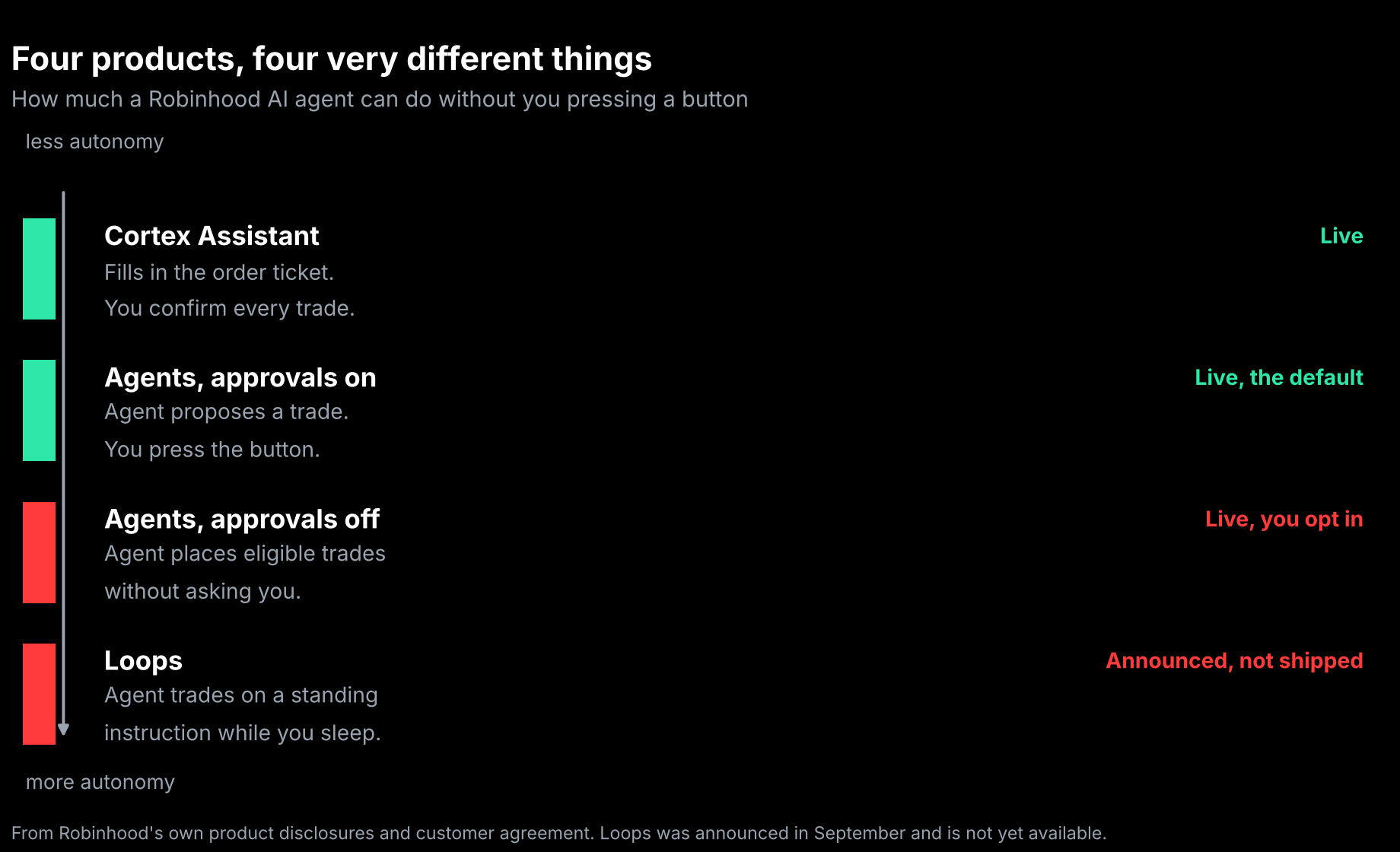
Cortex Assistant is a chat tool for subscribers. It can fill in an order ticket for you, but "no transaction will be executed without your explicit confirmation on the final order confirmation screen." It cannot trade on its own. It cannot place options orders at all.
Agentic Trading, launched in May, lets you connect an outside AI tool to a dedicated Robinhood account. It gets read access to your positions, balances and history, and it can place orders. Supported tools include the well-known assistants from the major AI companies. The account is separate from your main one, and you decide how much money goes into it.
Robinhood Agents, announced in September, is the same idea built into the app. Here is the control that matters: trade approvals are on by default. With approvals on, "your agent cannot place an order until you approve it." The agent proposes. You press the button.
You can turn approvals off. Then the agent places eligible trades without asking.
And there is a fourth thing coming, called Loops, which Robinhood has announced but not shipped. A Loop turns a strategy into a standing instruction the agent repeats continuously. Robinhood's own description says a Loop "may place, modify, or cancel trades in your account automatically, without prompting you for approval on each transaction," and can run "while you're asleep, away from your device, or otherwise not monitoring the market."
Turning a Loop off does not reverse orders it already placed.
The number nobody has published
Robinhood told investors how many agentic accounts exist. It did not tell anyone how many customers have switched trade approvals off.
That is the single figure that separates a research assistant from an autonomous trader operating an account unsupervised, and it is not disclosed. Until it is, the 200,000 figure tells you how many people opened the door, not how many walked through it.
Why a company writes down what could go wrong
A short detour, because this is the part most readers have never had explained.
Public companies are required to publish what could go wrong with their business. The rule is called Item 105, and it asks for the material factors that make an investment risky. Those passages are the risk factors, and they are usually the least-read section of any filing.
There are two reasons a company writes them carefully rather than vaguely. The first is that the rule requires it. The second is self-protection. Under a 1995 law, forward-looking statements accompanied by meaningful cautionary language get legal protection, and a related principle in the courts lets a company argue that a risk it disclosed cannot later be the basis of a claim that investors were misled.
Put plainly: writing down what could go wrong is low-cost insurance against being sued for not having said so.
There is a timing wrinkle worth knowing. An annual report carries the full list. A quarterly filing only has to report material changes to it. So when AI language appears in a quarterly filing that was not in the annual one, the company itself has decided the change is material. That is a signal, and it is free to read.
This is also no longer unusual. One study found the share of large US companies disclosing artificial intelligence as a risk rose from 12% in 2023 to 83% in 2025. A committee advising the securities regulator recommended last December that the agency require companies to disclose how they are deploying AI and who on the board oversees it. That recommendation has not become a rule.
Who is actually responsible
Here is where it gets genuinely unresolved, and this is the part that will matter long after this week.
Robinhood's position is that it does not supervise the agent. Its own language: Robinhood "does not control, supervise, monitor, recommend, or audit agents." The agent is a third-party tool you chose, running a model you selected, following instructions you wrote.
The AI companies that build those models are not broker-dealers and are not registered with securities regulators. They have no obligation to anyone's account.
And you, the customer, have signed a document saying the output may be erroneous or unintended and that the resulting losses are yours.
Follow that around the triangle and nobody is supervising the trading.
One thing readers should not assume will help. The Securities Investor Protection Corporation, which most people vaguely believe insures brokerage accounts, covers missing assets when a broker fails. It does not cover losses caused by an investment falling in value. An agent making a poor trade is not a failure of the broker. It is a trade.
What the regulators have said, which is not much
In June, eight members of Congress wrote to the chairman of the Securities and Exchange Commission about exactly this. The letter names no company. It asks 13 questions, including whether the agency has given any approval or guidance, what guardrails it requires, what liability the AI developers carry, and whether a third-party agent changes a broker's own obligations under securities law.
It also raises something larger than any individual account: if many retail agents run similar models on similar instructions, you get "correlated trading decisions" and "herding behaviour." Thousands of accounts reacting the same way to the same news within the same second is not the same market as thousands of people making up their own minds slowly.
The letter requested written responses by July 31. I could find no public response from the agency.
The industry regulator, FINRA, addressed AI agents in its annual oversight report last December. It flagged autonomy beyond approved scope, weak auditability of multi-step agent actions, and general-purpose agents lacking the domain knowledge for financial tasks. But read who that guidance is aimed at. It addresses firms deploying their own AI agents. It was not written for a firm whose customers connect agents the firm did not build and does not monitor.
That gap is the story. There is no rule. There is a technology-neutral report pointed at the wrong party, thirteen unanswered questions, and a proposed rule on AI conflicts that the agency withdrew in 2025.
The likeliest way this gets settled is not a regulation. It is the first customer who loses money and files an arbitration claim arguing that Section 29 should not hold. Nobody knows how that goes, because it has not happened yet.
Everyone else is doing it too, with different guardrails
Robinhood is not alone, and the comparison is more flattering to it than you might expect.
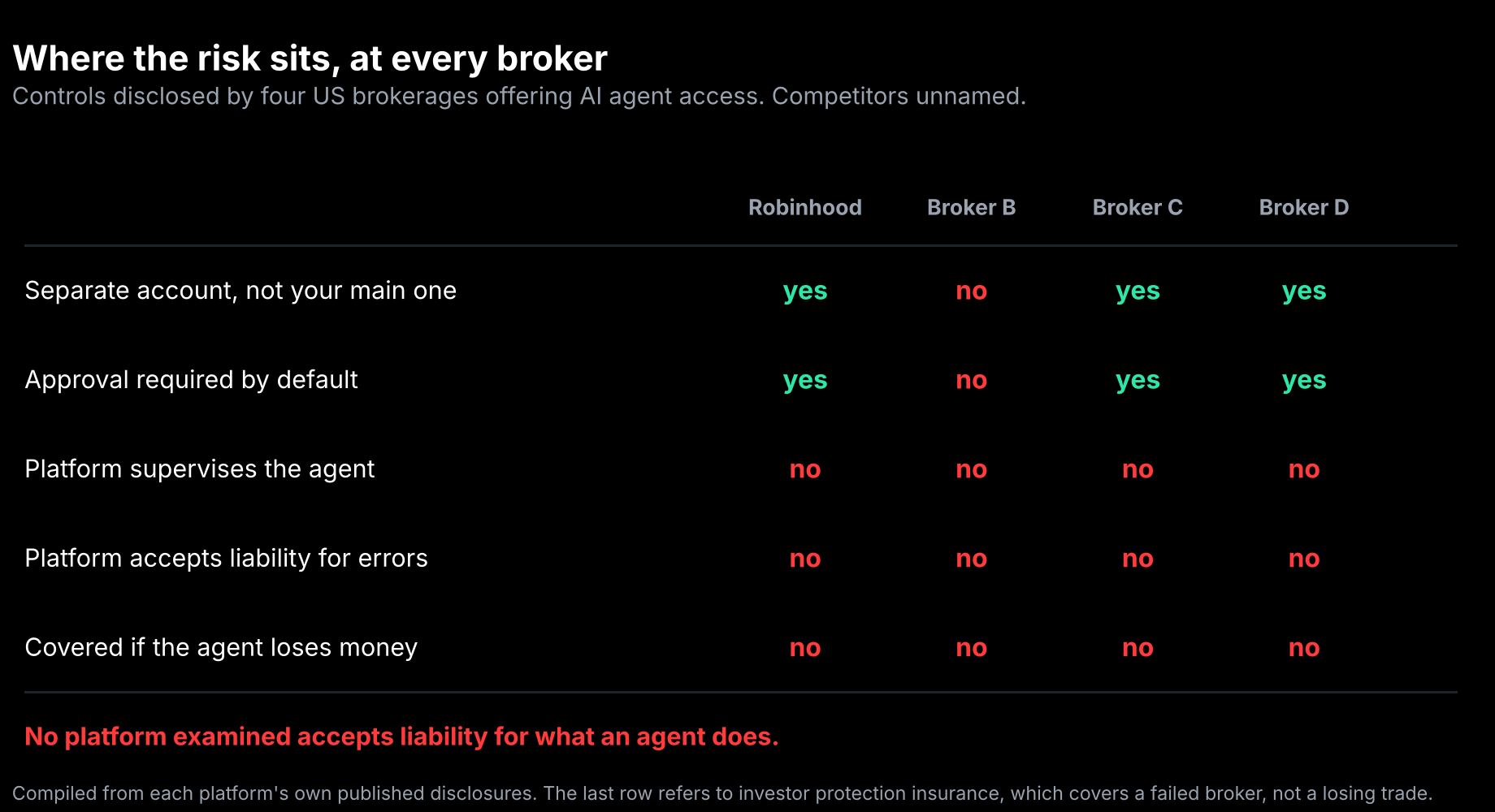
Several competitors offer agent access. One connects agents to the primary account rather than a separate one, with no sandbox described anywhere in its disclosures. Another requires that the customer approve each agent before it goes live. A large professional brokerage allows an AI assistant to draft trade instructions but requires the client to review and approve every one through a dedicated interface, with no autonomous execution at all.
What they share is the liability position. Across every platform examined in one review, the customer bears the risk of agent error. The language differs. The outcome does not.
What this does not tell you
It does not tell you this is why the stock fell. Robinhood dropped about 8% this week and the press connected the two. The sequence does not support it. The results and the filing landed Tuesday after the close, the shares fell roughly 7.4% in after-hours trading that evening, and the AI framing appeared in the press the following morning, after the move had already happened. Reuters attributed the fall entirely to a slowdown in crypto trading. No analyst note cited the AI disclosure. Nobody asked about it on the earnings call.
What analysts actually named was crypto revenue down 55%, operating expenses up 16%, October trading volumes below expectation, and the take rate.
It does not tell you the profit was weak, either. Reported earnings of $0.51 per share missed the $0.55 expected. Adjusted earnings of $0.60 beat it. About $0.07 of that gap is a mark-to-market loss on an investment fund, not the trading business. Revenue was a record $1.42 billion, up 12%.
It does not tell you an agent has lost anyone money. I could not find a single documented case of an AI agent making an erroneous trade in a retail brokerage account. The risk is real, disclosed and unresolved. The incident is hypothetical so far.
And it does not tell you the agreement holds. Section 29 is Robinhood's position, not a court's. Whether a customer who authorised an agent in general terms can be bound by a specific trade they never saw is an open question that no regulator has answered and no arbitrator has tested.
What this does give you is a question to ask of any product that acts on your behalf. Not what can it do. Who is responsible when it does the wrong thing, and what have you already agreed to. The answer is usually in a document revised quietly, four weeks before anybody notices.
That habit of reading what is actually disclosed rather than what is reported is the whole method. Techdamentals runs four separate valuation methods and shows the full range rather than a single number, for the same reason: a figure with no visible workings is a figure you cannot check.