Yesterday we published a piece arguing that the constraint on the AI buildout is not money. It is physical equipment and time, and most of it cannot be hurried.
This morning, one of the companies sitting on that constraint reported its quarter, and then did something about it.
GE Vernova agreed to pay $9 billion for a company most people have never heard of, which makes a part most people cannot picture. And here is the detail that makes it interesting rather than routine.
GE Vernova barely purchases anything from that company today.
First, the quarter, because the numbers are large
Orders of $29 billion, up 96% organically. Revenue of $12.6 billion, up 27%. Total order book of $197 billion, up $20 billion in a single quarter, with the chief executive saying it will pass $200 billion in the next one.
But the number that actually moved is further down the page.
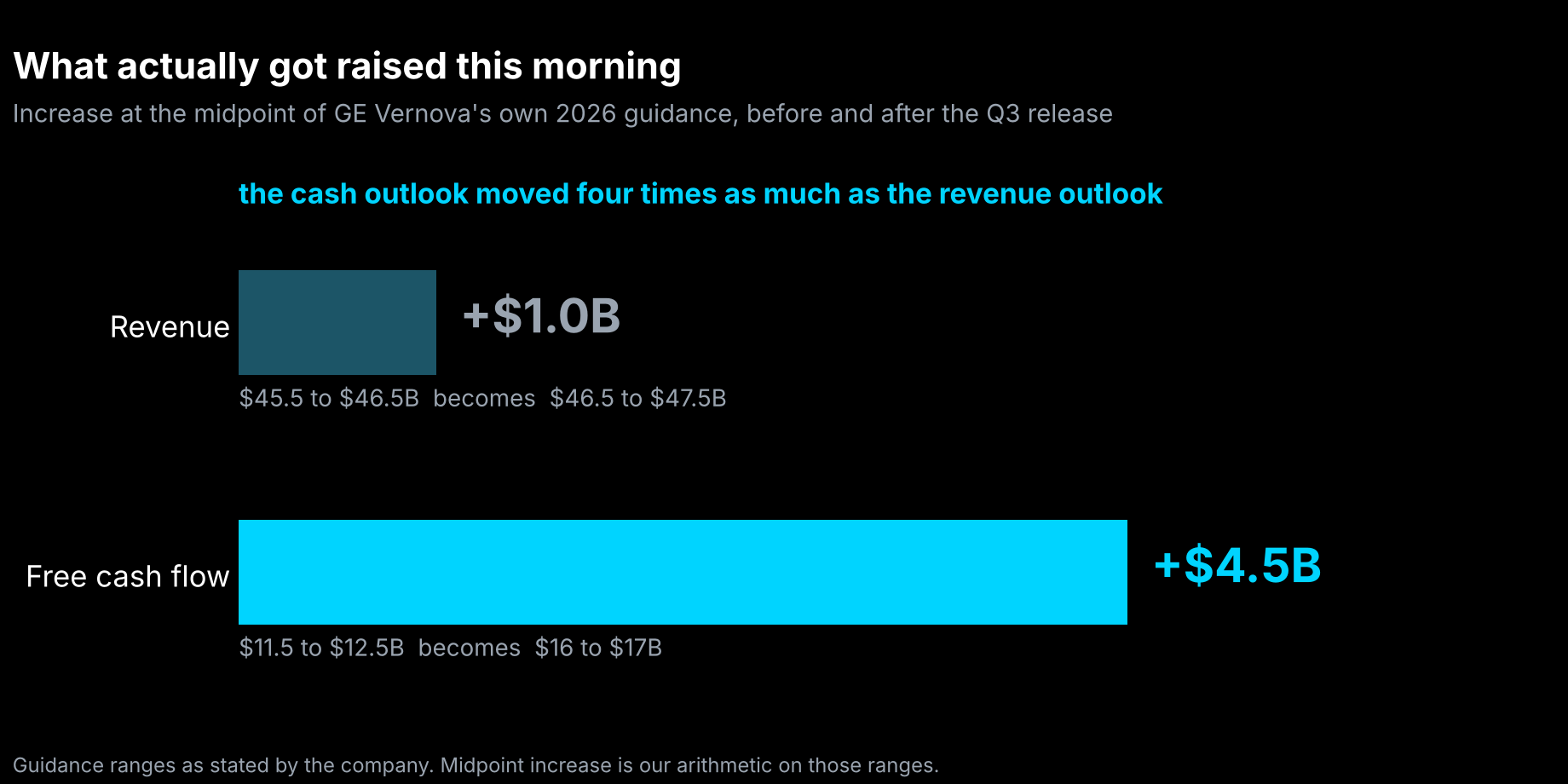
The company raised its free cash flow guidance for the year from $11.5 to $12.5 billion to $16 to $17 billion. That is roughly $4.5 billion of additional expected cash at the midpoint, against a revenue guidance raise of about $1 billion.
Free cash flow is the cash a business has left after paying its running costs and its capital spending. It is the money that can actually be used for something, as opposed to revenue, which is only what was billed. So when a company raises its revenue outlook by a billion and its cash outlook by four and a half, it is telling you the business converted far better than it expected, not just that it sold more.
That is the part of the release nobody will lead with, and it is the part that funded what came next.
What they actually paid for
The company is Trench Group, headquartered in Berlin, with 11 manufacturing sites across Europe, North America and Asia, more than 3,000 employees and over 800 utility and hyperscaler customers. Revenue has more than doubled since it became independent in April 2024, to over a billion euros. It has been engineering this equipment for more than 130 years.
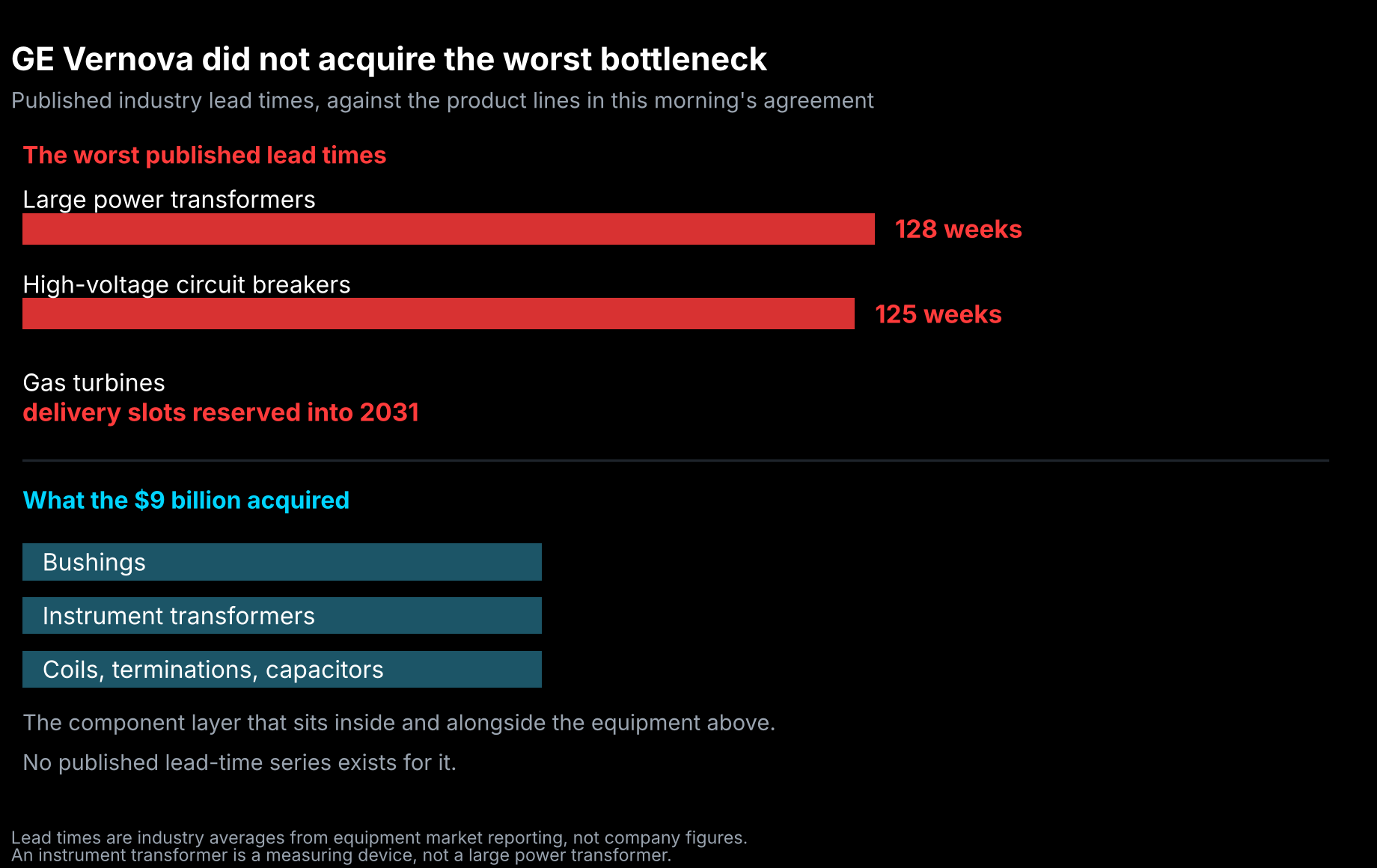
It makes bushings, instrument transformers and coils, plus cable terminations and capacitors. Those words mean nothing to most readers, so let us fix that, because the whole story is in them.
A bushing is the insulated passage that lets a high-voltage conductor pass through a grounded metal wall without the electricity jumping to that wall. Every large piece of grid equipment needs them, because the wires have to get inside the box somehow. They are unglamorous, they are precision-engineered, and if you do not have one, the box does not work.
An instrument transformer is a measuring device. Grid voltages are far too high to feed into a meter or a protective relay, so an instrument transformer scales the voltage or current down to something an instrument can read safely. It shares a name with the transformers we wrote about yesterday and it is a completely different product.
That distinction matters enough to say plainly. Trench does not make large power transformers, and it does not make high-voltage circuit breakers. Those are the two items with the worst published lead times, roughly 128 and 125 weeks, and they are not what changed hands this morning. Trench makes the component layer that sits inside and alongside them.
The terms: $9 billion, bought from the private equity firm Triton Partners, roughly half cash and half new debt, at about 13 times Trench's expected 2028 earnings before interest, taxes, depreciation and amortisation, which is a rough measure of the cash a business produces before financing and accounting choices. Note the year. Not this year's earnings or next year's, but a forecast two years out, for a company GE Vernova does not yet own, with no cost savings quantified anywhere in the release. Worth noting that the price is denominated in euros and converted at 1.12, so the dollar figure will move with the exchange rate. Closing is expected in late 2027.
The part that makes this a story
Here is what the chief executive said on the call, and it is the sentence the coverage is going to skip.
"Today, we source most of our bushings externally, but tomorrow, we will be able to internalize this key technology."
An analyst then asked him directly how much of Trench's output currently supplies GE Vernova rather than third parties. The answer was that GE Vernova is a small customer of Trench today.
So read the transaction again with that in mind. This is not a company fixing its own supply problem by purchasing its main vendor. It is a company paying $9 billion for a component maker it barely uses, whose parts go into equipment built by everyone, including its competitors. Trench says its components appear in the majority of high-voltage direct current lines built globally, which are the long-distance links that move large amounts of power between regions.
That is a different kind of purchase. It is not vertical integration in the usual sense of securing your own inputs. It is taking ownership of a chokepoint that other people also have to pass through.
The chief executive's framing supports that reading. "Lead times across the industry are increasingly important," he said, and the deal "will enhance supply chain certainty." Note the word industry. Not our supply chain. The industry's.
The date that gives the whole thing away
Buried in the acquisition release is a newly opened Trench facility in Charlotte, North Carolina, where manufacturing of 765 kilovolt equipment is expected to begin in late 2027. On the call, management said it would be the first US manufacturer of bushings at that voltage.
Hold that next to two other dates. The deal closes in late 2027. And yesterday's piece noted that the new US transformer factories under construction do not open until 2027 and 2028.
So GE Vernova is paying $9 billion, in roughly equal parts cash and debt, for capacity that largely does not start producing until after the transaction closes. The chief financial officer said most of Trench's capacity expansion spending will be finished before the close, which means GE Vernova gets the plants after someone else has paid to build them, and before they have produced much of anything.
That is either very good timing or a very long wait, depending on whether the demand is still there in 2028. Which brings us to the question somebody finally asked.
The question somebody finally asked
If you follow this industry you have heard the bull case: enormous order books, years of visibility, customers queuing. The obvious objection is that an order book is a promise, and promises can be unwound.
There is a specific version of that objection in this business, and it needs a definition first.
GE Vernova reports two different things and adds them together. One is backlog, which is signed contracts for work not yet delivered. The other is a slot reservation agreement, which is a customer paying to hold a place in a future production queue without having ordered the equipment yet. Think of the difference between a plane ticket you have already paid for and a deposit to hold a seat on a flight that has not been scheduled yet.
The company's headline figure of 122 gigawatts of gas equipment, up from 116 last quarter, is those two buckets combined. Which means the headline is partly contracts and partly reservations, and the company does not publish how often a reservation becomes a contract.
On the call, an analyst asked whether customers were having financing trouble, asking to exit slot reservations, or converting more slowly. The answer was "no, we are not," followed by the more useful detail: there has been no change in the cash terms required to secure the equipment.
That is the mechanism worth understanding. Customers put cash down to hold a slot. If demand were softening, the first thing to move would be those terms, because a manufacturer chasing a weakening order book starts asking for less money up front. Terms holding firm is better evidence than a denial.
Management also disclosed something genuinely new: backlog is now larger than the slot reservation balance for the first time. The mix has tipped from reservations toward contracts. That is a direction of travel rather than a conversion rate, and it is the strongest piece of evidence available on this question.
The split that is more interesting than it looks
Management gave one number that sounds like it settles the AI question and does not. Of the gas equipment customers, roughly 80% are traditional customers and 20% are data centers.
Read quickly, that says the AI story is a fifth of the business and the rest is ordinary utility work. Look at who the traditional customers are and it stops saying that.
Take Xcel Energy, which signed an alliance with GE Vernova in February reserving five gas turbines, plus wind capacity and grid equipment. Xcel is a utility. It counts in the 80%. And Xcel's own disclosure says its data center load could reach 6 gigawatts, with more than 2 gigawatts already contracted or under construction and over 20 gigawatts of further prospects in its pipeline.
So Xcel is a traditional customer purchasing equipment substantially because of data centers.
The same shape shows up elsewhere. NextEra has secured turbine slots for 4 gigawatts of projects.
And then there is the version that skips utilities entirely. Chevron and the investment firm Engine No. 1 are developing a gas plant near Pecos, Texas, using seven GE Vernova turbines, under a twenty year arrangement to supply up to 2.67 gigawatts to a Microsoft data center campus, with first power expected in 2028. Chevron supplies the gas from its own Permian production. The plant is designed not to connect to the grid at all, and no utility is involved.
Note what that does to the queue. Yesterday's piece said projects in the largest US grid region averaged more than seven years from start to switch-on, with over three of those spent waiting for permission to connect. This one never joins the queue.
The 80/20 figure counts who signs the contract, not what the electricity is for. Utilities purchase the turbines, and a rising share of what utilities are building serves data centers they will supply. Which means the real exposure is higher than a fifth, and nobody publishes how much higher.
That is the more useful version of the number, and it runs the opposite way to how it will be quoted. The data center orders booked directly in the electrification segment, more than $6 billion year to date including about $1.4 billion in the latest quarter, are the part you can see. The part flowing through utility customers is the part you cannot.
They have run this play before
The reason to take the Trench logic seriously is that GE Vernova already did this once, and told everyone how it worked.
It owns a transformer business called Prolec GE, which until recently was a joint venture, meaning two companies shared ownership and neither could act alone. GE Vernova bought out the rest of it. On the call, the chief executive gave the result in one line: the company has booked $900 million of transformer orders in the United States, to be filled from factories elsewhere in the world, and said plainly that it "could not do" that without owning all of Prolec.
Sit with that, because it is the whole argument in miniature. A supply agreement gets you product. Ownership gets you the right to decide which customer in which country gets the product first, and to move production between plants to make that happen. When a part is scarce, that scheduling right is the valuable thing, not the part.
Prolec contributed almost $950 million of revenue in the quarter. Management expects its integration to be substantially complete before the Trench deal closes.
So the sequence reads as a strategy rather than an impulse. Take full ownership of the transformer business, learn what ownership lets you do with allocation, then pay $9 billion for the component layer underneath.
Who else is standing in this layer
One clarification before the names, because it matters.
GE Vernova is not a disclosed counterparty of any AI company. Yesterday's piece listed the counterparties that are named in Anthropic's filing, and they are chip and cloud companies, not equipment makers. Nobody has published which transformer maker supplies which campus. What follows is the industry layer, not one customer's supplier list, and anyone telling you otherwise is filling in a blank.
With that said, this layer reports in public, and several of its members reported recently.
Vertiv, which supplies power and cooling infrastructure, also reported this morning: net sales of $4.31 billion, up 61%, operating profit up 90%, and full-year guidance raised for the third time this year. One thing worth knowing if you go looking: it stopped reporting backlog quarterly in February, so any current backlog figure you see in circulation is really the December 2025 one.
Eaton has the most specific disclosure in the group. Its data center revenue grew 65% organically against an underlying market it sizes at about 23%, and it quantifies its own exposure as roughly $3.4 million of content per megawatt built.
Powell Industries disclosed a single data center order above $400 million, part of a multi-phase design touching at least five North American facilities, with orders running three times its revenue in the quarter.
nVent grew its systems protection revenue 70%. Hubbell put its data center market growth at about 40%. Caterpillar reported power generation retail sales up 72%, with a $72 billion order book and power customers, in its own words, ordering through 2030. Bloom Energy delivered one power system in 55 days, which stands out mostly because everything else described here takes years.
Those are disclosures rather than estimates, which is the only reason to repeat them. What none of them tells you is whose data center the equipment ends up in.
What this does not tell you
It does not tell you the stock is worth more than it was yesterday. Nothing here is a view on price. Today is a useful illustration of why we avoid quoting intraday moves: reports of GE Vernova's move this morning ranged from down 6% to up 3.7% depending on which hour the writer looked, and the down 6% figure does not reconcile with the day's opening price at all. If you see a single percentage with no timestamp, it is probably wrong.
It does not tell you the acquisition works. The payoff is distant. The deal closes in late 2027, the Charlotte line produces at full voltage from late 2027, and about 13 times 2028 earnings is a full price with no savings quantified anywhere in the release. Add roughly $4.5 billion of new debt, European works council consultation, and regulatory approval across multiple jurisdictions, and there is a long runway for something to go wrong.
It does not tell you the whole business is accelerating. The segment at the centre of the bullish story, electrification, had orders fall 9% year over year this quarter. Management attributed that to a very large order in the prior year making for a hard comparison, which is plausible and checkable later. But the headline fact stands: while gas orders rose 178%, the electrical equipment segment that Trench is being folded into went backwards on orders. The wind business is still guided to lose $400 to $500 million for the year.
And it does not tell you how many reservations become orders. That number was not disclosed, has never been disclosed, and anyone quoting one is modelling rather than reporting.
What today does give you is a way to read any acquisition. The useful question is not what a company paid, it is what the price implies the company believes. Paying $9 billion for a supplier you barely use, at a full multiple, for plants that produce after the deal closes, only makes sense if you think the part itself becomes scarce and whoever owns it sets the terms. That is a bet on scarcity, not on growth, and those are different bets with different ways of going wrong.
That is also the problem a valuation has to solve. Techdamentals runs four separate methods and shows the full range rather than a single number, because when a thesis rests on something happening in 2028, the width of that range is the honest measure of how much is still unknown.