On Monday, November 2, 2026, Apple reported the largest annual revenue in its history. Four hundred and seventy-nine billion dollars for the fiscal year. The September quarter beat expectations on revenue and on profit. The iPhone set a September-quarter record. Services hit an all-time high.
The stock fell.
Not dramatically, a little under 2% in the regular session and about the same again afterward, but it fell, and the reason was in one sentence of guidance that almost nobody will read.
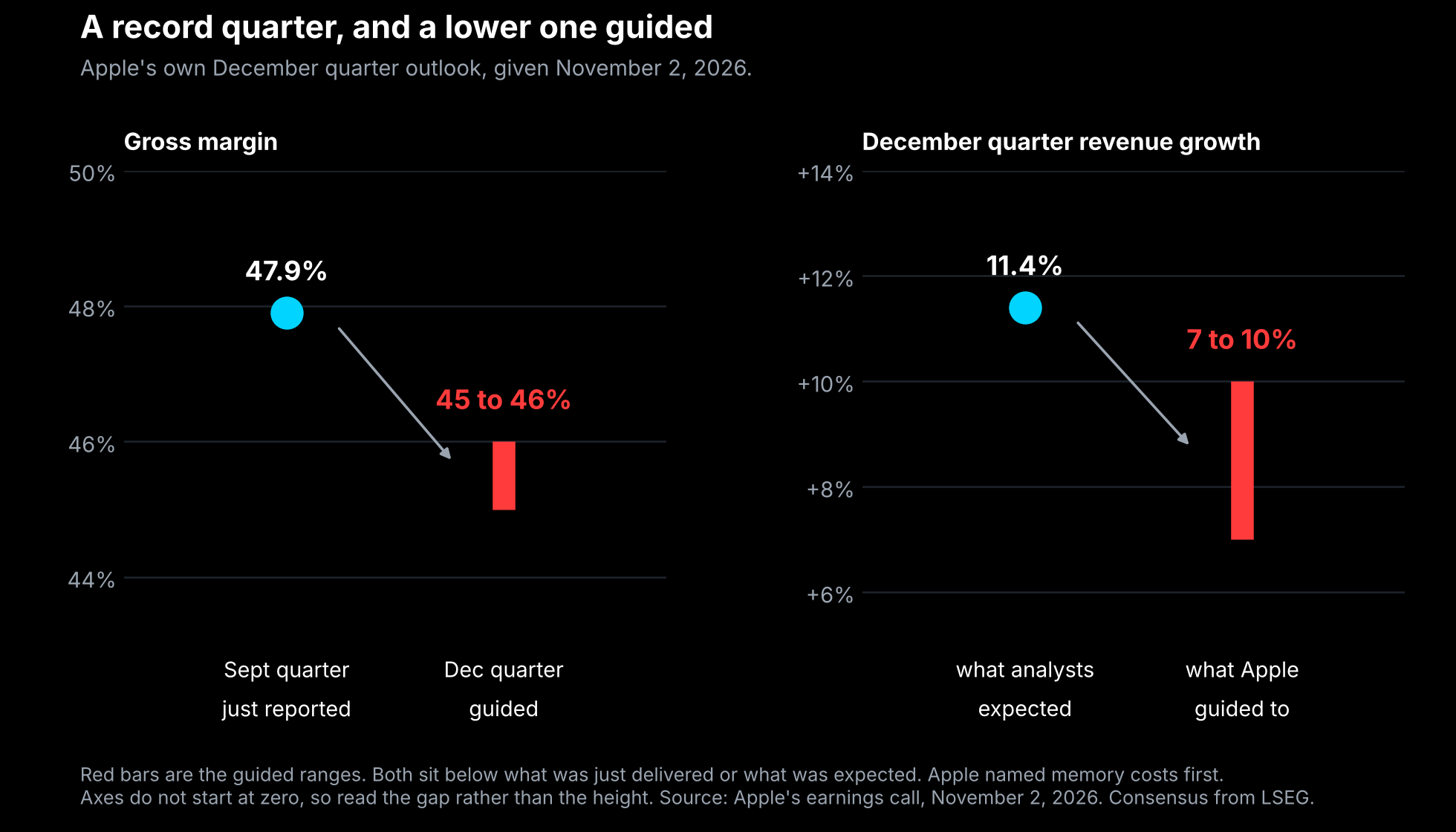
Apple told investors to expect a gross margin of 45% to 46% in the December quarter. The quarter it had just finished reporting came in at 47.9%. It also guided revenue growth of 7% to 10%, where analysts had been looking for 11.4%.
That is roughly two points of profitability, guided away, on the single biggest sales quarter of Apple's year. And when the chief financial officer explained the range, the first thing he named was the cost of memory.
If you read our last issue on AMD, you already know why that matters. This is the third company to name the same cause, and the second to do it in four days.
Two words you need before the rest of this makes sense
Guidance is a company's own forecast of its next quarter, given to investors on the earnings call. It is not a legal requirement and not an audited number. It is management saying, out loud, what it currently expects.
It matters more than the results almost every time, and the reason is simple once stated. The results describe a quarter that has already finished and that investors have spent three months estimating. Guidance is the first new information in the room. When a stock moves hard on an earnings day, it is usually the guidance that moved it, not the quarter.
Consensus is the average of what professional analysts who follow a company expect it to report. Several dozen people at different firms publish forecasts, a data company averages them, and that average becomes the number a result is measured against.
This is why a company can report its best quarter ever and have the stock fall. "Good" is not measured against last year. It is measured against what everyone had already assumed, and the price already contains the assumption.
Apple's results beat consensus. Apple's guidance came in under it. The second one won.
What gross margin is, and why two points is a lot
Before anything else, the term, because the whole article depends on it.
Gross margin is what a company keeps from each dollar of sales after paying only for the physical cost of making the thing. Not advertising, not salaries for office staff, not tax. Just the parts, the assembly and the shipping.
If Apple collects one hundred dollars for a phone and the components and manufacturing cost forty-eight dollars, the gross margin is fifty-two percent. What is left has to cover everything else, and whatever survives that is profit.
So when Apple says the December quarter will come in around 45% to 46% instead of 47.9%, it is saying that roughly two cents more of every dollar is going to suppliers rather than staying with Apple. On a quarter the company guided to somewhere between one hundred and fifty-four and one hundred and fifty-eight billion dollars of revenue, two points is around three billion dollars.
Three billion dollars is not an accounting rounding difference. It is roughly what Apple makes from the iPad in half a year.
The thing Apple named first
Here is the sequence that makes this more than a bad quarter.
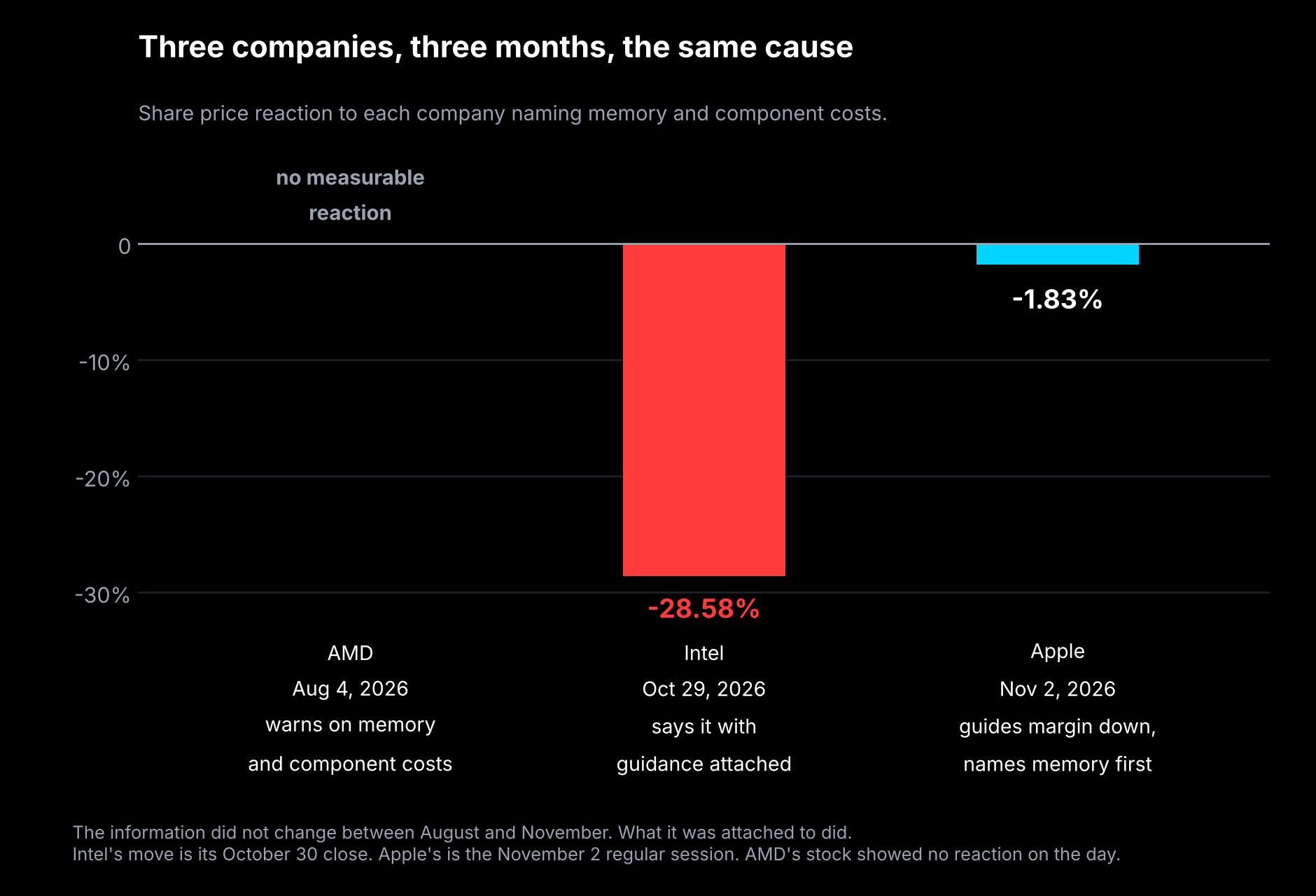
On August 4, 2026, AMD's chief executive told investors the company was planning for a softer personal computer market as higher memory and component costs weighed on demand. Nobody wrote about it.
On October 29, 2026, Intel said the same thing with numbers attached. Its revenue had actually grown 21% and its data center business had grown 78%, but it told investors that personal computer demand was collapsing because memory prices had pushed up the cost of a laptop, and it guided its own gross margin down from 44.1% to 38.0%. The stock fell 28.58% the following session, its worst day in more than fifty years.
On November 2, 2026, Apple guided its margin down and named memory first, alongside the cost of ramping its new Siri AI features.
Three companies, three positions in the industry, one cause. And the third one is the interesting one, because Apple is the company that was supposed to be immune.
Why memory got costly in the first place
If you have not followed this, the cause is worth a paragraph, because it is not a story about computers at all.
Memory is the part of a device that holds whatever it is working on right now, and the separate part that stores your files permanently. Every phone, laptop and server needs it. It is made in a small number of enormous factories by a handful of companies, and those factories take years and tens of billions of dollars to build.
Here is the part that connects it to everything else you have been reading about artificial intelligence. The data centers being built to run AI models need staggering quantities of memory, and they need the fastest kind. The companies making it have shifted their production toward those customers, because those customers will pay more and order more.
That leaves less for everything else, and the price of what remains goes up.
The scale of the increase is the part people underestimate. One research firm calculates that memory has gone from roughly 15% of what a personal computer costs to build to nearly 40%. A Gartner analyst said the cost of one common type of memory chip rose five times over a year.
So a laptop maker who changed nothing about its design, its factory or its workforce found that the parts inside its product had become a far larger share of the cost. There are only two responses available: raise the price and risk losing customers, or keep the price and lose profit.
Intel's customers refused the higher prices. Apple raised prices and gave up margin anyway.
Why Apple was supposed to be immune
Three reasons, and all three were good reasons.
Apple has the most pricing power in the category. When a component gets costlier, most manufacturers either absorb it and lose margin, or pass it on and lose customers. Apple has historically been able to pass costs on and keep the customers, because people who want an iPhone tend to want an iPhone specifically.
Apple purchases at enormous scale and commits years in advance. It is typically among the largest customers any component supplier has, which means better pricing and earlier access than anyone else gets.
Apple's product mix protects it. Services revenue hit an all-time high at $31.57 billion this quarter, and services have almost no physical cost attached. The more of Apple's money that comes from software and subscriptions rather than hardware, the less a component price should matter.
All three of those are still true. And the margin guidance went down anyway.
Apple's chief executive, John Ternus, running his first earnings call after succeeding Tim Cook on September 1, said the company had already raised prices to help offset higher component costs.
So the sequence is: Apple raised prices, and is still guiding profitability down two points. That is what it looks like when a cost increase is larger than the most powerful company in the industry can fully pass along.
The part that sounds like good news and is not
Now the detail that reframes the whole thing, and it is the opposite of what happened to Intel.
Apple's Mac business did $10.79 billion this quarter. Analysts had expected about $9.69 billion. That is a beat of roughly eleven percent, in the same three-month window when three independent research firms measured global personal computer shipments falling more than twenty percent.
So Mac is fine. Better than fine.
And Apple's problem with the Mac in the December quarter, according to the company, is that it may not be able to make enough of them. The constraint it named was memory, and the reason it bites is that demand has run ahead of what Apple planned for.
Sit with how different that is from Intel's problem.
Intel's demand was destroyed by price. Memory got costlier, laptop prices went up, people stopped purchasing, and Intel's partners stopped ordering chips.
Apple's demand is intact and the supply is the constraint. Same shortage, same cause, opposite symptom.
Both are the memory shortage. One company lost its customers to the price. The other kept its customers and cannot get the parts. That is what a genuine input shortage looks like as it moves through an industry: it does not hit everyone the same way, and the shape of the damage tells you where a company sits.
The thirty-three billion dollar clue
One number in the filings says more about what Apple expects than anything said on the call.
Apple's manufacturing purchase obligations rose by about thirty-three billion dollars between the June quarter and the September quarter.
A manufacturing purchase obligation is a commitment to pay a supplier for parts, agreed in advance, whether or not Apple ends up needing them. It is a promise with a price attached.
Companies make these commitments when they want certainty. You give up flexibility, and in exchange you lock in supply and, usually, a price. A thirty-three billion dollar increase in a single quarter is a company deciding that the risk of not having parts, or of paying more for them later, is worse than the risk of committing early.
Apple's finance chief said memory purchase prices are expected to keep rising.
Read those two facts together and you have Apple's actual forecast, stated in money rather than words. The company does not think this is temporary.
What else was in the quarter
Two things worth noting that have nothing to do with memory.
Greater China did $17.5 billion, up 21%, and still came in more than a billion dollars below what analysts expected. Strong growth, weaker than hoped. That is its own story and it is not a component story.
Apple repurchased twenty-four billion dollars of its own stock in the quarter. That figure deserves a moment, because it runs directly against what the rest of large American technology is doing right now. Across the biggest cloud companies, share repurchases have collapsed to roughly fourteen billion dollars a year, from about a hundred and five billion in 2024, because the cash is going into data centers instead. Apple returned more to shareholders in three months than that entire group is returning in a year.
Apple is building less and handing back more. Whether that looks like discipline or like a company with fewer places to put its money is a genuine argument, and it is being had right now.
What this does not tell you
It does not tell you Apple had a bad quarter. It had the best year in its history. Revenue grew 12%, the iPhone set a September record, Services set an all-time high, and the Mac beat expectations by about eleven percent in the worst personal computer market in years. The stock fell on guidance, not on results.
It does not tell you the margin guidance is wrong. Apple guides conservatively as a matter of habit and has beaten its own margin range before.
It also does not tell you Apple is in the same position as Intel, and the numbers make that clear. Hit by the same shortage in the same quarter, Intel guided its gross margin to 38.0% and Apple guided to 45 to 46%. Apple is giving up two points from a far higher starting place, and would still be keeping about seven cents more of every dollar than Intel. The force is identical. The cushion is not.
It does not tell you memory prices keep rising. Apple expects them to. Apple is not a forecasting service, it is a purchaser with a reason to secure supply, and purchasers who are worried commit early whether or not the worry turns out to be justified. The thirty-three billion dollars tells you what Apple believes, not what will happen.
It does not tell you the personal computer market has recovered. This is the mistake most coverage will make this week. Apple's Mac doing well in a collapsing market is evidence about Apple, not about the market. The three firms that count shipments independently all measured declines above twenty percent in the same quarter Apple beat. Both things are true, and the correct reading is that Apple is taking share in a shrinking category.
And it does not tell you what any of this is worth. Apple fell on guidance that would be a triumph at almost any other manufacturer. Whether two points of margin on a record quarter is a reason to change your mind about a company depends entirely on what you already believed about the next five years, not the next three months.
What the week genuinely shows is a single input working its way through an entire industry and producing different symptoms at every stop. It destroyed demand at Intel. It barely registered at AMD, which said it first. And at Apple, the company with more pricing power than anyone, it took two points of margin even after prices went up, and left the company unable to make as many computers as people want.
The shortage is the same everywhere. What it costs you depends on where you stand.
That is why we show the workings instead of a single figure. Techdamentals runs four separate valuation methods and displays the full range, because one number tells you where somebody landed and nothing about what it rests on.