On Thursday evening Intel told investors that personal computer demand was collapsing because memory prices had pushed up the cost of a laptop. On Friday the stock closed down 28.58%, its worst day since 1974.
On August 4, AMD's chief executive said this on her own earnings call:
"We are planning for a softer PC market as higher memory and component costs weigh on demand."
Same diagnosis. Same cause. Almost three months earlier. AMD's stock did not move on it, and essentially nobody wrote about it.
AMD reports on Tuesday evening, and most of the coverage this week will frame it as a test of whether Intel was right. That framing is already out of date, because the independent shipment data arrived three weeks ago and it backs Intel almost exactly.
The more interesting question is why one company got destroyed for saying something the other had already said.
The data is already in, and it is not close
Three research firms count personal computer shipments independently, using different methods and different definitions. All three published their third quarter numbers in the second week of October, well before Intel reported.
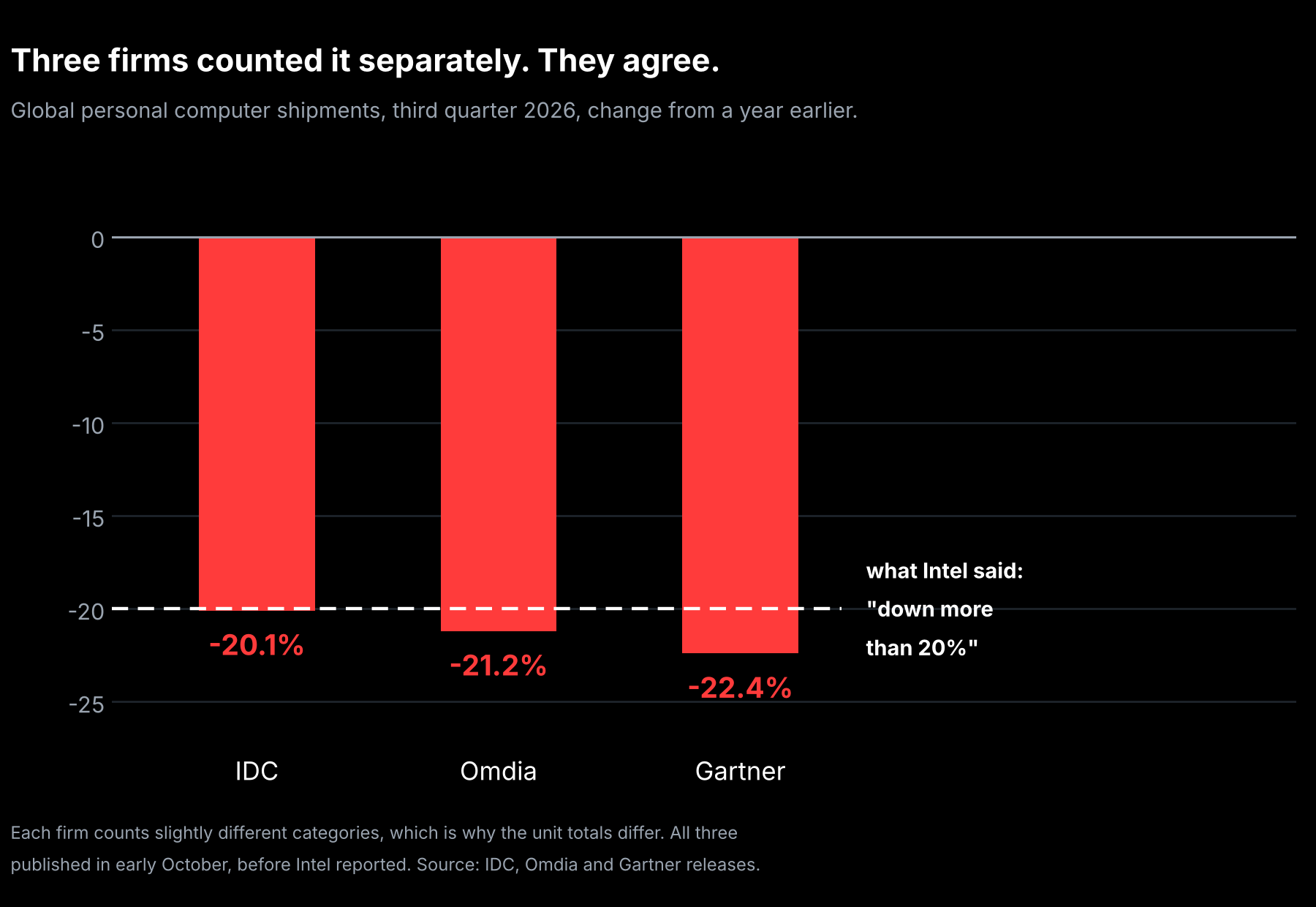
- IDC: down 20.1% from a year earlier, to 62.7 million units
- Omdia: down 21.2%, to 58.1 million
- Gartner: down 22.4%, to 55.4 million
The totals differ because each firm counts slightly different things. The growth rates agree within two percentage points, which for this kind of data is about as close to unanimous as it gets.
Now compare that with what Intel's finance chief actually said on the call: "We expect the 2026 PC unit TAM to decline approximately 12%, with second half units down more than 20%."
Intel was not making a bold forecast. It was describing something that had already happened and been independently measured by three separate organizations. The second-half claim is simply what the quarterly data already showed.
And on the cause, the trackers are more specific than Intel was.
Omdia calculates that memory has gone from about 15% of what a personal computer costs to build to nearly 40%. A Gartner analyst said DRAM costs "surged five times year over year in the second quarter" and that "the impact of higher memory and storage costs is now fully reflected in PC pricing." Omdia's analyst used almost identical language, saying the cost increases have "fully worked its way through to end-market pricing."
Note what that means. This is not a shortage where you cannot get the product. It is a shortage that showed up as a price, and then people stopped purchasing at that price.
One honest complication, because the three firms do not fully agree on the mechanism. Gartner describes it as price-driven demand destruction, with customers simply refusing the new prices. The research firm IDC describes it differently, as a hangover: vendors and retailers stocked up heavily in the first half of the year ahead of announced price increases, so the third quarter was always going to look thin by comparison. Intel offers a third version, that its own partners are aggressively working down inventory they already hold. All three can be happening simultaneously, and the distinction matters, because a pull-forward hangover ends on its own and demand destruction does not.
The damage was uneven, and the pattern is worth seeing. On Gartner's numbers, HP shipped 30.9% fewer computers than a year earlier, Dell 25.4% fewer, and Lenovo 22.4% fewer. Apple shipped 7.1% fewer and actually gained 1.7 points of market share. The companies competing hardest on price took the worst of it, which is what you would expect when the problem is price.
So why did only Intel get punished?
Three reasons, and the first one is simply that AMD is not really a personal computer company any more.
In AMD's most recent quarter, the Client segment, which is its PC chips, produced $3.06 billion of revenue. Its Data Center segment produced $6.72 billion. Client is about a quarter of the business. Data Center is nearly sixty percent.
So when AMD's chief executive warned about a softer PC market in August, she said it in a quarter where total revenue grew 50% and data center revenue grew 107%. The warning was true, specific, and completely drowned out.
Intel does not have that cushion in the same proportion. Its client business is still its largest single segment, so when the PC market contracted, the damage landed on the biggest part of the company.
The second reason is the guidance, not the quarter. Intel's reported results were decent. Revenue rose 21% and its data center business grew 78%. What broke the stock was guiding client computing revenue down more than 20% sequentially for the current quarter, and guiding gross margin from 44.1% down to 38.0%.
The third reason is that Intel had other problems at the same time. A fatal accident at its factory in Israel caused an extended shutdown, costing roughly $300 million of revenue and 200 basis points of margin, which is about a third of the margin decline and has nothing to do with memory. There is a separate shortage of the advanced substrates that connect a chip to a circuit board. And when Bank of America downgraded the stock, its published reasoning cited PC shipments, substrates, a lack of visible traction with outside foundry customers, and rivals growing two to four times faster. It did not mention memory prices at all.
Which tells you something. Intel described this as a memory story. The analysts cutting their ratings described it as an Intel story. Both were looking at the same quarter.
Worth noting the asymmetry in what happened next. Bank of America moved Intel to Neutral. Across the same window, no major firm appears to have cut its rating on AMD. Susquehanna, Jefferies and Bernstein all left their positive ratings in place. That is not an endorsement of anything, but it does tell you how the people paid to form a view on this read it.
The trap waiting for you on Tuesday
There is one thing to understand before AMD reports, because almost every write-up on Wednesday morning will get it wrong.
AMD can post a perfectly good quarter in its PC business and it would prove nothing about the health of the PC market.
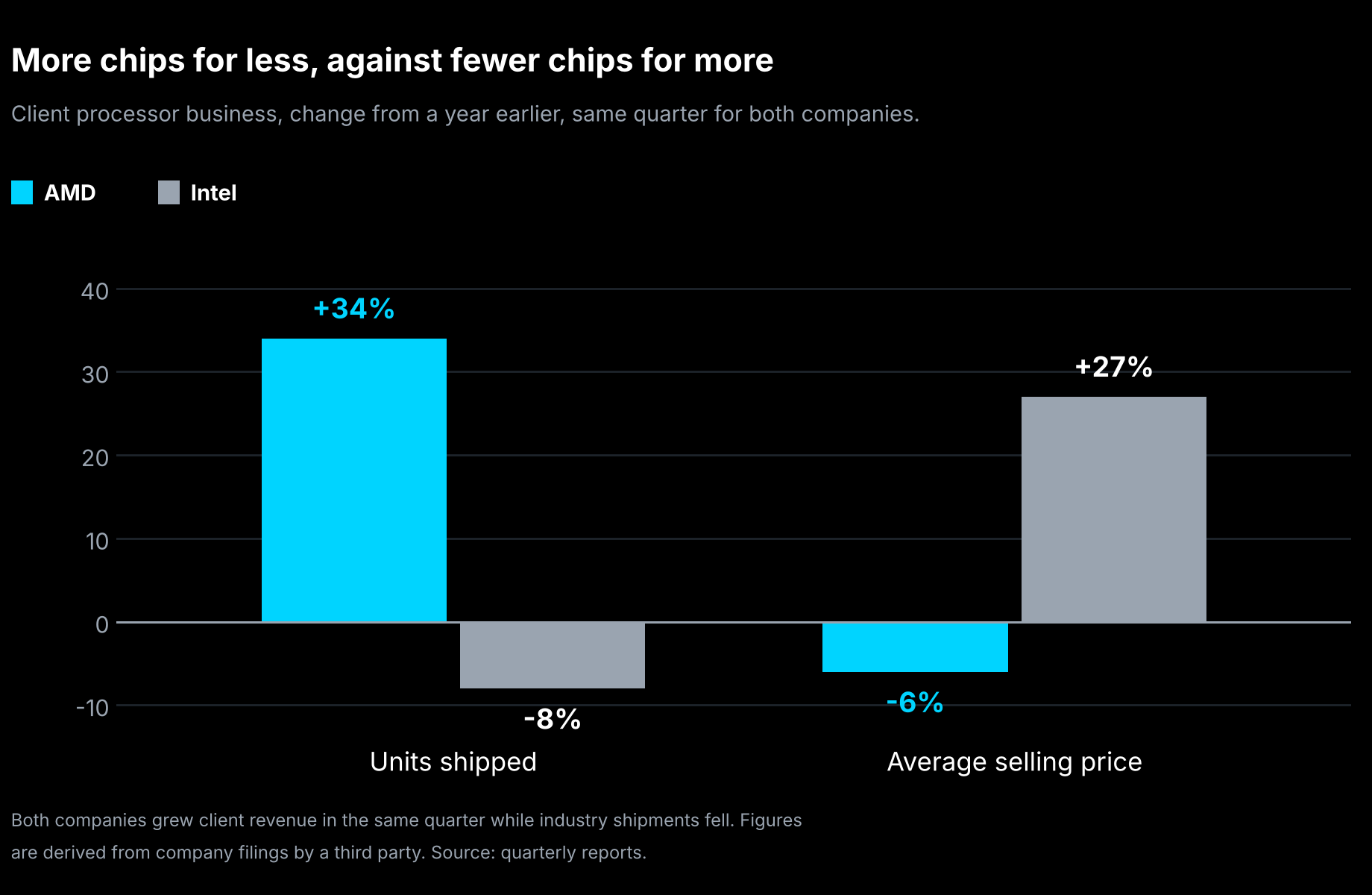
Look at what happened in the most recent quarter where both companies disclosed the detail. Comparing against the same quarter a year earlier:
- AMD shipped 34% more units at average prices 6% lower
- Intel shipped 8% fewer units at average prices 27% higher
Both companies grew client revenue. Industry shipments over that period were falling. AMD's unit growth was almost entirely market share taken from Intel, and it took that share at the thinner end of the market, shipping more chips for less money each.
The share data confirms it. AMD's portion of x86 client processor units went from 23.9% a year ago to 30.3% last quarter, the first time it has crossed thirty percent. That is a gain of 6.4 points in four quarters.
One honest qualifier on that. The gain is decelerating. Most of it happened between the middle of last year and the start of this one. The most recent quarter added only 0.6 points.
So the two things to hold separately are these. AMD winning share is a story about AMD and Intel. The number of computers being sold is a story about the market. A strong AMD client number is evidence of the first and tells you almost nothing about the second.
What to actually watch
The Client segment revenue line, on its own. AMD guided to what its finance chief described as "a slight growth in client offset by strong double-digit decline in gaming." Client was $3.06 billion last quarter, so the bar AMD set for itself is somewhere near 3.1 or 3.2 billion dollars.
One technical warning. AMD also reports a combined "Client and Gaming" figure. Do not use it. Gaming is collapsing for its own reasons, down more than 30% from a year earlier, and it will drag the combined number well below what Client actually did.
The guidance for the current quarter matters more than the result. AMD set its last guidance on August 4, before anyone knew third quarter shipments would fall more than twenty percent. Tuesday will be the first number AMD has issued with the full picture visible. Intel guided its client business down more than 20% sequentially. If AMD guides anywhere near that, the two companies are telling an identical story.
Gross margin against the roughly 56% the company guided to. Memory and component costs flow through here. AMD is the lower-priced vendor of the two, which means less room to pass higher costs along.
And anything management says about customer inventory. This is the specific mechanism Intel blamed for its collapse, that its partners are aggressively working down stock they already hold. AMD said nothing about it in August. If AMD confirms it, the stories converge completely.
For the overall numbers, AMD guided revenue of $13 billion plus or minus $300 million, and the market expects roughly $13.09 billion with non-GAAP earnings near $1.95 a share. Options pricing implies a move of 10% to 12%, the largest of any company reporting this week.
One more thing before Tuesday. Apple reports Monday evening. Apple makes computers, its shipments fell the least of any major maker last quarter, and it gained share. If even Apple shows strain, that is a stronger signal about the market than anything AMD says, because Apple has more pricing power than anyone else in the category.
What this does not tell you
It does not tell you AMD will have a bad quarter. The company has been taking share consistently, its data center business is growing at triple-digit rates, and PCs are only about a quarter of revenue. Those things can all be true while the PC market is in its worst contraction in years.
It does not tell you Intel was wrong. This is the part most coverage will mishandle. The shipment data from three independent firms already corroborates what Intel said about the market. If AMD reports well, the correct reading is that AMD is doing better than a bad market, not that the market is fine.
It does not tell you the market was right to punish Intel so severely. A 28.58% single-day decline on a quarter where revenue grew 21% and the data center business grew 78% is a violent repricing of the future, not an assessment of the past. Whether that was proportionate is a judgment, and reasonable people are disagreeing about it right now.
It does not tell you when PCs recover. Intel says the unit market shrinks about 10% again next year. Omdia forecasts about 7%. The research firm that publishes the most widely followed forecast has not updated its full-year view since March, before any of this was visible, which is its own small signal about how fast this moved.
And it does not tell you what either company is worth. AMD closed Friday at $504.80, down 10.88% on the day in sympathy with Intel, and about 22% below its highest close of the past year. Intel closed at $65.76. Those two moves happened on the same information. What you make of either depends entirely on what you think the next three years look like, not the last three months.
What the week genuinely offers is a lesson about how information gets priced. AMD said the PC market was softening on August 4 and the market shrugged, because the sentence arrived wrapped in a 50% revenue increase. Intel said it on October 29 and lost a quarter of its value, because the same sentence arrived attached to guidance that made it concrete.
The fact did not change between August and October. The packaging did.
That is why we show the workings rather than a single figure. Techdamentals runs four separate valuation methods and displays the full range, because one number tells you where somebody landed and nothing about what it rests on.