On Monday, November 2, 2026, Palantir reported a quarter that is close to the best thing a software company can produce.
Revenue of $2.313 billion, up 96% from a year earlier. Adjusted earnings of 44 cents a share. Both ahead of what analysts expected. Net income of $1.128 billion on a full accounting basis, a 49% margin. Its United States commercial business passed its United States government business for the first time in company history. And it raised its forecast for the full year to about $8.53 billion, roughly 91% growth.
Beat. Beat. Record. Raise.
The stock fell 3.15% after hours.
Before going further, one correction to something you will read everywhere this week. Palantir also fell about 3.13% during Monday's regular session, and the two declines together make the roughly 6% figure being quoted. The first of those happened before the results came out. Only the second one is a reaction to the quarter. Anyone telling you Palantir fell 6% on its earnings is adding together a drop that happened beforehand and a drop that happened after.
So the question is narrower than the headlines: why did a beat, a record and a raise produce a 3% decline?
Revenue describes the past
Start with the distinction the whole article rests on, because almost nobody explains it.
Revenue is money earned during the three months that just ended. Work delivered, services provided, invoices sent. It is a record of something that already finished happening.
Bookings are new contracts signed during those same three months. Work the company has agreed to do and has not started delivering. Bookings describe what is coming.
A company can have wonderful revenue and worrying bookings at the same time, because they measure different moments. Revenue is the past. Bookings are the near future. When they point in opposite directions, the market trades the bookings, because the bookings are the part nobody has priced yet.
That is exactly what happened here.
The numbers that were not in the headline
Palantir reports something called total contract value, usually shortened to TCV. It is the full value of everything a customer commits to across the life of a deal. When a company announces TCV bookings, it is telling you how much new business walked in the door.
Here is this quarter against the one immediately before it. Every figure is from Palantir's own quarterly press releases.
| Q2 2026 | Q3 2026 | Change | |
|---|---|---|---|
| Revenue | $1.935B | $2.313B | +19.5% |
| Total TCV bookings | $3.373B | $2.918B | -13.5% |
| US commercial TCV bookings | $2.132B | $1.463B | -31.4% |
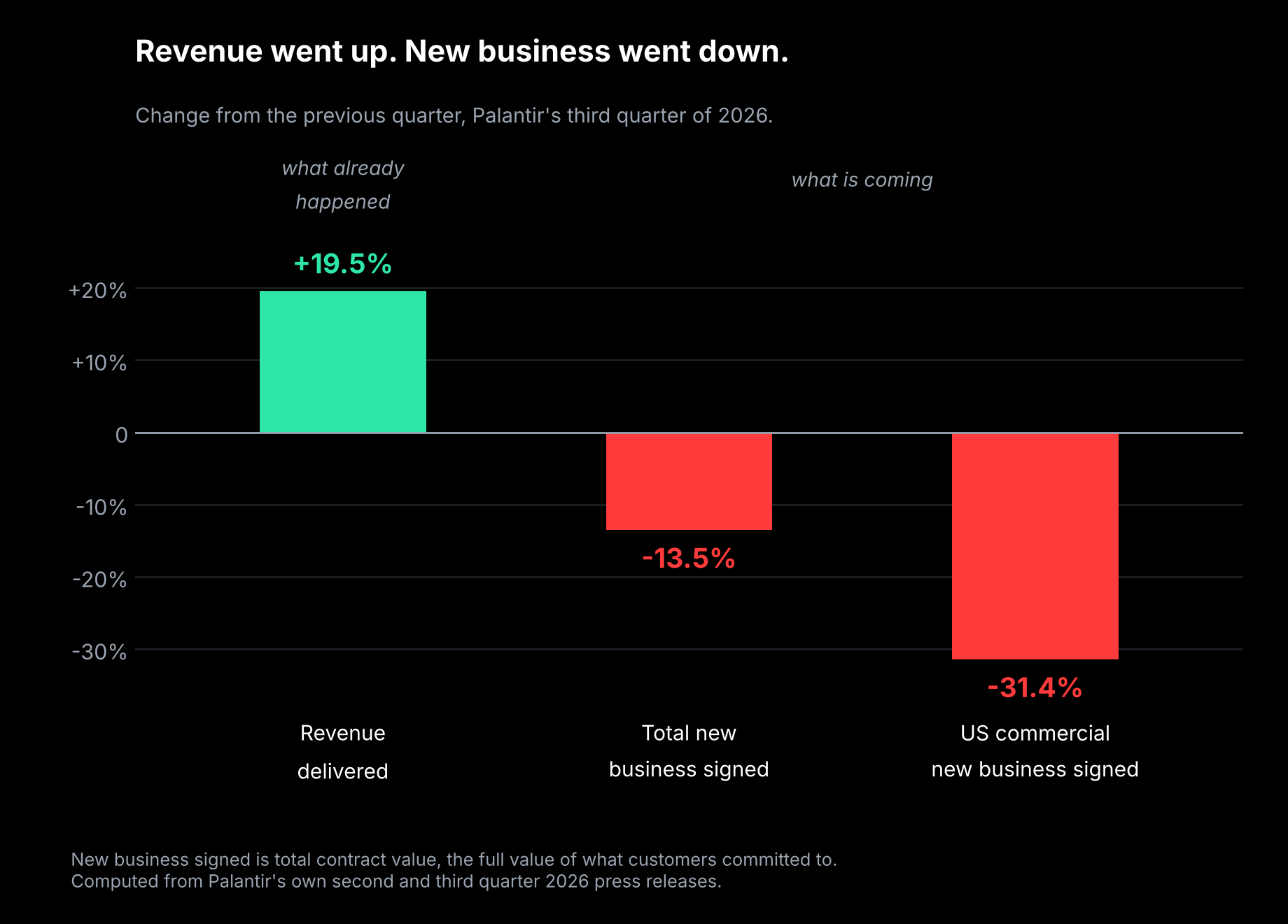
Revenue grew almost twenty percent in three months. New business signed fell thirteen percent, and the part of it everyone has been most excited about, United States commercial, fell nearly a third.
The same thing shows up in the annual comparison, which is arguably more striking because it shows how fast it changed.
| Growth from a year earlier | Q2 2026 | Q3 2026 |
|---|---|---|
| US commercial TCV bookings | +153% | +11% |
| Total TCV bookings | +49% | +6% |
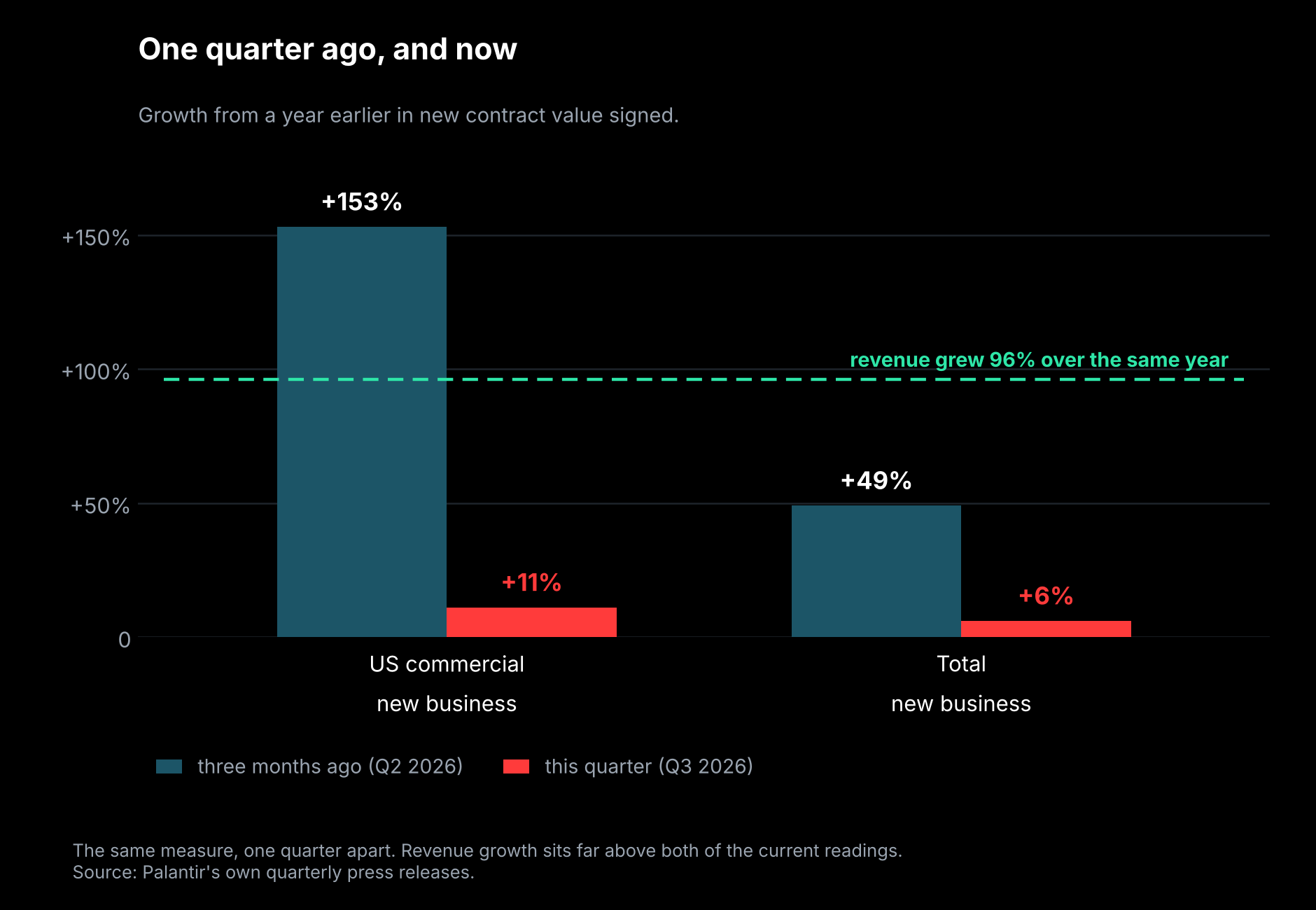
One quarter, and US commercial bookings growth went from 153% to 11%.
That is the whole answer to the question in the title. Revenue grew 96% from a year ago, and the measure of what is being added now grew 11%. A price that already assumed the first number had to adjust to the second.
Why those two cannot both continue
There is a mechanical reason this matters rather than being a curiosity, and it is worth stating plainly.
Revenue gets delivered out of the book of signed work. Think of it as a reservoir. Bookings flow in, revenue flows out, and what is sitting there is the backlog.
Opening backlog, plus new bookings, minus revenue recognized, equals closing backlog.
A company can deliver faster than it signs for a while, by working through a reservoir it filled in earlier quarters. It cannot do that forever. Over any long enough period, revenue growth converges on bookings growth, because revenue cannot come from anywhere else.
So when revenue is growing at 96% and new business is growing at 11%, those are not two facts about one company doing well. They are two speeds, and only one of them describes what is being added today.
Nothing here says Palantir is shrinking. Bookings are still growing at every level, and the company closed 64 deals worth ten million dollars or more in the quarter. But a reader looking at the 96% and a reader looking at the 11% are looking at different things.
The honest case that none of this matters
Before taking any of that as a verdict, there is a real argument on the other side and it deserves proper weight, because it is mechanically valid rather than spin.
Shorter contracts shrink bookings arithmetic while leaving revenue untouched.
Chief financial officer David Glazer said the company signed several eight-figure deals in the quarter that were shorter in duration than usual, because customers rapidly adopted initial sovereign artificial intelligence capabilities. Chief executive Alex Karp described the same thing as being much quicker to deployment with a shorter contract, and then an ability to expand that contract dramatically.
Work through what that does. TCV counts the full lifetime value of a contract. If a customer signs a one-year deal instead of a three-year deal at the same annual amount, TCV is a third the size. Revenue in the first year is identical. The bookings number looks worse and nothing about the business got worse.
And there is an argument it got better. A customer who commits for a shorter period often decided faster, and a company confident about renewals does not need long contracts to feel secure. Long contracts are partly a device for holding a customer who might otherwise leave.
Glazer also offered a reframe worth hearing: measured over the trailing twelve months rather than one quarter, United States commercial bookings were $6.114 billion, up 62%.
Two things weaken that defense, and both should be said.
Palantir did not quantify it. Not how many deals were shorter, not by how much, not what the effect on TCV was. The explanation is unfalsifiable from outside.
And the argument cuts both ways. If contract lengths are now shorter, then the bookings figure is a worse measure of the business than it used to be, which also means it cannot be used to confirm the demand story. A broken thermometer does not read correctly in either direction.
There is also a genuine piece of counter-evidence inside Palantir's own release. Its US commercial remaining deal value rose 4.5% from the prior quarter to $6.517 billion, while US commercial bookings fell 31%. Two of the company's own forward measures moved in opposite directions in the same three months. That alone should stop anyone concluding too much from any single one.
A word about the number everyone else is using
Most coverage of this quarter leads on remaining performance obligations, usually shortened to RPO, which Palantir put at $4.9 billion, up 88% from a year earlier and, in Glazer's word, flat against the prior quarter.
We have deliberately not built this article on that number, and the reason is instructive.
RPO is the one forward-looking measure that an accounting standard forces a company to define the same way every quarter. Bookings, TCV and "remaining deal value" are all defined by the company itself. So RPO sounds like it should be the most reliable figure here.
The problem is what the standard makes it leave out. RPO only counts the period where both sides are genuinely locked in. It excludes contracts with an original term of a year or less. It excludes anything beyond a notice period where a customer can walk away without penalty, which is why a two-year contract with a one-month cancellation clause contributes barely anything. And it excludes option years that have not been exercised, which is how a great deal of government work is structured.
Now notice what Palantir has just told us it offers customers: shorter sovereign artificial intelligence deals, and government contracts. Those are precisely the two things that are structurally hardest to put into RPO.
There is a second, duller problem. Palantir reported $4.9 billion this quarter, and $4.9 billion the quarter before. Both are rounded to one decimal place, so the real change could be anywhere from down 2% to up 2%. "Flat" is the company's characterization and it is almost certainly right, but nobody outside the company can show the subtraction. We would rather build on numbers you can check yourself.
One figure from that disclosure is worth keeping, though. Palantir's remaining deal value of $13.4 billion is nearly three times its RPO of $4.9 billion. The gap between those two is exactly the work that the accounting rules will not let the company count as contracted. That ratio tells you more about how this business is sold than either number does alone.
The thing that actually deserved the headline
Lost in all of this was a genuine milestone.
Palantir's United States commercial revenue reached $984 million, up 148%, and exceeded its United States government revenue of $953 million for the first time.
That matters because of what Palantir has been for most of its existence. It was built as a government contractor, and the long-standing argument against it was that government work is lumpy, politically exposed, slow to win and concentrated among a few customers. A company that depends on it is hostage to budget cycles it does not control. Ordinary businesses purchasing the same software changes that argument, and for the first time the commercial engine is the bigger one.
Keep the scale honest, though. The gap is $31 million, about 3%. It crossed over. It did not decisively overtake, and one ordinary quarter could put it back.
What this does not tell you
It does not tell you growth is ending. Revenue grew 96%, guidance went up, and the company expects to stay profitable on a full accounting basis in every quarter of 2026, which was not true of it for most of its history.
It does not tell you the bookings decline continues. One quarter is one quarter, and the shorter-duration explanation may be the entire story. The figure that would settle it is whether bookings reaccelerate next quarter. Worth noting that Palantir guided December quarter revenue to about 14.6% sequential growth, down from the 19.5% just delivered, which is the company's own expectation of some slowing.
It does not tell you anyone credible disagrees with the company. This is the oddest part of the day and worth saying out loud. Not one analyst on the earnings call asked about bookings, backlog or contract duration. The three who asked questions went to other subjects entirely. Every word available about the forward book came from Palantir's own chief financial officer. That is not a gap in this article, it is a finding about the coverage.
It does not tell you the drop was about the quarter at all. A stock that has risen a long way carries expectations no single report can satisfy, and some of what happened after the close was probably people taking profits. Karp argued the commercial business alone justifies where the company is priced. That is a claim about value, not a fact, and he would make it either way.
And it does not tell you which way this resolves, because the record goes both ways. When a fast-growing software company has stumbled on its forward numbers, it has sometimes been noise and sometimes been the first crack. C3.ai reported record annual revenue up 25% in 2025 and guided confidently; one quarter later its chief executive called the performance completely unacceptable, full-year guidance was withdrawn entirely and the company changed chief executives. The revenue line was the last thing to break. In other cases, companies that fell hard on a forward-book scare were materially higher six months later. The honest summary is that the market usually recovers from these and sometimes does not, and you cannot know which one you are in from a single quarter.
What the quarter genuinely offers is a habit worth taking into every earnings report you read. When a company beats and the price falls, do not look harder at the number that beat. Find the figure that describes what has not happened yet, and check whether it is still growing as fast as the one that describes what already did.
That is why we show the workings instead of a single figure. Techdamentals runs four separate valuation methods and displays the full range, because one number tells you where somebody landed and nothing about what it rests on.