On the morning of Monday, November 2, 2026, Oracle told regulators it was raising twenty billion dollars. Ten billion by issuing new shares, ten billion by issuing bonds.
The stock closed down 8.8%, at $119.22.
That reaction confuses almost everyone the first time they see it. The company now has more money than it did on Friday, October 30. Nothing about its products changed. Nobody cancelled a contract. It got what it asked for, and the price went down.
The explanation is more interesting than "investors panicked," and it starts with something that happened five days earlier.
The part almost no coverage mentions
On October 28, at its investor day in Las Vegas, Oracle made a promise. It committed to limiting the new money it would raise from capital markets, for its entire investment cycle running through fiscal 2030, to twenty billion dollars. Roughly ten billion of stock, ten billion of debt, excluding any refinancing of existing borrowing.
Chief financial officer Hilary Maxson described it as the final amount needed to fund the rest of the cycle.
The stock rose about 11% that day. Investors were not celebrating the spending. They were celebrating the ceiling. A company that tells you the maximum is a company whose future you can bound.
Five days later, Oracle drew the entire ceiling at once, in exactly the promised split.
Put the three sessions side by side and the shape is hard to miss. Up about 11% on the promise. Down 6.4% on Friday, October 30, as the whole artificial intelligence complex fell. Down 8.8% on the day the company actually did the thing it had promised to do.
So the fall is not really a reaction to the amount. The amount was pre-announced and the market liked it. The reaction is to the timing, and to one specific half of it. A company that expected to need that money gradually, over four years, does not take all of it in the first week.
Why issuing shares can lower the price, and why "dilution" is not the whole answer
Start with the half that moved the stock, because the bond half was expected and the share half is where the mechanism lives.
When a company issues new shares, it creates them out of nothing and puts them on the market. Oracle's filing works through an illustration: about 76.5 million new shares, on top of the roughly 3.02 billion that already existed. Afterward there are about 3.10 billion.
That is dilution, and it is simple arithmetic. If you owned one share, you used to own one three-billion-and-twenty-four-millionth of Oracle. Now you own one three-billion-and-one-hundred-millionth. Your slice got about 2.5% thinner.
Here is the part that gets skipped everywhere, and it is the single most useful idea in this issue.
Dilution by itself should not move the price at all.
Your slice of the company got 2.5% smaller, but the company got ten billion dollars larger. If the market thought that ten billion dollars was worth exactly ten billion dollars, the two effects would cancel and the share price would not budge. A smaller slice of a bigger pie is the same amount of pie.
So a 2.5% dilution cannot explain an 8.8% decline. It does not come close. Something else is doing the work, and there are two candidates.
The first is what the decision says about what management thinks. This has a proper name and a proper source. In 1984, Stewart Myers and Nicholas Majluf published a paper in the Journal of Financial Economics making an argument that has shaped how markets read these announcements ever since.
Their reasoning runs like this. The people running a company know more about it than outside investors do. A manager who privately believes the shares are worth more than the current price would rather not issue new ones, because that means parting with something for less than it is worth. A manager who privately believes the shares are generously priced has every reason to issue as many as possible.
Investors understand this. So when a company chooses to issue shares, the choice itself carries information, whether or not management intended to send any.
Myers and Majluf called the resulting behavior the pecking order. Companies prefer to fund themselves from their own cash first. If that runs out, they borrow. Issuing shares is the last resort, used when the first two are unavailable.
Now look at what Oracle actually did over the past year. It spent its own cash and went past it. It borrowed twenty-five billion dollars in February. It issued twenty billion of stock through a drip program between June and August. And on Monday it issued more of both.
That is the pecking order run all the way to the bottom. It is what a company looks like when internal cash is not enough.
The second candidate is plainer. New shares in a marketed offering are normally priced slightly below where the stock is trading, to make sure the whole block finds a home. Traders expect that, so the price drifts toward the expected offer price before the offer price exists. Oracle's filing cites a last sale price of $130.67 on October 30, with the actual offer price left blank because the deal had not priced when the document was filed. The stock closed at $119.22. That is consistent with a discount being anticipated, though it does not prove it.
Why borrow when you have cash, and why the old answer stopped working
The other half of the question is the bond half, and it has a famous precedent that is now actively misleading.
In April 2013, Apple sold seventeen billion dollars of bonds, the largest corporate bond offering on record at the time and its first since 1996. Apple was sitting on about $144.7 billion of cash. The puzzle looked identical to today's.
The answer back then was tax. About $102.3 billion of that cash sat outside the United States, and bringing it home meant paying a 35% repatriation tax. Borrowing domestically was simply the lower-cost way to get dollars into American bank accounts. Apple then handed the money to shareholders through dividends and repurchases.
That explanation is dead. The 2017 tax law ended the deferral regime that created the trap. If you see someone explain the 2026 borrowing with the 2013 logic, they are recycling.
So why borrow now? There is a second standard answer, and this year it is also wrong.
The second answer is that corporate cash earns interest, and if it earns more than the bonds cost, borrowing is free money. Let us check that against Monday's actual numbers.
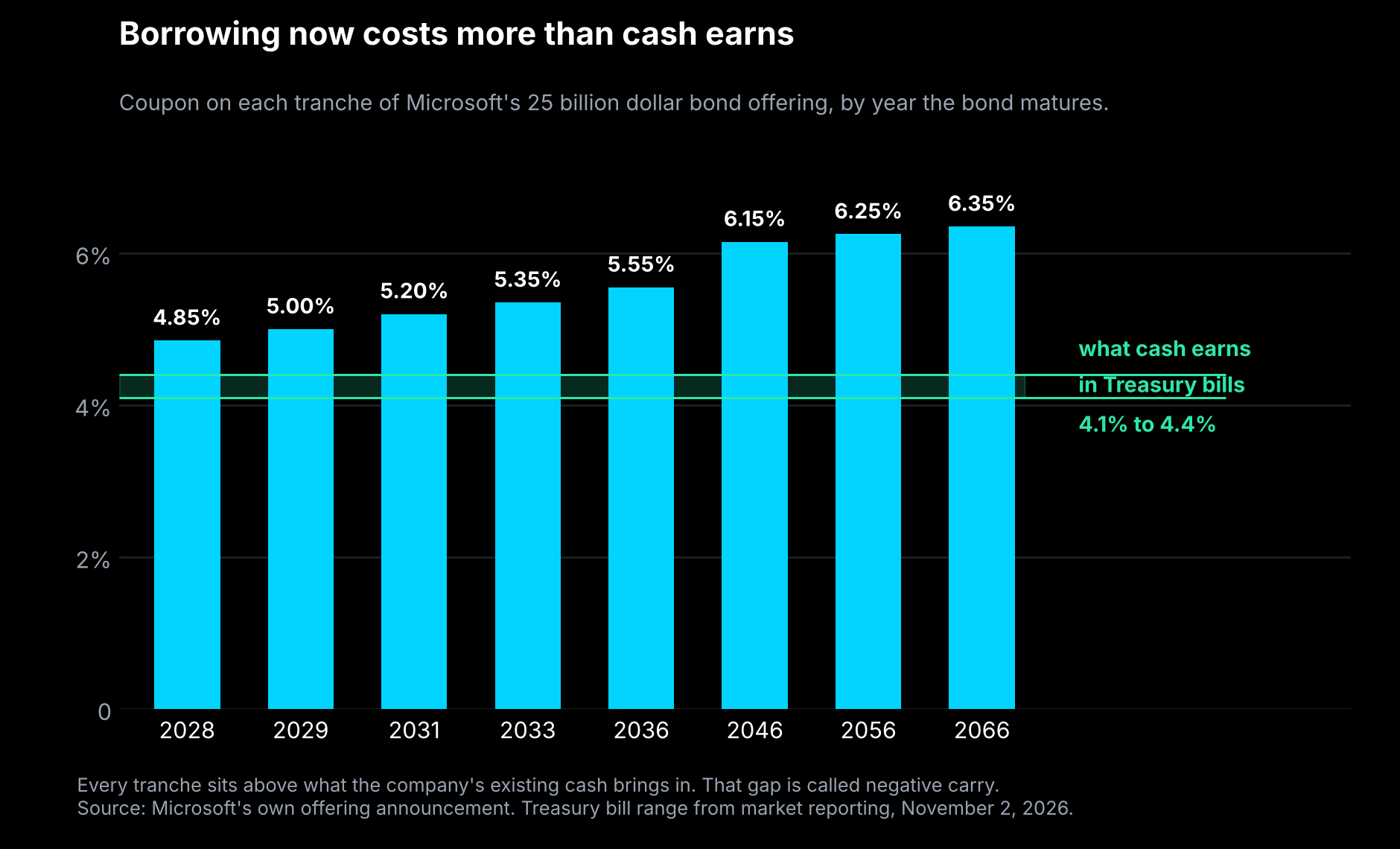
Microsoft priced twenty-five billion dollars of bonds on October 29. It did not issue one bond. It issued ten, each repayable in a different year, running from 2028 out to 2066. Each one of those is called a tranche, which is just the French word for slice, and the rate a bond pays each year is its coupon. Microsoft's ten-year slice pays 5.55%. Its forty-year slice pays 6.35%.
Corporate cash parked in short-term government bills currently earns somewhere around 4.1% to 4.4%.
Every single tranche costs Microsoft more than its cash earns. That is called negative carry, and it means the 2013 arbitrage has not just weakened, it has inverted.
Which leaves the reasons that do still hold.
Matching the loan to the asset. A data center is a building with a working life measured in decades. Funding a thirty-year asset with cash you might need next quarter is a risk you take only if you must. Microsoft issued paper running to 2066. Oracle's February deal also reached 2066. Those maturities are not an accident; they are roughly the life of the thing being built.
Keeping the buffer. Alphabet holds about $265 billion in cash and securities. It issued $25.1 billion of dollar bonds in the third quarter at a weighted average coupon of 5.55% and a weighted average maturity of fifteen years, and started a six billion euro deal on Monday. That is not a company that needs money. It is a company that would rather borrow while it can than run its reserves down.
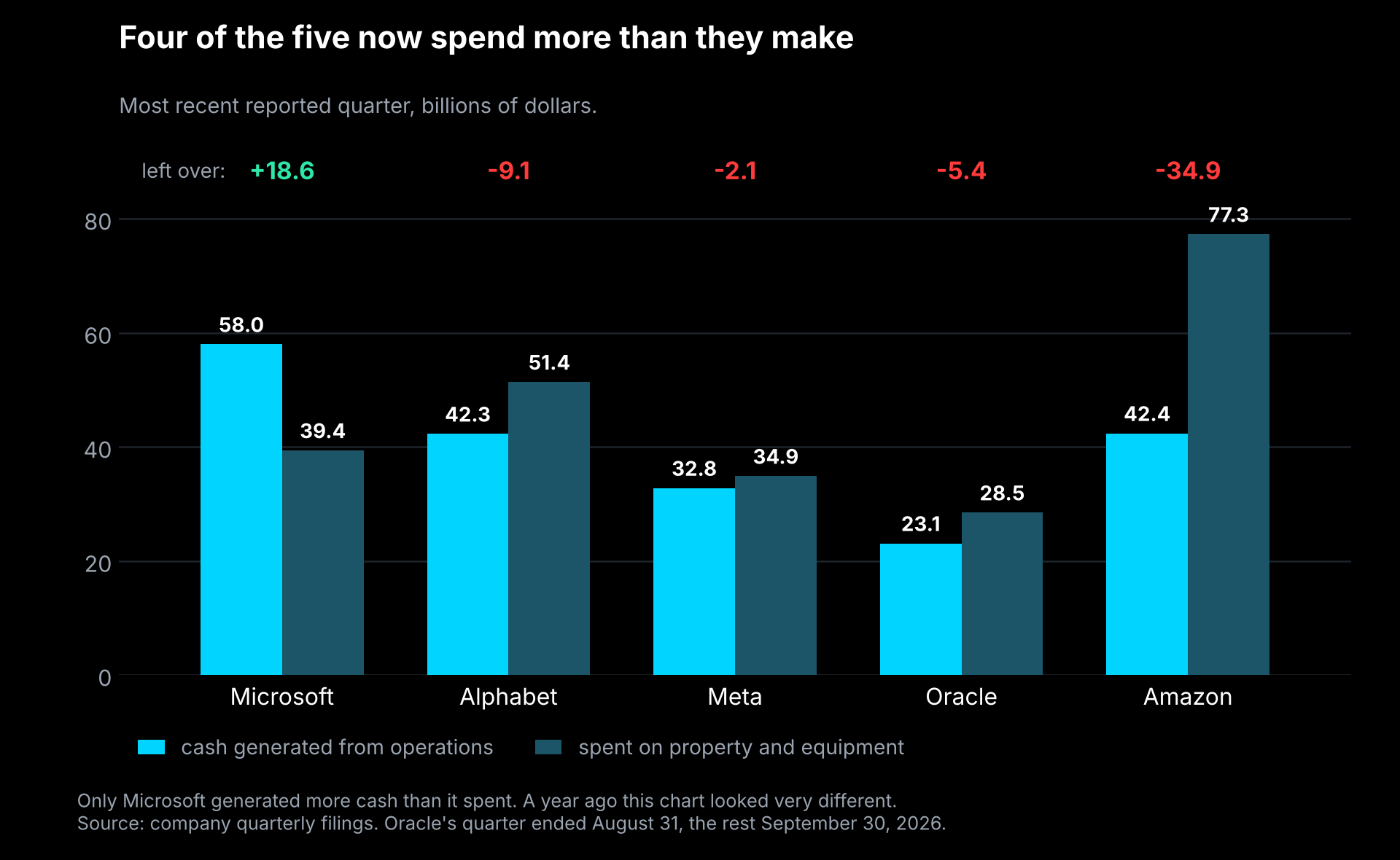
And for Oracle specifically, a reason that applies to none of the others. Oracle is not choosing between its cash and the bond market. In the quarter ended August 31, it generated $23.1 billion from operations and spent $28.5 billion on property and equipment, so it ended the quarter $5.4 billion short.
That shortfall has a name worth learning, because the rest of this article turns on it. Free cash flow is what a company has left after paying for the equipment and buildings it needs to keep operating. Cash in from the business, minus cash out for the physical assets. When it is positive, the company funds itself. When it is negative, the money has to come from somewhere else, and there are only two somewhere elses: lenders, or new shareholders.
Oracle's free cash flow was negative by about twenty-four billion dollars in its last full fiscal year. Its roughly thirty-seven billion of cash and securities amounts to about one quarter of its capital spending plan.
Oracle does not have the cash. That is the difference.
The half that does not have a name
You have almost certainly heard the word capex, short for capital expenditure. It is the money a company spends on physical things with a long life: buildings, machinery, servers. It is the number everyone quotes about artificial intelligence. We wrote a whole issue on what capex is and why the spending worries investors.
There is no equivalent word for the other half, and the reason is worth understanding, because it tells you something about how new this is.
Every public company publishes a cash flow statement each quarter. Think of it as a bank statement for the business, except every movement of money is sorted into one of three piles, because money moves for three different reasons.
Operating is the money the business itself brought in and paid out. Customers paying for cloud services, wages going out, electricity bills, tax. This is the company doing the thing it exists to do.
Investing is money going into long-lived physical assets, or coming back when the company parts with one. Servers, land, buildings, chips. Capex lives here. When you read that Amazon is spending two hundred and twenty billion dollars this year, this is the pile being described.
Financing is money moving between the company and the people who fund it. Borrowing from lenders and repaying them, issuing new shares, paying dividends. Oracle's twenty billion lands here.
So the structural partner to capex is not a different kind of spending. It is the financing pile, which in formal analysis gets written as cash flow from financing and occasionally shortened to CFF. Nobody says that out loud, and your friend at a barbecue has never heard it.
Four words do get used for this half, and commentary swaps them around carelessly, so they are worth separating.
Raising, or a capital raise, is the act itself. Oracle raised twenty billion dollars on Monday.
Issuance is bond market language and usually means debt specifically. You will see it in sentences like "hyperscaler issuance reached $182 billion this year."
Capital structure is the whole arrangement underneath a company: how much of it is funded by lenders and how much by shareholders. Every raise changes it.
Leverage is the result rather than the act. It describes how much debt a company carries relative to its size. Borrowing raises leverage, and leverage is the thing that makes lenders nervous.
None of those four is a neat shorthand the way capex is. Capex got a nickname because people needed to discuss it constantly. The financing line never got one, and the reason is simply that these particular companies barely used it. Microsoft had not issued a United States bond since 2017. The large cloud companies paid for their buildout out of pocket, which meant there was nothing much to name.
So I am going to give it one, and use it for the rest of this. CapIn. Capital in.
Capex is money going out the door into equipment. CapIn is the money coming in from lenders and shareholders to pay for it. That is not a standard term and you will not find it anywhere else, so do not take it into a meeting expecting to be understood. It is just easier than saying cash flow from financing nine more times.
And once you have a word for it, the thing it describes becomes easy to watch. Every quarter, for any company, you can ask what its capex was and what its CapIn was. If capex is large and CapIn is near zero, the company is paying its own way. If CapIn is climbing to meet capex, somebody else is funding the buildout and will eventually want a say.
Spending is a choice. Borrowing is a promise, and that difference is why the second one is a different kind of story. While these companies funded themselves, the only people who could object were shareholders, and a shareholder can do very little. They can complain, vote against a director, or leave. None of that stops a data center being built. A lender can decline to roll a bond over when it matures. A rating agency can cut you a notch and raise the price of every dollar you borrow afterward. Debt arrives with a calendar and with other people's permission attached.
So the spending number has not changed character. The line underneath it has.
What actually changed this year
This is the shift that makes it a story rather than routine corporate finance.
Until recently, the strongest argument against worrying about any of this was that the companies building artificial intelligence infrastructure were paying for it out of their own pockets. That was true. It stopped being true.
[[ CHART 3 HERE: debt_chart3 | Grouped bar chart titled "Four of the five now spend more than they make." Most recent reported quarter, in billions of dollars, showing cash generated from operations against capital spending for each company. Microsoft generated 58.0 and spent 39.4, a surplus of 18.6. Alphabet generated 42.3 and spent 51.4, a shortfall of 9.1. Meta generated 32.8 and spent 34.9, a shortfall of 2.1. Oracle generated 23.1 and spent 28.5, a shortfall of 5.4. Amazon generated 42.4 and spent 77.3, a shortfall of 34.9. Only Microsoft is in surplus. Source: company quarterly filings. ]]
One company out of five still generates more cash than it spends.
CapIn followed, exactly as you would expect. Michael Hartnett, chief investment strategist at Bank of America, put bond issuance by the largest cloud companies at $182 billion in 2026, against $17 billion in 2024. That is the number doing the work in this whole article. Two years ago the funding side was close to a rounding error for these companies. Now it is the size of a mid-sized country's borrowing. Over the same stretch their share repurchases collapsed to an annualized $14 billion, from $105 billion in 2024. Money that used to go to shareholders is going into the ground instead.
Three structures from the past week show how far this has traveled.
Meta raised $37.5 billion on October 26, and the shape of it is unusual. Twelve and a half billion came as mandatory convertible preferred stock paying 6.50%. The other twenty-five billion came from placing forty million shares at $625.00 each through something called a forward sale agreement, which means Meta receives no cash now. About $24.9 billion settles on or before November 19, 2027. The company locked in today's price for money it collects next year.
Amazon disclosed something in its third-quarter filing that has barely been noticed. A secured facility of up to approximately eighty billion dollars, drawable at its own discretion from early 2027 through late 2028, with a security interest granted in certain purchased assets. Nothing has been drawn. But a secured facility means collateral, and the collateral here is the equipment itself. That is a company arranging to borrow against its own servers.
And Meta's prospectus contains a disclosure worth reading carefully. It names Nvidia, Advanced Micro Devices and Broadcom as "Cornerstone Investors" who have indicated an interest in purchasing up to five billion dollars of the shares Meta is issuing. The same filing states plainly that these indications "are not binding agreements or commitments to purchase."
Both halves of that matter. Three of Meta's largest chip suppliers signaled interest in funding the company that purchases their chips, and none of them is obliged to do anything. Report only the first half and you have invented a deal.
Same announcement, completely different situations
The last thing to separate is that "AI giants are borrowing" treats five very different companies as one.
Microsoft raised twenty-five billion while generating $18.6 billion of free cash flow in a single quarter and holding $64.5 billion in cash. Its total debt before this deal was $35.5 billion, so the offering is roughly seventy percent of everything it already owed, added in one day. It is rated triple-A, the highest there is, and its new ten-year money came at about 64 basis points above the equivalent government bond. A basis point is one hundredth of a percentage point, so that is a premium of roughly two thirds of one percent for lending to Microsoft instead of to the United States.
Oracle raised twenty billion while burning cash, carrying $125.3 billion of debt against thirty-seven billion of cash and securities. In July, S&P Global Ratings cut it to BBB minus, which is the lowest rung of investment grade, one notch above the category informally called junk. S&P cited mounting debt and sharply negative cash flow. Moody's affirmed its own rating on Monday with a negative outlook. Oracle's new twenty-year paper was reportedly talked at around 360 basis points over governments, roughly five and a half times Microsoft's premium.
Same week. Same market. Same story about artificial intelligence. One of these companies is borrowing because the arithmetic favors it. The other is borrowing because it has to.
There is one more Oracle number that makes the twenty billion look small. Its filings disclose lease commitments that have not yet commenced of about $288 billion. Those are obligations it has signed and that do not appear as debt on the balance sheet, because the leases have not started. The raise that moved the stock 8.8% is about seven percent of that figure.
What this does not tell you
It does not tell you Oracle is in trouble. BBB minus is still investment grade. Its remaining performance obligations, meaning revenue under contract and not yet delivered, stand at $664 billion, up more than two hundred billion in a year. Its own plan has spending peaking this year and next, free cash flow turning positive in the second half of fiscal 2028, and at least thirty billion of free cash flow in fiscal 2029. That plan may work.
It does not tell you how much of Oracle's backlog is OpenAI. You will read that it is about half. That figure is an estimate by S&P Global Ratings, not an Oracle disclosure. Oracle publishes no customer breakdown of its backlog at all. The widely quoted three hundred billion dollar OpenAI contract comes from newspaper reporting in September 2025 and Oracle has never confirmed the amount. It has confirmed only that contractual commitments exist.
It does not tell you the money is going into artificial intelligence. Every one of these filings says the proceeds are for "general corporate purposes." Oracle's lists capital spending, repaying debt, acquisitions, dividends and share repurchases among the possibilities. The word artificial intelligence does not appear in the use of proceeds section. The AI framing is commentary, including management's own.
It does not tell you the borrowing is unwise. Robert Schiffman, a senior credit analyst at Bloomberg Intelligence, argues these are strong credits and that widening spreads reflect a flood of new supply rather than deteriorating finances. His view of where the real risk sits is blunt: the bubble people are discussing, he says, is in equity valuations. Hartnett at Bank of America makes a related point, that bondholders are now being treated better than shareholders because retained cash stays inside the company.
And it does not tell you the borrowing is safe. Torsten Slok, chief economist at Apollo, has documented that the gap between the cost of insuring hyperscaler debt and insuring bank debt widened to about sixty basis points, from near zero a year earlier, and that demand for these bonds thinned sharply through the year. His more fundamental objection is a sentence worth sitting with: that the marginal cost of producing computing power exceeds the marginal benefit it delivers to users.
What you can take from this is a habit rather than a conclusion. When a company raises money, three questions tell you most of what the announcement means. Which kind did it choose, since the pecking order says shares come last. Could it have used its own cash instead, which separates Microsoft from Oracle entirely. And what did it promise beforehand, because Oracle's problem on Monday was not the twenty billion. It was that the company had described the same twenty billion as a ceiling five days earlier.
That is why we show the workings instead of a single figure. Techdamentals runs four separate valuation methods and displays the full range, because one number tells you where somebody landed and nothing about what it rests on.