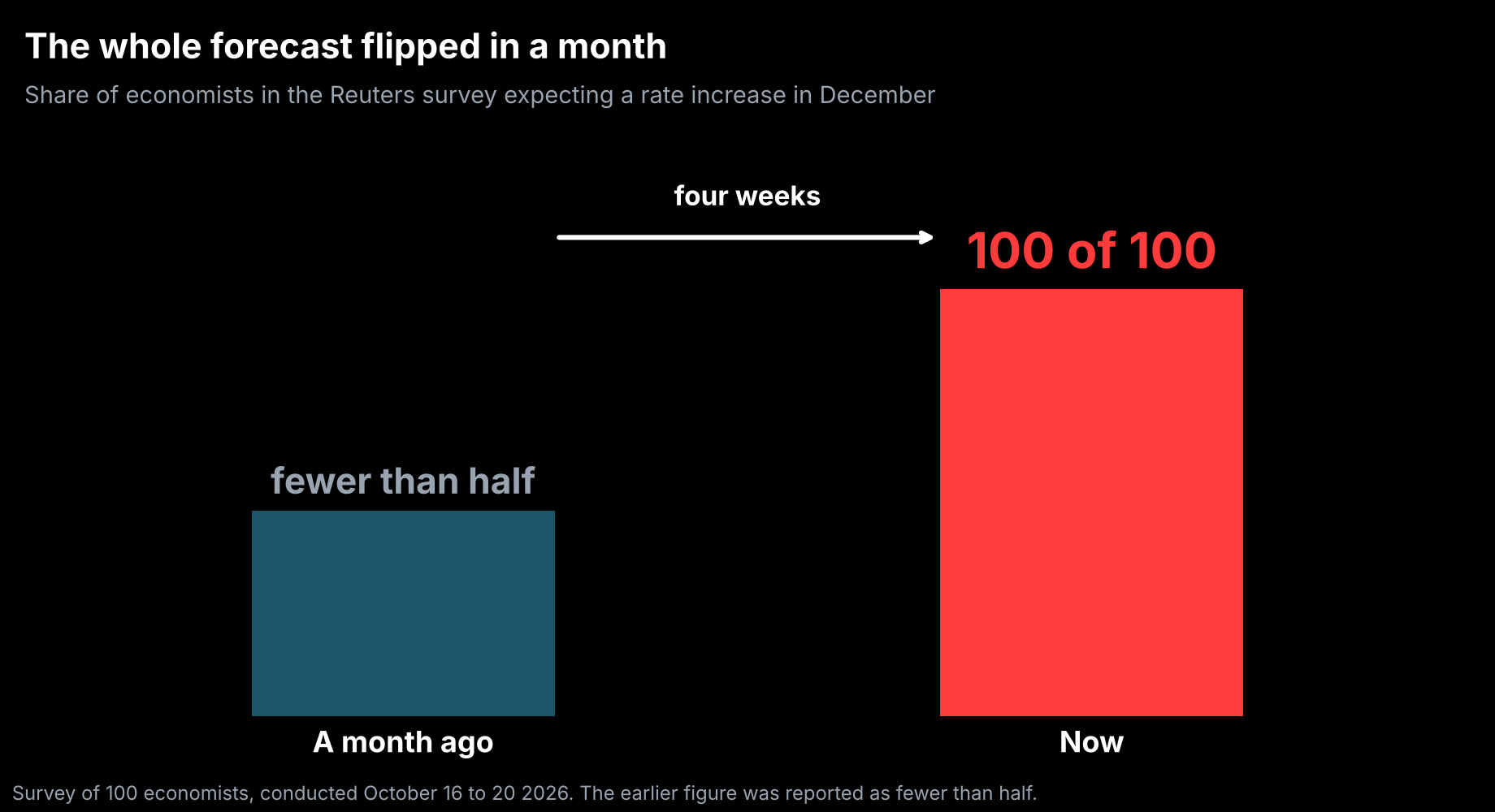
A month ago, fewer than half of the economists Reuters surveys thought the Federal Reserve would raise interest rates in December.
In the latest survey, all 100 of them do.
Not most. Not a strong majority. Every single economist asked.
That kind of unanimity is rare, and the shift behind it happened in about four weeks. Here is what moved, and why it matters more than any earnings report this week.
The Fed is raising, not cutting
Start here, because a lot of people still have the old picture in their heads.
The Federal Reserve raised its interest rate in September, by a quarter of a percentage point, to a range of 3.75% to 4.00%. That was the first increase since 2023, and the vote was unanimous.
The Fed meets again on October 27 and 28. Of the 100 economists in the survey, 94 expect no change at that meeting. All 100 expect an increase at the one after it, in December.
Looking further out, nearly 60% think the rate stops somewhere between 4.00% and 4.25%. But 38 of 92 forecasters now expect at least two more increases from here, which was about one in five a month ago.
So the direction of travel is not in dispute any more. The disagreement is about how far.
One calendar detail worth knowing. The October meeting lands six days before the November 3 midterm elections, and the December meeting lands after them. Since 1990 the Fed has changed rates inside the week before an election exactly once, in November 2022. That is not a rule, and the Fed says politics plays no part in its decisions, but it is a fact about the record that helps explain why forecasters cluster on December rather than October.
What changed in four weeks
Two inflation reports, both worse than expected.
Consumer prices. The September reading came in at 3.7% against the same month a year earlier, up from 3.4% in August. Month over month it rose 0.6%, which is a fast clip. Core inflation, which leaves out food and energy, went to 2.6% from 2.4%.
Producer prices. This is the one that did the damage, and it is the number most people have never heard of. Producer prices measure what businesses charge each other, before anything reaches a shop. September came in at 1.3% in a single month, against the 0.5% expected, and 6.3% over the year against 5.3% expected. The core version was 0.7% in the month, more than double the 0.3% forecast.
Here is why that second one matters so much. Producer prices sit upstream of consumer prices. When the cost of a thing rises at the factory, it generally reaches the shelf a few months later, because businesses do not absorb cost increases forever. So a hot producer price report is not news about today. It is a preview of consumer prices a few months out.
Two reports pointing the same way, one of them pointing forward, and the forecasts moved.
Which inflation number is the real one
Now a thing that confuses almost everyone, because there are three different inflation numbers in circulation and they do not agree.
| Measure | Latest reading |
|---|---|
| Consumer prices, headline | 3.7% |
| Consumer prices, core | 2.6% |
| Personal consumption expenditures, core | 3.0% |
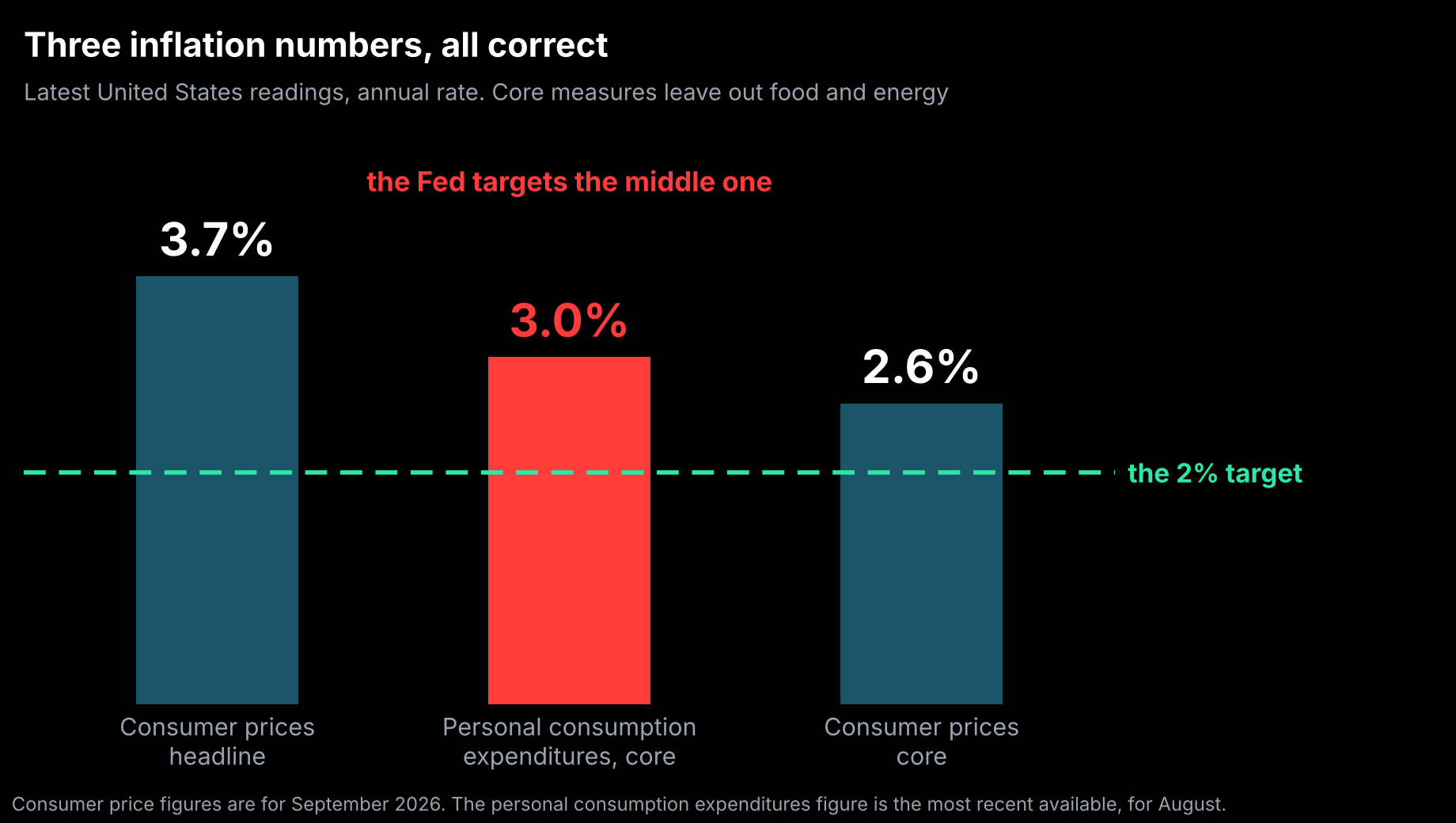
All three are correctly calculated. They differ because they measure different baskets of things in different ways, and because core measures leave out food and energy, which bounce around for reasons that have little to do with the economy overheating. We went through why the first two disagree in an earlier issue.
The one the Fed actually targets is the third one. Personal consumption expenditures, usually shortened to PCE, is the measure the 2% target refers to. It tends to run a little below consumer price inflation because it adjusts for people switching to alternatives when something gets costly.
So when you hear "inflation is 3.7%" and "the Fed targets 2%", those two numbers are not even measuring the same thing. The honest comparison is core PCE at 3.0% against a 2% target. Still a full percentage point above. Just not as far above as the headline suggests.
The part that does not get said out loud
Here is the line in the survey that should have been the headline.
Economists expect inflation to stay more than a full percentage point above the 2% target for the coming quarters, and not to return to target until at least 2028.
Inflation has now been above the Fed's target for close to six years.
Sit with that. The Federal Reserve has one widely understood job, keeping inflation near 2%, and by the consensus of the people who forecast it for a living, it will have missed that target for roughly eight years by the time it gets back.
That is the context for the hikes. The Fed is not raising rates because the economy is overheating today. Growth is forecast at 2.3% this year and 2.1% next, which is unremarkable. It is raising rates because the thing it is supposed to control has not responded, and because there is an argument inside the Fed, which we covered when the chair spoke last week, about whether the enormous spending on AI data centers is pushing prices up now or will push them down later.
Two quotes from the survey give you the tone better than any summary. Mizuho: "They'll go 25 in December, but the risk is greater they end up going 50 than they don't go at all." Morgan Stanley: "The risks are in the direction of a Fed that ultimately needs to hike rates more than we expect."
Both of those are people saying the risk is to the upside of the forecast they just gave you.
What this does not tell you
It does not tell you what the Fed will do. A hundred economists agreeing is a strong signal and it is also just a forecast. Less than half of this same group expected a December increase a month ago, which is a reminder of how quickly this consensus formed and how quickly it could unform. Two more inflation reports arrive before the December meeting.
It does not tell you rates are going up for you. The Fed sets a rate at which banks lend to each other overnight. A mortgage, a car loan or a credit card is priced off different things, and we have been through why a Fed move and a mortgage rate can go in opposite directions. The connection is real but it is loose and slow.
And it does not tell you this is bad for stocks or good for stocks. That question gets asked constantly and the honest answer is that it depends entirely on what was already assumed. If everyone already expects a December increase, and all 100 of them do, then the increase itself changes nothing when it arrives. What would move things is the Fed doing something different from the thing everybody has already written down.
That last point is really the same lesson three different numbers teach in this issue. Three inflation measures, all correct, all saying something different. A hundred forecasts that flipped in four weeks. A target that has been missed for six years by an institution that is very good at its job.
Single numbers are reassuring and usually incomplete. It is why Techdamentals produces a fair value with four separate methods and shows the range they span instead of one figure, because the width of that range tells you how much of the answer rests on assumptions that could move as fast as these forecasts just did.