In the last 48 hours, five large companies reported results.
All five came in at or above what analysts expected.
All five fell.
That is not a coincidence and it is not the market being irrational. It is the single most misunderstood thing about how share prices work, and this week it happened five times in a row clearly enough to point at.
The five
| Company | What it reported | What the stock did |
|---|---|---|
| Netflix | Revenue in line, margin above its own forecast, earnings above expectations | Fell about 6%, to a two-year low |
| Lam Research | Revenue up 54%, operating margin 40% against 34% a year ago | Fell about 9% |
| IBM | Beat on revenue and earnings, raised its cash flow forecast | Fell about 5.7% |
| Tesla | Adjusted earnings above expectations, deliveries above expectations, gross margin up | Fell about 5.3% |
| Meta | Revenue up 26%, ahead of expectations | Rose more than 7% after hours, then gave it back and fell about 1.9% |
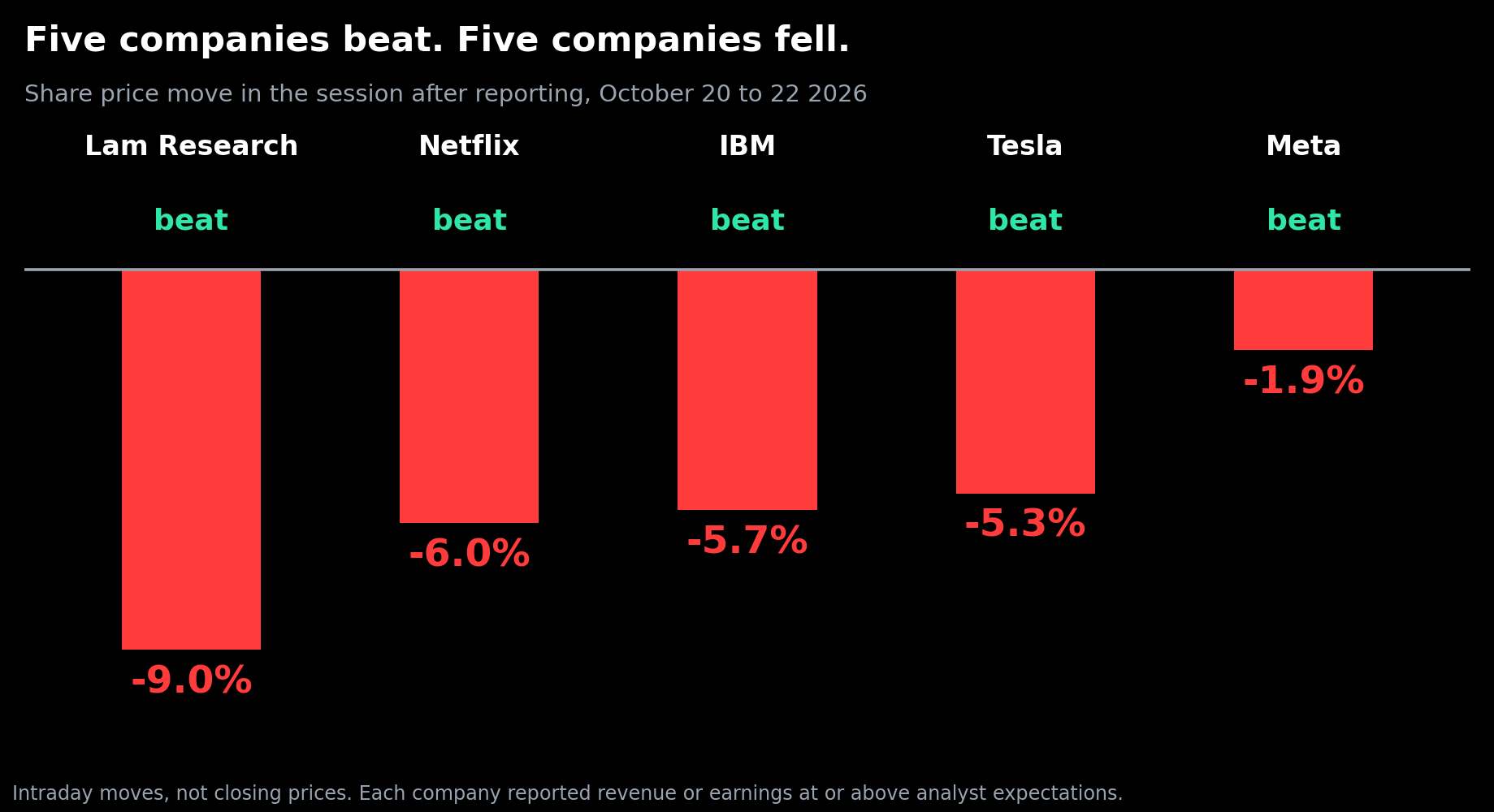
Five for five. Different industries, different problems, same direction.
What a share price is actually made of
Here is the thing that explains it, and almost nobody says it plainly.
A share price today is not a measure of how the company is doing. It is a number that already contains what people expect the company to do. Every forecast, every assumption, every guess about the next three years is baked in before the earnings release ever arrives.
So when results come out, the question the market is asking is not "were these good?" It is "were these different from what we already assumed?"
Those are completely different questions, and only the second one moves a price.
This is why a company can report its best quarter in years and fall. The good quarter was already in the number. People had spent three months pricing it in. When it arrives exactly as expected, nothing has changed, and a price only moves when something changes.
It is also why "beating expectations" is a weaker signal than it sounds. Analyst estimates are a published, widely known number. The real bar is not the published estimate. It is the unpublished one every holder is carrying in their head, which is usually higher.
Lam Research is the cleanest example this week. Revenue up 54%, operating margin up six points, and guidance for the next quarter roughly where people thought it would be. Nothing went wrong. Nothing got better than assumed either. The stock fell 9%.
The part that is actually new
Now the more interesting half, and the reason this week is worth writing about rather than filing as normal market noise.
In four of the five, the thing the market reacted to was not the quarter at all. It was a number about spending.
Netflix lowered its advertising forecast for the year and its cash flow forecast. Meta reported free cash flow of negative $2.12 billion, because it spent more on building data centers than the entire business produced in cash, and it raised the floor of its capital spending range for the year. IBM beat and raised its cash flow outlook but left its revenue growth forecast alone, and said about a quarter of its software growth came from deals that got pulled into the quarter. Tesla's operating profit fell 56%, almost entirely because operating expenses rose 39%, with research spending up 69%.
In every case the reported quarter was fine and the forward-looking line was what got priced.
Here is the detail that makes the pattern real rather than a story I am telling you.
Meta raised its spending plans and fell. Tesla cut its spending plans and also fell.
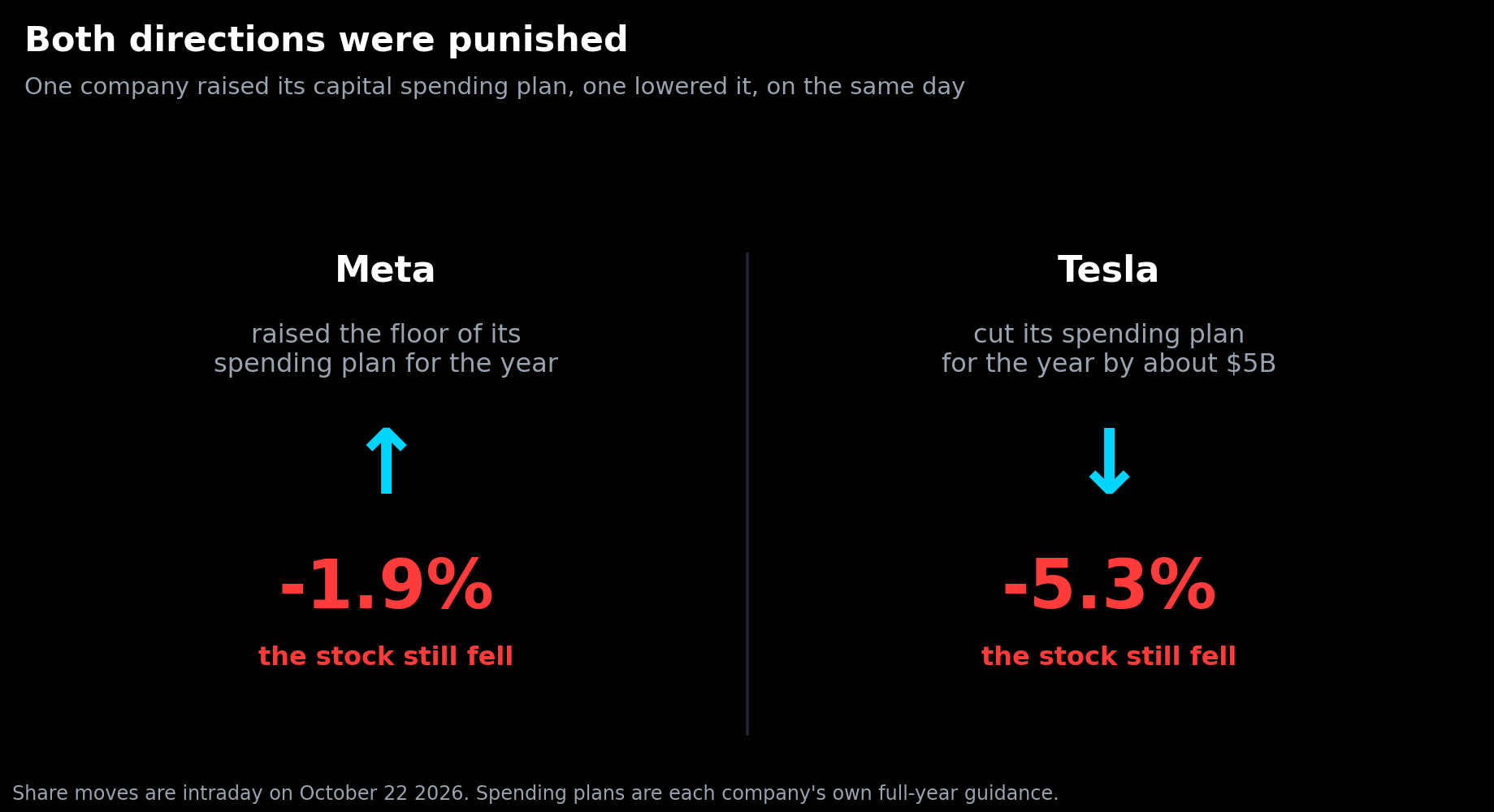
Those two cannot both be explained by "the market has turned against AI spending." If that were the rule, Tesla spending less would have been rewarded.
What explains both is something narrower. For about two years, announcing a larger AI budget was treated as good news on its own, because it