Tesla kept more money from every car it built this quarter than it did a year ago.
Tesla's operating profit fell 56%.
Both of those are true. They come from the same page of the same release. And the distance between them is probably the single most useful thing a person can learn from reading an earnings report, because it is where most of the confusion about company profits lives.
Two margins, and the difference between them
A company has more than one profit, and which one you look at changes the answer completely.
Gross margin is what is left from each revenue dollar after the direct cost of making the thing. For a car company, that is the metal, the battery, the parts, the factory labour and the electricity to run the line. It answers one question: is the product itself a money-making product?
Operating margin is what is left after you also pay for everything else the company does. Engineers who are not building this year's car. Executives. Marketing. The research teams working on products that do not exist yet. It answers a different question: after everything, is the company making money?
Here is Tesla on both measures, against the same quarter a year ago.
| A year ago | Now | |
|---|---|---|
| Gross margin | 18.0% | 19.6% |
| Operating margin | 5.8% | 2.6% |
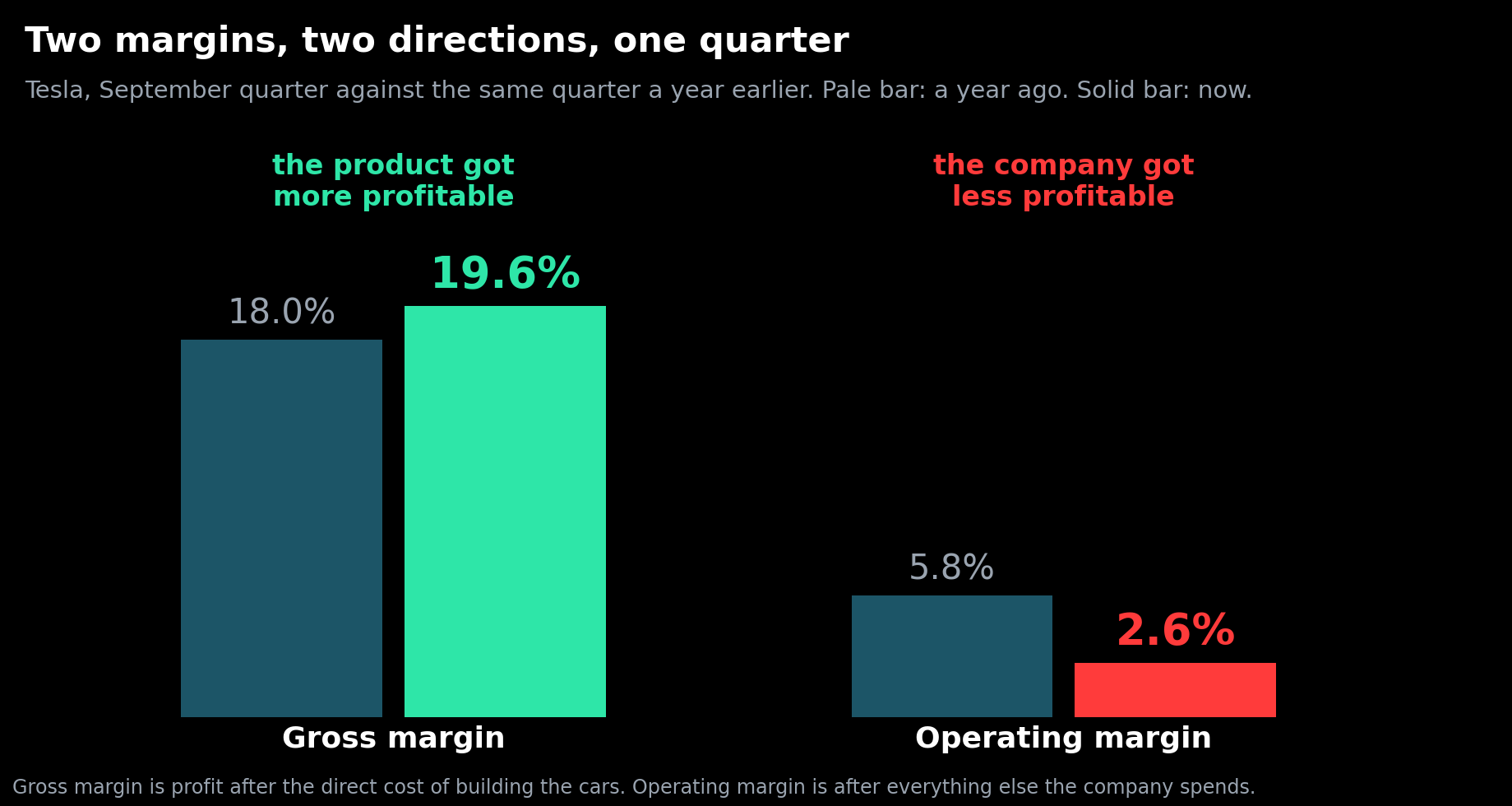
One went up. The other fell by more than half. That is not a contradiction and it is not an accounting trick. It is the whole story in two rows.
The car business got better. Automotive gross margin excluding regulatory credits, which is the cleanest look at whether a Tesla earns money as a product, came in at 18.1% against 15.4% a year ago. Gross profit in actual dollars rose to $5.494 billion from $5.054 billion, on revenue that was essentially flat at $28.0 billion.
Then everything underneath it got more costly.
Where the money went
Operating expenses rose 39%, to $4.78 billion. That one line is larger than the entire change in anything else.
Inside it, research and development rose 69%, to $2.761 billion from $1.630 billion. That is the spending on humanoid robots, on the autonomous driving software, on the Cybercab, on the chips. None of it built a single car that was delivered this quarter.
You can close the gap exactly, which is worth doing because it removes any argument about what happened.
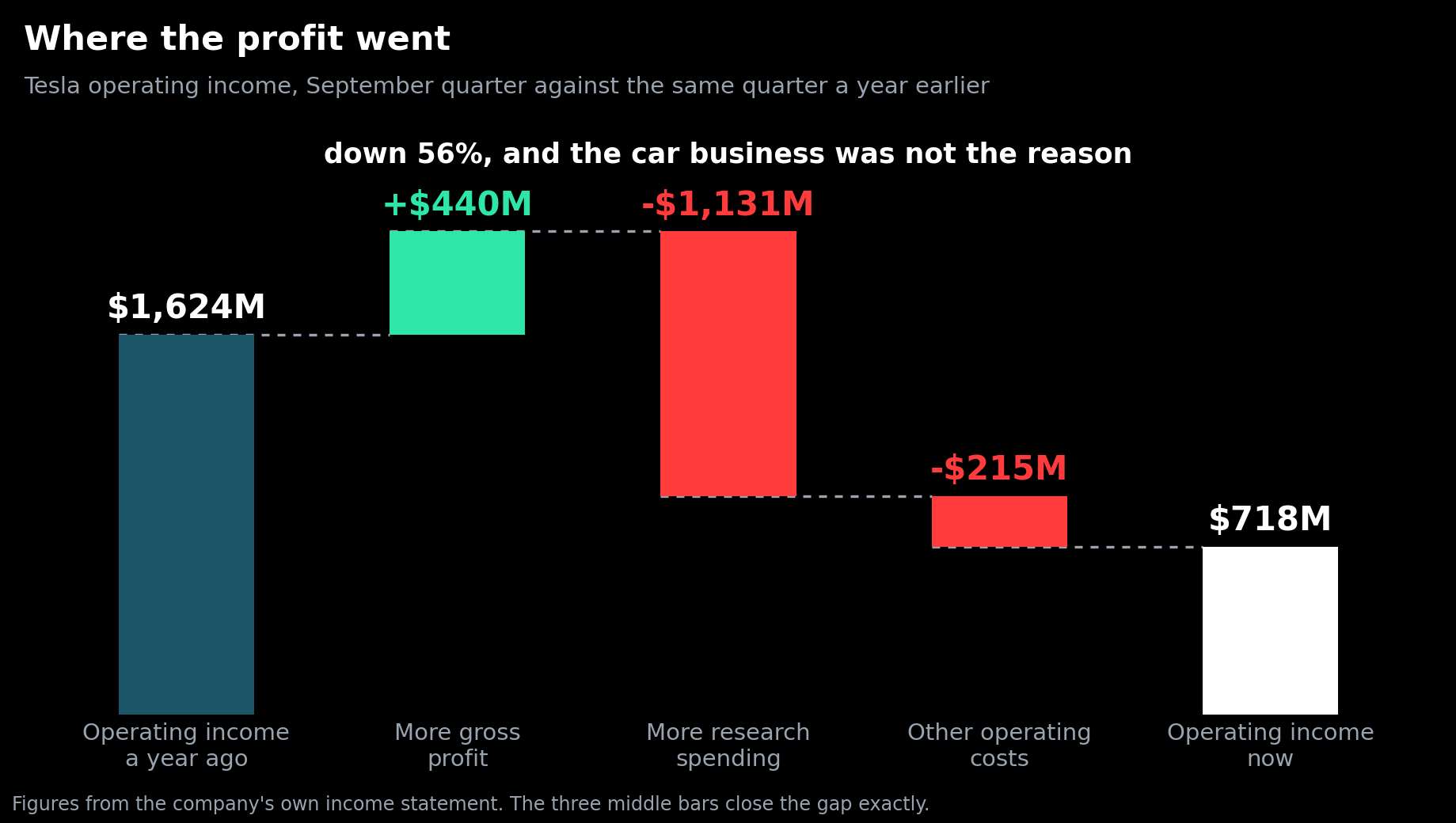
Start with operating income a year ago, $1.624 billion. Add $440 million, because gross profit genuinely improved. Take away $1.131 billion for the extra research spending. Take away another $215 million for the rest of the operating cost changes. You land on $718 million, which is the number Tesla reported.
So the answer to "what happened to Tesla's profit" is not that cars stopped working as a business. It is that the car business earned $440 million more and the company spent $1.3 billion more on things that are not cars.
Whether that is a good decision is a separate question, and an honest one. Money spent on a product that does not exist yet is either an investment or a waste, and no single quarter can tell you which. What the quarter can tell you is the size of the bet, and the size is most of the operating profit.
The line almost nobody reads
There is a third thing in here, and it gets skipped in nearly every write-up.
Regulatory credits fell 73%, to $113 million from $417 million.
Those credits are worth explaining because they are strange. Governments require carmakers to hit emissions standards. A company that misses can pay a company that beats them for the difference. Tesla, making only electric cars, has spent years on the receiving end of that arrangement.
The important part is what it costs Tesla to produce that revenue, which is approximately nothing. There is no factory, no parts, no labour. It arrives as almost pure profit.
So losing $304 million of it is not like losing $304 million of car revenue, where most of that money was going out the door to suppliers anyway. It is $304 million straight off the bottom line, and it accounts for roughly a third of the entire operating profit decline on its own.
That is what happens when the rest of the industry catches up on electric vehicles. The arrangement that paid Tesla for being early pays less as fewer companies need it.
Spending more and planning to spend less
One more thing from the earnings call, because it looks like it contradicts everything above and does not.
Tesla cut its capital spending plan for the year, to about $20 billion from a previous figure of more than $25 billion. The finance chief described it as managing capital deployment efficiently.
If the company is spending heavily on AI, why is the spending plan coming down? Because those are two different kinds of spending and companies treat them differently.
Operating expenses are money spent on this year's activity, like paying an engineer's salary. It hits the profit line this year, in full.
Capital expenditure is money spent on something lasting, like a building or a machine. It does not hit the profit line all at once. It sits on the balance sheet and gets charged against profit slowly, over the years the asset is used.
So Tesla raised the kind of spending that reduces profit immediately and lowered the kind that does not. Capital spending still more than doubled from a year ago, to $4.73 billion in the quarter. The plan for the rest of the year simply came down from where it was.
Free cash flow was $1.53 billion, down 62% from $3.99 billion. Cash and investments finished at $45.4 billion.
What this does not tell you
It does not tell you demand fell. This is the part that cuts against the headline, and leaving it out would be dishonest. Deliveries were 486,532, which is down 2% from a year ago but well above the roughly 462,000 analysts expected. Tesla said battery availability, not orders, was the limiting factor on volumes, and that it is sitting on the largest passenger vehicle backlog in four years. Inventory fell to 11 days of supply. A company that cannot build fast enough has a different problem from a company nobody wants to order from.
It does not tell you which profit number is the real one. Operating profit fell 56%. Net income fell 43%, to $787 million, partly because of a paper loss on Tesla's stake in SpaceX, which we looked at in an earlier issue. On the adjusted measure that excludes some of these items, earnings came in at $0.48 a share against about $0.45 expected, which is why the first headlines said Tesla beat. All three are correctly calculated. They are measuring different things, and a company gets to choose which one it puts in the press release.
And it does not tell you the spending will work. That is the entire question and this release does not touch it. The research budget nearly doubled on the strength of products that mostly are not shipping. The timeline the chief executive gave for humanoid robots reaching volume was at least a year, maybe longer. Everything above is a measurement of what has already happened. What it cost is known. What it returns is not.
That is the gap every valuation has to cross, and it is why a single number is the wrong shape for an answer. A company earning less today in order to earn more later is either trading away its future or building it, and the methods that value it disagree most loudly in exactly that situation. Techdamentals runs four of them and shows the full range rather than picking one, because when a company is mid-bet, the distance between the methods is the most honest thing on the page.