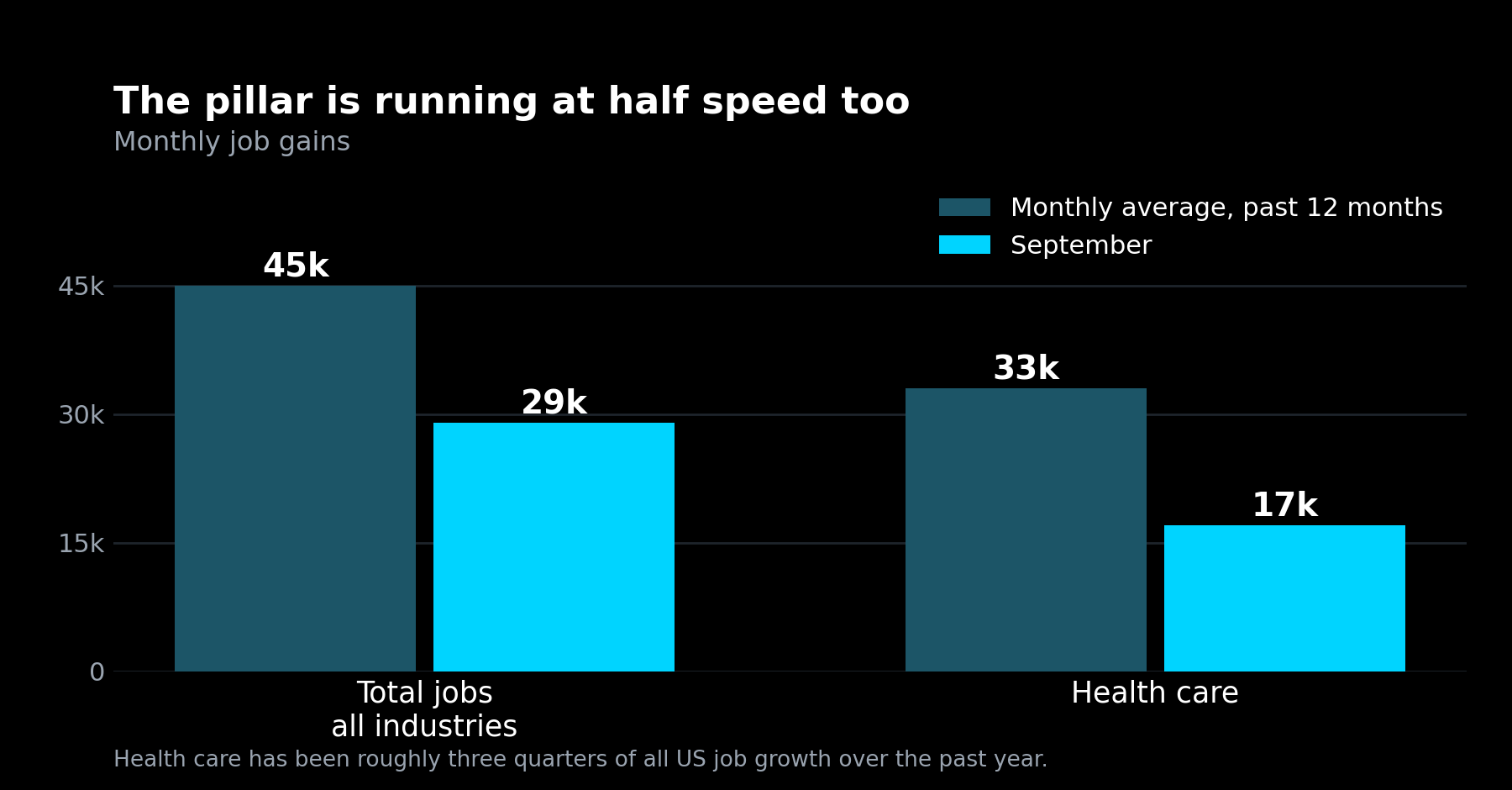
The economy added 29,000 jobs in September. Health care added 17,000 of them.
Zoom out and it's starker. Over twelve months, total job growth averaged 45,000 a month. Health care was 33,000 of that.
So roughly three quarters of all US job growth, for a year, has come from one industry.
The obvious read is the wrong one
Most people who notice this conclude health care is booming.
It isn't, particularly.
The Budget Lab at Yale compared where health care employment landed in 2026 against what the BLS projected a decade earlier. The gap was a tenth of a percentage point. Health care is growing almost exactly as forecast, for reasons obvious in 2016: an aging population, more treatments, and work that's hard to automate or send overseas. You can't nurse somebody from another country.
What's off forecast is everything else. Retail, professional services, leisure and hospitality all came in under.
So health care isn't carrying the labor market because it got stronger. It's carrying it because the rest got weaker. That's a different problem, and a worse one.
What's actually inside the health care number
The 17,000 breaks into three pieces.
These categories sort by where people work, not what they do. A nurse in a hospital counts under hospitals. A nurse in a care home doesn't.
Ambulatory services added 13,000. That's care without an overnight stay: doctors' offices, outpatient surgery, labs, home health.
Hospitals added 12,000.
Care homes, meaning nursing homes and assisted living, lost 9,000.
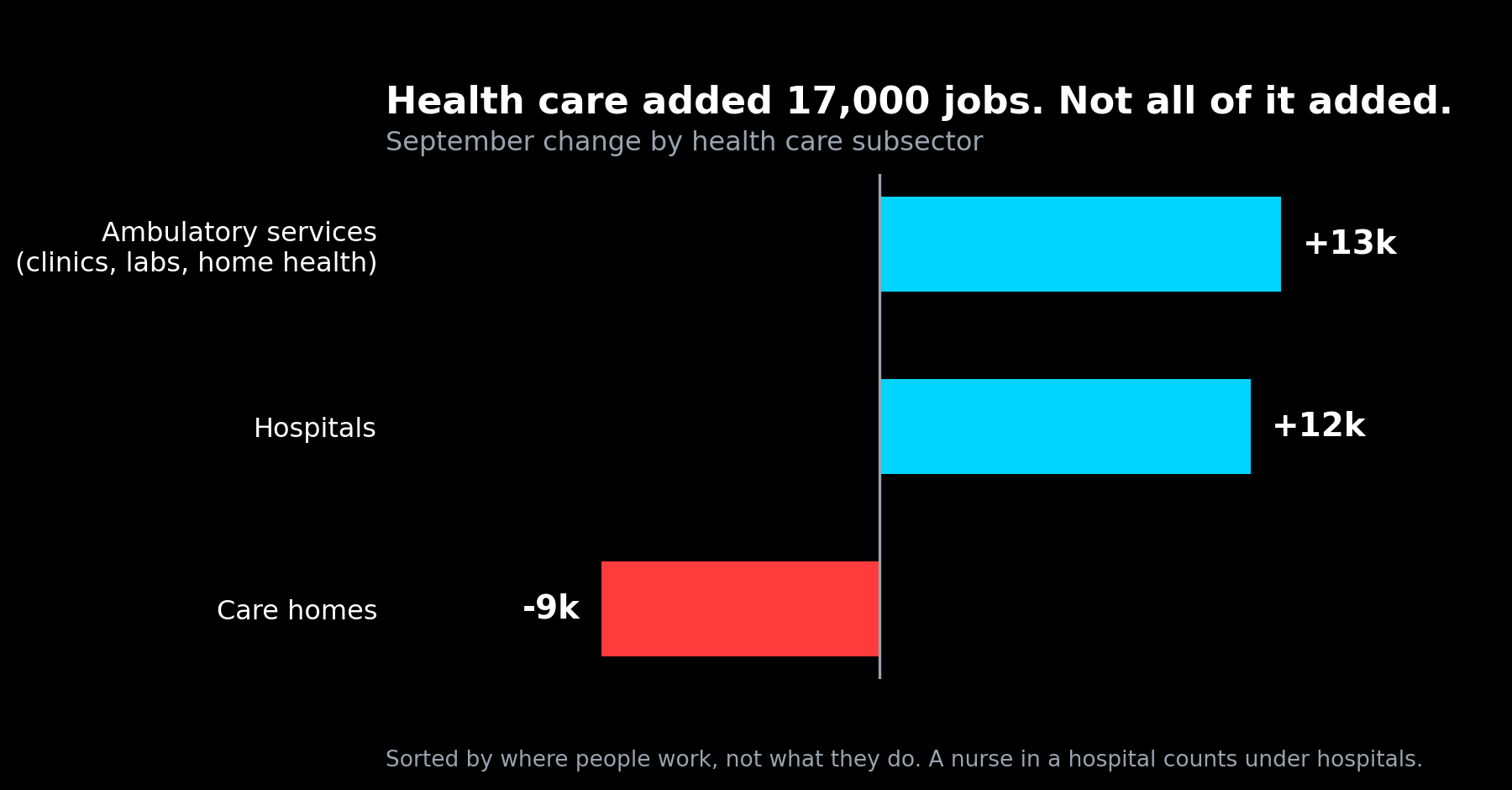
So the hiring is in clinics and hospitals. The losses are in care homes.
Those aren't interchangeable jobs. Hospital work pays better and is easier to fill. Care homes run on aides and assistants near the bottom of the wage scale, and struggle to keep them.
The part of health care that's growing is the better-paid part. The part losing people was already short-staffed.
Health care itself is also slowing. September's 17,000 was about half its own average for the past year. The pillar holding up the jobs report is at half speed.
Add up health care, construction and manufacturing and you get more than the month's total. So everything else, taken together, was slightly negative.
Why this matters more than it sounds
Health care is roughly 22% of the Fed's preferred inflation gauge, against about 7% of CPI. We went through why in Wednesday's issue.
The Fed has two jobs: stable prices and high employment. One industry is now most of one and a large slice of the other.
And a lot of it runs on government money. Medicare, Medicaid and insurance subsidies fund a big share of US health spending, and those programs don't just pay for care. They set prices for it. When Congress changes what Medicare pays for a procedure, that new price lands directly in the Fed's inflation gauge, because PCE counts what gets paid on your behalf.
So a reimbursement schedule can move the inflation number with nothing happening in the economy. The same decision moves hiring at the employers producing most of the job growth.
One vote, three outcomes. Those used to be separate conversations.
It also leaves the Fed in a bind. Weak hiring argues for easing. But the industry doing the hiring is also a large slice of the inflation it's trying to bring down. The same sector sits on both sides of the mandate, pulling opposite ways.
What this doesn't tell you
Monthly industry figures are noisy and get revised. This report cut July from +21,000 to -10,000.
"Three quarters of job growth" is a share of a small number. When the total is 45,000, any steady industry looks enormous. That's arithmetic as much as significance.
Why the other industries underperformed is contested. Yale points to slower labor force growth from immigration policy. That's one argument, not settled fact.
And jobs are not output. An economy can add workers while producing less.
The habit is the same as always. A total hides its own composition. Techdamentals shows every input behind a fair value for the same reason: the number matters less than what's inside it.