The US has two official measures of inflation. One says 2.4%. The other says 3.3%.
Same country, same prices, nearly a full point apart. The higher one is called PCE, and it's the only one the Fed acts on.
Why there are two inflation numbers
The one you see on the news is CPI. The Labor Department asks households what they purchase and what they pay out of pocket for it.
The other is PCE. The Commerce Department asks businesses about their sales, and it counts things paid for on your behalf.
That second part is the whole difference. If your employer pays $18,000 a year for your health insurance and that premium jumps 8%, CPI never sees it. You didn't pay it. PCE sees all of it, because somebody paid it for you.
The Fed has used PCE as its official yardstick since 2000.
Count different things and you weight them differently too.
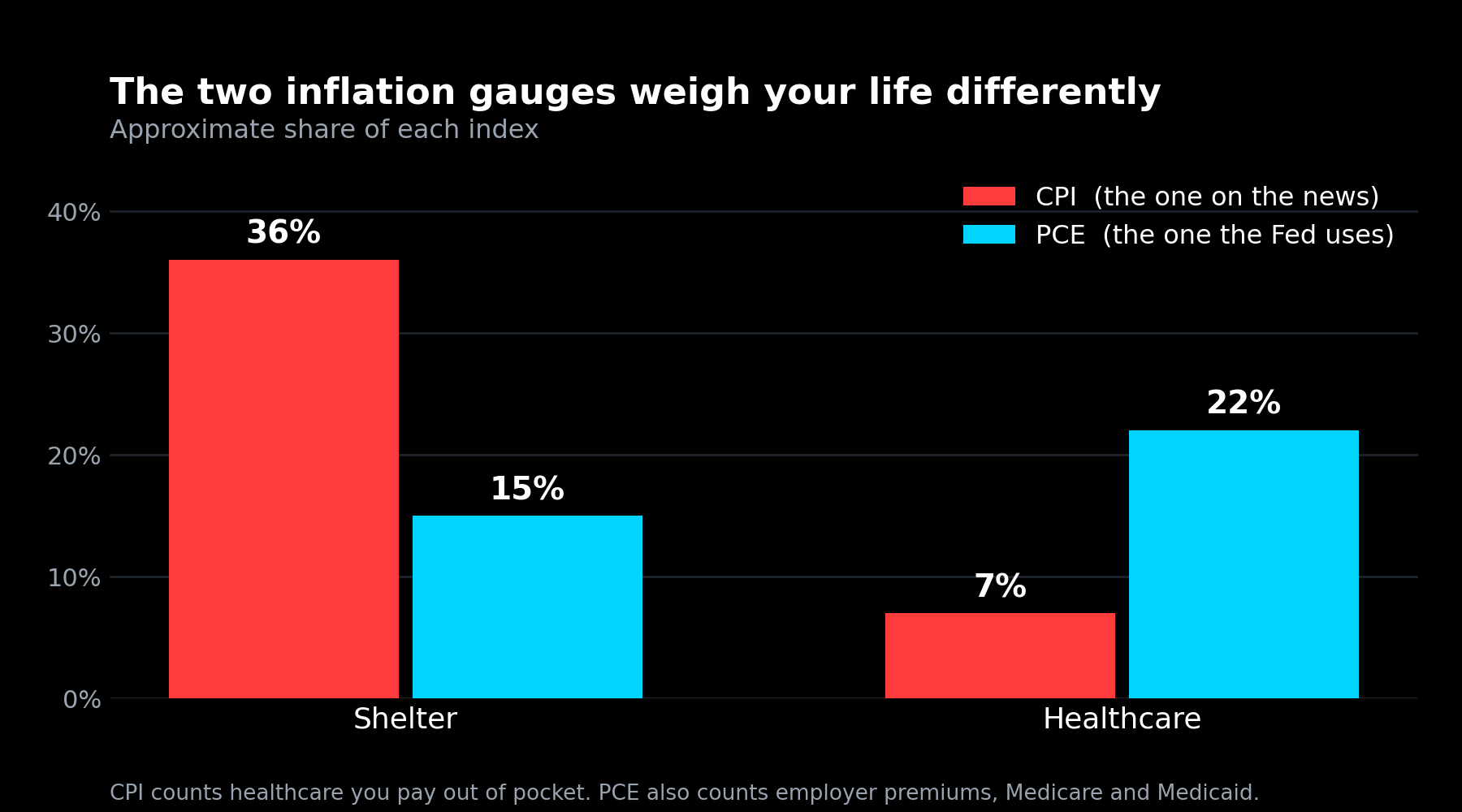
Shelter is roughly 36% of CPI. In PCE it's about 15%.
Healthcare runs the other way. It's around 7% of CPI, the share you pay yourself. In PCE it's closer to 22%, because employer premiums, Medicare and Medicaid all land inside it.
Which is why they're pulling apart right now
Two things are happening at once. Rent growth is cooling, meaning rents still rise but more slowly. And healthcare costs are climbing as procedures deferred during the pandemic finally get done.
Now run each through the baskets.
Cooling rent pulls CPI down hard, because rent is more than a third of it. It barely touches PCE, where rent is 15%.
Climbing healthcare barely touches CPI, where it's 7%. It pushes PCE up, because there it's 22%.
Same two facts. Opposite effect, entirely because the baskets are different shapes.
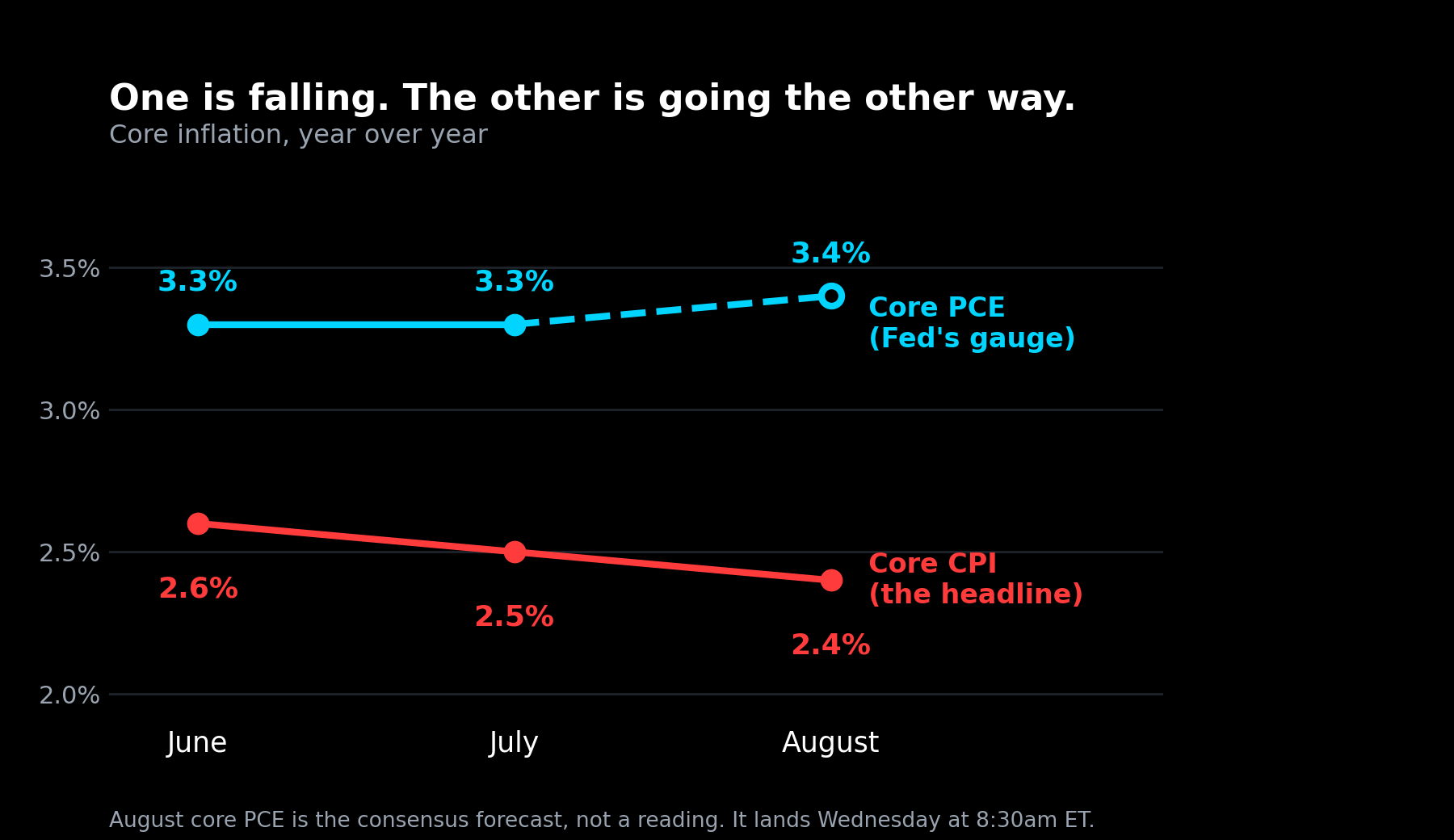
Core CPI went 2.6%, then 2.5%, then 2.4% in August, the lowest since March 2021. It's being celebrated as proof inflation is finally beaten. Core PCE has sat at 3.3% for two straight months and is expected to tick up.
So the good news everyone is pointing at is mostly rent cooling. And the Fed's gauge barely counts rent.
What lands Wednesday
August PCE, 8:30am Eastern, before the open.
Consensus is 0.3% for the month on core, which takes the annual rate to about 3.4%. It's the last core reading before the Fed meets on October 28, where traders are pricing roughly 70% odds of another increase.
Rough thresholds: 0.4% on the month strengthens the case for October, 0.2% or lower pushes the conversation to December.
But here's the part almost nobody will mention. This release also carries annual revisions, and they reach back to 2021. Fed governor Waller has said downward revisions to some non-market prices look likely.
Non-market prices are the odd corner of PCE. They're estimates for things nobody actually pays for, like the services a bank provides you free. CPI doesn't include them at all. PCE does, and they get revised.
So the number on the screen tomorrow could read 3.4% while the history underneath it quietly moves.
What this doesn't tell you
Neither one is the correct measure. It depends what you're asking.
For your own cost of living, CPI is closer. It tracks what actually leaves your wallet, and it's what Social Security adjustments are indexed to.
For what the Fed is going to do, it's PCE and nothing else. That's the number the 2% target refers to.
Your wallet reads CPI. Your portfolio reads PCE.
A print is a first draft, not a verdict. One month proves little either way, and the gap could close from either direction or persist.
This is the same problem underneath every valuation. Two people can look at one company and reach different numbers, not because either is careless, but because they weighted the inputs differently. Techdamentals shows every input behind a fair value, so you can see which assumption is doing the work.