On Thursday, TIME published an interview in which Trump was asked why the government hadn't taken shares in OpenAI and Anthropic the way it did with Intel.
He ruled out nationalizing them. Then he said this: "I might. Maybe I could do that. I have many deals like that. I do that."
Nothing is agreed, and a maybe is worth exactly nothing. But the second half of that quote is the part worth sitting with, because it's true. He does have many deals like that. More than most investors realize.
Intel is the one with real numbers attached, so start there.
What the deal actually was
In August 2025, the government took 433.3 million shares of Intel at $20.47 each. That's $8.9 billion, and Intel described it as 9.9% of the company.
Intel closed at $24.80 that same day, so the price was about 17% under the market.
Here's the cleaner way to see it. Three days earlier, SoftBank had agreed to put $2 billion into Intel at $23 a share. Same company, same week, an ordinary investor paying a real price.
The government paid $20.47. That's 11% less than what SoftBank paid seventy-two hours before.
Now the part that matters, and it's in Intel's own press release.
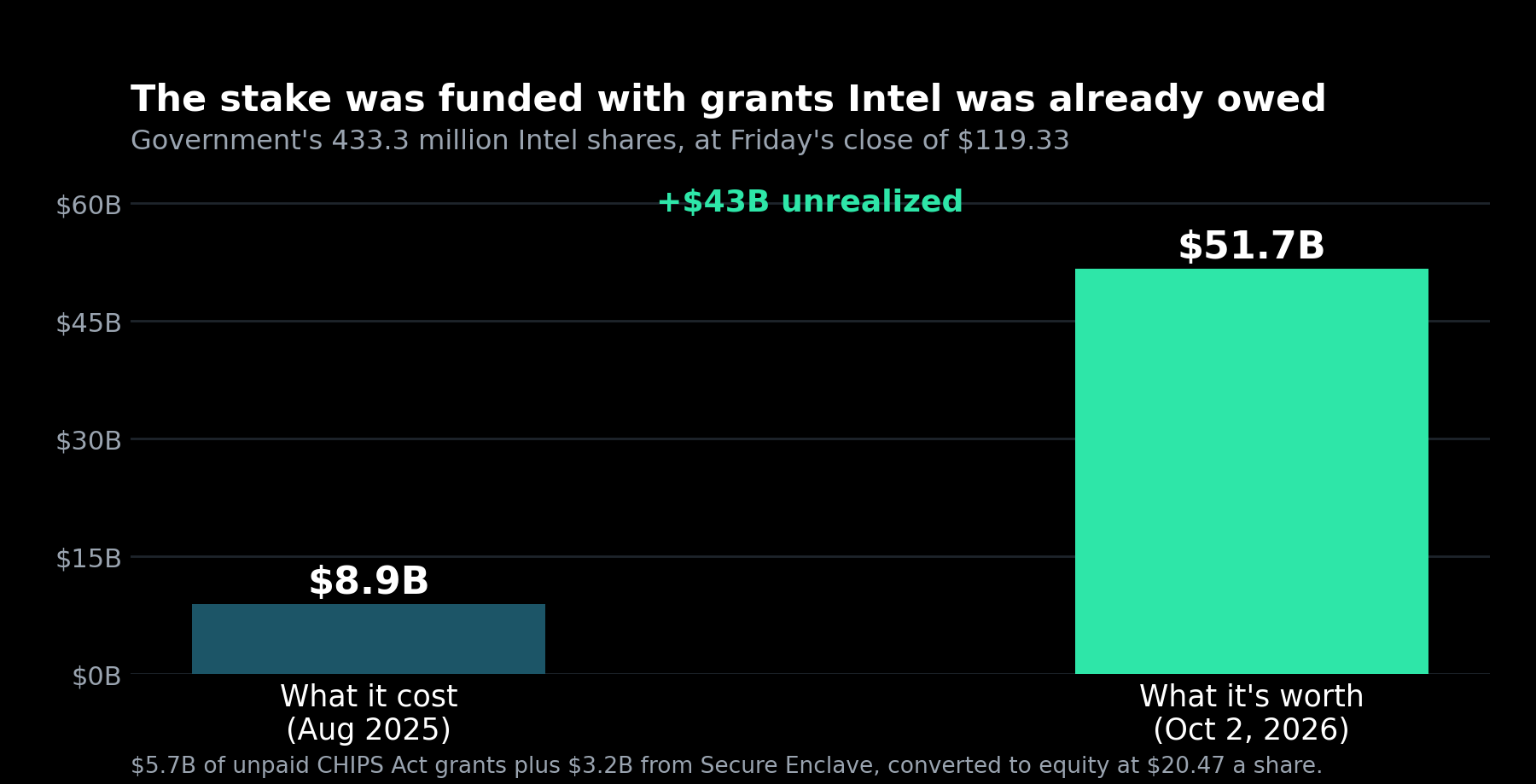
The $8.9 billion didn't come out of a checkbook. It came from converting money Intel had already been awarded but hadn't yet received: $5.7 billion in CHIPS Act grants and $3.2 billion from a defense program called Secure Enclave.
Intel was already owed that money, and it was a grant. Grants don't ask for anything back. Instead, that promised money became a purchase of nearly a tenth of the company.
The part shareholders paid for
Here's the piece almost nobody explains.
Those 433.3 million shares were new ones. There are two ways stock can end up in somebody's hands. Existing shares can change owners, which means a current holder gives theirs up and the company itself gets nothing. Or the company can create brand new shares, which means the company collects the money and everyone who already owned a piece now owns a smaller fraction.
Intel printed new ones.
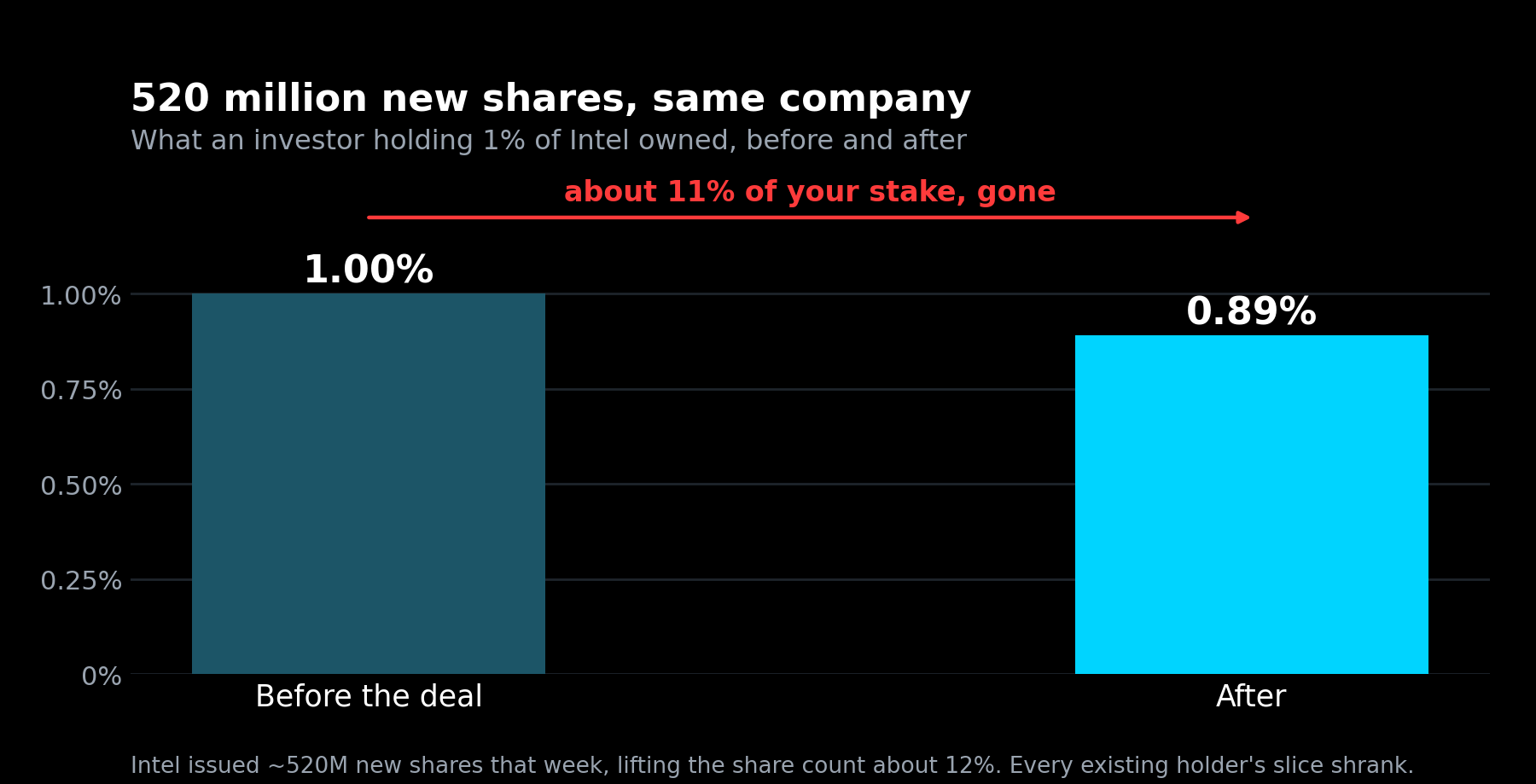
Across that week Intel issued roughly 520 million new shares in total, the 433.3 million to the government plus SoftBank's portion. That lifted the share count about 12%.
So if you owned 1% of Intel before, you owned about 0.89% after. The business didn't change. Your claim on it got smaller.
We went through the opposite version of this in the buyback issue, where retiring shares cuts the same pie into fewer slices and your slice grows. This is that arithmetic running backwards.
And what Intel got in exchange was money it had already been promised.
What the government got besides shares
Three other terms, and each one tells you something.
The stake is passive. No board seat, no governance rights, no special access to information. On paper, the government is just another shareholder.
But it agreed to vote with Intel's board, with limited exceptions. That's unusual. It means management can count on a large voting bloc in any shareholder vote. For a company that's faced pressure from activist investors, that's worth something, and it isn't the kind of thing that shows up in a valuation model.
And there's a warrant. The government can purchase another 5% of Intel at $20 a share, any time in five years, but only if Intel stops owning at least 51% of its foundry business.
Worth slowing down on that one. A warrant is the right to purchase shares at a fixed price later. This one is only usable if a specific thing happens. So it isn't really an investment. It's a leash. It says: keep control of the foundry, or we take another 5% at a price that will probably look very low by then.
One more detail. The clawback and profit-sharing conditions attached to an earlier $2.2 billion grant were eliminated. Intel gave up equity and got out of some obligations.
How it turned out
The government paid $20.47. Intel closed Friday at $119.33.
That $8.9 billion position is now worth about $51.7 billion. An unrealized gain of roughly $43 billion, which is a return of about 480% in fourteen months.
One more wrinkle. Intel has issued more stock since. The share count is up around 5.25 billion now, which means the government's 433.3 million shares are about 8.25% of the company rather than the 9.9% it started with.
So the government got diluted too. The arithmetic doesn't care who you are.
Now the honest part, because this cuts both ways and most coverage only picks one side.
If you held Intel through this, you got diluted by about 11%. That's a real cost and it's permanent. But the 90% you kept went up almost six times. You are not worse off. You'd have been better off without the dilution, but that compares against a world that may not have existed, because part of why the stock ran is arguably the deal itself. Government backing changed how the market saw the foundry business.
So shareholders paid for the taxpayer's $43 billion gain, in the sense that it came out of a pie they owned part of. And they still came out fine. Both things are true.
And here's the detail that should keep anyone honest about this. Intel's shares rose the day it was announced, somewhere between 5 and 7%.
The market was told a tenth of the company had been handed over, at a price well under where the stock was trading, and decided the company was worth more afterward than before. Investors judged that having Washington behind the foundry was worth more than the stake it cost.
Intel isn't the exception
One more thing, because it reframes everything above.
Intel gets covered as a one-off. It isn't. It's the one everybody noticed.
Last May the Commerce Department announced letters of intent with nine companies for about $2 billion in quantum computing money, on one condition, in the department's own words: "The Department will receive a minority, non-controlling equity stake in each company."
One of those nine was IBM, for $1 billion.
If you hold an S&P 500 index fund, you hold IBM. You are already a co-shareholder with the federal government, and nothing in your account tells you so.
Count the deals that did make headlines alongside the ones that didn't and the tally runs past thirty positions across at least four agencies. No agency publishes a list of them. Every count you can find, including that one, is somebody adding up press releases.
That's a thread worth pulling on its own, and I'll do that midweek.
What this doesn't tell you
One deal, one outcome, one company. Intel was struggling and needed what the government was offering. That's a very different starting position from a company everyone wants a piece of.
Private companies work differently too. Both labs filed confidentially to go public earlier this year, but neither has set a date or a price, and until they do there's no public shareholder to dilute the way Intel's were. If that changes, everything above applies directly.
And nothing has been agreed anyway. "I might" is not a deal, and he said no to nationalizing in the same breath.
The thirty-plus figure is a tally of announcements, not an audited number, so treat it as a floor. Some are letters of intent that may never close. Some are loans with warrants attached, which is not the same as owning stock.
And the real untested risk isn't dilution at all. It's that a government shareholder wants things an ordinary shareholder doesn't. Domestic production. Jobs in particular places. Supply chains that serve national security. Those goals are legitimate and they don't always point the same direction as the share price. That tension hasn't been tested, because so far the stock went up and nobody had to choose.
The habit worth keeping is the one underneath all of this. A share price is a claim on a business divided by the number of claims outstanding, and both halves can change without the business changing at all. Techdamentals shows every input behind a fair value, including the share count, so you can see which part moved.