On Tuesday, November 10, 2026, after the market closed, CoreWeave reported that its revenue had nearly tripled in a year. Buried a few lines below that number were two others.
Operating income was 207 million dollars. Interest expense was 846 million.
A company whose interest bill is four times what its operations earn is not supposed to be able to keep borrowing. CoreWeave is borrowing more. This issue explains why anyone lends to it, what is holding the structure up, and where it could crack, using the company's own press release and earnings call.
One note on sourcing. CoreWeave has not yet filed its quarterly report with the SEC for this period, so the detail below that goes beyond the press release comes from the second-quarter filing, and we say so each time.
What CoreWeave does, in one paragraph
CoreWeave rents computing power to companies that train and run artificial intelligence models. It purchases Nvidia processors and builds data centers to hold them, then charges customers for access, usually under multiyear contracts. It is what the industry calls a neocloud, a new cloud company built around that one job rather than a general-purpose business.
The important thing about the model is the order of events. The processors and buildings get paid for first. The customer payments arrive later, over years. The gap between the two is what borrowing fills.
The numbers
For the three months ended September 30, 2026, CoreWeave reported the following.
Revenue was 3,661 million dollars, up from 1,365 million a year earlier. Operating income was 207 million (a 6% margin). Net loss was 709 million. Interest expense, net, was 846 million, up from 310 million a year earlier.
Cash purchases of property and equipment were 9,441 million dollars. Cash from operations was 1,975 million. The company also reports a larger capital spending figure of 14.5 billion dollars for the quarter, which management said was above the high end of its own guidance. We could not find a formal definition of that figure. The filing for the prior quarter shows a separate line for equipment additions financed by suppliers, which is probably where the roughly 5 billion dollar difference sits, but that is our inference.
For all of 2026 the company expects revenue between 13.0 and 13.3 billion dollars and capital spending between 37 and 39 billion. Capital spending of that size against revenue of that size is the whole story in one comparison. It is spending close to three dollars on the buildout for every dollar it will bring in this year.
How the borrowing works
Here is the mechanism, because almost every headline skips it.
CoreWeave does not mainly borrow against itself. It borrows against its contracts.
A delayed draw term loan, which the company calls a DDTL, is a loan facility that is agreed in advance and then drawn in pieces as the money is needed. The company's quarterly filing says these loans are collateralized with the assets underlying the contributed contracts and the pledged contractual cash flows, and that they amortize over time as contracted cash flows are generated. In plain words: a customer signs a contract to pay for computing capacity for several years. CoreWeave takes that contract to lenders and says, lend us the money to build the capacity, and the customer's payments will repay you.
Chief Executive Michael Intrator said on the call that these facilities can finance "anywhere from 70% to 100%" of the associated capital spending. The company has said it expects to fund most of the remaining spending needed to deliver its backlog this way.
Backlog is the amount of contracted revenue the company has yet to deliver. CoreWeave reports about 132.5 billion dollars of it, which it defines as remaining performance obligations plus other amounts it expects to recognize as revenue. That figure, against a company whose revenue this year will be about 13 billion, is what lenders are underwriting.
That is why the structure can stand while interest exceeds operating income. The lenders are not mainly looking at today's profit. They are looking at a signed stream of future payments from customers, and whether those customers will keep paying.
There is a second source of cash that makes the first one easier. Customers also pay in advance. Intrator said the company has collected prepayments on 70% of its deals, and Chief Financial Officer Nitin Agrawal said it expects about 9 billion dollars in prepayments and deposits over the next three months, with more than 3 billion of that tied to existing capacity that needs no new equipment.
The three margins that disagree
If you have wondered how a company can report a 62% margin and a loss in the same release, here is the answer. They are different measures that stop counting at different points.
Adjusted EBITDA was 2,256 million dollars, a 62% margin. EBITDA means earnings before interest, taxes, depreciation and amortization, so it ignores the cost of the equipment wearing out and the cost of the money borrowed to pay for it. For a company whose business is owning costly equipment and financing it, those two things are most of the cost.
Operating income was 207 million, a 6% margin. Here depreciation is counted. The company's own reconciliation shows depreciation and amortization of 1,889 million dollars in the quarter, which accounts for nearly all of the gap between the first number and the second.
Adjusted operating income was 379 million, a 10% margin. It starts from operating income and adds back stock-based pay and amortization of acquired intangibles.
Net loss was 709 million, a loss of 19% of revenue, and the difference between operating income and net loss is mostly that 846 million dollars of interest.
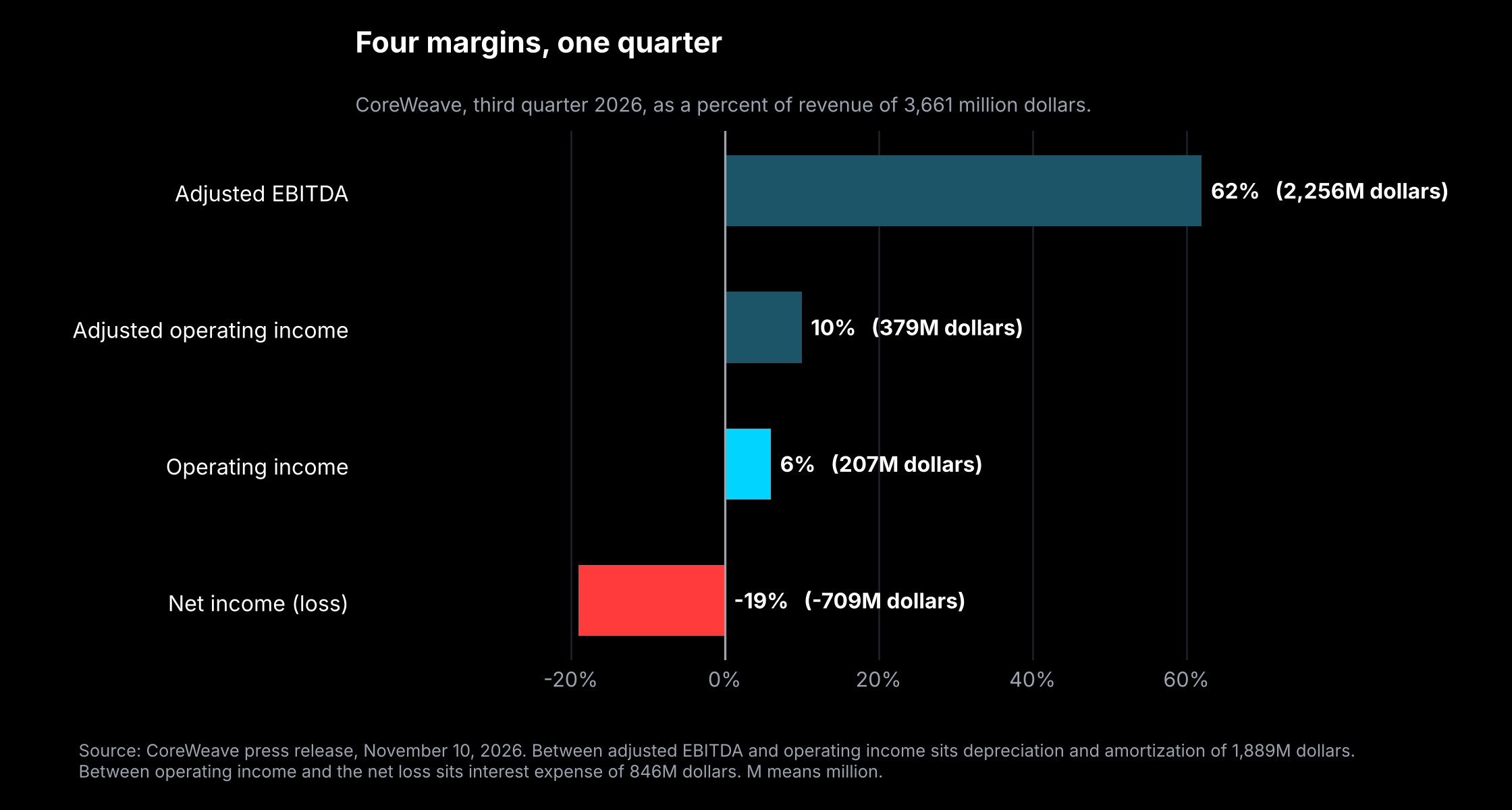
The press release's own headline says "expanding margins," so it is worth checking which way each one moved, because the answer depends on the comparison.
Against the second quarter of 2026, all three improved. Adjusted operating margin rose from 5% to 10%, operating margin from negative 2% to 6%, and adjusted EBITDA margin from 59% to 62%.
Against the same quarter a year earlier, the picture is mixed. Adjusted operating margin fell, from 16% to 10%. Operating margin rose from 4% to 6%. Adjusted EBITDA margin rose from 61% to 62%. And the net loss grew, from 110 million dollars to 709 million.
Management's line that the company reached double-digit adjusted margin a quarter ahead of its own plan is true, and it refers to the plan, not to last year.
The interest bill, put in proportion
Now back to the comparison that started this issue.
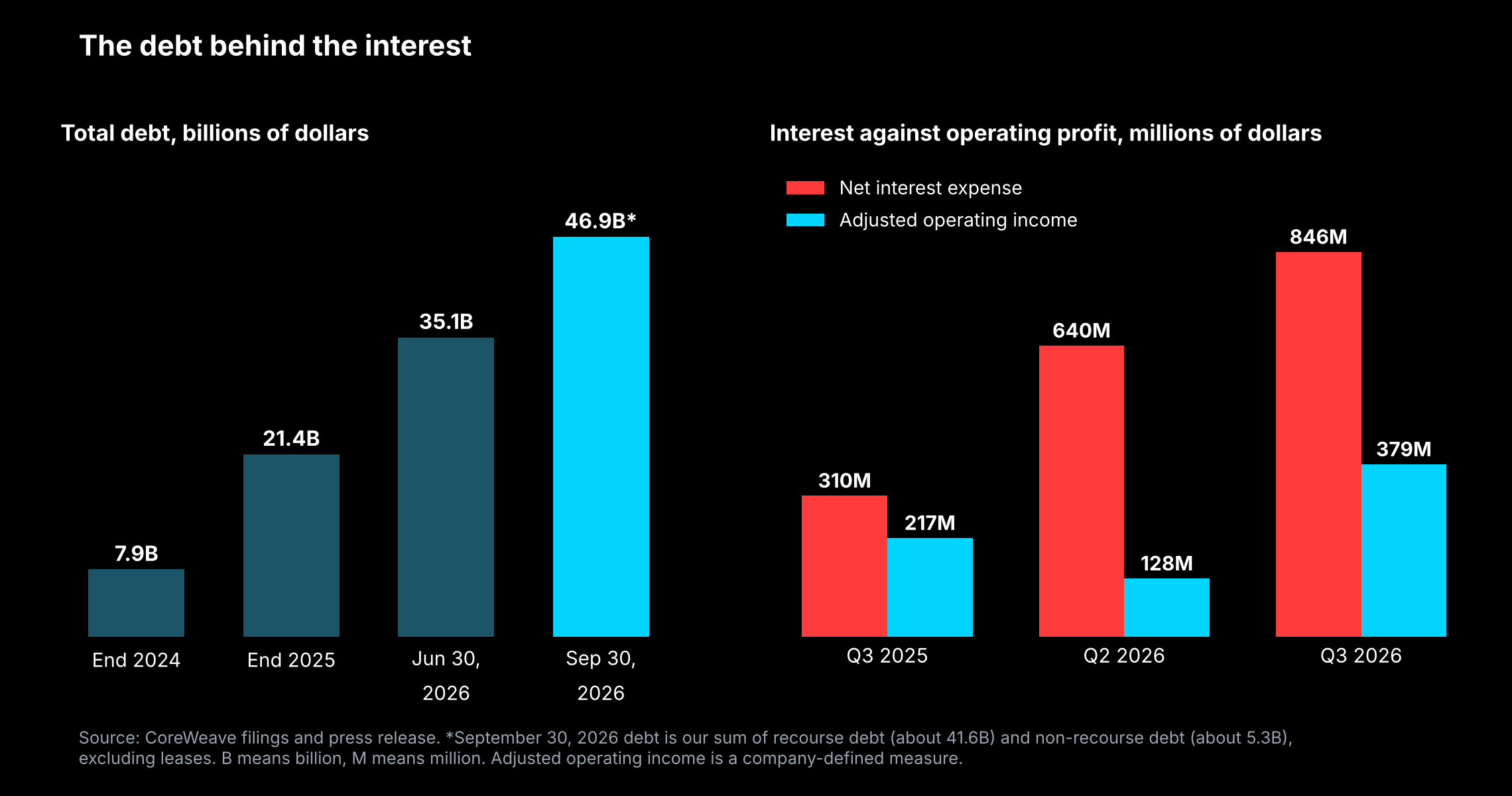
In the third quarter, interest of 846 million dollars was 4.1 times operating income of 207 million, and 2.2 times adjusted operating income of 379 million. It was also about 23% of revenue.
The trend matters more than any single quarter. In the second quarter, interest was 640 million against adjusted operating income of 128 million, which is 5.0 times. A year earlier, interest was 310 million against adjusted operating income of 217 million, or 1.4 times. So the ratio got far worse, then improved as profits rose faster than interest in the latest quarter.
One caveat on the 846 million figure. The company capitalizes interest on data centers still under construction, meaning part of the interest cost goes onto the balance sheet rather than the income statement. In the second quarter the amount capitalized was 79 million dollars. So reported interest expense is not the full cost of borrowing, and the true figure is somewhat higher.
And it is going up. The company guided fourth-quarter interest expense to between 1.05 and 1.15 billion dollars. That is roughly 4.4 billion dollars a year at that pace.
How much debt, and at what price
At the end of 2024 CoreWeave had 7.9 billion dollars of debt. A year later it had 21.4 billion. At the end of June 2026 it had 35.1 billion. At the end of September, the press release shows about 41.6 billion of recourse debt and about 5.3 billion of non-recourse debt, roughly 46.9 billion dollars in total by our sum, not counting leases.
The two terms matter. Recourse debt is something the parent company is on the hook for. Non-recourse debt is limited to the assets of a particular subsidiary, so lenders can only go after what was pledged. Only one of CoreWeave's delayed draw loans is marked non-recourse in the second-quarter filing, so it would be wrong to say the structure insulates the company from its lenders.
What does it cost? Management said the weighted average cost of its debt was 7.9%, down 250 basis points from a year earlier. We could not reproduce that figure from the filings. Weighting the effective rates in the second-quarter report gives something near 8%, so it is plausible, but the company does not define exactly how the number is built.
The rates on individual pieces vary widely. The second-quarter filing shows senior notes with stated rates between 9.0% and 9.75%. It shows the oldest delayed draw loan at an effective 15%, a loan from an investment firm at 12%, and an asset-level facility at the low end of around 7%. The convertible notes sit near 2% to 3%, because investors accept less interest in exchange for the right to convert into shares.
Which brings up the apparent contradiction. On the call, Agrawal said the company does not intend to issue additional parent-level unsecured debt through 2027 at current yields, and Intrator said it would not use the unsecured debt market at current yields. But in September the company sold convertible notes, which are unsecured parent-level debt: 3.7 billion dollars at first, upsized to 4.2 billion, at 2.875%. It also announced a program to issue up to 35 million shares. Both came before those remarks, and the statements are worded as "additional" and "at current yields," so it is not a contradiction on the dates. We could not find management squaring the two on the call. The plain summary is that the company has already raised unsecured money this quarter, and says it does not plan to raise more of that kind at today's prices.
Convertible notes are loans that can be turned into shares at a set price. They carry a low interest rate because the lender gets a possible share of the upside. For existing shareholders they carry a cost the interest rate does not show, which is dilution if the conversion happens.
What the bond market says
The company says its cost of debt is 7.9%. The market for its older, unsecured bonds has said something different.
On October 14, the 9.625% notes due 2032 were reported to be yielding about 14.8%, and briefly 15%. By November 6 they were reported yielding more than 16%. A yield is the return an investor would earn by purchasing the bond at its current price, so a yield far above the stated rate means the bond's price has fallen below face value, which signals that investors want to be paid much more for the risk.
The reports of those yields come from secondary sources, and we have not confirmed them against trading data. Treat them as indications. Even so, they explain the company's behavior. It says it will not issue unsecured debt at those yields, and it is funding the buildout through asset-backed loans instead, where the lender's claim is on a specific contract.
There is a clean illustration of how that structure changes the credit. In March 2026, the company closed an 8.5 billion dollar facility whose loans were rated A3 by Moody's and A (low) by DBRS, an investment-grade rating. The loans got that rating even though the company itself is not rated investment grade. The last corporate credit rating we could confirm is a Moody's Ba3 from May 2025, and we found no more recent rating action, so the current status is unverified.
That is the point of the structure. The lenders are not rating CoreWeave. They are rating a contract.
Who is on the other side of the contracts
If the loans are only as good as the customers' promises, the next question is who the customers are. The honest answer is that the filings name very few.
In the second quarter, one customer accounted for 36% of revenue, another for 26% and a third for 10%. The filings call them Customer A, B and C and warn that the labels may refer to different companies from one period to the next. Two customers each represented 32% of accounts receivable at June 30.
Only one period is tied to a name. For all of 2025, the annual report said about 67% of revenue came from a single customer, Microsoft. For 2026 the percentages are not mapped to names.
The filings do disclose contract sizes for some customers. OpenAI committed to pay up to about 6.5 billion dollars through May 2031. Meta placed an order for up to about 21.0 billion dollars through December 2032. Jane Street committed about 6.0 billion in April.
Management's reassurance is worded narrowly. Intrator said more than 75% of committed capital spending is tied to investment-grade and enterprise customers. That statement covers committed spending, not all capital spending, and it is management's description, not a figure from a filing. Also, OpenAI does not have a credit rating from a major agency that we could find, so it should not be described as investment grade.
Is this unusual?
Borrowing to build is not unique to CoreWeave. In our earlier issue on capital spending, we showed how the largest technology companies are spending more on construction than their cash flow comfortably covers. You can read that one here.
What differs is the degree. CoreWeave's cash from operations of 1,975 million dollars covered about 21% of its cash purchases of equipment, and about 14% of its reported capital spending. The rest came from lenders and investors: net debt raised in the quarter was about 8.0 billion dollars, from 10.3 billion borrowed less 2.3 billion repaid.
This is where our own term fits. CapEx is money going out to build. CapIn is the other half of that, money coming in to pay for the building, through borrowing and the sale of shares. For most large companies CapIn is a footnote. For CoreWeave it is the main plot, and the question to ask each quarter is whether it keeps arriving at an acceptable price.
What this does not tell you
It does not tell you whether the customers will keep paying. The whole structure depends on contracts being honored for years, and a contract is a promise, not cash.
It does not tell you the company is in trouble. Revenue grew, margins improved from the prior quarter, backlog is large, and management says contracted cash flows are sufficient to service and repay the debt. That is management's statement, and nobody outside the company can check it yet.
It does not tell you what any share is worth. Nothing here values anything.
It does not tell you what the quarterly filing will say. Customer concentration for the third quarter, the debt table and the interest capitalized are all in a filing that has not been published yet, and any of them could change the picture.
The thing to carry forward is a question to ask of any company that is growing quickly with borrowed money: what, specifically, is the lender relying on? For CoreWeave the answer is contracts with customers. That makes the next thing worth watching a different list than the usual one. It is not the profit line. It is who signed, for how long, with what protection, and whether their payments are arriving on schedule.
That is the kind of thing that sits under a valuation rather than in a headline. Techdamentals shows the inputs behind every fair value rather than handing you a single number, puts the fundamentals and the chart in one place, and reads the SEC filing to find the real reason a stock moved after earnings.
Try Techdamentals for 3 days, no card needed
This is educational content, not financial advice. Techdamentals is an educational tool and does not recommend any security.