Next week, three of the biggest companies in the world tell investors how much money they spent on AI over the last three months, and what they plan to spend next. Microsoft and Alphabet report on Wednesday, October 28, and Amazon reports on Thursday, October 29. Meta already reported on October 21, and searches for "companies reducing AI spending" are up 500% in the past week, according to Google Trends. The word that sits behind all of it is capex. If you have heard it on the news and nodded along, this article is for you. I will explain it from scratch, show you the numbers, and tell you honestly what nobody can know yet.
What a company is, and where its money goes
A company is a business that provides a product or service to earn money. The money it brings in from customers is called revenue. Out of that revenue it pays for everything it needs to run: salaries, rent, electricity, advertising, and so on. What is left over is profit.
There is a second kind of spending that is different, and it is the subject of this article. Some purchases are not used up this month. A bakery pays for flour and wages every week. But the same bakery also pays for an oven once, and that oven bakes bread for ten years. Those are two different kinds of money going out the door, and accountants keep them in separate boxes.
What is capex?
Capex is short for capital expenditure. It is money a company spends on long-term things it will use for years, like buildings, land, machines and equipment. In the bakery, the oven is capex and the flour is not.
According to Wall Street Prep, capex pays for assets, meaning things the company owns that are expected to help it for more than 12 months. The everyday costs, like wages and electricity, are called operating expenses, or opex for short. Those are the costs of running the business this month.
For a company like Meta, Alphabet, Microsoft or Amazon, capex means buildings called data centers, which are warehouse-sized buildings full of computers. It also means the servers inside them, which are the computers themselves, and the specialized chips that do AI work, along with the network cables, power equipment and cooling systems that keep it all running. AI, short for artificial intelligence, is software that can write, answer questions, make images and spot patterns. It takes an enormous amount of computing power to build and to run, and that power lives in data centers.
How capex shows up in the numbers (and why it confuses people)
This is the part that trips people up, so I will go slowly.
When you pay for flour, the cost hits the bakery's profit right away. When you pay $10,000 for an oven, accountants do something different. They do not count the whole $10,000 against profit this year. They spread it out over the years the oven will last. That spreading is called depreciation. If the oven should last ten years, about $1,000 a year shows up as a cost, even though the bakery paid all $10,000 on day one.
Why does that matter? Because it creates two different pictures of the same spending. Profit looks at the $1,000 slice. Cash looks at the $10,000 that actually left. Cash is the actual money in the bank, and cash flow is the money moving in and out over a period of time.
Wall Street Prep describes it the same way: the full cash outflow for capex appears in the cash flow statement, which is the report that tracks where the money went, in the period the purchase happens. Depreciation is a non-cash cost, which means nobody writes a check for it. It is just the accounting for spreading the purchase out.
So there are two ways to measure what a big spending program does. A company can look fine on profit, because depreciation spreads the cost out over many years, and still be burning through cash right now. Hold on to that, because it is the heart of why investors are nervous.
Free cash flow, the number everyone is watching
Free cash flow is the money left after a company pays for its operations and its capex. The usual formula is cash from operations, meaning the cash the business throws off by running day to day, minus capex. If that number is positive, the company is generating more cash than it is spending on its long-term assets. If it is negative, it spent more than it earned, and the gap has to come from savings or borrowing.
Why do investors like this measure? Because it is harder to dress up than profit. It is cash in, cash out. And it is one of the main inputs when people try to work out what a company is worth, which is why the Techdamentals IV Calculator uses cash flow as one of its inputs.
Keep that formula in mind for the next section, because it is where Meta's number comes from.
What Meta reported on October 21
Meta, the company behind Facebook and Instagram, reported its third quarter, which is the three months from July through September. Companies report this way every three months, in what are called earnings reports.
According to CryptoBriefing and the call transcript, Meta spent $34.9 billion on capex in the quarter, including payments on equipment it leases. Its cash from operations was $32.8 billion. Do the subtraction and you get negative $2.12 billion of free cash flow. CryptoBriefing, citing StockTitan data, called it the first negative quarter since the first half of 2012.
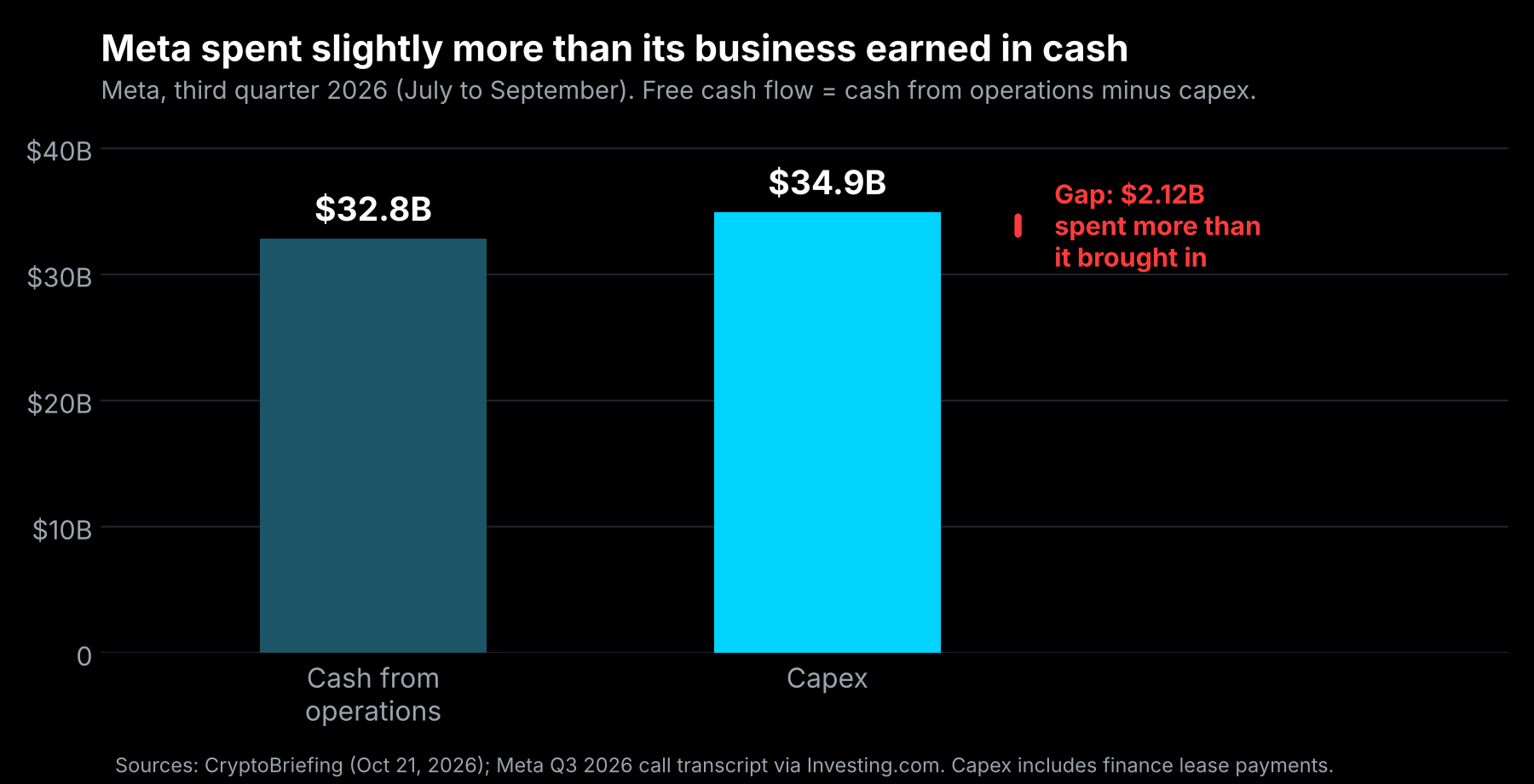
To be clear about what that is and what it is not: Meta is not running out of money. Revenue in the quarter was $64.6 billion, up 26%. The point is that the business generated $32.8 billion of cash, and it put $34.9 billion into building things, so for one quarter it spent a little more than it brought in.
Meta also narrowed its full-year capex outlook, which is what a company calls its guidance, meaning its own forecast of what it expects. The range is now $135 billion to $145 billion, tightened from $130 billion to $145 billion. For comparison, in the second quarter, Hargreaves Lansdown reported Meta's free cash flow was just $784 million, down 91% from the year before. So the cash cushion has been shrinking for a while.
What about next year? The chief financial officer, Susan Li, said on the call that Meta is "quite early" in planning its 2027 budget and capacity, and gave no 2027 capex number. She said the company expects to keep investing aggressively. The transcript also named depreciation as one of the things pushing Meta's infrastructure costs up, which is the spreading-out effect I described earlier showing up in the profit numbers.
What the others are spending
Meta is the one that has reported so far. Here is where the other three stand, with a warning that these are plans and early numbers, and that they will change next week.
Alphabet, which owns Google, raised its 2026 capex guidance by $15 billion to a range of $195 billion to $205 billion after its second quarter, according to OANDA. In the first half of 2026 it spent $80.6 billion, compared with $39.6 billion for the first half of 2025. That is about double. Its free cash flow in the second quarter was about negative $5.9 billion.
Amazon now expects to spend about $220 billion of cash capex for 2026, up from $200 billion, according to Zacks via Yahoo Finance. Part of the increase came from higher memory costs, meaning the price of computer memory chips. Over the 12 months ended June 30, Amazon's free cash flow was negative $7.6 billion, compared with positive $18.2 billion a year earlier.
Microsoft is harder to pin down, because the sources I found disagree. Tradingpedia says it spent about $36 billion last quarter, guided to about $50 billion this quarter, and projects $175 billion for calendar 2026. Sherwood News reported $190 billion for the calendar year back in April. I do not know which is right, so I am showing both.
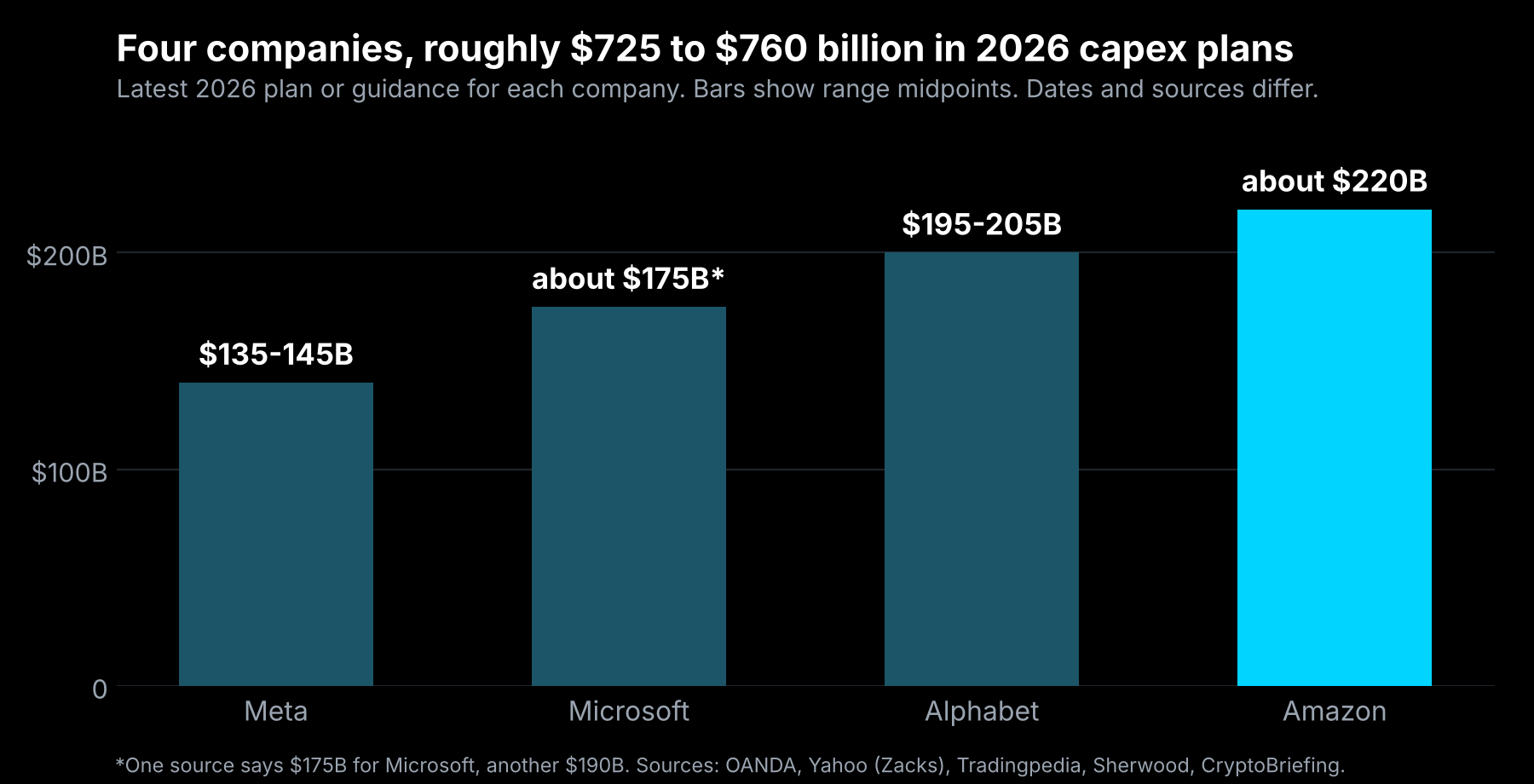
If you add the latest numbers from each company, you get something in the range of $725 billion to $760 billion for 2026. That is my own arithmetic, mixing different dates and sources, so treat it as a rough size and not a precise total. In April, Sherwood News put the four companies' plans at more than $700 billion, nearly double what they spent the year before.
The word you will hear for these four, and a few others like them, is hyperscalers. It means companies that run cloud computing at enormous scale. Cloud computing is when you rent computing power over the internet instead of owning your own computers. When a company like Amazon rents out computing power to other businesses, that is a cloud business, and AI work is one of the things those customers pay for.
Why investors worry
Here is the honest summary of what the worry actually is. It is not that these companies are spending money. Spending can be good. The worry has a few parts, and they stack.
1. The money goes out first, and the payoff comes later. Capex is spent now. The revenue it creates, if it does, shows up over years. In the meantime, the cash is gone. That is the free cash flow squeeze we just looked at.
2. Nobody knows how much AI revenue is coming. Investing.com wrote in July that investors were becoming "far less patient" about waiting for a return on the spending, and that Alphabet's capex had risen faster than revenue. The companies point to demand. Alphabet has a cloud backlog of $514 billion and Amazon's cloud unit has $496 billion. A backlog is business that customers have signed up for but the company has not yet delivered or been paid for. That is a real number, but it is a promise from customers, and it does not tell you how profitable the work will be.
3. The equipment gets old. This is the part I find most overlooked. Depreciation spreads the cost over the useful life of the equipment, and in AI the chips can become outdated quickly as newer ones arrive. If equipment wears out or becomes obsolete faster than the accounting assumes, the cost shows up sooner than expected. I cannot tell you how fast that is happening, and the companies and their critics disagree about it. I am flagging it as a question, not a finding.
4. The scale keeps going up. Each time a company reports, the range tends to move. Meta's range was $125 billion to $145 billion as of April. Alphabet raised its numbers. Amazon went from $200 billion to $220 billion. When the numbers keep rising, investors ask where it stops.
5. The cushion is thinner. These companies have had plenty of spare cash. But as the free cash flow numbers above show, a few have gone from generating a lot of spare cash to roughly zero or negative in some periods. That changes what they can do with their money, including whether they have to borrow.
How to read a capex number for any company
You can use this for any company, not only Big Tech. Here is how I would look at it.
- Capex compared with cash from operations. If capex is bigger than operating cash flow, the company is spending more than it earns in cash. That can be fine for a while, but find out how it is paying for the gap.
- Capex compared with revenue. Some businesses always spend a lot, like railroads and phone networks. Others do not. A jump in the ratio tells you something changed.
- Whether the guidance keeps moving. A range that gets raised several times in a year is a different story from a steady one.
- What the spending is for. Keeping existing equipment running is different from building new capacity. Companies do not always split the two clearly.
- What the company says it gets back. Look for backlog, contracts or revenue growth in the same area, and remember that those are early signs, not proof.
- The depreciation line. Over time, spending flows into the profit numbers through depreciation. If it is rising fast, the past spending is starting to weigh on reported profit.
What is capex, and why does Big Tech's AI spending worry investors?
Capex, short for capital expenditure, is money a company spends on long-term assets it will use for years, such as buildings and equipment, as opposed to the everyday costs of running the business. For Big Tech, it means data centers, servers and AI chips. It worries investors because the cash goes out first and the payoff comes later, because nobody knows how much revenue the spending will create, because chips can age quickly, and because the numbers keep rising while free cash flow shrinks. Meta's free cash flow was negative $2.12 billion for the third quarter, and Alphabet, Amazon and Microsoft report next week.
What this doesn't tell you
The strongest case against the worry is the demand. If customers really do want all the computing power these companies are building, then the spending is not wasteful, it is a business reaching for something it can charge for. Alphabet and Amazon each report hundreds of billions of dollars of cloud backlog, and Meta's CEO said compute, not demand, is the limit on how fast one of its AI products can grow. If that holds, today's negative free cash flow could be a temporary dip in a longer build.
I should also be upfront about what is thin. The negative free cash flow numbers come from different periods: a single quarter for Meta, a single quarter for Alphabet and a trailing 12 months for Amazon, so I cannot compare them with each other. The Microsoft figures conflict between sources. The first negative quarter since 2012 comes from a data provider as quoted by one outlet, and I have not checked it against Meta's filing. And my $725 billion to $760 billion total is a rough sum of numbers from different dates.
The depreciation point is a question and not a finding. I do not have figures on how long these companies assume their chips last, and I would want to see them before saying anything stronger.
Finally, this article is a snapshot that will be out of date by Friday. Microsoft, Alphabet and Amazon will each give new numbers next week, and any of them could change the picture, in either direction. I am not going to tell you what they will say, or what the stocks will do when they say it, because nobody reliably knows.
If you want to look at a company's numbers before a headline moves the price, the Techdamentals IV Calculator shows each company's debt and cash next to its price, cash flow and growth numbers, so you can see what a result rests on.