On Monday, November 9, 2026, Google announced two new processors: the TPU 8tx and the TPU 8i Max. They are the third and fourth systems in its eighth generation of chips designed for artificial intelligence work.
Google is not in the chip business. It runs a search engine, a video platform, an advertising business and a cloud service. Designing a processor is one of the hardest and costliest things a company can attempt, and there is a company a few miles away whose entire business is doing it very well.
So why bother?
The answer is a single number, and it is not in the announcement. It is 75%.
The number
In its most recent reported quarter, the three months ending July 26, 2026, Nvidia's gross margin was 75.0%.
A gross margin is what a company keeps from each sale after paying the direct cost of producing the thing it sold. If you charge a hundred dollars for something that costs you twenty-five dollars to make, your gross margin is 75%. It does not include wages for the research staff, or offices, or marketing. It is the raw spread between price and production cost.
For context, a supermarket runs a gross margin around 25%. A car manufacturer is often in the teens. Software companies run high, frequently above 70%, because copying software costs almost nothing.
Nvidia is not a software company. It designs physical objects that are manufactured in enormous furnaces and shipped in crates. And it keeps three quarters of every dollar.
That is the whole explanation for this article. When your supplier earns a 75% margin on what it ships you, and you are purchasing tens of billions of dollars of it, the question stops being why would you build it yourself and becomes why wouldn't you.
What these chips actually do, and why it matters here
Before the costs, one distinction. Almost nothing about this subject makes sense without it, and it is almost never explained.
There are two completely different jobs these processors do.
Training is building the model. You show a system an enormous quantity of text, images or code, and it gradually adjusts billions of internal settings until it produces useful output. This is done in long, extremely demanding runs that can occupy tens of thousands of chips for weeks. It happens relatively rarely, and it is where the research happens, which means the methods change constantly. Nobody doing it knows exactly what next year's approach will require.
Inference is using the finished model. Somebody types a question and the model produces an answer. Each individual answer takes a tiny fraction of the work that training took. But inference happens billions of times a day, forever, and the calculation is essentially the same every time.
That difference is the heart of this whole story.
A general-purpose processor is flexible. It can do many different kinds of calculation reasonably well, which is exactly what you want when you do not know what you will be asking of it next year. Flexibility is what Nvidia offers, and in a field changing as fast as this one, flexibility is worth paying for.
A purpose-built chip gives up that flexibility deliberately. If you know precisely which calculation you will be performing, billions of times, you can design hardware that does only that, and strip out everything it does not need. The result is slower at everything else and considerably better at the one thing, and crucially, it costs less to produce because there is less in it.
So the economics of building your own chip depend heavily on which job you are optimizing for. For training, where the requirements keep shifting, giving up flexibility is dangerous. For inference, where the work is repetitive and predictable, it is close to ideal.
And the balance between those two jobs has shifted. When this field was mostly research, training dominated. As these systems moved into products that millions of people use daily, the volume of inference grew enormously. That shift moves the ground under the whole question, because it moves work into exactly the category where purpose-built hardware wins most easily.
You can see it in the announcement itself. Both of the chips Google introduced this week are aimed at running finished models rather than building new ones.
Why Google has a ten-year head start
One more thing that explains why Google specifically, rather than any large company with money.
Google has been designing these processors since 2015. The chips announced this week are the eighth generation. That is a decade of built-up engineering, manufacturing relationships, and institutional knowledge about what goes wrong.
This matters for the arithmetic that follows, because the cost of designing a chip is not the same every time. The first one is brutal: you are building a team, learning the process, and finding out what you do not know. The eighth costs far less, because the team exists, the tools exist, and much of the design carries forward.
It also explains why the obvious objection to this whole story is partly right. People have been predicting that in-house chips would displace Nvidia since roughly 2016, and for most of that decade the prediction was wrong, because the in-house efforts were small, early and awkward. The difference now is not that somebody had a clever idea. It is that one of those efforts has been compounding for ten years and has reached the point where the output is competitive.
Ten years of being wrong about a trend is not evidence the trend is fake. It is sometimes evidence that the trend is slow.
The arithmetic, as best anyone outside can estimate it
Nobody publishes what these chips cost to produce. But researchers at Epoch AI, an organization that studies the economics of computing, have estimated it.
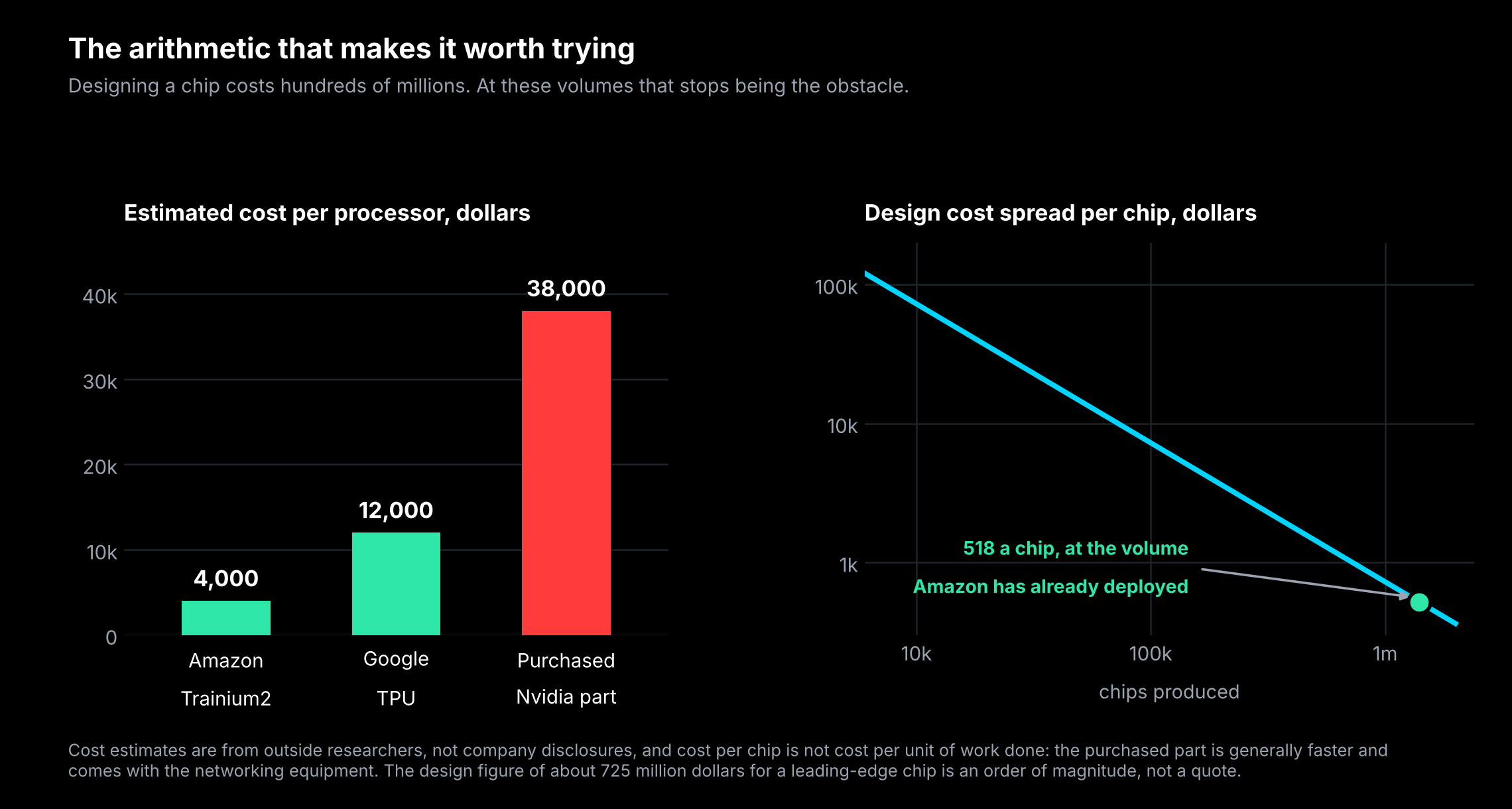
Their estimate for the median cost of a recent-generation Google TPU, to Google, is about $12,000.
Their estimates for comparable Nvidia hardware run between 33,000 and 42,000 dollars per processor for one generation, and between 38,000 and 49,000 for the next.
So very roughly, the chip Google designs for itself costs it something like a third of what the equivalent purchased part costs.
Now the obvious objection, and it is a real one. Cost per chip is not cost per unit of work done. Nvidia's processors are generally faster, so you may need fewer of them. Nvidia also supplies the networking equipment that connects thousands of chips together, which is a genuine part of the system and not a free accessory. A threefold gap in price per chip is not a threefold gap in the total cost of running a data center.
But it does not have to be. Even a fraction of that gap, applied across hundreds of thousands of units, is a number large enough to fund an entire engineering organization many times over.
What it costs to try
This is the part that stops most companies, and understanding why it no longer stops these particular companies is the key to the whole story.
Designing a chip on the most advanced manufacturing process is estimated to cost somewhere around $725 million, before a single unit is produced. That figure comes from an industry research firm and should be treated as an order of magnitude rather than a precise quote, but it is the right size.
Three quarters of a billion dollars to find out whether your chip works.
For almost every company on earth that is a disqualifying number. You would have to ship an enormous quantity to earn it back, and you are competing against a company that has been doing this for thirty years.
But look at what happens at the volumes these companies now operate at. Amazon disclosed that roughly 1.4 million of its own Trainium2 chips had been deployed as of early 2026. Spread a billion dollars of design cost across 1.4 million units and it works out to around seven hundred dollars a chip.
Against a per-chip saving that may run into the tens of thousands.
That is the change. The engineering cost did not fall. The volume rose until the engineering cost stopped mattering.
What Google actually announced
With the motivation established, the announcement itself is easier to read.
The TPU 8tx is built for something called confidential computing, which means keeping data and the model itself protected while they are actively being used rather than only while stored. The target customers are governments and regulated industries, where the rules about who can see what are strict. It pairs Google's own silicon with fifth-generation AMD processors as the host system.
Google's claim for it is up to two times lower latency than the previous system, with what it describes as a near-zero performance penalty. Latency means the delay before you get an answer. Note that lower latency is not the same as being twice as fast overall, and this chip uses the same underlying silicon as its predecessor.
The TPU 8i Max packages two of Google's existing inference chips together into one unit. That gives it double the computing power, double the fast on-chip memory and double the memory bandwidth, inside the same physical rack space. It is aimed at work that is heavy on memory rather than raw calculation, with coding assistants and drug discovery given as examples.
Google named no customers, gave no pricing, and announced no availability dates for either system.
The thing that actually changed this year
Here is the part most coverage is missing, and it matters far more than two new model numbers.
For most of their existence, Google's chips were not available to own. You could rent time on them through Google Cloud, in the same way you rent any other computing capacity, but you could not have one. That made Google a competitor in the cloud computing business, and not a competitor in the chip business. Those are different industries.
That changed in 2026. On its April 2026 earnings call, Google's chief executive said the company would deliver its processors to a select group of customers for installation in those customers' own facilities. By the following quarter the finance chief confirmed it had happened, saying the company "started delivering TPU systems to customer data centers in the second quarter." Google's own announcement this week says customers can now deploy its chips directly into their own facilities.
That is a genuine change of category. A company that rents you computing is a landlord. A company that ships you the machine is a supplier.
Google says nearly 100 customers now use its processors, including research laboratories, trading firms, retailers and universities. Read that number carefully, because it cuts both ways. Nearly all of those are renting capacity rather than purchasing hardware, and a hundred customers is a small number for a chip business. The one that matters most is an artificial intelligence research company that has committed to roughly one million of these processors and more than a gigawatt of power capacity.
That last fact is the real evidence. Not that Google built a chip, but that a company training frontier models decided it could do so at enormous scale without Nvidia hardware.
Who else, and how seriously
It is tempting to say all the big technology companies are doing this. They are, and they are nowhere near equivalent, and the differences matter.
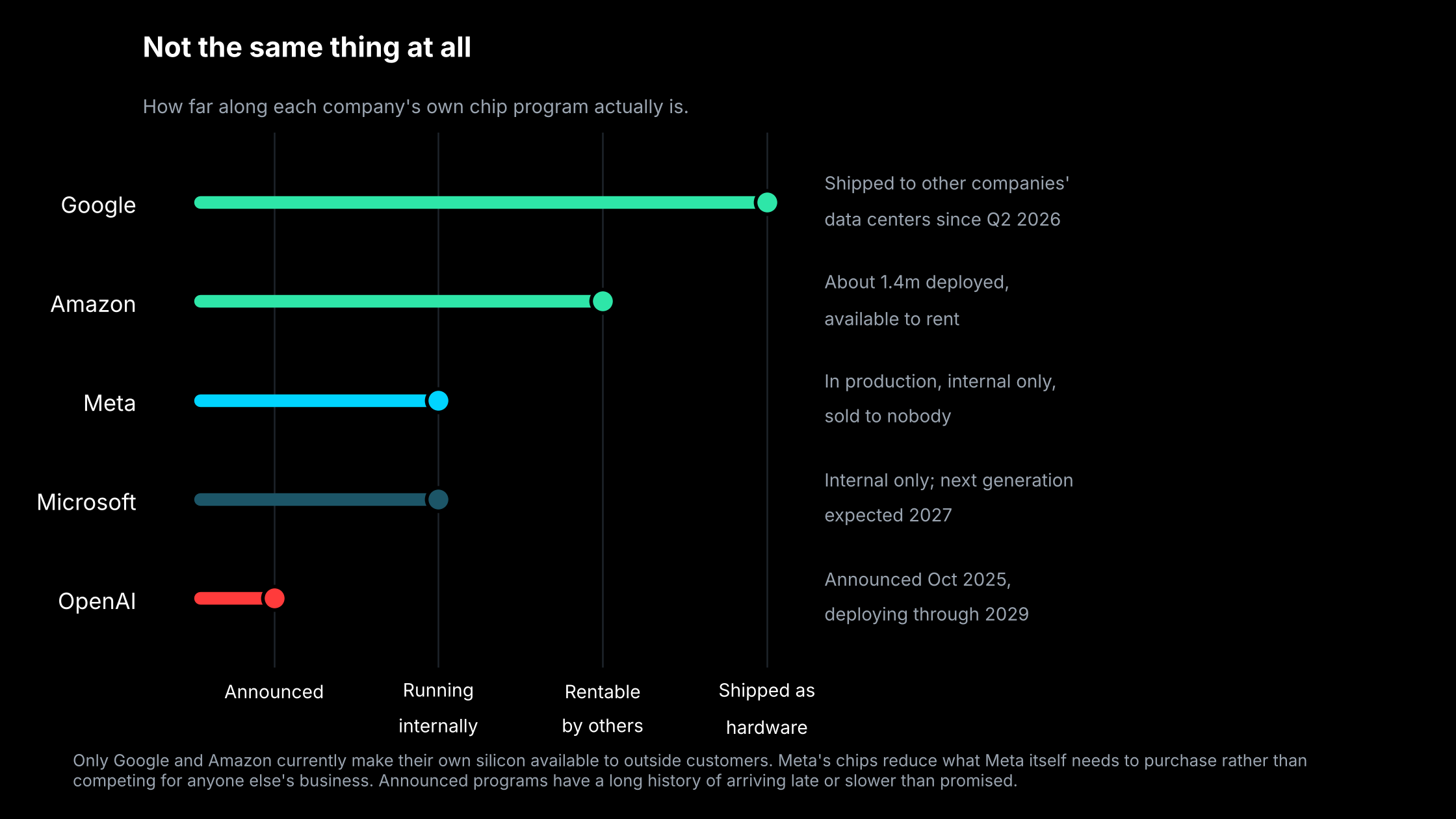
Amazon is furthest along after Google. Roughly 1.4 million of its chips were deployed by early 2026, a newer generation reached the market in December 2025, and outside customers can rent the capacity.
Meta has chips in production and uses hundreds of thousands of them for the systems that decide what appears in your feed. But Meta offers nothing to anyone else. Its chips reduce what it needs to purchase. They do not compete for anybody else's business.
Microsoft is earlier than its publicity suggests. Its current chip is in production but reserved for Microsoft's own products rather than offered to cloud customers. The next generation was announced in October 2026 with deployment expected in 2027.
OpenAI, with a partner, announced a very large custom chip program in October 2025 that deploys through 2029.
So the honest ordering is Amazon and Google well ahead, Meta reducing its own purchases without competing, Microsoft arriving next year, and OpenAI later than that. Describing these as four equivalent threats would be wrong.
How much of the market this adds up to
Epoch AI, the same group behind the cost estimates, tracks the share of newly shipped computing capacity by who made the chip. For the second quarter of 2026, measured in standardized performance units rather than raw unit counts, its estimates were:
| Share of newly shipped capacity | |
|---|---|
| Nvidia | 63% |
| 25% | |
| Amazon | 5% |
| AMD | 4% |
| Huawei | 3% |
Three caveats you need alongside that table. It measures standardized performance rather than units or revenue. It excludes Microsoft and Meta, so the listed shares are slightly overstated. And it covers newly shipped capacity in one quarter, not the installed base, which Nvidia dominates far more completely.
Still, 25% is not a rounding error. For most of the previous decade, in-house chips were.
The part that argues against all of this
Now the honest counterweight, because a piece that stopped here would be advocacy rather than analysis.
Nvidia is not losing. In the quarter ending July 26, 2026, its revenue was $96.2 billion, up 106% from a year earlier. Its data center business alone was $89.0 billion, up 117%. Gross margin went up, to the 75% figure this article started with. For the full prior fiscal year, revenue was $215.9 billion, up 65%.
Those are not the numbers of a company being displaced. A share of a market can fall while the absolute volume rises enormously, and that is what has been happening.
And the customers building chips are also purchasing more Nvidia hardware than ever. Google Cloud made Nvidia's newest systems generally available in October 2026. Alphabet has guided to capital spending of 180 to 190 billion dollars for 2026, with more expected the following year, and a large share of that is Nvidia equipment. The same company doing both things is not a contradiction. It is what you would expect if the in-house chip handles the workloads it suits and the purchased hardware handles everything else.
There is also a software problem that does not get solved by building good silicon.
This is the part most people underrate, so it is worth a moment. Nvidia's advantage was never only the chip. Over about two decades it built a set of software tools that let researchers use its hardware, and an entire generation learned on them. Every university course, every tutorial, every piece of example code assumes that hardware. A competitor does not only have to match the chip. It has to persuade people to relearn how they work.
Some of that has genuinely eroded. The most widely used framework for building these models now routes through an intermediate translation layer that can target more than one manufacturer's hardware, which means a great deal of code is no longer written directly against Nvidia's tools. Competing software has narrowed the measured performance gap to somewhere in the range of 10 to 30% for many tasks, down from several times worse a few years ago.
How hard the switch is depends entirely on what you are doing. A program that only runs finished models, written in standard tools, might take weeks to move. A program with heavily customized training code, tuned over years, can take six months to a year. That range is why inference work migrates first and training work migrates slowly or not at all.
The strongest evidence that the software barrier is passable is not any of those numbers. It is that a frontier research laboratory is running roughly a million of Google's chips in production. Somebody solved it, at scale, for real work.
Where the advantage holds up best is the networking. Connecting tens of thousands of chips so they behave as a single machine is its own engineering discipline, with its own hardware and its own software, and it is harder than designing the processor. That part of Nvidia's position has not been replicated by anybody.
What would have to be true for this to really matter
The useful discipline with a story like this is to say in advance what evidence would settle it, rather than watching prices and deciding afterwards.
Here is what we would want to see, and none of it is visible yet.
A company that is not Google operating Google's chips at serious scale in its own building. The shipments began in the second quarter of 2026 and most of the revenue is expected in 2027. Until outside organizations are running this hardware in volume, in facilities Google does not control, the merchant business is a stated intention with early deliveries attached.
A custom chip winning work it was not designed for. Purpose-built hardware wins on the predictable, repetitive jobs. The test of whether this is a genuine competitive shift rather than a niche is whether these chips start taking work that currently requires flexibility.
Nvidia's margin falling. This is the cleanest single indicator, and it is the reason to watch that number rather than the share price. A supplier facing real competition eventually has to choose between keeping its prices or keeping its volume. So far Nvidia has given up neither: margin went up last quarter. If that 75% starts compressing while volumes hold, something has changed. If it does not, the in-house programs are absorbing growth rather than taking share.
And the networking problem being solved by somebody else. Tying tens of thousands of processors together so they function as one machine is a harder problem than designing the processor. Whoever does that well has replicated the part of Nvidia's position that is genuinely difficult to copy.
Those four would constitute evidence. Announcements would not, and there will be a great many announcements.
So why is Google making its own AI chips?
Because its supplier keeps three quarters of every dollar, and Google purchases enough to make that worth attacking.
A chip it designs costs it something in the region of a third of the purchased equivalent. The design program costs hundreds of millions, which sounds prohibitive until you divide it by the number of units a company at this scale deploys, at which point it becomes a few hundred dollars a chip. Google has been doing this since 2015, so the engineering organization already exists and the cost of the next generation is lower than the cost of the first.
What is new in 2026 is not that Google designs chips. It is that Google began shipping them to other companies' buildings, which turns an internal cost-saving program into a product, and that a frontier research laboratory committed to roughly a million of them.
What is also true, and belongs in the same breath, is that Nvidia's data center revenue grew 117% in its most recent quarter and its margin went up. Both things describe the same market. One company's share of new shipments fell while its absolute volume more than doubled, because the market itself grew faster than the share loss.
What this does not tell you
It does not tell you Nvidia is in trouble. Its most recent quarter was the strongest in its history by a wide margin.
It does not tell you the chips are equivalent. The cost comparison here is per processor, from outside estimates, and does not account for performance differences, networking, or the engineering staff required to use custom hardware well.
It does not tell you what happened to any share price today. We have deliberately not connected this to today's trading, because the most prominent move in this sector today was driven by a separate company-specific matter that has nothing to do with chip design.
It does not tell you these programs will succeed. Two of the five described here have not deployed at all yet, and announced chips have a long history of arriving late, slower than promised, or not at all.
And it does not tell you what any company is worth. Nothing here values anything.
What we would keep is the method rather than the conclusion. When you want to know why a company is doing something costly and difficult, the most useful place to look is usually its supplier's margin. A high margin is a signal to everybody downstream that there is money sitting on the table, and sooner or later somebody with enough volume decides to reach for it.
That is the kind of thing that sits under a valuation rather than in a headline. Techdamentals shows the inputs behind every fair value rather than handing you a single number, puts the fundamentals and the chart in one place, and digs out the real reason a stock moved after earnings.