Brent crude ended this week near $98 a barrel. The previous Friday, October 30, 2026, the settlement was $113.43. Most of the coverage you will read this weekend attributes that to hope: talks between Iran and the United States, a midterm election that went badly for the administration, and a sense that the war is winding down.
Here is the problem with that story.
On Thursday, November 5, 2026, the political risk consultancy Eurasia Group cut its estimate of the odds of a deal to 10%, down from 20%, and raised the probability of renewed American strikes to 60%. On Friday, November 6, Fereidun Fesharaki of the energy consultancy FGE said: "Not only are we not close to a resolution, we are even worse than we were before the June MOU."
In the same week, 35 vessels were attacked in and around the Strait of Hormuz during October, the worst month since the war began. A seafarer was killed in an explosion aboard a products tanker on Wednesday, November 5.
So the price of oil fell hard while the people who study this conflict for a living became more pessimistic, not less.
That is not a contradiction. It is the most useful thing in this week's news, because it shows you something about prices that is easy to say and hard to feel: a commodity price is not a measure of danger. It is a measure of whether the danger is stopping barrels from arriving.
Where this started
American and Israeli strikes on Iran began on Saturday, February 28, 2026. The last price before the war was $71.32 a barrel on Friday, February 27.
Iran declared the Strait of Hormuz closed on March 4. The strait is the narrow channel at the mouth of the Persian Gulf through which a large share of the world's seaborne oil has to pass. It was never physically blocked, but marine insurers withdrew cover on March 5, which closes a shipping lane just as effectively. A ship without insurance does not sail.
Prices peaked around $138 in April. A ceasefire in early April collapsed within days. A truce signed in June collapsed in July. Over a hundred suspected mines were cleared from the shipping lanes by late August. As of late October the strait remains effectively closed, with Iran tying any reopening to the United States lifting its blockade of Iranian ports.
At $98, oil is still about 36% above where it was the day before the war started. Nothing about this week returns the market to normal. It takes back part of an enormous move.
What a war premium is, briefly
When a conflict threatens supply, the price of oil rises above what current supply and demand would justify. That extra amount is the risk premium. It is not a cost anybody has paid. It is a wager on what might happen.
We wrote about this at length when it was building. The short version is that a risk premium is the market's collective estimate of a future disruption, multiplied by how bad that disruption would be, and it can vanish in a session because an estimate is all it ever was.
What makes this week interesting is that the premium shrank for a reason almost nobody is reporting.
The week, and why the timing matters
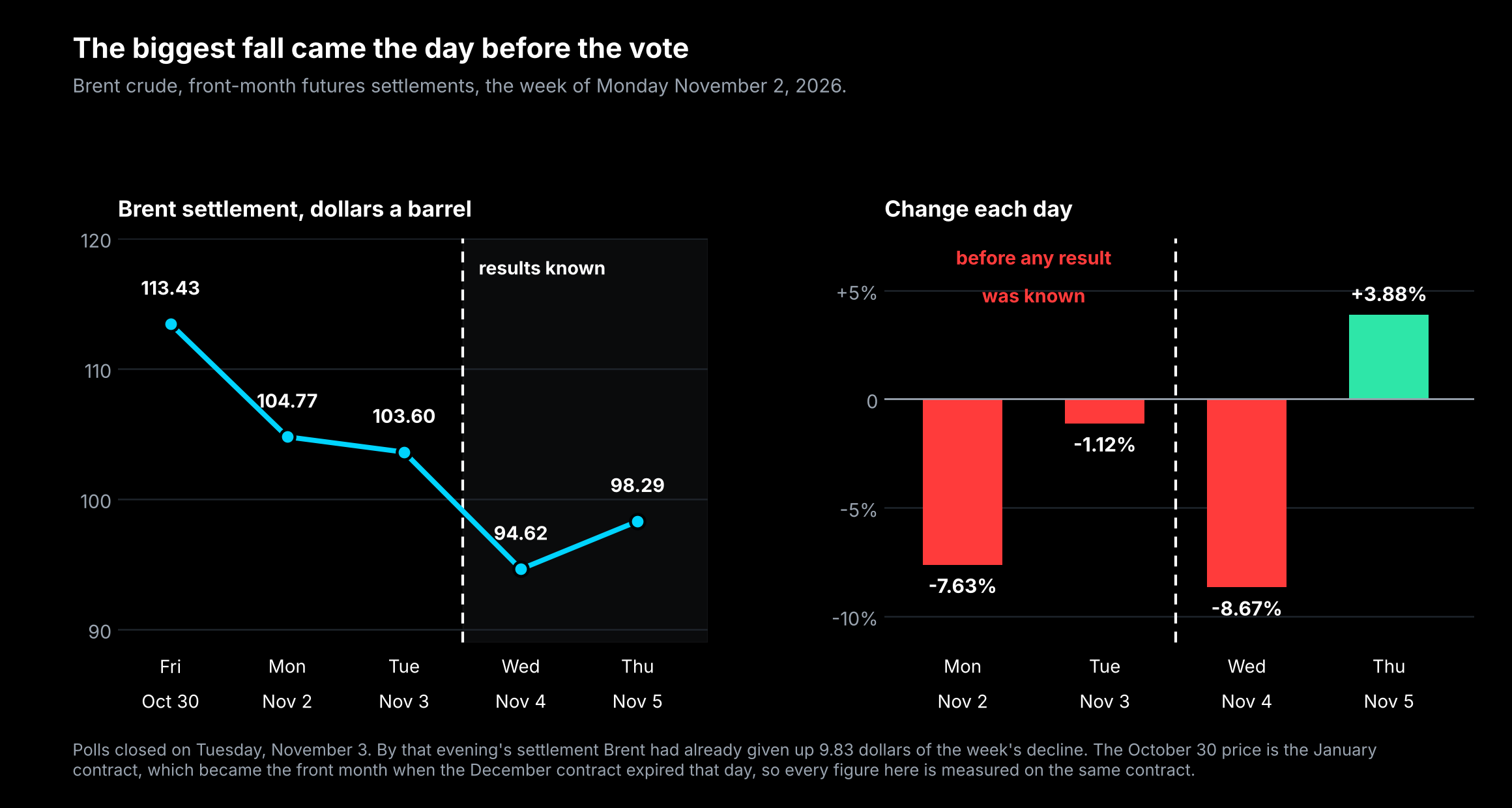
Here is the week of Monday, November 2, 2026, measured on the same futures contract throughout.
| Brent settlement | Change | |
|---|---|---|
| Friday, October 30 | $113.43 | |
| Monday, November 2 | $104.77 | -7.63% |
| Tuesday, November 3 | $103.60 | -1.12% |
| Wednesday, November 4 | $94.62 | -8.67% |
| Thursday, November 5 | $98.29 | +3.88% |
Look at Monday, November 2.
The single worst session of the week happened on Monday, November 2, the day before Americans voted. The cause was reported at the time and had nothing to do with the election: Iranian and Qatari officials were discussing terms to end the war, and a draft proposal was circulating.
By the settlement on Tuesday, November 3, before a single result was known, Brent had already given up $9.83 of the week's total decline. That is roughly two thirds of the move, banked before the polls closed.
The election mattered. It is not the explanation.
The explanation that does not hold
If the market were pricing peace, you would expect the people closest to the negotiations to be getting more optimistic. They are getting less.
The Qatari-mediated talks ended without a breakthrough. A senior Iranian official said the two sides remain far apart. Eurasia Group moved its deal odds down to 10% on Thursday, November 5, and put renewed American strikes at 60%, warning that escalation could push Brent back into a range of 110 to 125 dollars a barrel.
And the war's effect on Iran specifically has not eased at all. Iranian crude loadings, meaning oil actually leaving Iranian ports on ships, ran around 2 million barrels a day in March. In both September and October 2026 they were zero, the first months with no loadings since the fighting started. Roughly 200,000 to 300,000 barrels a day still reach customers through Iraq, and at least 54 tankers of Iranian oil are sitting idle offshore with nowhere to go.
Iran's exports did not recover. They stopped completely.
The explanation that does hold
Somebody else's barrels turned up.
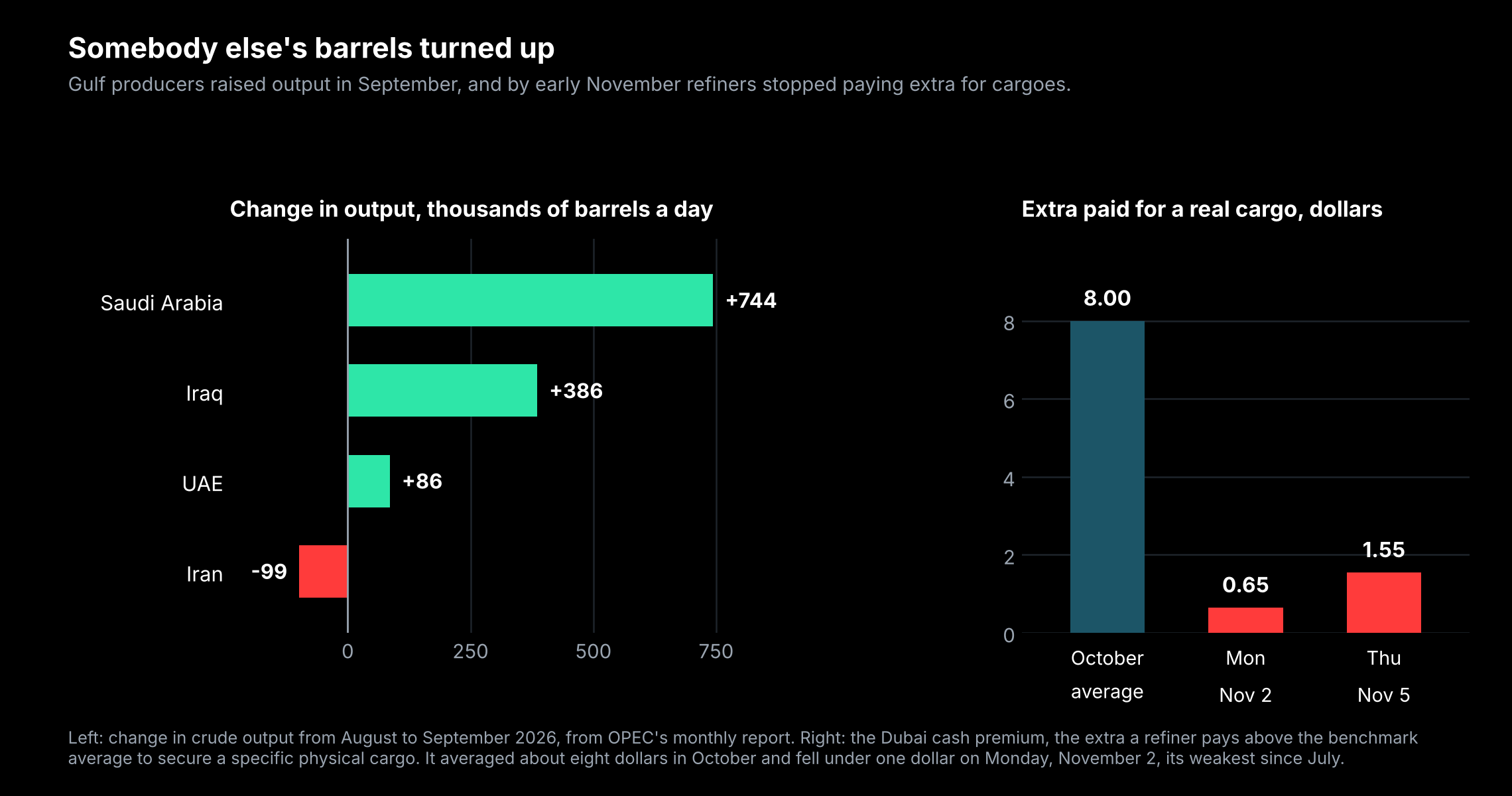
Between August and September 2026, output from OPEC countries rose by 920,000 barrels a day. Saudi Arabia added 744,000. Iraq added 386,000. The United Arab Emirates added 86,000 and pushed its Murban exports to a record 2.4 million barrels a day, against 1.2 to 1.5 million before the war. Iran fell 99,000.
The United States government's energy agency estimates that the amount of Middle Eastern production sitting idle because of the conflict fell from 5.8 million barrels a day in August to 4.8 million in September, and expects about 4.5 million for the rest of the year.
Iran's barrels are gone. The rest of the Gulf replaced most of them.
You can see this most clearly in a number that rarely makes the news. A spot premium is the extra amount a refinery pays, above the published benchmark average, to get hold of a specific physical cargo at a specific time. It is what refiners taking real deliveries actually pay, which makes it a much cleaner reading of scarcity than a futures price that speculators also trade.
Through October, the Dubai cash premium averaged around $8. On Monday, November 2 it was 65 cents, the weakest since July. The Oman premium hit 95 cents on Tuesday. Both recovered somewhat by Thursday, November 5, reaching $1.55 and $1.76.
And then the producer's own signal. On Wednesday, November 4, Saudi Aramco cut its December official price for its main grade sold to Asian refiners by $2, to a discount of $6.50 against the regional average. That is the weakest since May 2020, and larger than analysts expected.
A producer does not discount into scarcity. Aramco cut because there are enough barrels.
The test that settles it
There is a clean way to check whether the market really believes the danger has passed, and it is to look at the people who carry the danger.
If shipping through a war zone were genuinely getting safer, the cost of moving oil through it would fall and the companies that own tankers would do well. This week, rates for the largest crude tankers fell 3.8%, rates for the next size down fell 29.8%, and shares in crude tanker companies fell 18.7%, a steeper decline than oil itself.
So the shipping market agreed with the oil market. Both repriced downward together, in the same week the attack count stayed near its worst.
That is the resolution. Not that anybody thinks the strait is safe, but that the world has arranged its supply so that the strait matters less.
The levels make this point better than the direction does. Earnings for the largest crude tankers are still running at roughly six times where they were in January. War-risk insurance, which cost about a quarter of one percent of a ship's value before the conflict, now runs 3% to 10%. Shipping crude from the Gulf to India costs about $16 a barrel against $2.50 before the crisis. One-year charter rates did not fall at all this week.
Risk is still priced as severe. It simply stopped being priced as worsening.
About that 16% figure
You will see it reported that Brent had its worst week since the pandemic, down about 16%. Treat that carefully, because it is a measurement artifact and it is a useful thing to understand.
Oil futures are contracts to deliver in a specific month. The December contract expired on Friday, October 30, and the January contract became the one quoted. Those two contracts were not trading at the same price. December went off the board $4.21 above January.
Comparing this week's January price against last week's expiring December price produces about 16%. Comparing January against January, which is the change an actual position would have experienced, produces about 13%.
You can see the error in the same sentences that contain it. Several reports give Brent down 16% and West Texas Intermediate down 13% in the same breath. The American contract does not expire until November 20, so it was measured consistently. The entire difference between the two benchmarks this week is the contract change, not anything happening in the world.
And 13% is not extraordinary for this market. The median weekly move in Brent across its history is under 3%, which makes 13% sound enormous. But 2026 has already delivered four weekly declines of that size or larger, including a 17% week in April. Against this year's own volatility, this week is a little above average. The comparable pandemic week, ending March 13, 2020, fell 29%.
You will also see this week called the worst for oil since the pandemic began. We are not using that description. On one widely used price series, the week ending Friday, April 17, 2026 fell more than 17%, which is larger than this one. Whether this week ranks first depends on which series you measure and whether you use spot or futures prices, so we would rather give you the size of the move than a superlative we cannot stand behind.
So why is oil falling during a war?
Because the war stopped removing barrels from the market.
That is the whole answer, and it is different from the one most coverage is giving. Oil did not fall because peace arrived. By the assessment of the people who track this most closely, peace is less likely this week than last. Attacks on shipping in October were the worst of the entire conflict, a seafarer died on Wednesday, November 5, and Iran is exporting nothing by sea.
Oil fell because Saudi Arabia, Iraq and the United Arab Emirates increased production enough to cover what Iran stopped sending, because the physical premium for a cargo collapsed from about $8 to under a dollar, and because the largest producer in the region responded by cutting its prices to the lowest in six years.
A risk premium pays for the possibility that oil will not arrive. When oil arrives anyway, from somewhere else, the premium goes away whether or not the risk does.
What this does not tell you
It does not tell you the price will keep falling. Eurasia Group's central case is renewed strikes, and it warns that would put Brent back in a range of 110 to 125 dollars a barrel. The same substitution that cushioned this shock has used up spare capacity, which can make the next one worse.
It does not tell you the danger is over. 129 shipping incidents and 25 seafarer deaths have been recorded since the conflict began. Those numbers are still rising.
It does not tell you prices at the pump are about to fall. Crude is one input into refined fuel, refining capacity is its own separate shortage, and the pass-through takes weeks when it happens at all. October's inflation reading, published Tuesday, November 10, will show September and October energy costs, not this week's.
And it does not tell you what any company is worth. Nothing here values anything.
The thing worth keeping is the distinction between a risk and a price. They are related, and they are not the same, and this week they moved in opposite directions in plain sight.
Techdamentals is built around that gap. It gives you a fair value range for a company rather than a single number, puts the fundamentals and the chart in one place, and pulls out the real reason a stock moved after earnings instead of the headline.