On Thursday, November 12, 2026, after the market closed, Cisco reported revenue up 24%, earnings per share up 40%, and a higher forecast for the full year. By the evening, headlines said the stock was rising after hours. By early Friday, November 13, 2026, it was trading about 2% to 3% lower.
When a company beats on almost every line and still falls, the question is what the market read that the headline did not. This issue works through Cisco's press release and earnings call to find the candidates. One caution up front: nobody outside the trading desks can say which of them moved the stock, and we will not pretend to.
Two notes on sourcing. Cisco's own release and call transcript are the basis for every company figure below. Cisco has not yet filed its quarterly report with the SEC that we could find, so details that normally sit there are not here. The after-hours and early-Friday moves vary by source and time of day, and we give ranges.
What Cisco reported
For the quarter ended October 24, 2026, Cisco reported the following.
Revenue was 18.52 billion dollars, up 24% from a year earlier. Product revenue was 14.7 billion, up 32%. Services revenue was 3.85 billion, up 1%. Networking, the largest product group, was 11.1 billion, up 43%. Security grew 7% and collaboration grew 8%.
Non-GAAP earnings per share were 1.40 dollars, up from 1.00 a year earlier. Non-GAAP means the company's own adjusted figures, which leave out items such as the cost of acquisitions and stock-based pay. On the strictest accounting basis, earnings per share were 1.14 dollars, up from 0.72.
Analysts had expected about 18.1 billion dollars of revenue and about 1.33 dollars of earnings per share, according to the LSEG survey cited by two summaries we found. The average of analysts' forecasts is called the consensus. Cisco beat both.
It also raised its forecast, which companies call guidance. For the full fiscal year ending in July 2027, it now expects revenue of 74.8 billion to 75.8 billion dollars, up from 72.2 billion to 73.4 billion before. It raised its earnings per share outlook to between 5.47 and 5.53 dollars, from between 5.05 and 5.11. For next quarter it guided revenue of 18.0 billion to 18.2 billion dollars and non-GAAP earnings per share of 1.34 to 1.36 dollars, against a consensus that one summary put at about 1.23.
Remaining performance obligations, which are contracted revenue not yet recognized, were 46.2 billion dollars, up 8%. Operating cash flow was 4.4 billion, up 36%. Cisco paid 1.7 billion dollars in dividends and repurchased about 18 million of its own shares, at an average price of 112.38 dollars, for roughly 2.0 billion.
By the usual scorecard, that is a good quarter. So the stock did not fall on revenue or earnings.
The margin: where it went
The number that moved the other way was gross margin. Gross margin is what is left of each sale after the direct cost of making the product, shown as a percentage of the sale. If a product is priced at 100 dollars and costs 35 dollars to make and deliver, the gross margin is 65%.
Cisco's non-GAAP gross margin was 65.6%, down from 68.1% a year earlier. Here are the last eight quarters, from Cisco's own releases.
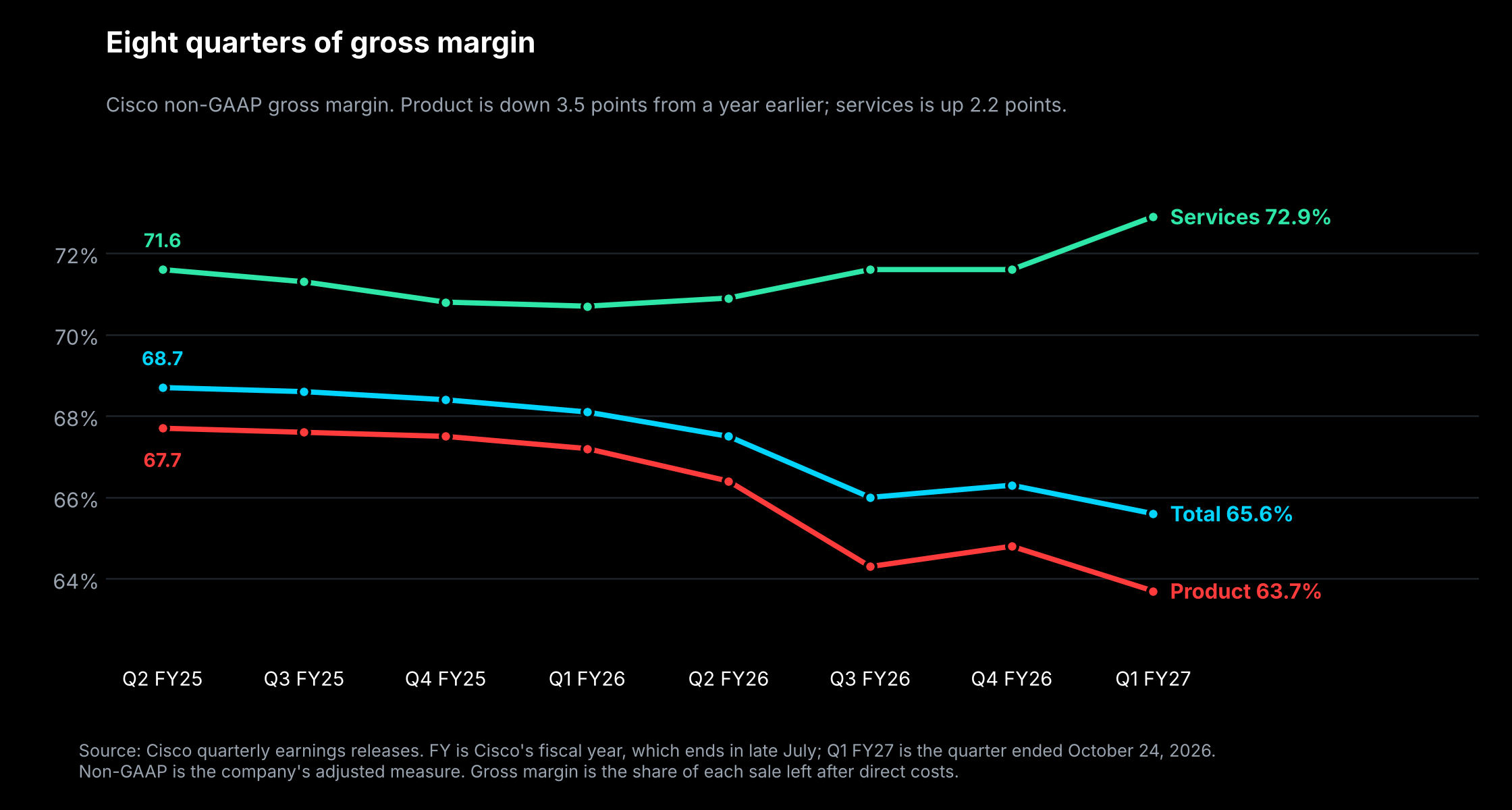
Two things stand out. The decline has been going on for most of two years, not one quarter, and it has not moved in a straight line: the fourth quarter of last fiscal year ticked up from the third. And the decline sits entirely in products. Product gross margin fell from 67.2% to 63.7%. Services margin rose, from 70.7% to 72.9%.
Why? Chief Financial Officer Mark Patterson gave two reasons on the call. Gross margin fell "as hardware revenue growth significantly outpaced software and services revenue growth," and the product margin decline was "primarily driven by higher hardware mix and elevated memory costs," partly offset by price increases and productivity improvements.
Both reasons deserve a plain-English explanation. Mix means the proportions of what a company offers. Hardware earns a lower gross margin than software and services. When hardware grows 32% and services grow 1%, the average falls even if no individual product got less profitable.
Memory here means the computer memory chips inside networking equipment. Their prices have risen sharply this year. TrendForce, a firm that tracks the market, reported that contract prices for one common type, DRAM, rose about 80% from the first quarter to the second quarter of 2026 and about 40% from the second to the third, with another increase of about 20% forecast for the fourth quarter. Cisco said it signed a multiyear memory supply agreement in the quarter, which suggests it is trying to lock in supply and price.
A point worth noticing: Cisco did not say the margin decline came specifically from sales to the largest cloud companies. It said hardware mix. Some coverage has paraphrased that as artificial intelligence networking gear being lower-margin, but that is a journalist's reading, not a statement from the company.
Was the margin a miss?
Here the sources disagree, so we are careful. Cisco had guided for a non-GAAP gross margin of 65% to 66% for the quarter, so 65.6% was inside its own range. One preview put the consensus at about 65%, and one summary described the result as in line with about 65.5%. A headline on another site called it a miss without giving a consensus figure. We could not find a clean number.
Cisco also warned. On its previous earnings call it described a modest gross margin headwind for the full year from higher hardware volume. Now it expects the full-year margin to land at "just shy of" 65%. With next quarter guided to 65% to 66%, the back half of the year would have to run lower to average just under 65%. That last step is our own arithmetic, not a Cisco statement.
So the margin was not a surprise to the company, and it may not have been to the market. It may have been a reminder.
The orders
The second candidate is orders. Cisco's chief executive, Chuck Robbins, said total product orders grew 21% from a year earlier, on top of 13% growth a year before that. Excluding the largest cloud companies, which the industry calls hyperscalers, product orders grew 14%, on top of 9%. Networking orders grew 28%, the ninth straight quarter of double-digit growth.
Orders are what customers have committed to purchase, which come before revenue. They matter because they show what revenue will look like in the coming quarters.
The question is the comparison. In the previous quarter, product orders had grown 35%, according to a summary of that call published by Nasdaq. A report on an analyst note on Friday, November 13, 2026, carried by Investing.com, put the ex-hyperscaler growth rate at 14% against 25% the quarter before. The call itself gave no sequential comparison, so we are relying on those secondary sources for the earlier figures.
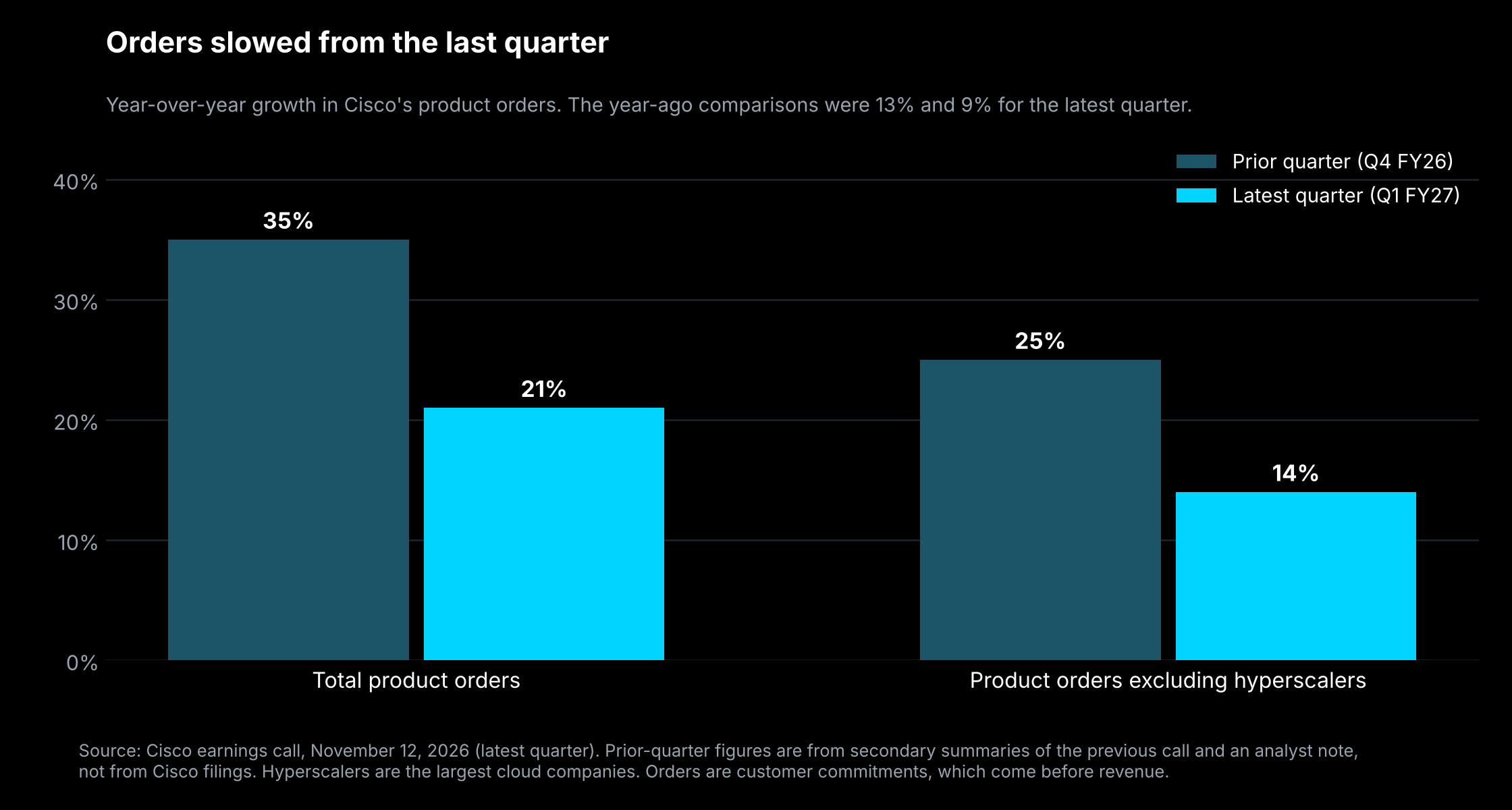
There is a wrinkle that makes this harder to read. Cisco has stopped guiding on orders from the hyperscalers and now guides on revenue. Robbins said, "we made the decision just to go to the revenue side so that it's just cleaner." The company now expects 9 billion dollars of artificial intelligence infrastructure revenue from hyperscalers in fiscal 2027, up from an earlier 7.5 billion and, in the release's words, more than double fiscal 2026. Patterson said that would be about 12% of next year's revenue, up from 6% this year.
Be careful not to mix these up. In fiscal 2026, Cisco took 9.3 billion dollars of hyperscaler artificial intelligence orders. For fiscal 2027, the 9 billion is expected revenue. One is a commitment from customers and the other is what Cisco will recognize. When asked about order trends, Robbins did not give a hyperscaler order figure for the quarter, and said he did not expect "normal linearity in this business at all." Orders from this kind of customer come in large, uneven pieces.
Since we wrote about the other side of this market, it is also worth noting that Robbins cited growth in artificial intelligence orders from "neocloud, sovereign and enterprise customers," which are not part of that 9 billion. We explained how a neocloud like CoreWeave pays for its buildout in our issue on its borrowing.
The run before the print
The third candidate is not in the release at all. It is the stock itself. Cisco had risen about 32% this year before the results, against about 9% for the Nasdaq, according to two summaries. One analyst note on November 5, reported by Yahoo Finance, argued that expectations for artificial intelligence demand were already reflected in the price and that some customers might have pulled purchases forward ahead of Cisco's price increases.
The company's own repurchases give a small clue about the path. It paid an average of 112.38 dollars for the shares it repurchased during the quarter. The close on Thursday, November 12, 2026 was 102.01. That is consistent with a stock that fell in early November, which one source also reported. It is not evidence of anything else.
When a stock has run, a good quarter can be a smaller surprise than it looks. That is a general pattern and not a finding about Cisco.
What else is in the numbers
Three other details are worth knowing, because they could matter on the next call.
Inventory. At the end of its last fiscal year, on July 25, 2026, Cisco held 5.7 billion dollars of inventory, up from 3.2 billion a year before, according to its fourth-quarter release. That is consistent with a company purchasing components ahead of demand and with higher prices for them. It is not, by itself, a problem.
Supply. Patterson said Cisco is seeing "not a lot of issues at all" in supply, naming optical components as the biggest one.
Services. Services revenue grew only 1%, but its gross margin rose to a high for the period we checked, 72.9%. The part of the business that earns the highest margin is the one growing the slowest, which is the mix problem in one line.
What this does not tell you
It does not tell you why the stock reversed. The margin, the slowdown in orders and the run before earnings are all plausible. Each is sourced. None is established as the cause.
It does not tell you the margin will keep falling. Cisco guided to a range of 65% to 66% next quarter and "just shy of" 65% for the year. Its operating margin, which measures profit after operating costs, was 37.8% on a non-GAAP basis, the highest of the seven quarters for which we could find the figure.
It does not tell you what any share is worth. Nothing here values anything.
It does not tell you what the quarterly filing will say. The SEC filing for this quarter is not out yet, and customer concentration, purchase commitments and the inventory detail will be in it.
The habit worth keeping is to read what a number was measured against. A gross margin of 65.6% can be a fall from last year, a result inside the company's own range, and a reminder of a trend, all at once. Which of those a market reacts to is a separate question, and one the filings do not answer.
That is the kind of reading that sits under a valuation rather than in a headline. Techdamentals shows the inputs behind every fair value rather than a single number, puts the fundamentals and the chart in one place, and reads the SEC filing to find the real reason a stock moved after earnings.
Try Techdamentals for 3 days, no card needed
This is educational content, not financial advice. Techdamentals is an educational tool and does not recommend any security.