On the morning of Thursday, November 12, 2026, Nvidia told the market that its founder and chief executive, Jensen Huang, had resigned as president, CEO and member of the board, effective immediately. Five days earlier the company's stock had closed at 186.64 dollars. By the close on Thursday, November 12, it was 166.19 dollars.
Nvidia is scheduled to report its quarterly results on Tuesday, November 17, 2026, at about 1:20 p.m. Pacific time, with no permanent CEO in the building. This issue is about what we actually know. That turns out to be a short list, and the rest is a set of specific questions that the report on November 17 can start to answer.
One note on sourcing. Everything below about the leadership change comes from Nvidia's own filing with the SEC and its press release. Where a fact comes only from news reports, we say which outlet reported it and that Nvidia has not confirmed it. We are leaving out reports about anyone's private life, because they do not change what the company has to do next.
What the filing says
Public companies have to file a short notice with the SEC, called an 8-K, within days of certain events. A change of chief executive is one of them. Nvidia's 8-K says the board "accepted the resignation" of Mr. Huang as president, CEO and director, effective immediately. It gives no reason and states no disagreement with the company.
The same filing and the press release say three other things.
First, Colette Kress, 59, is interim CEO. She has been Nvidia's chief financial officer since September 2013 and keeps that job while she fills in. An interim CEO is a temporary appointment that runs until a permanent one is chosen. It signals continuity more than direction.
Second, Harvey C. Jones, 73, has been named chair of the board. The release calls him the company's first-ever chair. He has been a director since 1993.
Third, the board is starting a search for a permanent CEO and will consider internal and external candidates. That sentence also tells you something by omission: nobody was waiting in the wings with a title. Jones said in the release that "the Board has full confidence in Colette and the leadership team," and that the company expects operations, customer commitments and the product roadmap to continue "without interruption."
The filing mentions no investigation, no separation agreement and no consulting arrangement with Mr. Huang. The press release gives no financial guidance and confirms that the earnings date has not moved.
What Nvidia said before Thursday, and what is only reported
The filing is not the whole context, and the context matters for what comes next.
On Sunday, November 8, 2026, Nvidia's board put out its own statement. It said a committee of independent directors, working with outside counsel, would lead an independent investigation "in light of recent reporting that founder and CEO Jensen Huang has been the target of a foreign intelligence effort." The board said Mr. Huang fully supports the review, and that it "has no reason to believe that either national security or NVIDIA secrets were compromised."
Beyond that, what has been published comes from news organizations, and Nvidia has not confirmed it. The Wall Street Journal reported on Wednesday, November 11, 2026 that the board was preparing to remove Mr. Huang. TechCrunch's timeline, drawing on reporting by the New York Times, the Information and Bloomberg, describes earlier reporting about a Nvidia customer, the Singapore-based company Megaspeed, which U.S. and Singapore authorities reportedly examined in October 2025 over suspected diversion of chips to China. Nvidia's own statement does not mention that company.
Three House committee chairs requested a closed-door briefing from Mr. Huang on Thursday, November 5, 2026, according to the same timeline. Yahoo Finance's live coverage reported on Thursday, November 12, that one of them said Mr. Huang agreed to testify before Thanksgiving. We could not confirm that against a primary source.
The distinction is practical. The things in the filing are facts. The things in the reporting may be right, and some may turn out to be wrong or incomplete, and a few could affect what the company says on November 17.
Who is actually in charge
Colette Kress is not a stand-in from outside. Forbes's profile has her at Nvidia for 13 years, after eight years in finance at Texas Instruments, 13 years at Microsoft, including four as chief financial officer of its server and tools division, and three years as finance chief at Cisco. She is the person who has explained Nvidia's numbers to investors on every earnings call for more than a decade. In 2025, when Washington cut off sales of one of Nvidia's chips to China, she was the one who told analysts about a 4.5 billion dollar charge and an 8 billion dollar hole in the next quarter's revenue.
That history has two implications. She knows the company's finances better than almost anyone alive. And she has been the company's voice on bad news before, so the November 17 call will not be her first hard one. What it does not tell you is whether she wants the permanent job, or whether the board wants her in it. Neither document says.
Harvey Jones is a different kind of figure. He has been on the board for 33 years and, since 2004, has been the managing partner of a private family office called Square Wave Ventures. His role as the company's first chair is new, and so is the structure around it.
Here is the governance detail worth explaining. Until Thursday, Nvidia's proxy statement said it did not have a board chair. It used an independent lead director, Stephen Neal, to balance a CEO who sat on the board. A lead director is the independent director who runs meetings of the outside directors and speaks for them when the CEO is also a director. A chair runs the board itself. Neither document says what happens to the lead director role now that there is a chair, so we do not know.
The proxy filed in May said the board had ten members, with an eleventh seat approved in July. Mr. Huang was one of them, which by our count leaves ten, though no filing states the current number.
What the stock has done
Nvidia's stock was already down before Thursday. The record close in the past year was 239.24 dollars on Tuesday, October 6, 2026. By the close on Thursday, November 12, 2026 it was 30.5% below that.
The last week looked like this. Friday, November 6: 186.64 dollars. Monday, November 9: 178.67, down 4.3%. Tuesday, November 10: down 5.5%. Wednesday, November 11: 173.73, up 2.9%. After the close that evening, following the Wall Street Journal report, the stock was down about 8.6% in after-hours trading. On Thursday, November 12: the stock opened sharply lower, reached an intraday low of 148.80 at 9:31 a.m. Eastern, which was 14.4% below the November 11 close, and recovered to close at 166.19, down 4.3%. About 740 million shares traded, against an average of about 131 million.
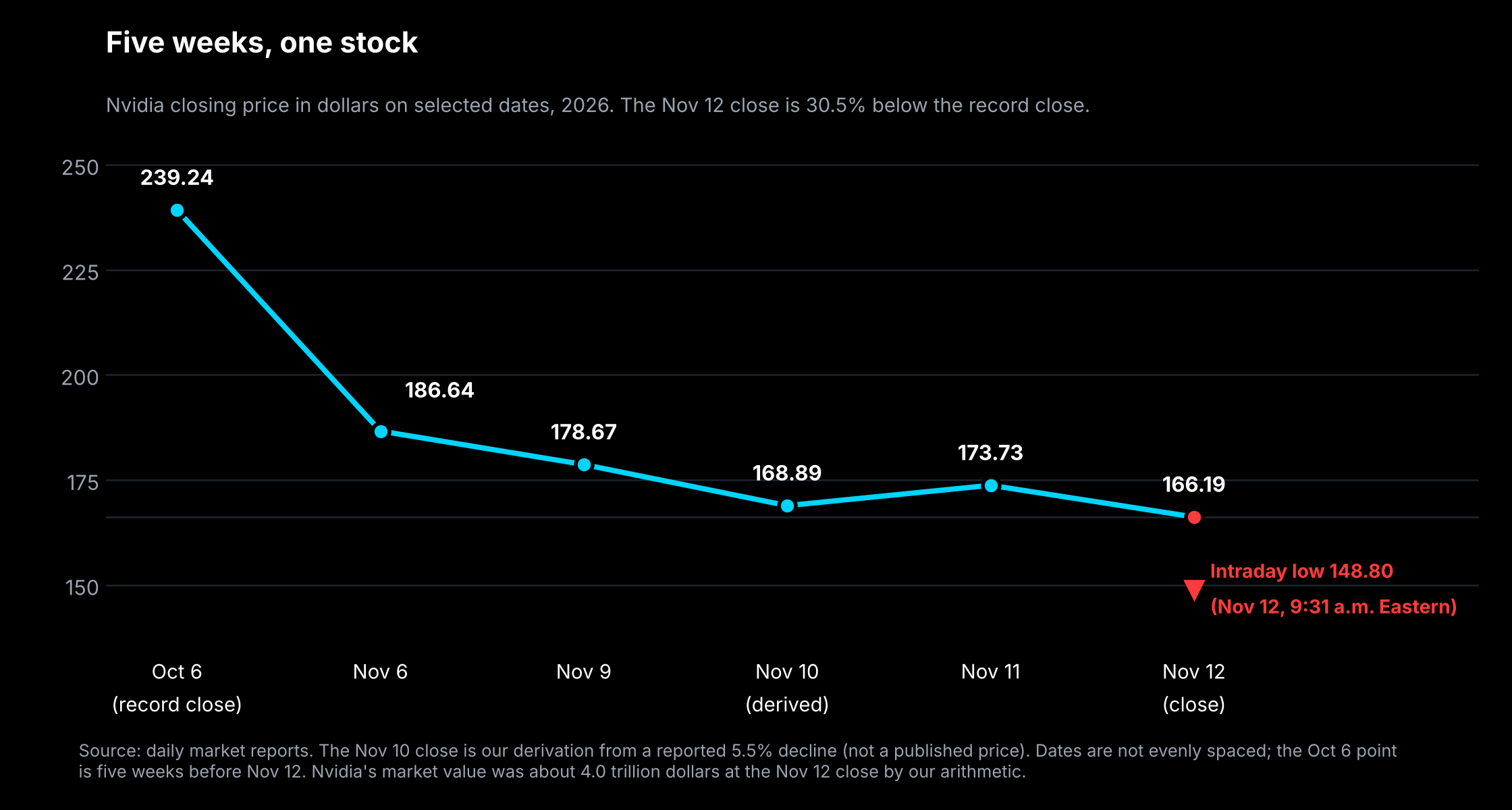
Nvidia's market value was about 4.0 trillion dollars at Thursday's close and about 3.6 trillion at the intraday low. Those are our own arithmetic, using about 24.1 billion shares outstanding from its latest quarterly report. A figure of 4.19 trillion dollars that circulated on Thursday was Wednesday's value.
We are not saying the leadership change caused the full decline from October. The stock fell for weeks before this. What the numbers do show is that Thursday's volume was more than five times the average, and that the stock went from a low of 148.80 to a close of 166.19, a gap of 11.7%.
The three questions the November 17 report has to answer
Does the guidance hold? In August, Nvidia reported 96.2 billion dollars of revenue for the quarter ended July 26, 2026, up 106% from a year earlier. For the quarter now ending, it guided to 108.0 billion dollars, plus or minus 2%, with a gross margin of 74.0%, plus or minus half a percentage point. Guidance is a company's own forecast for its next quarter. Gross margin is what is left of each sale after the direct costs of making the product. Nvidia said that forecast assumes no data center compute revenue from China.
Analyst averages, which are called consensus, were running slightly above the middle of that range before Thursday: about 108.9 to 109.0 billion dollars of revenue, according to two sources that do not say when they were compiled. The guidance predates everything in this issue, and Nvidia has not commented on it since.
What did the company commit to in the meantime? Here the quarterly report filed in August is more useful than the headlines. It shows 279 billion dollars of supply and capacity commitments, which are agreements to pay suppliers for chips, memory and manufacturing capacity over time. That was 119 billion the quarter before. Total commitments were 366 billion dollars, which also includes 29 billion for cloud services Nvidia has agreed to purchase, 25 billion in data center leases that have not started, 25 billion in equity investments and 8 billion in capital spending.
The filing also describes pledges to stand behind other companies' obligations, with a maximum exposure of 108.5 billion dollars. 105 billion of that is a cap on promises Nvidia made in August 2026, after the quarter ended, tied to a data center site for a customer that is an affiliate of OpenAI. Those promises end if certain events occur, including OpenAI reaching a satisfactory credit rating. We covered how that kind of borrowing against signed customer contracts works in our issue on CoreWeave.
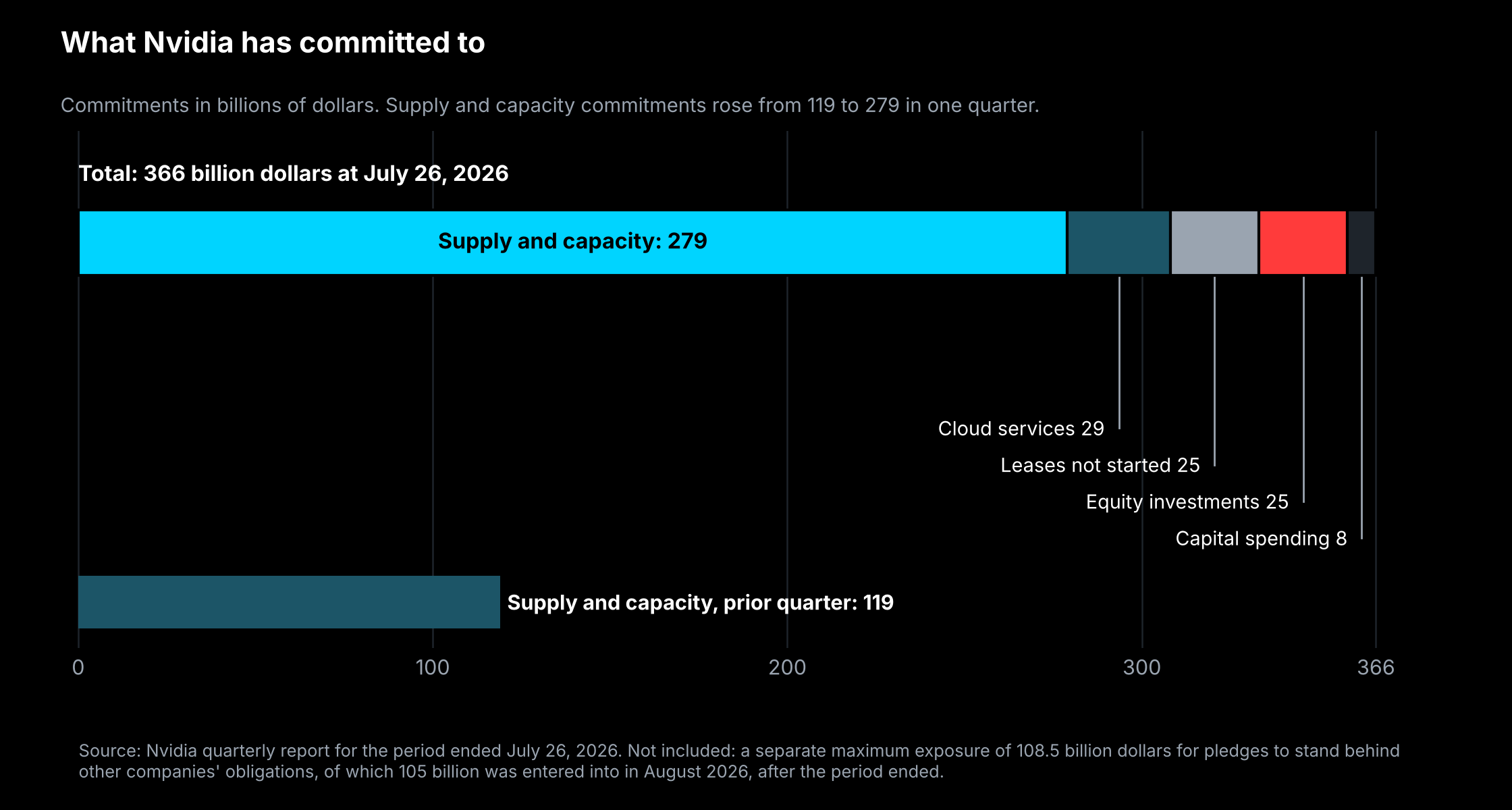
The key point is who inherits all of this. A new CEO does not start with a blank page. Those commitments are signed, and any decision to change them would be the board's and the new CEO's, not something the November 17 report can resolve. Whether customers can keep paying for what these commitments build is a fair question for the call. That is our framing, not a statement from the company or an analyst, and it is one place where the interim CEO's background in finance is relevant.
Who are the customers? Nvidia's quarterly report shows that at July 26, 2026, five direct customers accounted for 22%, 14%, 13%, 11% and 10% of its accounts receivable, which is what customers owe it for products already delivered. A direct customer is a company that purchases from Nvidia itself, such as a server maker or cloud provider, as opposed to the end user that eventually runs the chips. The filing does not name them. In January the same measure showed three customers at 25%, 18% and 13%.
Concentration of that kind is why leadership matters to a supplier. When a handful of customers account for most of what you are owed, the relationships between your chief executive and their chief executives are part of the business. That is the argument analysts make for why Mr. Huang's departure is more than a name change, and it is a reasonable one. It is also a judgment, not a measurement.
What the analysts are saying
The reaction from analysts has been split between near-term calm and long-term caution. KeyBanc's John Vinh called the appointment of Ms. Kress constructive, "given her tenure as CFO since 2013 and deep institutional knowledge of Nvidia's business and strategy." Bernstein's Stacy Rasgon wrote, "We aren't really worried about near-term impacts to the business," but questioned "the ability of any new CEO to truly fill Jensen's shoes." Baird's Tristan Gerra listed potential headwinds including "incremental senior management departures" and write-down charges.
We are not reproducing any analyst's price estimate or rating. Those are opinions about a stock. The quotes above are opinions about the business, and they are useful for the same reason: they tell you which questions professionals think matter.
What the filings say about key people
Every company's annual report has to list its risks, and Nvidia's lists the loss of key people. The heading says that if Nvidia is "unable to attract, retain and motivate our executives and key employees," its business may be harmed, and the text says it is "highly dependent on the services of our longstanding executive team." It also warns that failing "to ensure effective succession planning, transfer of knowledge, and smooth transitions" could hinder strategic planning.
That language does not name Mr. Huang. Risk factors are written to cover a category, and companies rarely name one person in them. It is worth knowing what the document says, and also what it does not.
One more fact belongs here. According to the company's proxy statement, Mr. Huang owned 870,604,104 shares, or 3.58% of the company, as of March 23, 2026. At Thursday's closing price that is roughly 145 billion dollars, by our arithmetic. Nothing in the filing addresses his holdings, and he is no longer on the board.
What this does not tell you
It does not tell you why Mr. Huang resigned. Nvidia's filing gives no reason. The reporting that exists is attributed to named outlets and has not been confirmed by the company.
It does not tell you what the company will say on November 17. Nvidia has not commented on guidance since August, and a change in the CEO does not by itself change the quarter that is already over.
It does not tell you who will lead the company permanently. The board has said only that a search is starting.
It does not tell you what Nvidia is worth. Nothing here values anything.
The habit worth keeping from a week like this one is to separate three things on every headline: what the company filed, what a named outlet reported, and what an analyst concluded. The first can be checked. The second can be right or wrong. The third is an opinion, and sometimes a useful one.
That is the kind of reading that sits under a valuation rather than in a headline. Techdamentals shows the inputs behind every fair value rather than a single number, puts the fundamentals and the chart in one place, and reads the SEC filing to find the real reason a stock moved after earnings.
Try Techdamentals for 3 days, no card needed
This is educational content, not financial advice. Techdamentals is an educational tool and does not recommend any security.