"AI is going to hit the demand side of the economy before the supply shock."
That is Kevin Warsh, the new Chair of the Federal Reserve, speaking in Bangkok on Friday. One sentence, sounds technical, and it is the center of an argument inside the Fed about whether the money pouring into artificial intelligence is making inflation worse or is about to make it better. One of his own colleagues is not convinced.
They have not resolved it. They meet in eleven days.
First, who these people are and what they control
The Federal Reserve is the central bank of the United States. Its main job is keeping prices stable, which in practice means holding inflation near 2% a year.
It is not there. In September, consumer prices were 3.7% higher than a year earlier. Strip out food and energy, which swing around for reasons that have nothing to do with policy, and the figure was 2.6%. Both are above 2%, and both got further from 2% last month rather than closer. We walked through why those two numbers differ, and which one the Fed actually watches, in an earlier issue.
The Fed's main tool is one number: the interest rate banks charge each other overnight. Everything else follows from it. Mortgage rates, car loans, credit card rates, what a company pays to borrow, and what a saver earns all move in rough sympathy with it.
When inflation runs hot, the usual response is to raise that rate. Borrowing gets costlier, people and companies spend a little less, demand cools, and prices follow. When the economy is weak, the Fed lowers it and the process runs in reverse.
Rate decisions are made by a committee of eighteen officials. The Chair runs it. Since May 22 the Chair has been Kevin Warsh, who replaced Jerome Powell and who sat on the Fed's board through the 2008 financial crisis. In September the committee raised rates by a quarter of a percentage point, to a range of 3.75% to 4.00%. It was the first increase since 2023, and most officials indicated they expected at least one more before the year ended.
That is the setup. Inflation is above where they want it, they have started raising rates again, and they have two meetings left this year.
What the Chair actually said
Warsh spoke on Friday in Bangkok, at the International Monetary Fund's annual meetings, in a conversation with the IMF's managing director. Because of the time difference it reached American screens on Thursday evening.
On what the Fed will do next, he gave nothing, on purpose. "I don't prejudge meetings," he said. He described the period since the last decision in careful, deliberately unexciting terms: "Over the month or so that's transpired since then, the world has broadly conformed to our expectations." The two remaining meetings, he said, are where it gets settled.
Then came the sentence at the top of this issue.
"AI is going to hit the demand side of the economy before the supply shock."
That sentence is doing a lot of work, so here is what it means.
Start with what happens when a lot of people suddenly want the same thing.
Building artificial intelligence means somebody has to purchase real, physical objects. Chips. Servers. Steel and concrete. Electrical transformers. Land near a power line. Electricians who know how to wire a building that draws as much power as a small town. Here is the thing: the number of transformers in the world did not go up because AI got good. Neither did the number of electricians.
So you have far more money chasing the same amount of stuff. The company that wants a transformer this year has to outbid the company that also wants one, and the winner pays more. That is what economists call a demand force. It pushes prices up, and it is what is happening now.
Now the other end. Suppose the technology works, and a company that needed ten people to do a job can do it with six. Or a factory turns out more units in a shift without hiring anyone. The same economy is now producing more stuff with the same effort. More stuff on the shelves, roughly the same money chasing it, and nobody has to outbid anybody. That is a supply force. It pushes prices down.
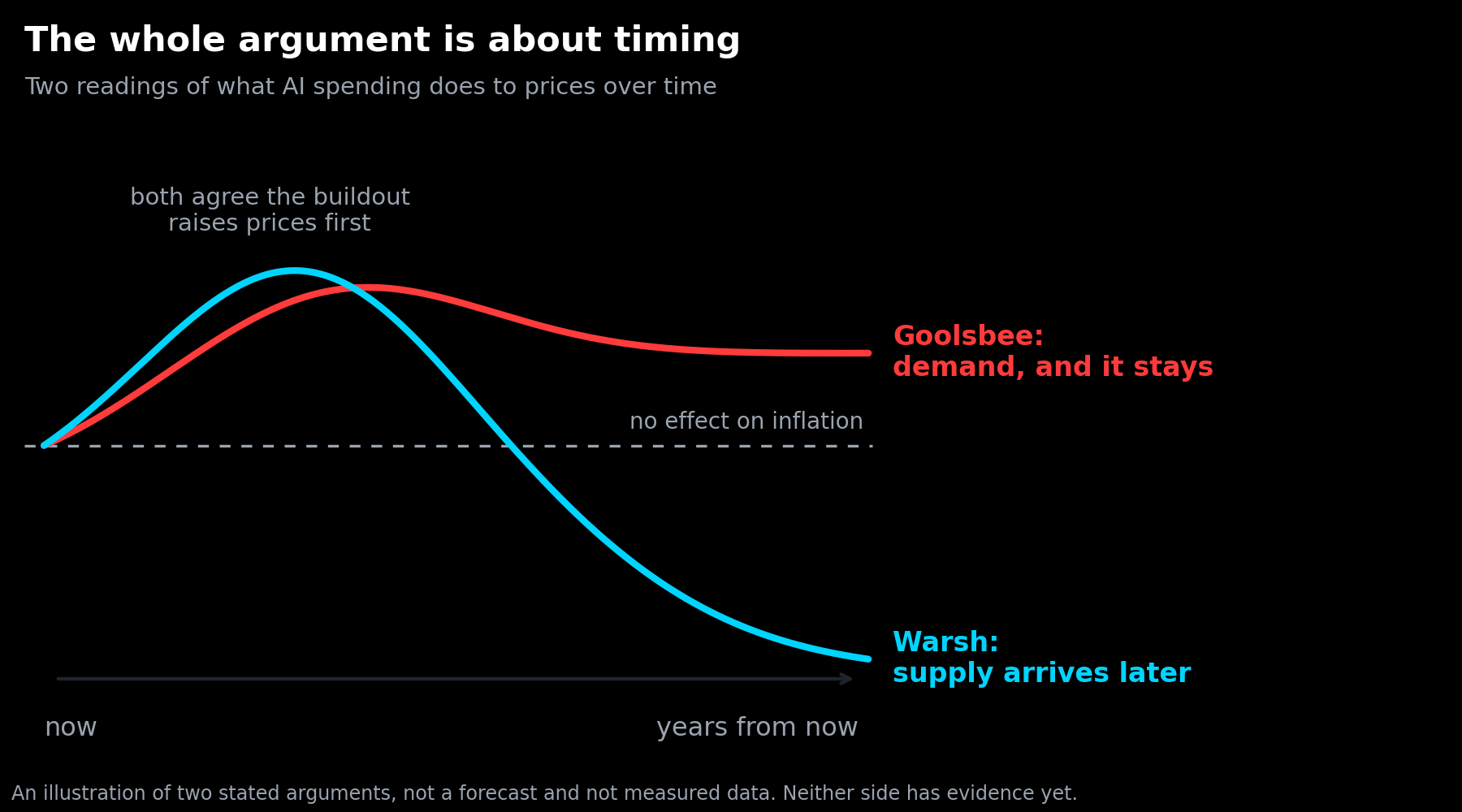
So to put it the plain way: right now there is a lot of demand hitting a supply that cannot grow fast enough, which raises prices. Warsh's argument is that later the supply side catches up and then overshoots, which lowers them. Same technology, opposite effect, separated by some number of years.
The honest part is that nobody knows how many years, and that is the entire fight.
But why would the second part happen at all? Because of what the money is being spent on.
Notice that it is not simply being spent, it is being spent on building things. A data center is not a meal. It is a machine that sits there afterwards, doing work. The transformer that cost too much this year keeps delivering power for the next thirty. So the same dollars do two jobs, in sequence. On the way in they bid up the price of everything needed to build. Once built, the thing they built starts producing.
If what it produces lets the rest of the economy do more with less, that shows up as lower prices. Say a law firm reviews contracts in half the time, or a trucking company routes its fleet with fewer empty miles, or a factory catches defects before they happen. Each of those means the same output for less cost. Multiply it across enough of the economy and the general price level stops rising as fast, or falls.
That is how one thing can do both. It is not two separate forces that happen to arrive in order. It is one purchase, with its bill arriving years before its benefit.
So his view is that the thing making inflation worse today is the thing that makes it better tomorrow. He called the wave a "massive investment surge" and one of the largest upsides for the global economy. He was also careful not to promise it would be smooth, saying the transition is "likely to be a very bumpy one," with the effect on jobs uncertain over the next twelve to eighteen months.
He has been consistent about this. At the Fed's Jackson Hole conference in August he called AI "potentially a new factor of production" and framed the open question precisely: "Will the application of AI cause a significant, sustained rise in productivity across the economy? And if so, when?"
He also said something at Jackson Hole that cuts the other way, and it is worth holding onto: "Price stability is not self-executing, nor is inflation necessarily mean-reverting." In plain terms, inflation does not fix itself just because you expect it to.
His colleagues are not sold
This is the part most coverage skipped, and it is the actual story.
Austan Goolsbee, who runs the Chicago Federal Reserve and votes on rates, looks at the same buildout and sees something plainer. He has pointed out that AI demand is spilling into electricity, construction, land and equipment, and said: "I'm getting increasingly nervous that that's just straight, old-fashioned overheating demand."
Read that against Warsh's sequence and the disagreement is clean. Warsh sees a temporary cost on the way to a lasting gain. Goolsbee sees an economy running hot and is not willing to assume the second half arrives on schedule. If Goolsbee is right, strong data calls for tighter policy, not patience.
Two Fed governors, Philip Jefferson and Michael Barr, have raised a related worry from a different angle. They have warned that all this investment could push up what economists call the neutral rate, which is the rate that neither speeds the economy up nor slows it down. If an enormous amount of capital is competing to get built, the price of money can settle higher on its own. If that is happening, today's rates are less restrictive than they look, and the Fed would have further to go than it thinks.
And Mary Daly of the San Francisco Fed split the difference last week, saying further increases were likely but that there was no urgency to move in October.
Nobody at the Fed knows which of these is right. That is not a criticism. Warsh said it himself at Jackson Hole, and it is the most honest line any central banker has offered in a while: "We never see, and can only infer, what's really happening on the supply side."
They are arguing about something none of them can measure yet.
The week the odds moved three times
Here is the useful part, and it is a lesson about market-implied probabilities rather than about the Fed.
Going into Wednesday, traders put the chance of an October increase at roughly 21%. Then September's inflation figures landed hotter than forecast, with consumer prices up 3.7% over the year against a 3.6% expectation, core prices at 2.6% against 2.5%, and producer prices up 1.3% in the month, the largest jump since March 2022. The October odds jumped to about 54%.
By Friday morning they had drifted back to around 28% without much new information. Then Warsh spoke, said explicitly that he would not say anything about the meeting, and the odds fell again to roughly 15%. One prediction market had October at 14% by the weekend, while putting December at 79%.
So in three days the number went 21, then 54, then 28, then 15, on one data release and one appearance in which the speaker declined to signal anything.
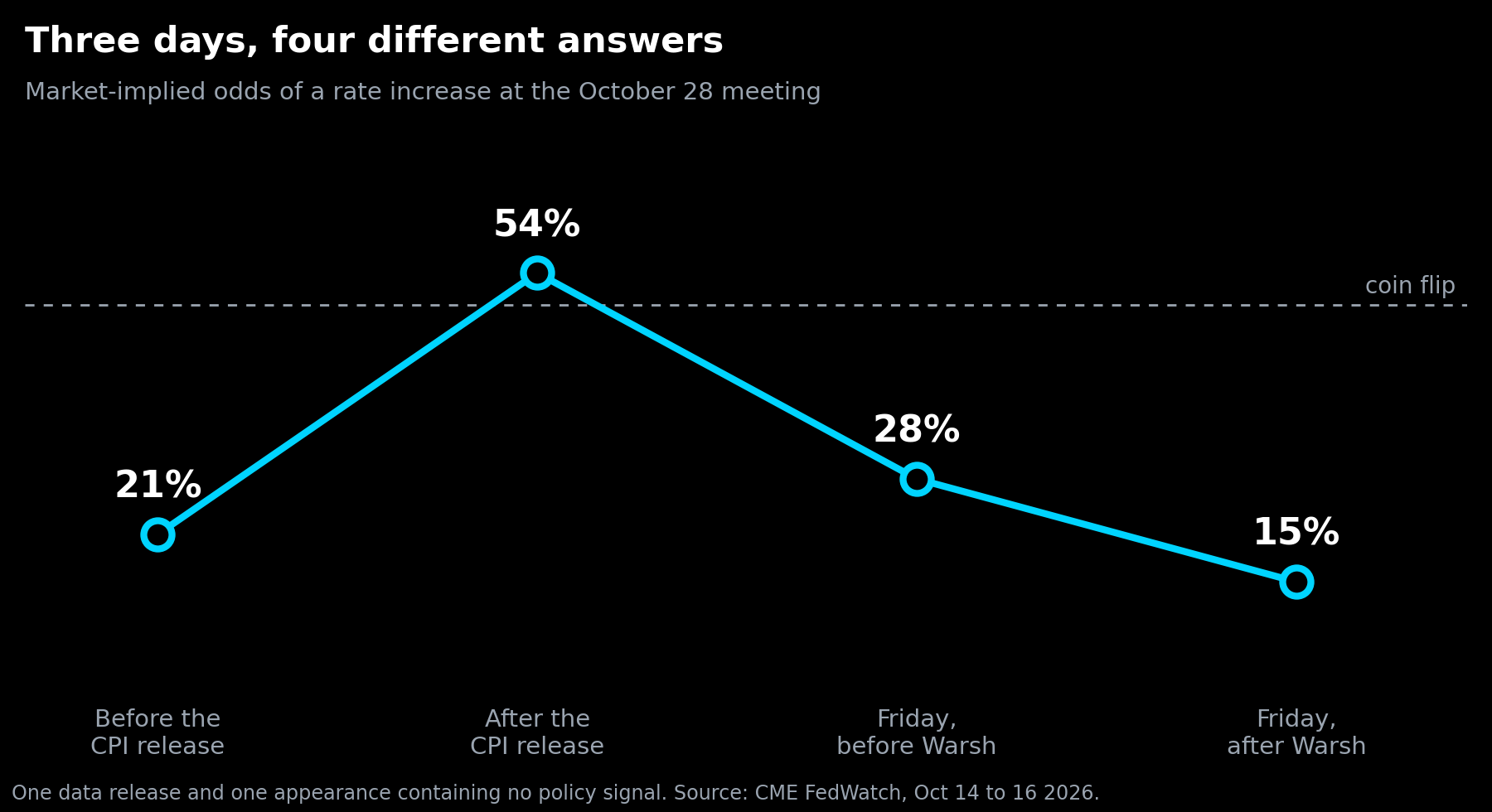
Notice the irony. Warsh opposes forward guidance as a practice, warning at Jackson Hole that it "risks creating ambiguity in the name of clarity." He gave none. And the market treated the absence of a signal as a signal anyway, halving the October odds on it.
The rest of the week pointed the same direction. The Nasdaq fell 4.48% over the five days, its worst week since late June, with the semiconductor index down an eighth straight session. Yet the 10-year Treasury yield fell about 15 basis points on the week, its largest weekly decline since February. Hot inflation data and falling yields at the same time is not a contradiction. It happens when worries about growth start outweighing worries about prices.
Why eleven days from now is unusual
The next rate decision lands on October 28. The midterm elections are November 3.
Six days apart. Since 1990 the Fed has moved rates inside the week before an election exactly once, on November 2, 2022. It is not a rule, and the Fed insists the calendar does not enter the room. But it is rare enough that it changes how any decision gets read afterwards, which is itself a reason the week matters.
What this does not tell you
It does not tell you what the Fed will do on October 28. The odds above are the clearest possible demonstration of why. They moved by more than thirty percentage points in either direction inside three days, on one report and one speech containing no policy content. Those are prices in a