On an earnings call in August, Nvidia's chief financial officer said this out loud:
"We know some will call this circular financing."
And then: "We see it differently."
When a company worth several trillion dollars pre-empts an accusation on its own earnings call, the accusation is worth understanding.
The short version is that the companies supplying the artificial intelligence boom have been investing in the companies purchasing from them. Money goes out as equity. It comes back as revenue. Both halves are real, both are legal, both are disclosed, and the combination makes the growth look more independent than it is.
Michael Burry has been the loudest voice arguing this matters. He is worth taking seriously and he is also widely misreported, including on the single fact everyone repeats about him.
So: what the deals actually are, what he actually claimed, and where the strongest arguments against him sit.
The simplest example, and it is in a filing
Forget the complicated ones. Here is the clean case, from a document Amazon filed with regulators this February.
Amazon invests $50 billion in OpenAI. Fifteen billion immediately, thirty-five billion later subject to conditions.
OpenAI commits to roughly $100 billion of additional Amazon cloud services over eight years.
Same announcement. Both directions. Money leaves Amazon as an investment and returns as cloud revenue.
Now, is that wrong? Not obviously. Amazon owns a stake in a company that looks likely to be valuable, and it has locked in enormous demand for data centers it is building anyway. OpenAI gets capital and locked-in capacity. You could describe it as a straightforward strategic partnership and you would not be lying.
But notice what it does to the numbers. When Amazon reports cloud revenue growth, some of that growth is being paid for with Amazon's own money. An outside observer looking at the revenue line cannot tell which part came from a customer who found Amazon on the open market and which part came from a customer Amazon capitalized.
That is the entire argument. Not fraud. Not fake revenue. Just a growth figure that is less independent than it appears, and no way from outside to measure how much less.
The pattern repeats. Microsoft holds roughly 27% of OpenAI and has a contract for $250 billion of OpenAI cloud purchases. Amazon has put about $13 billion into Anthropic. Nvidia and Microsoft are investing up to $10 billion and $5 billion in Anthropic, which has committed to purchase $30 billion of Microsoft cloud capacity. AMD issued OpenAI a warrant for up to 160 million of its own shares at one cent each, vesting as OpenAI purchases chips, then issued Meta a warrant on the same terms for another 160 million.
Read that last one twice. AMD has promised up to 320 million of its own shares to two customers, contingent on those customers purchasing from AMD.
Three corrections before we go further
Most coverage of this topic contains at least one of these errors.
One. The famous $100 billion Nvidia and OpenAI deal never happened.
In September 2025 the two companies announced what was reported everywhere as a $100 billion investment. The original announcement called it a letter of intent, which almost no coverage emphasized.
On December 2, 2025, Nvidia's chief financial officer said publicly: "We still haven't completed a definitive agreement." By March 2026 Jensen Huang said the original structure was "probably not in the cards." What actually occurred was smaller: Nvidia took roughly $30 billion of ordinary equity in a later round, not tied to deployment milestones.
If you still see "Nvidia invested $100 billion in OpenAI" written as fact, that is a letter of intent that expired being reported as a transaction.
Two. Nvidia's $105 billion Ohio commitment is not $105 billion of money.
It is a ceiling on a backstop. Nvidia has agreed to cover a shortfall if OpenAI defaults on lease and power payments at a data center, up to that cap. Nvidia pays nothing unless something goes wrong. On its most recent balance sheet, the disclosed notional across all such arrangements was $3.5 billion.
A contingent ceiling and an outlay are different things, and that difference is the entire point of the structure.
Three. Michael Burry did not bet $1.1 billion against AI.
This is the most repeated error about him and his own regulatory filing disproves it.
His fund's last public filing, for September 2025, showed put options on Nvidia and Palantir with a reported value of about $1.1 billion. Here is what that figure means. Divide it by the shares involved and you get $186.58 for Nvidia and $182.42 for Palantir, which are those stocks' closing prices on the last day of the quarter.
So the column reports shares times the share price. It is the size of the position being controlled, not money spent. A put option is a contract that pays off when a stock falls, and what you pay for it, the premium, is not disclosed in these filings at all. It is typically a low single-digit percentage of the notional.
The honest sentence: he controlled roughly $1.1 billion of downside exposure, and what he paid for it is unknown and almost certainly a small fraction of that.
One more thing you should know. His fund deregistered in November 2025, so there is no public filing after September 2025. Everything about his positions since then comes from his own posts on a paywalled newsletter, with no regulatory verification behind it.
The depreciation argument, which is his real one
Circular deals are the part that gets attention. His sharper argument is about accounting, and it needs one concept explained first.
Depreciation is how a company spreads the cost of equipment across the years it expects to use it. Spend $6 billion on servers you expect to last six years, and you charge $1 billion a year against profit rather than $6 billion in year one. The number of years is called the useful life, and it is an estimate the company makes itself.
That estimate is a direct lever on reported profit. Stretch the useful life and the annual charge falls and profit rises, with no change to the cash spent or the business underneath.
Burry's claim, in a post from November 2025: "Understating depreciation by extending useful life of assets artificially boosts earnings, one of the more common frauds of the modern era." He argued that acquiring chips on a two to three year product cycle should not result in longer assumed lives.
His estimates, which he has never shown the workings for outside a paywall: hyperscalers will understate depreciation by about $176 billion across 2026 to 2028, with Oracle overstating earnings by about 27% and Meta by about 21% by 2028.
Here is what the actual filings say.
Microsoft, in 2022, extended server and network equipment from four years to six, disclosing the effect precisely: operating income up $1.1 billion in a single quarter.
Alphabet, in January 2023, moved servers to six years, telling investors to expect depreciation about $3.4 billion lower that year.
Meta, effective January 2025, went to 5.5 years: depreciation down about $2.3 billion over nine months, net income up about $2.0 billion, or 76 cents per share.
Those are real, disclosed, and exactly the pattern he describes.
But two facts cut hard against the clean version.
I went looking for the counterevidence, and it is stronger than I expected.
Amazon went the other way. Effective the same month Meta lengthened, January 2025, Amazon shortened the life of some servers from six years to five. Its stated reason, from the filing: "The shorter useful lives are due to the increased pace of technology development, particularly in the area of artificial intelligence and machine learning."
That cost Amazon money. Roughly $889 million of extra depreciation over nine months and about $677 million less net income, hitting its cloud division.
So in the same month, two of the largest companies on earth looked at the same technology and moved their estimates in opposite directions, and the one that moved against its own earnings cited AI as the reason.
And Oracle, the company Burry claims overstates most, never changed its useful life at all. Its filings put servers and networking equipment at six years and have not revised it. So his Oracle case cannot rest on an accounting change. It has to rest on the argument that six years was always too generous, combined with how fast Oracle is spending. That is a defensible position. It is also a different and weaker claim than "they changed the number to flatter earnings," and nobody seems to have noticed the distinction.
One more observation that cuts against his own rhetoric. His $176 billion over three years is roughly $59 billion a year across the whole group. If he genuinely believed the true economic life were two to three years against six years assumed, the number would be several times larger. His headline figure implies a modest trimming of useful lives, not a collapse. His arithmetic is more conservative than his language.
Why this argument is really about growth
Here is a piece of mechanics almost nobody explains, and it determines whether any of this matters.
Under straight-line depreciation with flat spending, the annual charge converges on annual spending regardless of the useful life. A company spending $20 billion a year forever eventually charges about $20 billion a year whether it assumes three years or six.
The earnings benefit of a longer useful life exists only while spending is growing, and it reverses when growth stops.
That is why this argument is specifically about 2026 to 2028, and why it is not hypothetical.
Some arithmetic, which is mine rather than anyone's disclosure. If capital spending grows 50% a year, a company assuming a six-year life charges depreciation equal to about 46% of that year's spending. At a three-year life it charges about 70%. The gap is roughly a quarter of annual capital spending, flowing straight through to operating profit.
Applied to Microsoft, a six-to-three-year switch would add something like $33 billion of annual depreciation, on the order of 18% of operating income.
Treat that as an order of magnitude, not an estimate. It rests on a single blended life, a growth assumption, and figures the company does not break out. But it tells you the question is not trivial. A few years of assumption is worth tens of billions of reported profit.
The strongest case against him
This is the part most coverage skips, and it has actual evidence behind it rather than assertion.
Old chips are still earning. A firm that tracks rental prices for graphics processors found that A100 rental prices rose about 20% during 2026, five years after that chip launched, with its residual value no longer declining. The head of research there argues that as AI shifts from training new models to running them, older chips stay useful, because some workload can always run on them.
The companies renting them agree. CoreWeave's chief executive said on a call that A100s are still generating revenue, with some contracts running through 2029. And Jensen Huang argued in an October interview that useful lives could run eight years or longer, and that "nobody gives a credit" for the residual value of his chips. He is the supplier, so weight it accordingly, but it is on the record.
Burry's reply to that is the sharpest thing he has written, and it is why the two sides are not really meeting: "A chip can rent and still depreciate very fast economically."
He is making a real distinction. Rental data answers is this chip still useful. Depreciation asks how fast is its earning power declining relative to what it cost. A chip can earn money every day and still be worth far less than its book value. Both sides have evidence, and they are measuring different things.
His best piece of evidence is his own: Baidu extended server lives from four-to-five years to five-to-six in 2024, then took an impairment of over 50% of its net equipment value. The pattern he predicts has already happened once, at a company that did exactly what he describes.
Does the telecom comparison hold?
Everyone reaches for the late 1990s, when equipment makers lent money to telecom companies so those companies could purchase their equipment. It is the right instinct, and the details matter.
The numbers from Lucent's own annual report are brutal. It had $8.1 billion of customer financing commitments in 2000. By 2002 it was holding reserves of about $950 million against $1.1 billion actually lent.
It was reserving roughly 86% of everything it had lent. Revenue fell from $28.9 billion to $12.3 billion in two years, and the company lost over $14 billion in 2001 and nearly $12 billion in 2002.
Nortel, Motorola, Alcatel, Ericsson and Nokia all ran versions of the same program.
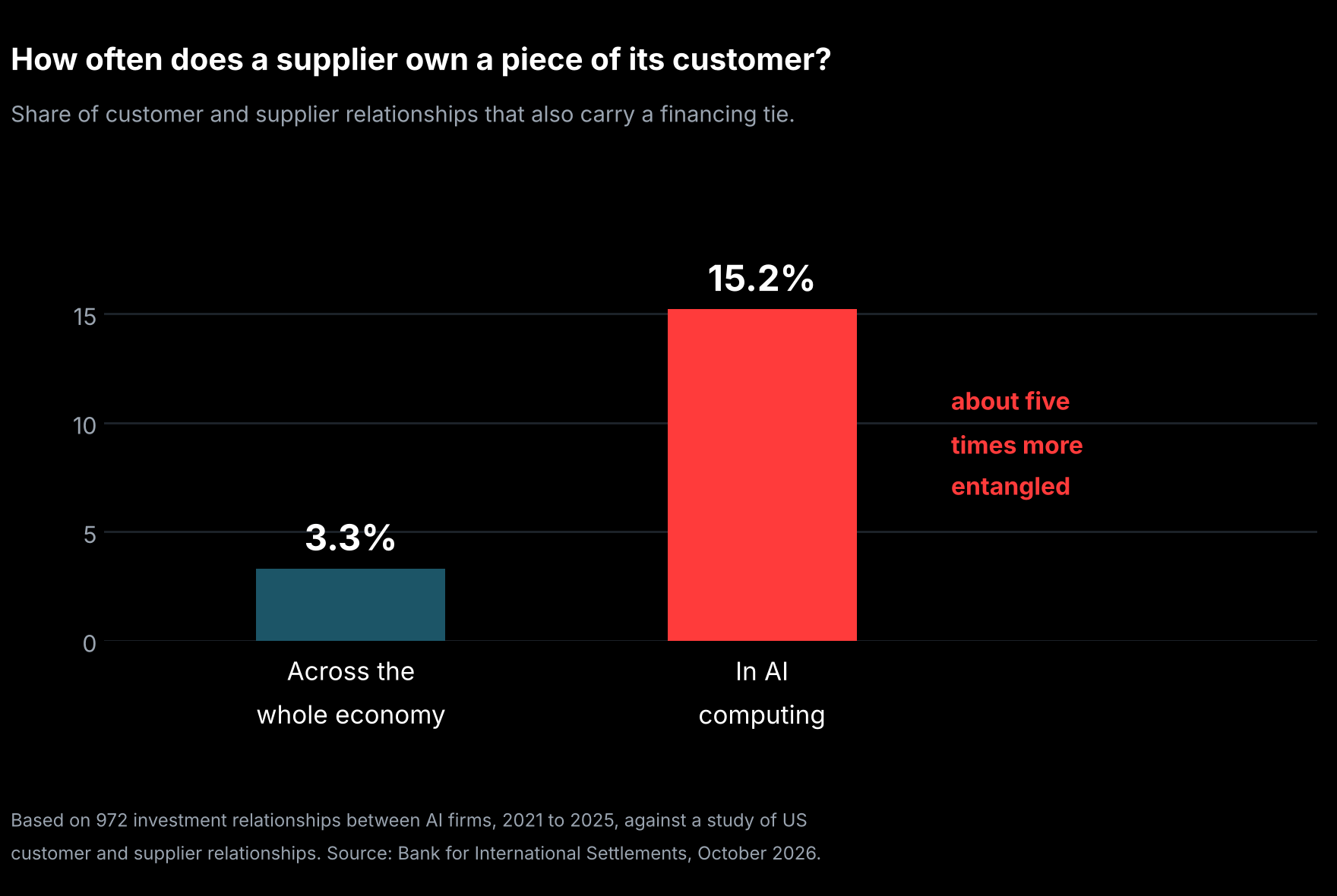
This comparison has official backing. The Bank for International Settlements published analysis in October reaching for exactly this analogue, and it did something nobody else has: it measured the circularity. Across 972 investment relationships between AI firms from 2021 to 2025, 55% of money flowing into AI firms came from other AI firms, and relationships where the investor also supplies the target accounted for 46% of AI-to-AI deal value.
And here is the benchmark that makes it concrete. In the broad economy, companies hold direct equity stakes in their own trading partners in about 3.3% of cases. In AI computing, the figure is 15.2%, roughly five times more entangled with its own customers than normal industry. That is not an opinion. It is a measurement.
But here is where the analogy genuinely breaks, and it is the best argument the optimists have. At the peak of the fiber boom, only about 7% of the fiber capacity that had been laid was actually being used. Companies built enormous infrastructure that nobody needed.
Today, North American data center vacancy is near a record low of 1.6%, with utilization around 80%. The capacity being built is full the moment it opens.
That is a real and important difference. The 1990s built something nobody wanted. This boom is building something there is a queue for. Whether that queue is itself funded in a circle is the question, but the demand is visibly there in a way fiber demand was not.
And one fact has shifted this year that has not been widely noticed.
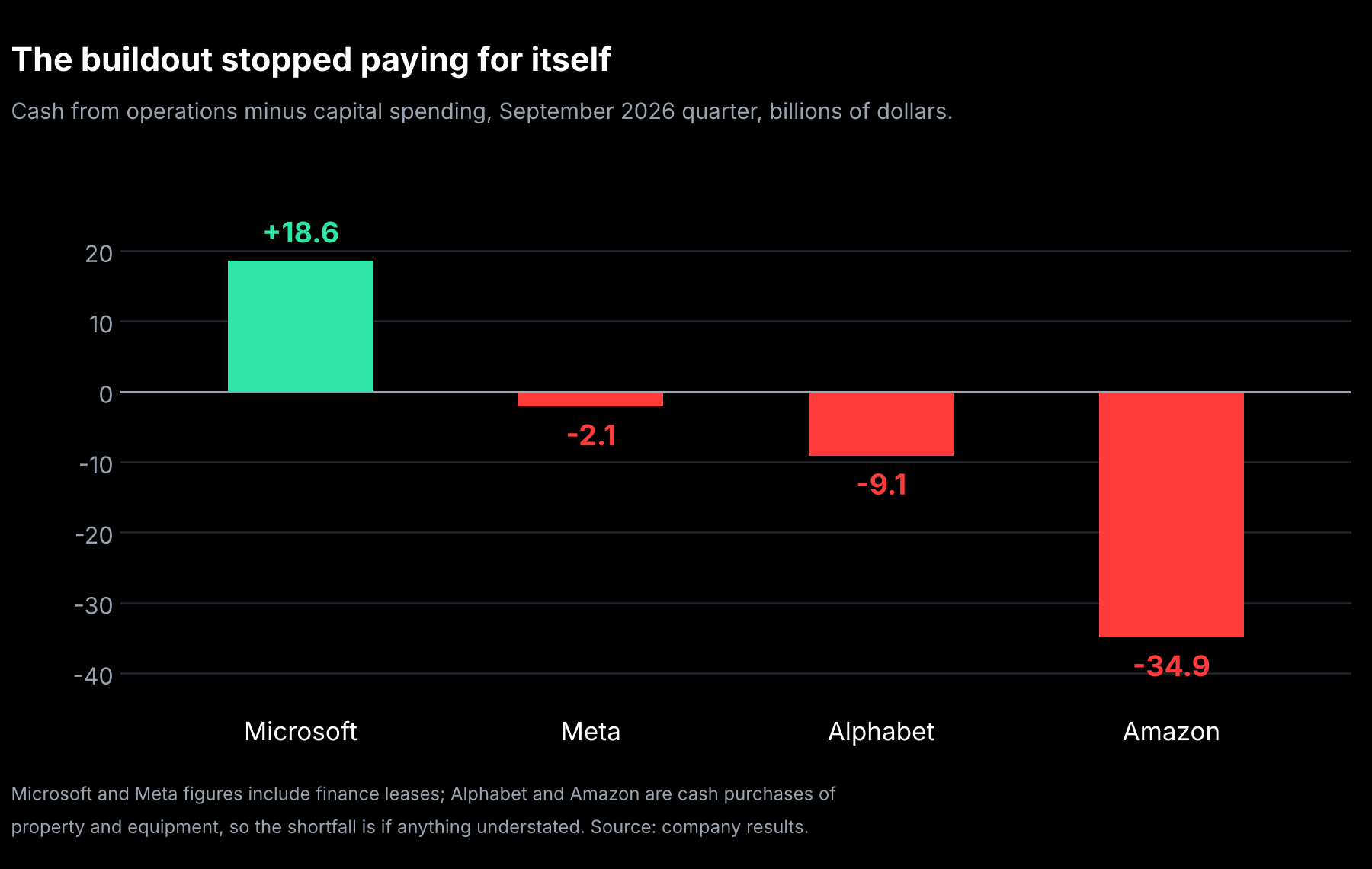
The strongest argument against the telecom comparison used to be that today's spenders fund everything from their own cash, unlike the debt-financed telecom companies that went bankrupt.
That was true in 2025. It stopped being true in 2026.
In the September 2026 quarter, of the four largest spenders, only Microsoft generated more cash from operations than it spent on capital. Alphabet was about $9 billion negative. Meta was slightly negative, its first negative free cash flow since 2012. Amazon was roughly $35 billion negative, and over the trailing year spent $215 billion against $168 billion of operating cash flow. A year earlier its spending and cash generation almost exactly matched, so that is a $57 billion swing in twelve months.
The debt followed. The BIS puts hyperscaler bond issuance at $222 billion by September 2026, more than 10% of long-term government issuance this year. Moody's puts their data center lease commitments at $1.2 trillion by mid-2026, of which about $820 billion relates to leases that have not started yet and therefore are not recorded as debt.
That last number is the one to sit with. Eight hundred and twenty billion dollars of commitments, disclosed but not on any balance sheet as borrowing.
What this does not tell you
It does not tell you anyone is committing fraud. Every deal described here is disclosed in public filings. Every useful-life estimate is stated and the changes are quantified. Burry's word "fraud" is his characterization of a practice, not an allegation anyone has brought, and no regulator has acted.
It does not tell you the depreciation estimates are wrong. They may be exactly right, and the rental data on older chips is real evidence that they are. We find out over the next three years, in impairments or in their absence.
It does not tell you Burry is right. His fund no longer files public disclosures, his workings sit behind a paywall, and his biggest claimed example is a company that never changed the assumption he objects to.
It does not tell you he is wrong either. The useful-life extensions happened and were worth billions in reported profit. The circularity is measured and it is five times normal. The cash position flipped this year. Those are facts, whatever you conclude from them.
And it does not tell you how much of any supplier's revenue is circular. Nvidia's finance chief said labs it backs should be about a quarter of its business next year, but that was forward-looking, about a specific subset, with no method attached. Nine months earlier the same company told analysts its investments were "a small share" of revenue. No independent analyst has published a verifiable estimate, and the companies do not disclose it. Anybody giving you a precise percentage made it up.
What you can take away is a question to carry into any fast-growing business, and it has nothing to do with AI specifically. Not how fast revenue is growing, but who is paying for it, and where did they get the money. If a meaningful share of a company's customers were funded by that company, then its growth and its investments are the same bet made twice. That can work for years. It worked for Lucent for years.
The accounting will tell you eventually. It just tells you last.
That is why we show the workings instead of a single figure. Techdamentals runs four separate valuation methods and displays the full range, because one number tells you where somebody landed and nothing about what has to stay true for it to hold.