Inflation went up again on Thursday. The measure the Federal Reserve actually targets rose to 3.6%, from 3.4% a month earlier.
Almost all of that increase was energy prices.
The Fed raised interest rates in September. It held them this week, and two officials voted against holding because they wanted to raise again immediately. Three more said publicly on Friday that more increases are coming.
So here is the question nobody is asking plainly enough, and it is the one that matters: a tanker was attacked in the Strait of Hormuz on Friday, and oil went up again. Can an interest rate do anything about that?
Raising rates cannot produce a barrel of crude. It cannot reopen a shipping lane or rebuild a refinery. What it can do is make everything else in the economy weaker until total demand falls enough to offset the price of the one thing nobody can supply.
That is the trade the Fed is making right now, and it is worth understanding properly, because it determines what happens to your mortgage rate, your savings account and your portfolio over the next year.
What Thursday's numbers actually said
The measure is called the personal consumption expenditures price index, usually shortened to PCE. The Fed targets it rather than the more famous consumer price index because it adjusts for substitution, meaning it accounts for people switching to something else when one thing gets costly. The Fed's target is 2%.
September's reading, released Thursday:
- Headline PCE: 3.6% from a year earlier, up from 3.4%. Up 0.5% in the month alone.
- Core PCE: 3.1%, up from 3.0%. Core strips out food and energy.
- Consumer spending rose 0.5%, but adjusted for prices it was essentially flat. People spent more and received almost nothing extra for it.
- The saving rate fell to 3.8% from 4.0%.
Separately, the economy grew at a 3.4% annualized rate in the third quarter, up from 2.2%.
So: growth strong, spending nominally up but flat in real terms, savings being drawn down, inflation accelerating away from target.
How much of this is actually energy
This is the number that should drive the whole discussion, and it was buried.
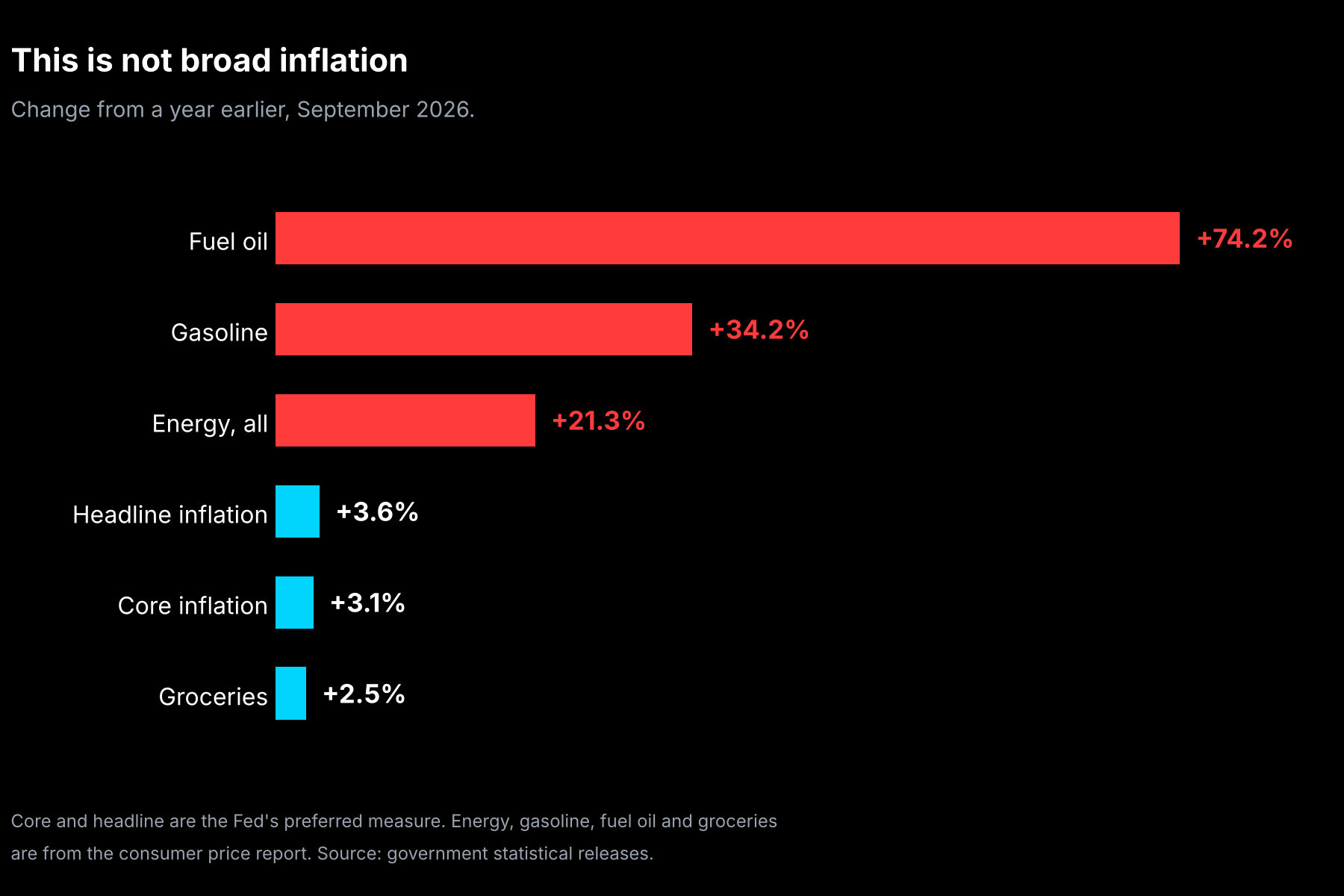
Energy goods and services were up 21.3% from a year earlier, accelerating from 16.9% the month before.
Energy is roughly 4% to 4.5% of what Americans spend. So take that jump of about 4.4 percentage points in the energy rate, multiply by a 4% to 4.5% weight, and energy's direct contribution to headline inflation rose by roughly 0.18 percentage points.
The headline accelerated by 0.20 percentage points.
In other words, essentially the entire acceleration was energy. I want to be careful here, because both 3.4% and 3.6% are rounded figures, so the true gap sits somewhere between 0.1 and 0.3 points. The direction is unambiguous. The precision is not. And this is my arithmetic from published weights, not an official breakdown, because the government does not publish one.
Run the same calculation on the full figure and energy contributes something like 0.85 to 0.90 points of the 3.6%. About a quarter of all the inflation in that number is energy prices directly, before you count anything energy does to the cost of making and moving everything else.
The underlying price data is more vivid than the PCE summary. From the September consumer price report: gasoline up 34.2% from a year earlier. Fuel oil up 74.2%. Groceries, by contrast, were up just 2.5% and flat on the month.
That is not broad inflation. That is one category on fire while the rest behaves.
One oddity worth flagging, because a sharp reader will catch it. Core CPI is running at 2.6% while core PCE is at 3.1%. Core PCE normally runs below core CPI. The inversion is real and comes mostly from PCE weighting medical care far more heavily, with hospital and outpatient costs up 5.6% and 6.9%, plus airline fares up 22.4%. If you see those two numbers side by side and assume somebody transposed them, they did not.
Why central banks usually ignore this
Here is the concept, and almost nobody explains it, so let me do it properly.
When the price of oil jumps because a shipping lane closed, that is not the same event as inflation caused by too much money chasing too few goods. It is a relative price change. One thing got costlier because there is less of it. Every other price in the economy did not move.
Two consequences follow.
First, it drops out on its own. Inflation measured over twelve months compares today with a year ago. If gasoline jumps 30% and then simply stays there, next year the comparison is against the high price, and the contribution to the inflation rate goes to zero without anything happening. Economists call this the base effect. A one-time jump in a price level is not ongoing inflation, even though it looks identical in the data for twelve months.
Second, the shock is already doing the central bank's work. Gasoline up 34% is effectively a tax on every household. Money spent at the pump is money not spent elsewhere. That weakens demand by itself. So the Fed raising rates on top of it is applying the brakes to an economy already being slowed.
This is why the textbook answer is to look through an energy shock. You tolerate a bad headline number you cannot fix, and you watch two things instead: whether it leaks into core inflation, and whether people's long-run expectations of inflation start moving. If both stay contained, you wait.
We have an unusually good measurement of that leak. The Dallas Federal Reserve published research this year modelling exactly this shock. Its central findings:
- A 10% rise in gasoline prices raises headline inflation by 0.24 percentage points on impact.
- The same shock raises core inflation by 0.02 points. An order of magnitude smaller.
- One-year inflation expectations rise 0.33 points, peaking two months later.
- Five-to-ten-year expectations move 0.03 points. Essentially nothing.
That last line is the whole argument for patience. People expect fuel to be costly this year. They do not expect it forever. As long as that holds, the shock is a price level event rather than an inflation event.
Why the argument is weaker than it was
Now the problem.
The "look through it" case depends on the shock being temporary. And I need to correct a framing you will see in nearly every headline this week, including the ones about Friday's tanker attack.
This is not an incident. The Strait of Hormuz has been closed or contested since late February. This is month nine.
The scale: before the conflict, roughly 125 large vessels passed through daily carrying about 17.1 million barrels of oil a day, close to a fifth of the world's crude. Flows have partly recovered, to above 80% of pre-conflict levels on good days, but the variance is brutal. On October 8, about 20.8 million barrels moved through. On October 11, 2.9 million. In the first half of October alone, more than twenty vessels were struck. The United States Navy has rated the threat severe and is running a convoy system.
Friday's attack, in which explosive devices were attached to a tanker by a small boat, is the latest entry in a long list, not a new development. Nobody has confirmed who carried it out.
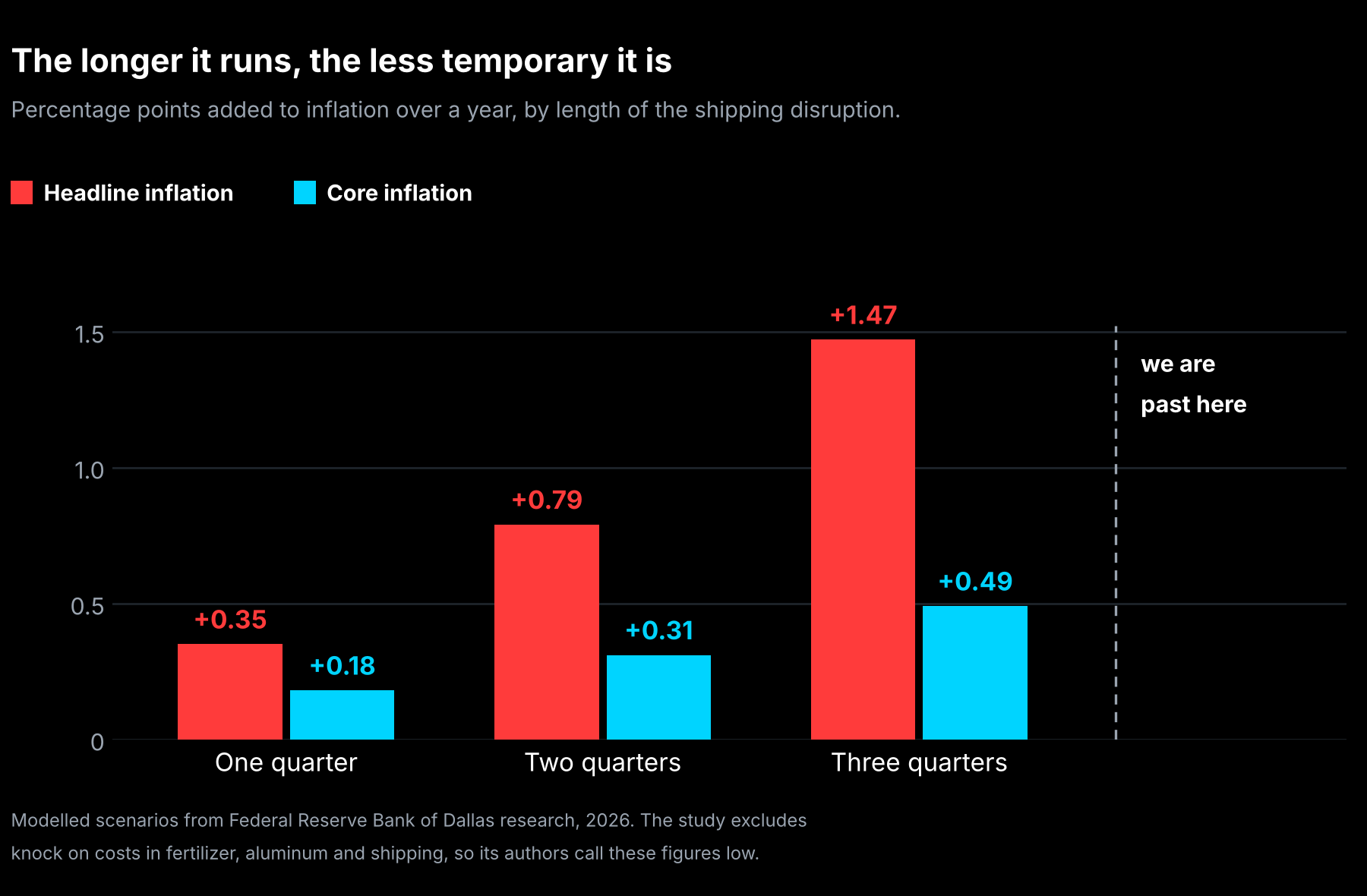
That duration is precisely what undermines the patience argument, and the Dallas Fed research quantifies it. The longer the disruption runs, the more it stops behaving like a one-time shock:
- A one-quarter closure adds about 0.35 points to headline inflation over the year and 0.18 to core.
- Two quarters: 0.79 headline, 0.31 core.
- Three quarters: 1.47 headline, 0.49 core.
Core nearly triples between the short case and the long one. And that study explicitly excludes knock-on costs in fertilizer, aluminum and shipping, so its authors say the real impact is larger than modeled.
We are past three quarters.
There is corroborating evidence from the business side. An Atlanta Fed survey asked firms what they would do with oil near $130 through year end. About half expected a meaningful rise in input costs, about 40% expected to raise their own prices, and a third expected demand to fall. Oil-intensive firms expected to raise prices by an additional 1.7 percentage points.
That is the leak. Not households expecting inflation forever, but companies passing along costs because their margins were already compressed from the last few years.
What the Fed actually did, and what the market did back
The Fed held rates at 3.75% to 4.00% on Wednesday, after a 25 basis point increase in September.
The vote was 10 to 2. Governor Lisa Cook and Cleveland Fed President Beth Hammack both dissented in favor of an immediate increase. Cook dissenting on the hawkish side is not where most observers would have placed her.
Chair Kevin Warsh refused to signal anything. His words: "I don't believe in forward guidance absent exigent circumstances, absent a crisis," and "I also don't believe in prejudging meetings." On oil he acknowledged that "energy and related prices have moved higher again in recent weeks" and said he is "not going to be the guy who says that oil prices haven't gone up." Asked what he would do if oil fell, he said only that it is "something that we're going to have to interrogate."
He did not say he is looking through the oil shock. He did not say he is not. He declined to be pinned.
On Friday, three regional Fed presidents spoke. St. Louis's Alberto Musalem: "I judge that additional firming of monetary policy will be necessary, and soon." Richmond's Tom Barkin: "Inflation's high, demand is solid, unemployment is relatively low," and "the direction of travel is pretty straightforward. The question, though, is pace." Dallas's Lorie Logan reportedly wants at least two more increases before pausing.
Worth noting what they did not say. None of the three addressed the oil shock directly. Barkin mentioned diesel once, in a list of business cost pressures. These officials are talking about broad inflation and the pace of increases, not about Hormuz.
And here is the part that surprised me. Despite all of that hawkish talk, the market became less convinced this week, not more.
Odds of a December increase were around 87% on Wednesday afternoon, before the Fed met. By Thursday evening they were near 83%. By Friday midday, about 73%.
Further out, the move was larger. The expected cumulative increase through next June fell from roughly 2.8 quarter-point moves to about 2.0.
The market heard the hawkish statements and priced fewer hikes, mostly because stocks fell hard on Thursday and Friday and because Warsh refused to commit. That gap, between what officials are saying and what traders are pricing, is itself the story. Somebody is wrong.
Elsewhere: the ten-year Treasury yield touched 5.04% after the Fed meeting and settled back to about 4.90% by Friday. Gold fell below $4,000 for the first time in months, down 2.6% on Friday and more than 4% in October, its second consecutive monthly decline. Brent crude is near $118, up roughly 13% to 14% in October for a fourth straight monthly gain, with US crude up about 15%.
Gold falling while inflation accelerates is counterintuitive and worth a moment: gold competes with interest-bearing assets, so when the market expects higher rates for longer, holding a metal that pays nothing gets less attractive. Inflation hedging and rate expectations pull it in opposite directions, and this month rates won.
The right historical comparison
Everyone reaches for the 1970s. That is the wrong analogue and reaching for it will mislead you.
The right one is September 2005.
Eight days after Hurricane Katrina destroyed much of the Gulf Coast's refining capacity, the Fed raised rates 25 basis points, its eleventh consecutive increase. Its statement explicitly acknowledged the devastation and said energy prices would set back spending, production and employment in the near term. It then judged that these developments did not pose a lasting threat, citing contained core inflation and stable long-term expectations. One governor dissented, preferring no change.
The parallel is close. Katrina was a refining shock rather than a crude shock, which is exactly what today's situation has become. The Fed hiked anyway while saying the energy effect was temporary. It kept hiking to 5.25% by June 2006. Headline inflation peaked near 4.7% and fell back as the base effect rolled off. Core stayed contained.
The counterexample is 1990. Oil nearly doubled after Iraq invaded Kuwait, and the Fed did not hike. It was already cutting into a recession and kept cutting. The difference was the state of the economy: 1990 was weakening, 2005 was strong. Today looks like 2005 on that measure, with growth at 3.4%.
On the 1970s, the reason that comparison misleads: both the 1973 and 1979 episodes featured long-run inflation expectations that had come unmoored and wage contracts formally indexed to inflation, so a price shock mechanically became a wage shock became a price shock. The Dallas Fed's own modelling finds long-run expectations moving three to seven hundredths of a point in every scenario it tested. That single difference is why the 1970s do not apply, and it is the thing to watch. If long-run expectations start moving, the analogy becomes relevant and everything above changes.
What this does not tell you
It does not tell you the Fed will raise rates in December. The market says roughly seven in ten, down from near certain three days ago. Warsh explicitly refused to signal. There is a jobs report and another inflation report between now and then.
It does not tell you inflation is only energy. Core is at 3.1% and rising slowly, which is above target without any help from oil. Medical costs and airfares are both running hot. Energy explains the acceleration, not the level.
It does not tell you the oil shock ends. There were diplomatic developments on Friday, a letter from the Vice President and a Qatari mediation draft that an Iranian official called unacceptable while the foreign minister said diplomacy still has a chance. Nobody knows. Anyone who tells you they do is guessing.
It does not tell you a recession is coming. Growth was 3.4% last quarter. Unemployment is little changed. The Fed's own statement describes activity as expanding at a strong pace. What is visible is a squeeze on households, with real spending flat and savings being drawn down, which is a different thing from a contraction.
It does not tell you what any of this does to a particular company. Higher fuel costs land very differently on an airline than on a software firm. Higher rates land very differently on a homebuilder than on a company holding net cash. The useful exercise is not to ask what the Fed does but to ask, for anything you hold, which of these two forces touches it and in which direction.
And it does not tell you the Fed is making a mistake. It may be right that core inflation and expectations require a response regardless of what caused the headline. It may be wrong, tightening into a real income shock that was already slowing the economy. Both arguments are being made in good faith by serious people, and two of them sit on the committee and voted against the majority this week.
What this week genuinely offers is a clear view of a limit. Monetary policy works on demand. The problem is supply. The Fed can slow an economy until it needs less oil, which is a real tool and a blunt one, and the people who feel it first are not the ones who closed the strait.
That is the kind of distinction a single number never shows you, which is why we show the workings. Techdamentals runs four separate valuation methods and displays the full range, because one figure tells you where somebody landed and nothing about what it depends on.