Exxon reported on Friday, and inside the release is a line that has not been true in years.
Its refining business earned more than its oil production business.
On the adjusted figures the company publishes: refining $9.05 billion, oil and gas production $7.31 billion. Refining ahead by about 24%.
A year ago that same refining segment earned $1.84 billion. It has gone up roughly fourfold while the drilling business grew 25%.
For a company whose entire public identity is finding and producing oil, the profit engine has moved to the part of the business that takes somebody else's oil and turns it into fuel.
This is the second half of the story we published this morning about the Fed and the oil shock. That one was about what happens to inflation. This one is about where the money actually lands, and the answer is not where most people assume.
The number, with the caveat it deserves
I want to be careful here, because there are two ways to count this and they give different answers.
On a reported basis, under standard accounting, refining earned $7.169 billion and oil production earned $7.088 billion. Refining ahead by $81 million, which on numbers that size is a rounding error. That quarter also carried negative timing effects of $2.54 billion, which are accounting artifacts rather than business performance.
On an adjusted basis, which strips those timing effects out, refining earned $9.05 billion against $7.31 billion. Ahead by $1.75 billion.
The adjusted comparison is the more honest one for what actually happened in the business, and it is also the larger gap, so I am using it and telling you which one I used. Anyone citing the crossover without saying which basis they are on is being sloppy.
Several outlets have reported this is the first such crossover in at least six years. I could not verify that quarter by quarter myself, so treat it as their claim rather than mine. The year over year move, which is enormous, I verified directly.
What a refinery actually does, and the one number that drives it
Here is the concept, and it explains the entire article.
Crude oil is useless. You cannot put it in a car. A refinery takes crude in and turns out gasoline, diesel, jet fuel and other products. It is a factory, and like any factory its profit is the gap between what the raw material costs and what the finished goods fetch.
That gap has a name: the crack spread. It is measured per barrel, and the industry shorthand is 3-2-1, meaning three barrels of crude in, two barrels of gasoline and one of diesel out, which roughly matches what a typical American refinery produces.
Here is the part that surprises people. A refiner does not much care whether crude costs $60 or $120. It cares about the gap. Crude is its input, so a high crude price is a cost, not a windfall. This is why a refining business can print record profits while the drilling business next door complains, and why the two halves of an oil major do not move together.
Now look at what the gap has done.
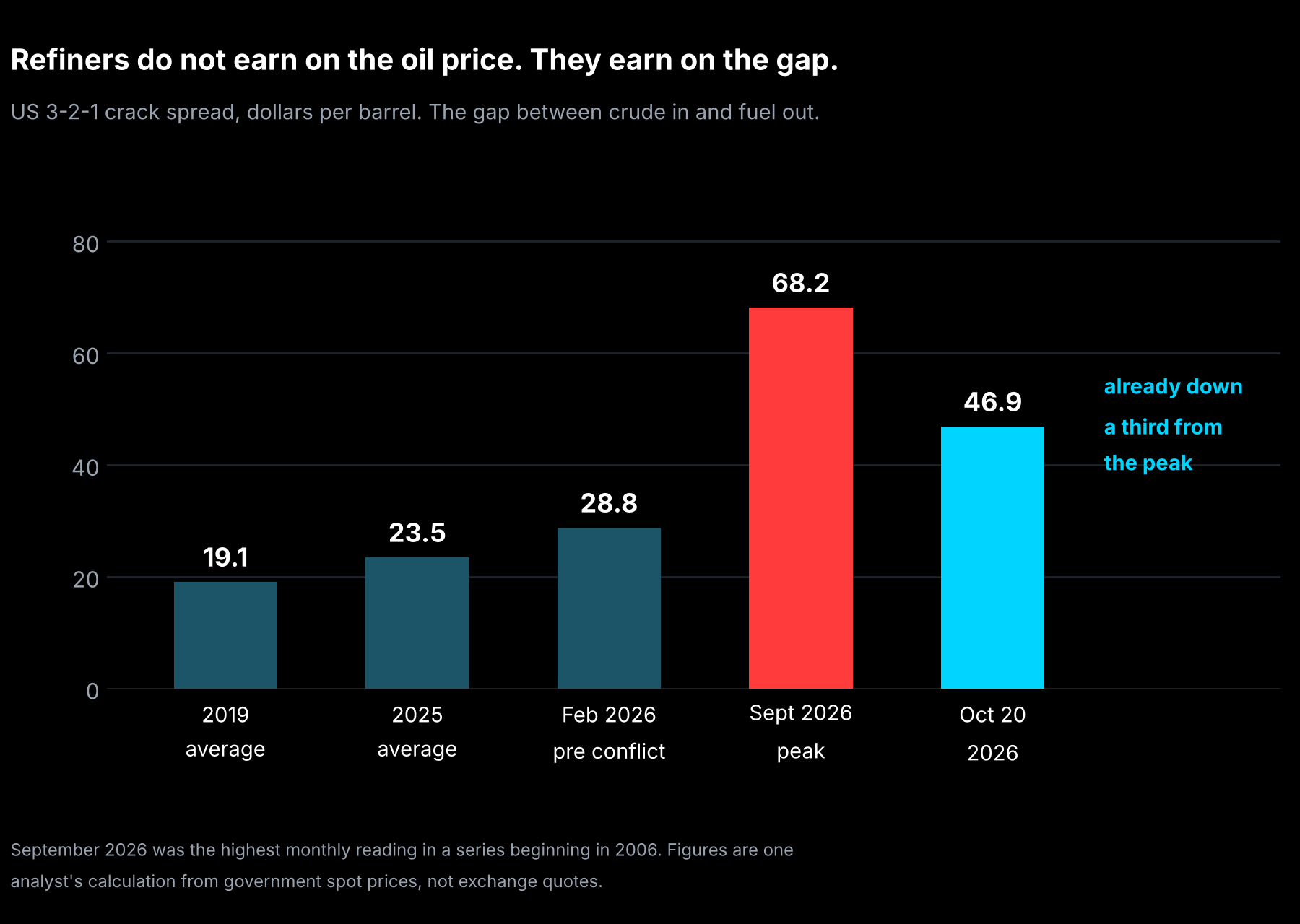
The American 3-2-1 crack spread averaged about $19 a barrel in 2019 and about $23 in 2025. In September 2026 it averaged $68.23, the highest monthly reading in a series going back twenty years.
And within that, diesel is where the violence is. The diesel crack spread hit a monthly record of about $111 a barrel in September, against a previous high near $95 set in October 2022. In the last week of February, before the conflict began, it was about $49.
So the diesel margin has roughly 2.3 times, in eight months.
One honest qualification, and it matters. The blended 3-2-1 has already come off hard. By October 20 it had surrendered roughly a third of that September average. The diesel crack has held near records while the gasoline-weighted blend faded. This is a diesel story, not a general refining story, and if you read it as "refining margins are booming" you will be surprised when the gasoline-heavy refiners report something weaker.
The best corroboration comes from a company rather than a calculation. BP publishes its own refining margin indicator. It averaged $46.70 a barrel in the third quarter, against $29.60 in the second. BP posted its highest quarterly profit on record. Its chief executive also said margins are "starting to soften," which is worth holding onto.
Why this happened, and it is not what you would guess
Nobody damaged an American refinery.
American refiners are running flat out. Industry utilization was 92.8% in the week to October 23, against a five-year average near 87.6% for that week. Exxon ran its Gulf Coast refineries at 100%. Chevron ran its American system near 98% with record throughput. European plants are described as running near full capacity.
That is the opposite of a damaged industry. So where did the shortage come from?
Mostly from Russia. Roughly thirty Russian refineries have been struck by drones over recent months, plants representing something like 80% of national capacity. Estimates of how much output that removed vary by a factor of two, from roughly three to five million barrels a day, and I am not going to pretend otherwise because the underlying estimates genuinely conflict and none of them trace to a primary source I could check. Russian runs have partly recovered, and two credible outlets published irreconcilable figures for the recovery within forty-eight hours of each other.
Some from the Gulf. Several large refineries in Saudi Arabia, Bahrain, Kuwait and the United Arab Emirates have reportedly had units offline during the conflict. I am stating that carefully because much of the specific reporting rests on claims by combatants that the governments involved have not confirmed, and republishing a belligerent's announcement as an event is how misinformation spreads.
And here is the part that gets the least attention and probably matters most. None of this would have produced record margins if the system had spare capacity. It did not.
The United States had 18.98 million barrels a day of refining capacity at the start of 2020. By July 2026 it was about 18.04 million, a decline of roughly 932,000 barrels a day, or 4.9%. Eleven sites closed or converted since 2020, against smaller expansions elsewhere. The list includes Philadelphia Energy Solutions at 335,000 barrels a day, Shell's Convent refinery at 211,000, Phillips 66's Alliance refinery at 255,000, Lyondell's Houston plant at 264,000, and Phillips 66's Wilmington operation at 139,000.
Valero closed its Benicia, California refinery this year, 145,000 barrels a day, into the margin spike.
Europe is further along the same path. Roughly 500,000 barrels a day of European capacity closed in 2025 alone, from around 14 million at the turn of the century, and one major research firm expects European capacity to fall about a fifth more by 2035. The United Kingdom has lost two of its six refineries.
So the mechanism is this. A system that had already retired about 5% of American capacity and far more of Europe's, with no cushion left, lost somewhere between 3% and 5% of global capacity to drone strikes and conflict. Every refinery still standing became dramatically more valuable. American refiners did not catch a lucky break. They caught an arbitrage created by other people's destroyed assets.
The correction nobody is making
Here is where most coverage of this story is wrong, and it is worth knowing because it tells you something about how these companies actually differ.
Chevron reported the same morning, and its drilling business still out-earns its refining business. Upstream $5.70 billion against downstream $4.93 billion.
Chevron's refining results were spectacular in their own right. American downstream earnings went from $638 million to $3.59 billion, up 462%. Total downstream up 334%. Its American refineries ran at record throughput, with crude unit inputs of 1,093 thousand barrels a day, up 3%.
But its production business grew too, by 73%, and it started from a larger base.
So "refining now earns more than drilling" is an Exxon fact, not an industry fact. If you read it as a statement about the oil majors generally you will be wrong about half of them. The difference comes down to the relative size of each company's two halves and where their refineries sit, not to some new law of the industry.
Both companies are, however, telling the same story about production. Exxon's output fell year over year, to 4,534 thousand barrels of oil equivalent a day year to date from 4,651. Chevron's fell too, to 3,980 from 4,086, which it attributed partly to lower entitlements at higher prices and to the Middle East conflict. Chevron's international refined product sales fell 9% on Middle East supply disruptions.
Read that together and the picture is clear. These companies are producing less oil and making more money, because the scarcity is not in the ground. It is in the factories.
What they are doing with the money
This is the most under-reported part of the story and it is the piece that should stay with you.
Across BP, Chevron, Exxon, Shell and TotalEnergies, the quarter produced roughly $56 billion in combined net profit, the second-strongest on record. Combined net debt fell to about $117 billion from $204 billion earlier this year. Combined share repurchases were about $12.3 billion. Shell reduced its capital spending guidance by a billion dollars.
So where is the money going? Debt reduction and shareholder returns. Not refineries.
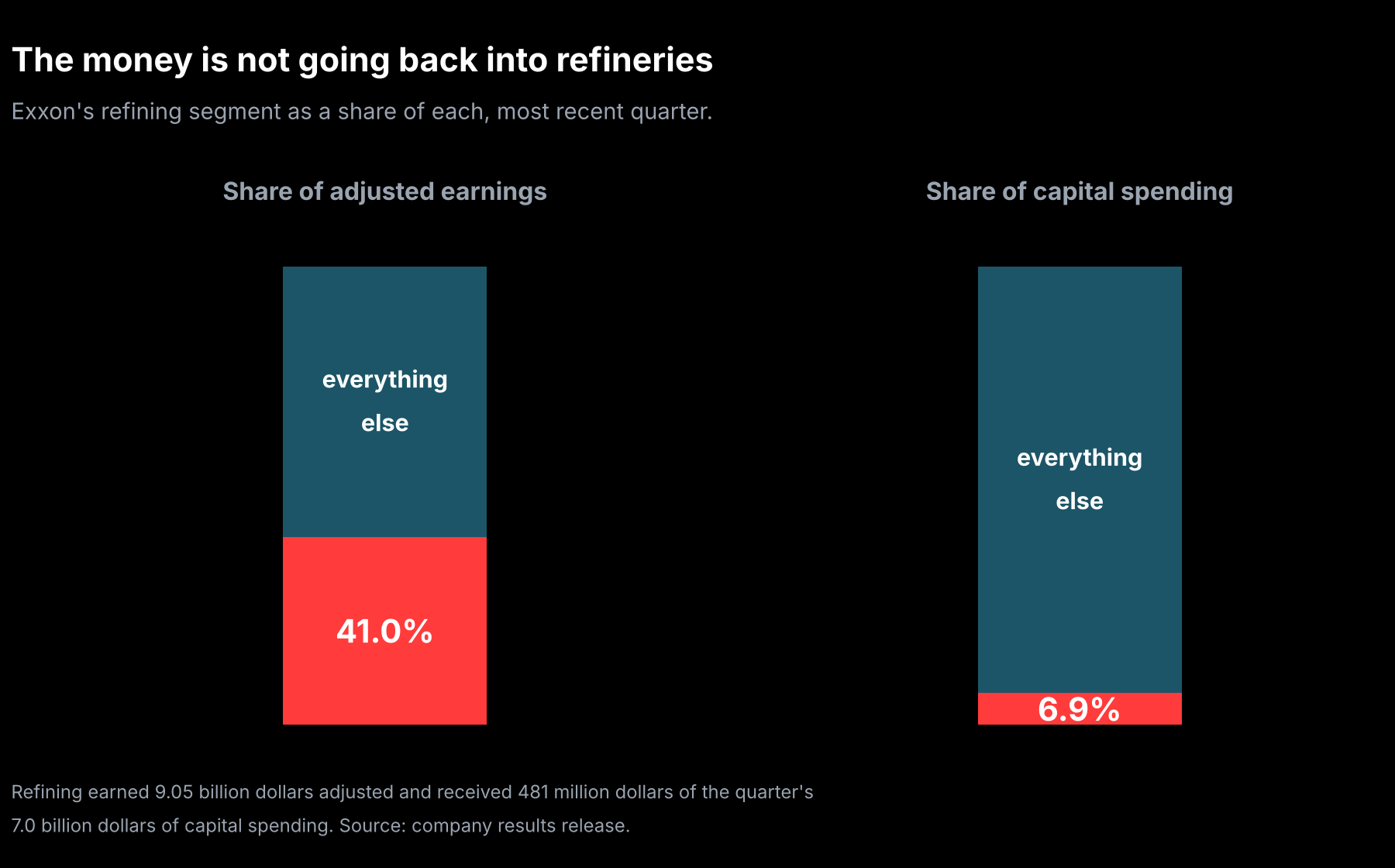
Look at Exxon's own capital allocation. Of $7.0 billion of capital spending in the quarter, the refining segment received $481 million. That is 6.9% of the capital for the segment producing 41% of the adjusted earnings. Refining spending has risen year to date, to $2.0 billion from $1.25 billion, but off a very small base.
Exxon returned $9.4 billion to shareholders in the quarter, $4.3 billion in dividends and $5.1 billion in repurchases, and has signaled about $20 billion of repurchases next year. Chevron returned $2.5 billion in the quarter and cut its capital spending, guiding to the low end of its range.
What is actually being added is modest and specific. Exxon's chief executive said the company expects to increase American distillate throughput by about 100,000 barrels a day, from investments including its Baytown plant, with no timeline attached. Note the wording carefully: that is distillate throughput and yield, meaning getting more diesel out of the same plants, not new crude processing capacity. Most coverage blurs that distinction. Chevron has indicated its Pascagoula plant could expand 7% by the end of the decade.
Set that against the arithmetic. One hundred thousand barrels a day is about 0.55% of American refining capacity, against the 932,000 barrels a day the country has already lost since 2020.
And you do not have to guess at the reasoning, because Chevron's chief financial officer said it out loud: "We think in decades, not quarters." A refinery takes the better part of a decade to permit and build and then has to earn its money over thirty or forty years. Committing billions on the basis of a margin created by a war is a bet that the war, or something like it, lasts long enough to pay the capital back. Nobody is making that bet.
Exxon's chief executive framed the opposite side of the same coin, arguing the improvements are durable: "These are lasting improvements, not simply the result of favorable prices and margins." He also named the real constraint plainly: "Frankly, diesel is the key crunch point here, because it is so critical to economic growth."
If you want to know which public companies are most exposed to this, the pure refiners are the clearest expression, because they have no drilling business diluting the effect. Valero, Marathon Petroleum, Phillips 66, HF Sinclair, PBF Energy, Delek and CVR Energy all live or die on the crack spread. Exxon and Chevron are hybrids. BP, Shell and TotalEnergies are the large overseas comparisons.
How long does this last
Genuine disagreement here, and the honest thing is to show you both sides rather than pick.
For longer. Goldman Sachs has said the diesel squeeze can run through 2027. The Energy Information Administration forecasts distillate inventories staying below the five-year low through the end of 2026 and most of 2027. American diesel inventories were 107.9 million barrels in September, the lowest for that time of year since records began in 1982. Chevron says decades, not quarters.
For shorter. BP's own chief executive says margins are starting to soften, and that is the most important dissent available because it comes from a company reporting a record margin. The blended American crack spread has already surrendered about a third of its September peak in a single month. And record margins historically pull more output into the market, which limits further gains.
Both views are on the record this month, from serious people, and they cannot both be right.
What this does not tell you
It does not tell you Exxon is becoming a refining company. Its production business still earned $7.3 billion and remains far larger year to date. One quarter is a crossover, not a transformation.
It does not tell you the same is true elsewhere. Chevron's drilling business still out-earns its refining business. This is an Exxon fact.
It does not tell you how much refining capacity is actually offline. The estimates conflict by a factor of two and none of them trace to a source I can verify. Anyone giving you a precise figure is giving you a guess with a decimal point on it.
It does not tell you margins stay here. The blended crack spread has already fallen by nearly a third from its September peak. The diesel crack is holding. Those two facts are both true and they point different directions.
It does not tell you the companies believe this lasts. This is the clearest signal in the whole quarter and it runs against the headline. If management teams thought these margins were durable, capital would be flowing into refineries. It is flowing into debt repayment and share repurchases instead. Exxon put 6.9% of its capital into the segment generating 41% of its earnings. That is a judgment, and it is a cautious one.
And it does not tell you what any of this is worth. A company earning record profits from a margin created by a war is not the same investment as a company earning ordinary profits from a stable business, even if this year's figures look identical. The question is never what a business earned. It is what has to stay true for it to keep earning it, and here the honest answer is that a shipping lane has to stay dangerous and thirty Russian refineries have to stay damaged.
That is exactly the kind of thing a single number cannot carry, which is why we show the workings. Techdamentals runs four separate valuation methods and displays the full range, because one figure tells you where somebody landed and nothing about what it rests on.