Over the weekend the people building this stuff said they want to slow down.
Dario Amodei published an essay on Saturday arguing the industry is moving too fast, with a three-part plan for doing something about it. Anthropic committed to the first part on its own, which is letting outside evaluators sit inside the company with employee-level access. Sam Altman agreed and said OpenAI would match it. Elon Musk posted three words. Demis Hassabis said the direction is right. The President played the whole thing down.
That's an unusual amount of agreement from people who normally agree on nothing.
Markets read it as bad news for chips and good news for software. I think that read is half right, and the half it gets wrong is the more interesting one.
Two directions, not one
A slowdown does two things at once, and they point opposite ways.
It means less compute bought sooner. If you stretch out a training schedule, you stretch out the hardware order that goes with it. That's the leg everyone priced on Monday, and it lands on anything whose revenue is somebody else's capital budget.
It also means the disruption arrives later. A lot of businesses have spent the past two years being marked down on the argument that AI agents were about to do their job for a fraction of the price. Push the capability jump out by a year and that argument gets weaker, not stronger.
Same essay. One sector's cost, another sector's reprieve.
The part that actually explains the tape
Here's what I think is going on, and it isn't that one leg is bigger than the other.
It's that one of them is fast and the other one is slow.
The down leg shows up almost immediately. A capital plan gets stretched, orders get pushed, and you can see it in a quarterly number within a few months. There's a paper trail. Somebody announces it.
The up leg shows up as nothing happening. Customers who don't leave. Contracts that renew the way they always have. Pricing that doesn't get cut. You can't point at any of that on a Monday, and you won't be able to point at it next quarter either. You find out years later, if you find out at all.
So even if the two effects were exactly the same size, the market would see one of them long before the other. Which is a decent explanation for why a slowdown headline reads bearish on the day, and why it might not read that way in two years.
Which side is a given business on
Forget sectors for a second. The question that actually sorts this is simpler.
Does this company's revenue depend on somebody else's capital budget, or on their own customers renewing?
Revenue tied to a capital budget Revenue tied to renewals Lands hard and fast when plans get stretched Barely moves on a pacing announcement Order books and backlog tell you early You learn from churn that didn't happen The buyer can defer for a quarter without breaking anything The buyer has to actually leave Gets repriced on a headline Gets repriced on a renewal cycle
Most companies are somewhere on a line between those, and a few sit on both ends at once. But if you hold something and you're wondering whether this news was good or bad for it, that's the question, not which sector it trades in.
The number under all of this
It's worth being specific about how much money is involved, because the abstraction hides the scale.
The four biggest spenders have guided to roughly $725 billion of capital expenditure this year, against something near $410 billion last year. That's up about 77%.
2026 guidance Amazon ~$200bn Microsoft ~$190bn Alphabet $175–185bn Meta $115–135bn
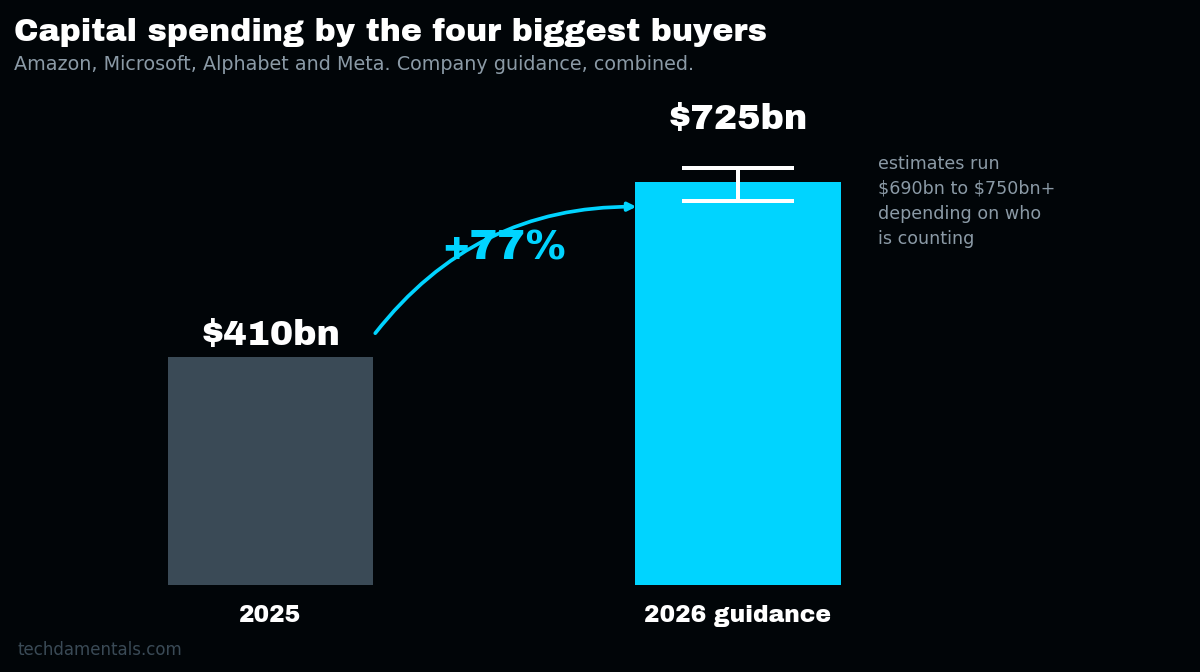
And here's a thing I found more interesting than the total. The estimates don't agree with each other. Depending on who's counting and which companies are in the set, the figure lands anywhere from about $690 billion to $800 billion. Nobody can pin down a number this large to better than $100 billion, which should tell you something about how precisely anyone can forecast what happens to it.
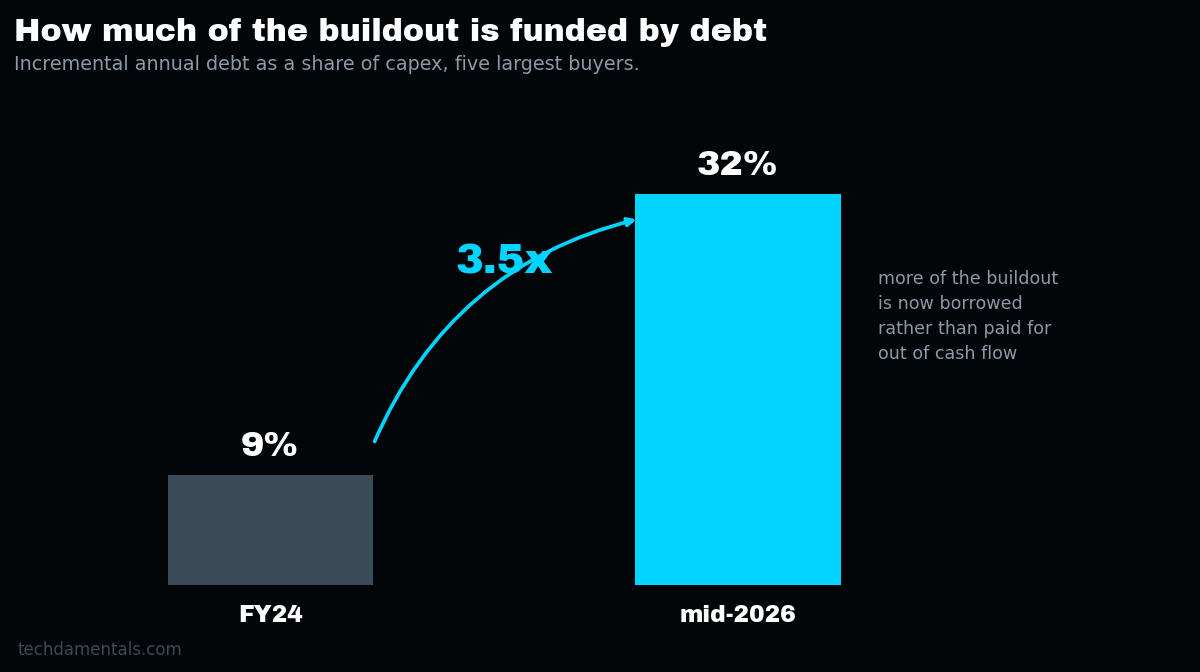
One more detail that matters for how fast the down leg would move. Until recently this spending came out of operating cash flow. It increasingly doesn't. Incremental annual debt has gone from around 9% of capex to roughly 32% on a trailing basis. Spending that's funded by borrowing is spending that gets looked at harder when the reason for it gets questioned.
What this doesn't tell you
Three things nobody can price, and I'd rather name them than pretend the above is a conclusion.
None of it is binding. One company committed to outside evaluators and another said it would match. That's a commitment, not a regulation. Commitments made in a good week get revisited in a bad one, and there's no mechanism here that stops that.
There's a waiver question sitting underneath. The plan asks the US government for permission to let competing labs coordinate without it counting as collusion. Grant it and the pace gets set collectively, which is structurally useful to whoever is already in front. Refuse it and the coordination doesn't happen at all. Two very different worlds, and no way to handicap which one we're in.
And there's a cost nobody has a number for. David Sacks, pushing back on the plan, said these companies face real product liability exposure if what they build ends up enabling a serious cyber-attack. Whatever you think of the rest of his argument, that part is a genuine line item that does not currently appear in anybody's model. Not in a bank's, not in mine.
On the underlying safety claim itself, the essay warns that a swarm of misaligned agents could do hundreds of billions in damage. Other researchers in the same coverage called that implausible. I'm not in a position to settle that and I'm not going to pretend otherwise. What I'd say is narrower: the people who build these systems now think the risk is real enough to slow down for, and that statement on its own changes how a capital plan gets written, whether or not the underlying claim turns out to be right.
The honest summary
One essay moved two sectors in opposite directions on a single session. Nobody filed anything. Nobody changed guidance. The explanation showed up after the move, which is usually the tell.
And none of what moved the tape is a thing a valuation model can see. A model looks at money already earned, debt already owed, growth already booked. An essay isn't a line item. A liability nobody has been hit with isn't a line item. A waiver nobody has granted isn't one either.
What a model can do is show you which assumption an answer is resting on, and let you change it. That's the whole thing Techdamentals is built to do. It values a company off its own cash flow, debt and growth, puts every input on the page next to the answer, and when its methods land far apart it says so instead of averaging the disagreement away.