On Tuesday, November 10, 2026, Anthropic filed its second amendment to a registration statement with the Securities and Exchange Commission, and for the first time it contained a price. The company estimated that its shares would be offered between 70 and 78 dollars each. Press reports say pricing is expected on Wednesday, November 18, 2026 and the first trade on Thursday, November 19, 2026. Those dates are not in the filing, and we will come back to why that matters.
A filing like this raises questions that almost no headline answers. Who sets the price, and how? Why is there a range instead of one number? Who actually gets to purchase shares at the offering price, and who does not? Why do different outlets quote different company values from the same document? This issue works through those questions using the filing itself, with Anthropic as the worked example.
Three notes before we start. First, everything about Anthropic below comes from the filings on the SEC's website, mainly the amendment filed on November 10, 2026, and we say so whenever a number comes from a news report instead. Second, the filing is more than a million and a half characters long, and we read the parts that bear on these questions, not every page. Third, this issue explains how the process works and what the document says. It does not say what the shares are worth, and nothing here is a view on whether anyone should participate.
What an IPO is
An initial public offering, or IPO, is the first time a company offers its shares to the general public through a stock exchange. Until then the shares are held privately: by founders, employees, and investors who put money in at earlier stages.
Companies do it for a few reasons. They can raise money by creating new shares and offering them. Existing holders can get a way to turn their shares into cash. And the company gets a public price that makes it easier to use shares for pay and acquisitions.
The money part has a name worth knowing. Shares the company itself creates and offers are called primary shares, and the company receives the proceeds. Shares that existing holders offer are called secondary shares, and the money goes to those holders, not to the company. Most IPOs include both, and the mix tells you something about what the offering is for.
In Anthropic's case the filing lists 825 million Class A shares in the offering. The company is offering about 801.4 million of them. Existing stockholders are offering about 23.6 million, which is about 2.9% of the deal. The company will not receive any proceeds from that smaller piece. Underwriters also hold an option to purchase up to 123.75 million additional shares from the company within 30 days, which we explain below.
The document behind the headline
To go public in the United States, a company files a registration statement with the SEC. For a first-time offering the form is called an S-1. It is a long public document describing the business, the risks, the finances, who owns what, and the terms of the offering.
The first version is rarely the last. Companies amend it as the SEC asks questions and as the deal takes shape. Anthropic's S-1 was filed on October 26, 2026. A first amendment followed on November 2, 2026, and a second on November 10, 2026. The first two left the price range blank. The second filled it in.
That blank is normal. Early versions describe the business and the structure but leave out the price, because the price is set closer to the offering, after the company and its bankers have talked to investors.
Two more steps matter. The SEC must declare the registration statement effective before shares can be offered, which means the SEC has finished its review and does not object to the offering proceeding. Then, after the price is set, the company files a final prospectus with the actual price and numbers. Everything we cite here comes from the second amendment, and a final prospectus will supersede much of it. We could not confirm from the SEC's filing index whether a further amendment has been filed, so check before relying on any figure below.
The filing also says Anthropic has applied to list its Class A shares on the Nasdaq Global Select Market under the ticker ANT. The word is applied. A listing is not final until the exchange approves it.
Where the price comes from
This is the part most people have wrong. Many readers assume the company or its bankers simply pick a number. The process is closer to a structured auction with a lot of conversation in it.
The company hires banks to manage the offering. They are called underwriters. For Anthropic, the filing names Goldman Sachs and Morgan Stanley as the lead banks, with a larger group of firms in the syndicate. We saw different counts of underwriters between versions of the filing and in our reading of the tables, so we will not give a number.
The underwriters do something called bookbuilding. In the days before pricing, the company and the banks present to large investors, which is usually called a roadshow. Investors tell the banks how many shares they would want and, in some cases, at what price. The banks keep a running tally of that demand. That tally is the book.
The price range printed on the filing is a starting estimate, not a promise. If demand looks stronger than expected, the final price can come in above the range. If it looks weaker, the price can come in below it, or the deal can be delayed. The range in the amendment, 70 to 78 dollars, tells you where the company and banks think the price will land at the time of filing. The prospectus uses 74 dollars, the midpoint, for its illustrative math.
Notice what the range does not tell you: how much demand there is. The book is private, and the filing contains none of it. Reports about the book being "oversubscribed" or not come from people close to the deal, not from the document.
Here is what the money looks like at the midpoint. 825 million shares at 74 dollars is about 61 billion dollars before fees, which is our own arithmetic. Renaissance Capital, a firm that tracks IPOs, reports about the same. Some headlines quote about 64 billion dollars, which appears to be the figure at the top of the range with all shares counted, not the midpoint. We did not find a figure we could verify for how this compares with other offerings, so we will not call it the largest ever.
The underwriters are paid for this work through a discount on the price, and the per-share figure was blank in the version we read. They also receive the option mentioned earlier. It is called a greenshoe, after the company that first used it, and it lets the banks offer up to 15% more shares if demand is strong. Here that is the 123.75 million additional shares from the company. Banks typically offer investors more shares than the base deal, and the option covers that extra amount. If the stock trades below the offering price, the banks can repurchase shares in the open market to cover instead, which supports the price. If it trades above, they exercise the option. The effect is to give the banks a tool for managing the first days of trading.
Who gets the shares
A common belief is that anyone with a brokerage account can purchase shares at the offering price on the first day. In practice most of the shares go to large institutions, such as mutual funds and pension funds, because they are the ones who tell the banks how much they want during bookbuilding.
Retail investors do get a share in some deals, and Anthropic's filing is specific. It says the company currently expects allocations to retail investors, in the United States and other countries, to represent up to 20% of the Class A shares offered, with final amounts based on actual demand. At the company's request, shares will be offered through several brokerages. The filing names Charles Schwab, Fidelity, Robinhood, SoFi, and E*TRADE from Morgan Stanley, and the underwriters may also allocate shares to customers of their own online brokerage arms.
Two details deserve attention. The word is up to, which is a ceiling and an expectation, not an allocation anyone is promised. And a request to purchase through a brokerage is not an order that will fill: when demand exceeds the shares available, allocations can be reduced or filled only partly.
We also found a conflict worth flagging. One outlet reported the retail share as not disclosed, citing a different news report of 15% to 20%. The amendment we read does disclose up to 20%. The likeliest explanation is that the outlet read an earlier version, but we did not check the first amendment to confirm.
The filing also says directors and affiliated parties have indicated non-binding interest in purchasing up to about 303 million dollars of Class A shares at the offering price. The underwriters may allocate more, fewer, or none, and shares purchased this way carry the same lock-up restrictions as other insiders.
The second deal inside the deal
Here is the piece that most readers will miss, and it is the most unusual part of the structure. Alongside the public offering, the filing describes a concurrent private placement. The company will offer 26.0 billion dollars of Class N stock to seven partners at the same price as the IPO, and the placement is expected to close immediately after the offering, subject to conditions.
At the 74 dollar midpoint, the filing lists the following.
Google would take 135,135,135 shares, about 10.0 billion dollars. Nvidia would take 135,135,135 shares, about 10.0 billion. AMD would take 33,783,783 shares, about 2.5 billion. Broadcom, Micron and Microsoft would each take 13,513,513 shares, about 1.0 billion each. TSMC would take 6,756,756 shares, about 0.5 billion.
Two facts make this different from the public offering. These shares are not registered in the IPO. They are what the law calls restricted securities, which means they cannot be freely resold to the public until a holding period or exemption applies. And they are not subject to the lock-up agreements described later. The dollar amounts float with the final price, so 1.0 billion dollars for Microsoft is the figure at the midpoint, not a fixed amount. The filing says each party "would" purchase, conditional on the offering closing.
This matters for Microsoft in particular, because it already sits in several roles at once. It supplies cloud capacity to Anthropic, it announced an investment in Anthropic in November 2025, and Anthropic's newest products now compete with parts of Microsoft's own software. The filing adds another role. Microsoft would purchase shares at the IPO price through the placement, while also being the recipient of a spending commitment from Anthropic of tens of billions of dollars. We return to that number below.
Several of the seven are companies that supply chips, memory, or cloud services to Anthropic, and some press reports describe them as suppliers. We saw that description in the news coverage, and we did not find it stated in the part of the filing we read, so we attribute it to the press.
Five kinds of shares
Anthropic's stock comes in several classes, and that is the single most important structural fact in the filing for anyone trying to understand who controls the company. The details come from the filing and from its draft charter.
Class A is ordinary voting stock, one vote per share. It is the class being offered to the public.
Class N has no votes, except where the law requires them. It participates in the economics like ordinary stock. It converts into Class A shares when it is sold or transferred to an unaffiliated party in the ways the charter describes. The filing says it is held primarily by strategic business partners. Amazon and Google are listed as holding about 1.92 billion and 1.65 billion Class N shares respectively before the offering. So Class N is not Microsoft's class, as some coverage implies. It is the class strategic partners hold.
Class T is a single share held by the Long-Term Benefit Trust. It has no economic rights, but it elects the smallest number of directors that makes a majority of the board, until a defined sunset time.
Class F is a single share held by an entity called Anthropic Founders, LLC. It has no economic rights either, but its voting power is set by a formula in the charter so that it equals 50.1% of total voting power.
Class E is for employees other than the co-founders. None will be outstanding when the offering closes.
The Long-Term Benefit Trust deserves a plain explanation. The charter defines it as a Delaware noncharitable purpose trust, and the prospectus describes five financially disinterested voting trustees. Through its Class T share it elects and removes the directors who make up a board majority. Certain changes to the charter's public benefit provisions require both board approval and approval from the trust. The company says the trust has no role in day-to-day management or strategy and mainly selects directors and advises.
Anthropic is also a Delaware public benefit corporation. Its stated purpose is to responsibly develop and maintain advanced artificial intelligence for the long-term benefit of humanity. That is a legal structure that lets directors weigh that purpose alongside shareholder returns.
Finally, the company says it will be a controlled company under Nasdaq's rules, which allows it to rely on exemptions from some governance requirements, such as having a nominating and governance committee made up entirely of independent directors.
One caution on the sources. The charter we read is the version attached to the original filing, and later amendments may have changed the text. A reader making a decision would want the final version.
Why two people can quote two different company values
This is where the numbers in headlines stop agreeing, and the reason is not a mistake. The filing states no company value at all. Every figure you read is somebody's arithmetic: a share price multiplied by a share count. The two inputs are what differ.
The filing says 13,086,672,593 shares will be outstanding after the offering and the private placement, counting every class. Multiply that by the ends of the range and you get about 916 billion dollars at 70, about 968 billion at the 74 midpoint, and about 1.02 trillion at 78. One outlet, FinanceFeeds, published figures on this basis and describes them as its own calculation. They are the simplest numbers, and they use only shares that exist.
Other outlets use a fully diluted share count, which adds shares that could come into existence: options, restricted stock units that have not vested, and shares that would be issued if convertible notes turned into stock. Using that count, Renaissance Capital puts the value at about 1.2 trillion dollars at the midpoint, and Open magazine says about 1.3 trillion. Reports based on Reuters put it as high as about 1.4 trillion at the top of the range. None of those pieces gives its share count, and we could not find a fully diluted count in the part of the filing we read.
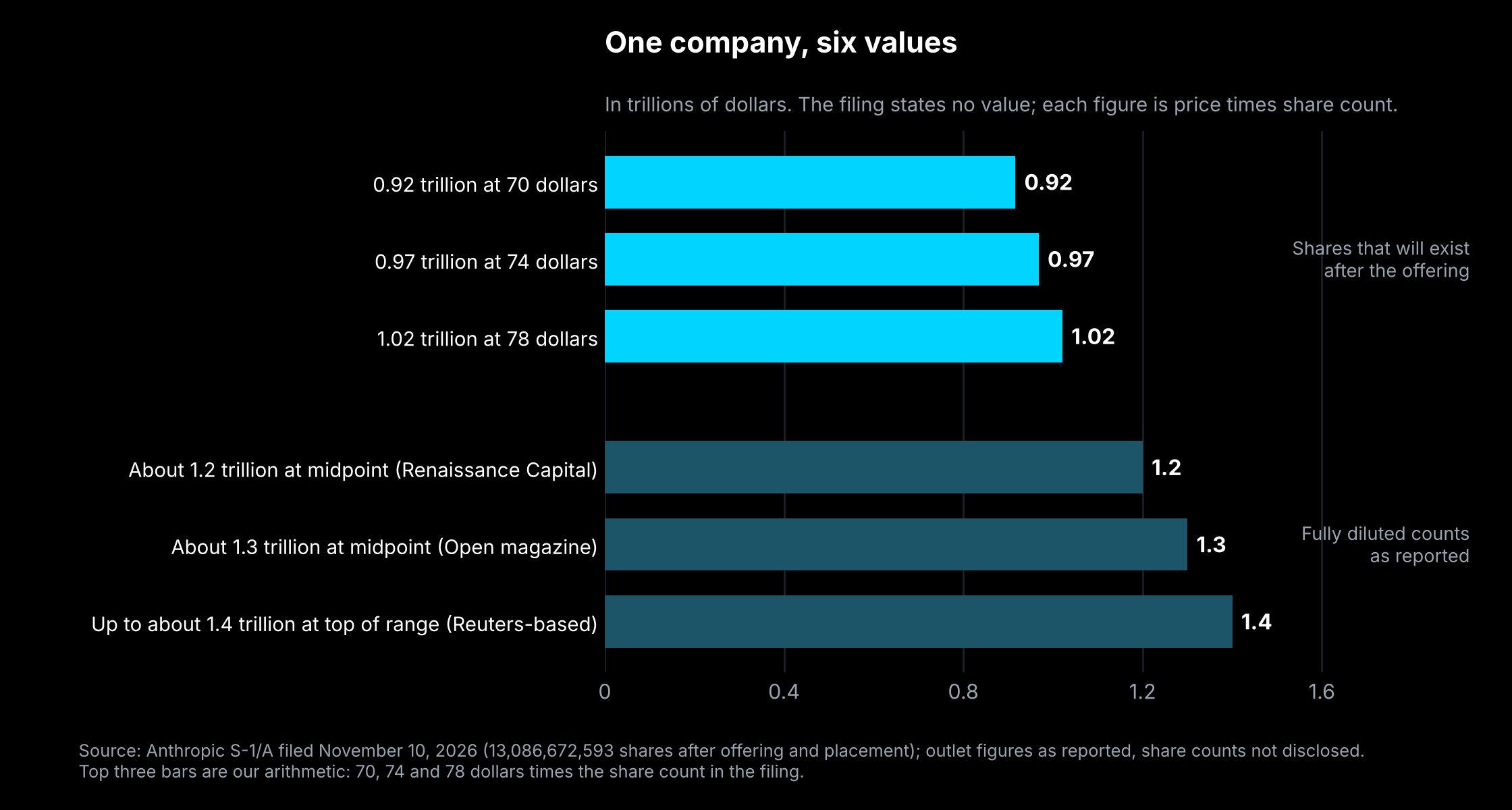
You may have seen a figure of 1.33 trillion dollars. We looked for where it comes from and could not trace it to the filing or to a source we could open. That does not mean it is wrong. It may be a different price point or a newer calculation. It does mean the number cannot be treated as the company's own, and anyone quoting it should say which share count they used.
The habit worth keeping is to ask what a headline number was multiplied by. A company value is a price times a count, and counts differ in what they include.
What the financials say
The filing's finances are large and unusual in form, so a plain reading helps.
Revenue for 2025 was 4.585 billion dollars. For the first nine months of 2026 it was 33.242 billion. The filing says revenue for the three months ended September 30, 2026 was 17.0 billion dollars.
The net loss was 41.965 billion dollars in 2025 and 104.039 billion for the nine months of 2026. Those numbers are very large relative to revenue, and the reason is not what a reader might assume. Most of the 2026 loss is not operating cash going out the door. The filing attributes it mainly to a 94.324 billion dollar expense from the change in the fair value of convertible notes, derivative liabilities, and similar instruments, which the company says was primarily driven by an increase in the fair value of its outstanding convertible notes, reflecting a higher company valuation.
That needs a plain explanation. A convertible note is a loan that can turn into shares later. When a company's value rises, the shares those notes would convert into are worth more, and accounting rules require the company to record that increase as an expense. It is a bookkeeping charge that grows when the company is valued more highly, not a payment out of pocket. The operating loss, which measures the business itself, was 1.26 billion dollars for the nine months, and 8.06 billion for 2025.
There is a second piece. The filing says the third quarter operating loss was driven mainly by 5.0 billion dollars of compute bought under short-term commitments, plus about 2.0 billion dollars of non-cash charges related to matching employee donations. It adds that short-term compute costs significantly more than comparable compute under multi-year commitments. We read that as the company explaining that demand outran its contracted capacity, though that interpretation is ours and not a filing statement.
On cash, the filing reports 95.6 billion dollars of cash and equivalents and 36.3 billion in short-term investments at September 30, 2026, a total of about 131.8 billion before any IPO proceeds. Total indebtedness was 6.2 billion, and the filing describes an agreement with Broadcom for up to 42.0 billion dollars of convertible notes.
A reader should not equate the net loss with cash burn, and should not equate the commitments below with annual spending.
The commitments
The filing states aggregate committed spending of approximately 900.9 billion dollars, substantially all of it for compute and infrastructure. About 70.7 billion is due in the 12 months after September 30, 2026, and about 451.6 billion is expected to be incurred before the end of 2030.
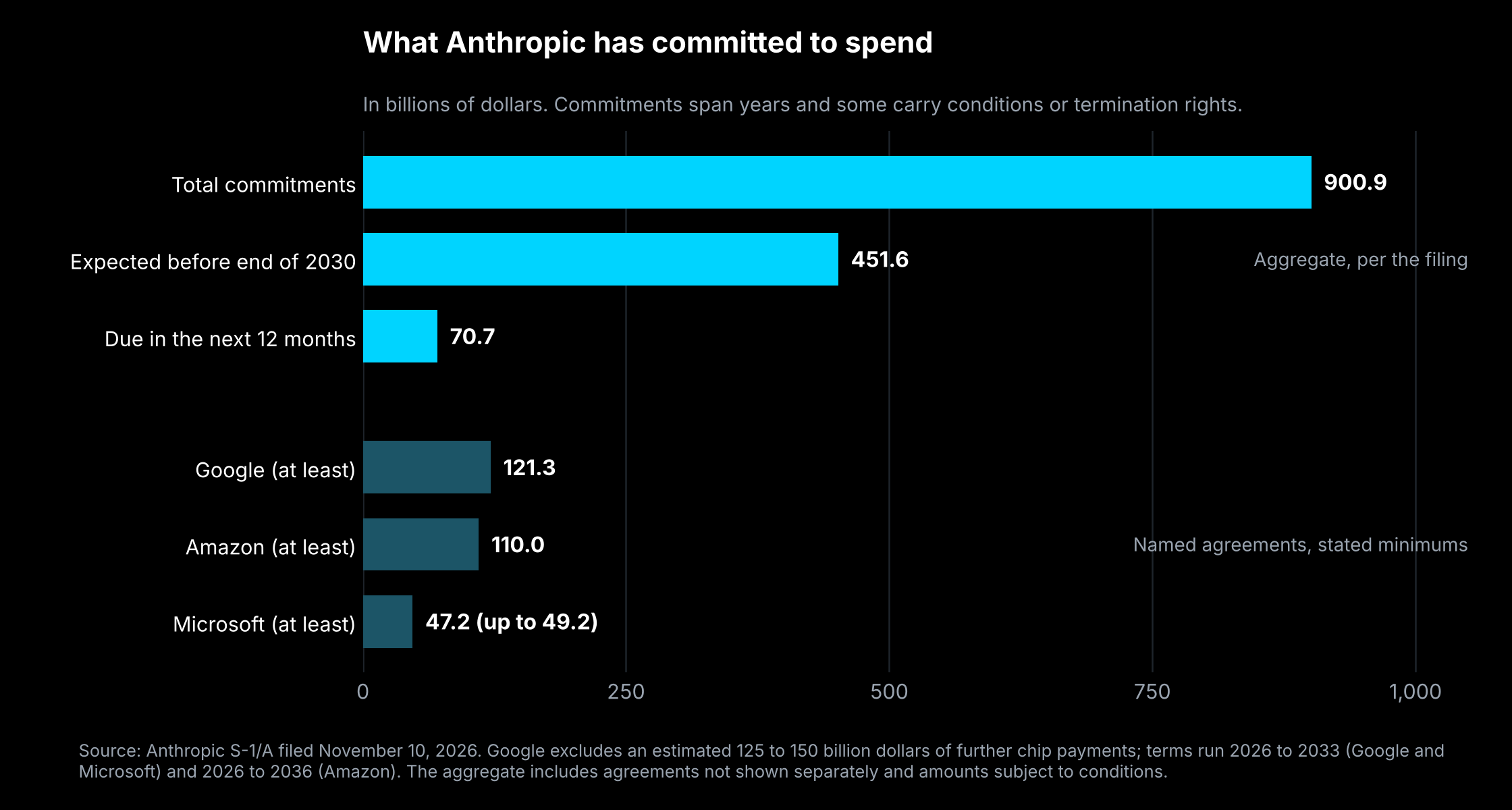
Three named agreements stand out. Anthropic committed to spend at least about 121.3 billion dollars with Google from April 2026 to July 2033, and the filing adds that further payments for specialized chips of an estimated 125 to 150 billion dollars are not in the contractual obligations table. It committed to at least 110.0 billion with Amazon from May 2026 to April 2036. And it committed to at least 47.2 billion, and up to 49.2 billion, with Microsoft from November 2026 to June 2033.
That last number conflicts with what most readers remember, and it is worth slowing down on. When the Microsoft relationship was announced in November 2025, coverage said Anthropic had committed to 30 billion dollars of Azure compute. The filing now says at least 47.2 billion, for a specific window, under an agreement signed in November 2025 and amended between February and November 2026. A secondary report also described an earlier version of the filing with a figure of about 44.9 billion, which suggests the number moved between amendments. We did not find the 30 billion figure in the part of the filing we read. So the 30 billion is what was announced, and the filing is what has been committed to since. Any article repeating the older figure is out of date.
Two warnings apply. The aggregate includes commitments that are subject to conditions or termination rights, so it is not all fixed spending. And other totals circulating, from 269 billion to 637 billion dollars, are third-party sums of earlier versions or of some of the agreements. We would not use them.
On customers, the filing says the top five accounted for approximately 25% of revenue in the first nine months of 2026, and that revenue through cloud-provider marketplaces was about 44% over that period, up from about 11% in 2023. It did not show us whether any single customer exceeds 10% of revenue, so we do not say either way.
The lock-up, and why it matters
The last piece of the puzzle is what happens to the shares that are not part of the offering.
When a company goes public, most of its shares are held by insiders. If all of them could be offered on day one, the supply could overwhelm demand. So underwriters require insiders to sign lock-up agreements, promising not to offer their shares for a set period.
Anthropic's filing describes a 180-day lock-up for directors, officers, and holders of substantially all of its stock, with exceptions for gifts, transfers to family or affiliates, trading plans, option exercises, and tender offers. It is not a single date. The company's own lock-up ends at the earlier of two trading days after its first-quarter 2027 earnings release or the close of the 180th day. The co-founders and certain large holders are restricted longer, until the third quarter 2027 earnings release or the 365th day, whichever comes first.
There are also staged early releases. For employees and non-founder directors and officers, up to about 10% of holdings can be released on the first trading day, and a further tranche after the full-year 2026 earnings release. The filing's section on future sales lists about 316 million shares that could become available shortly after the prospectus date, and about 1.7 billion after the 2026 annual results. The table of tranches is complex and tied to events, and we read it only in part, so we do not quote tranche sizes beyond what is above.
Remember the point from the private placement. Those Class N shares sold to the seven partners are not subject to the lock-up, which means the supply picture is not as simple as the headline offering suggests.
The dates and what is not confirmed
Here is what we can say about timing. The filing's own text gives no pricing or trading date, and its expected closing date was blank in the version we read. The dates in circulation, pricing on Wednesday, November 18, 2026 and a first trade on Thursday, November 19, 2026, trace to press reports that attribute them to CNBC and to the company's IPO website. One tracker we found says they depend on regulatory clearance and that the registration statement was not yet effective as of November 12, 2026. That tracker is published by a firm that offers products tied to Anthropic, so we treat it as interested. Renaissance Capital says only the week of November 16, 2026.
So the date is plausible and widely reported, but it is not confirmed. It depends on the SEC declaring the filing effective and on the price being set.
How to read one of these filings
If you want to read an IPO document yourself, here is the order that works for us.
Start with the cover page, which has the price range, the share count, and the exchange. Then read the summary, which describes the structure and the deal. Go next to the use of proceeds, which says what the money is for. Read the risk factors for what the company worries about. Look at the capitalization and dilution sections for share counts, and the description of capital stock for the classes and who controls the vote. Finally, read the underwriting section for the lead banks, the allocation rules, the lock-ups, and any concurrent deals.
Then check three things. Which numbers are in the filing and which come from articles? What is the share count behind any value you are shown? And what would change if the price came in at the top or bottom of the range?
What this does not tell you
It does not tell you the price. The range is an estimate. The final price comes from the book, which is private, and it can land above or below the range.
It does not tell you the company's value. The filing states none. Published figures differ because they use different share counts, and we could not trace the 1.33 trillion dollar figure.
It does not tell you when trading starts. Pricing and first trade dates are reports, not filing statements, and they depend on the SEC and on pricing.
It does not tell you how a stock will trade. Nothing in this issue values anything or says what the shares are worth.
It does not tell you what is in the final prospectus. We did not find a final one, and a later amendment could change the range, the share count, or the structure.
The habit worth keeping is to separate three things that headlines blend together: what a document says, what the press says about it, and what someone calculated from it. Most confusion about an IPO comes from treating the second and third as the first.
That is the kind of reading that sits under a valuation rather than in a headline. Techdamentals shows the inputs behind every fair value rather than a single number, puts the fundamentals and the chart in one place, and reads the SEC filing to find the real reason a stock moved after earnings.
Try Techdamentals for 3 days, no card needed
This is educational content, not financial advice. Techdamentals is an educational tool and does not recommend any security.