On Tuesday, November 3, 2026, after the market closed, AMD reported the biggest quarter in its history and guided the next one far above what anyone expected.
Revenue was $13.377 billion, up 45% from a year earlier and 16% from the previous quarter. Profit per share came in at $2.09 against roughly $1.95 expected. The data center business did $8.546 billion, up 97%. And for the current quarter the company guided to about $17 billion, which would be roughly 66% growth, when analysts had been looking for something closer to $16.3 billion.
The stock jumped about 10% in the first minutes and settled around 7.7% higher through the call.
One line missed. It was the PC chip business, and it is the only part of AMD that the thing we have been writing about all week actually touches.
This is the third company in six days to guide its profitability down for the current quarter. The other two told investors exactly what was doing it. This one did not say.
Three terms, because the whole article needs them
Guidance is a company's own forecast of its next quarter, given to investors on the earnings call. It is not audited and not required. It is management saying out loud what it currently expects.
It usually matters more than the results, and the reason is simple once stated. The results describe a quarter that already finished and that investors spent three months estimating. Guidance is the first genuinely new information in the room.
Consensus is the average of what professional analysts expect a company to report. This is why a company can post its best quarter ever and have the stock fall. "Good" is not measured against last year. It is measured against what everyone had already assumed.
Gross margin is what a company keeps from each dollar of sales after paying only the physical cost of making the thing. Not salaries, not advertising, not tax. Just the parts, the assembly and the shipping.
If AMD collects a hundred dollars for a chip and the materials and manufacturing cost forty four dollars, the gross margin is fifty six percent. What is left has to cover everything else, and whatever survives that is profit.
What actually happened inside the quarter
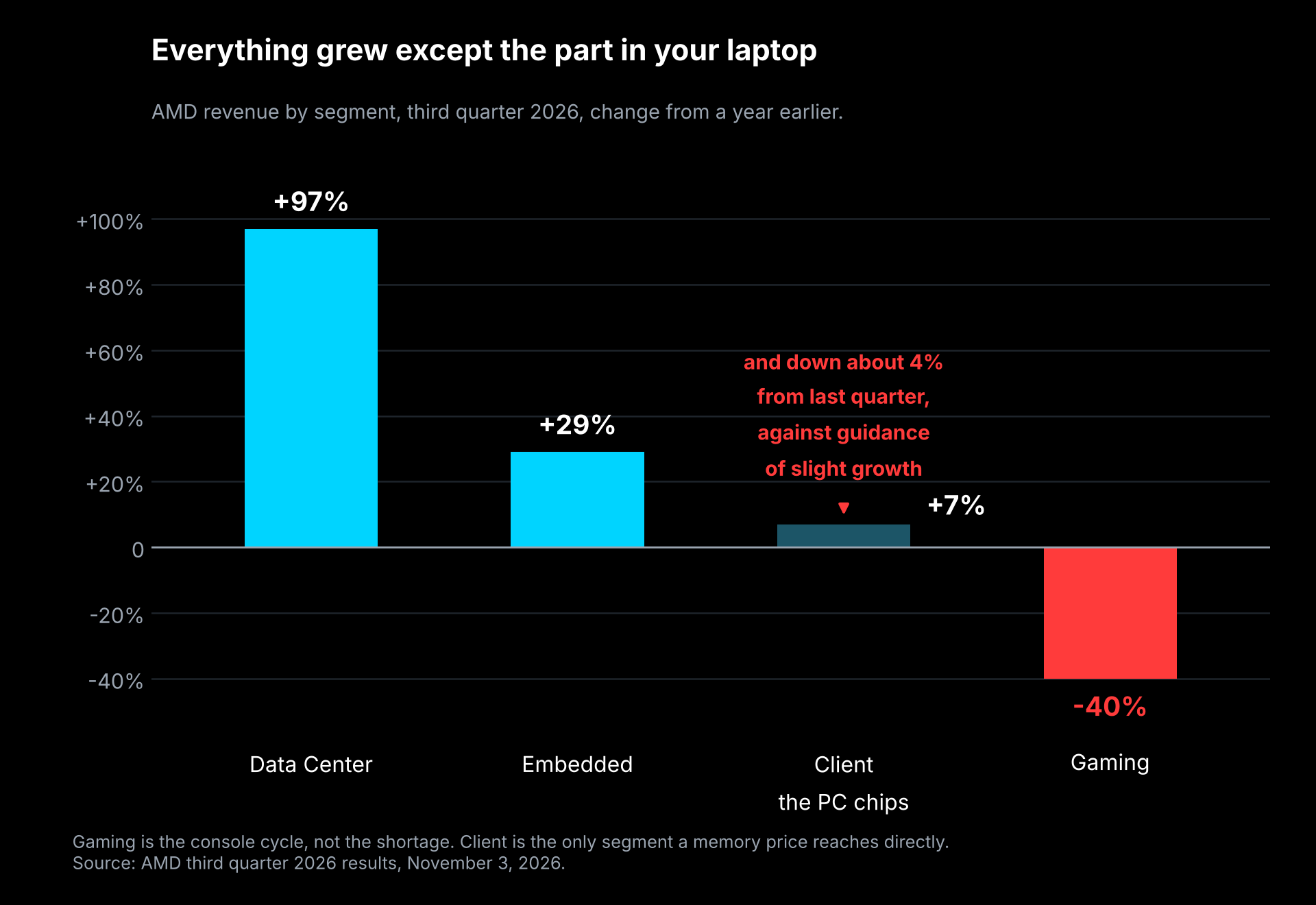
AMD runs four businesses, and this quarter they moved in opposite directions.
Data Center did $8.546 billion, up 97%. Its operating profit margin reached 33.7%, up nine percentage points from a year earlier. That is worth holding onto, because the loudest claim about this industry right now is that building these systems destroys profitability, and AMD's largest segment got substantially more profitable while doing it.
Embedded, which supplies the chips that go inside industrial equipment and cars, did $1.109 billion, up 29%, at a 40.8% operating margin.
Gaming did $773 million, down 40%. Almost all of that is the console business, and AMD attributed the decline to where we are in the console cycle rather than to anything happening this quarter. Consoles are sold on long contracts that ramp and fade on a schedule set years earlier.
Client, which is the PC chip business, did $2.949 billion. Up 7% from a year ago, and down about 4% from the previous quarter, which is the direction that matters. AMD had told investors to expect slight growth in that line. It shrank instead, and it landed below where analysts had it.
So every business grew except the one that sits inside a laptop.
The sentence that was not there
Here is the part that makes this issue worth writing.
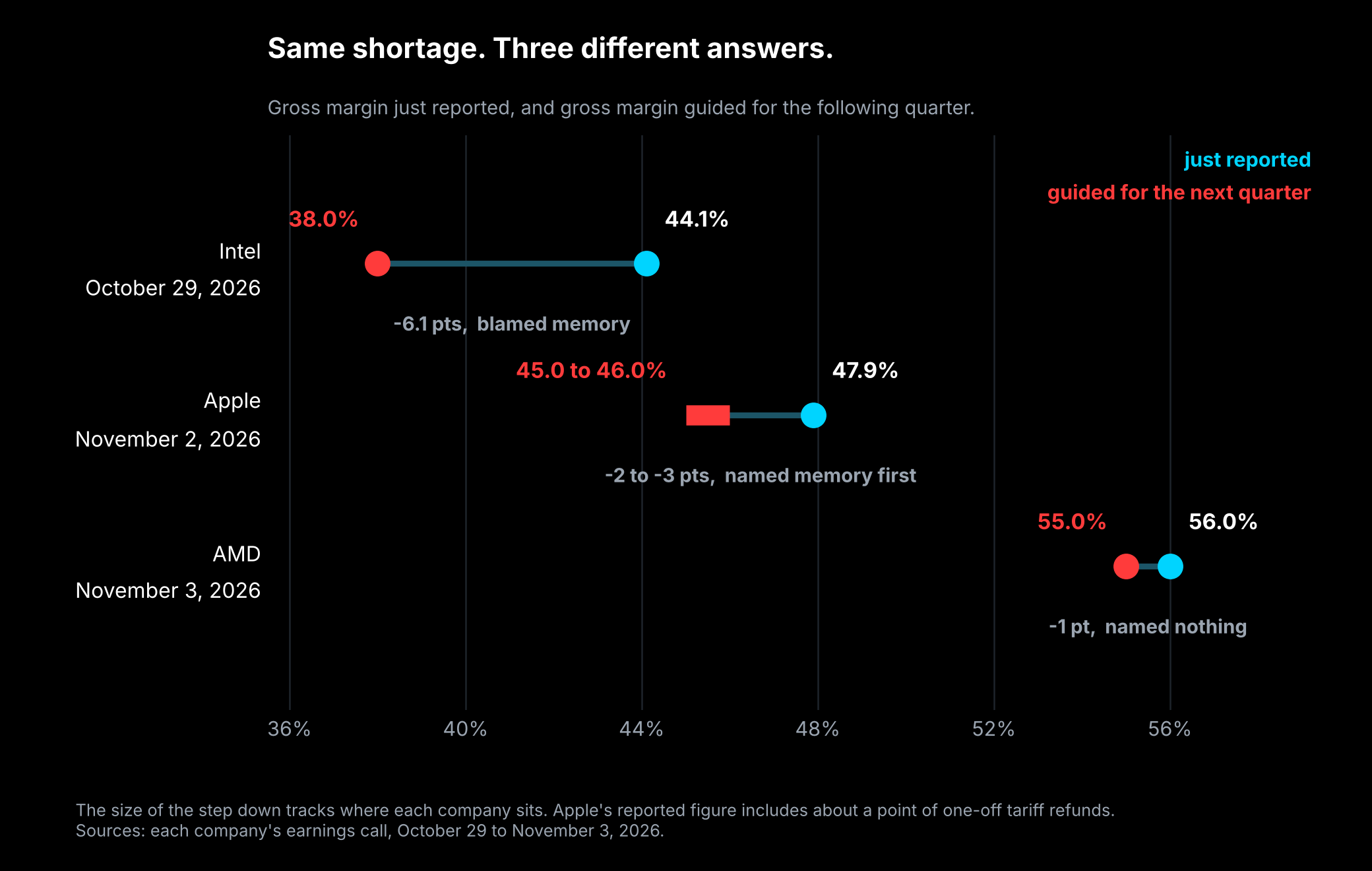
AMD guided gross margin for the current quarter to about 55%, down from the 56% it just reported. A single point.
Now compare how the other two companies handled the same moment.
Intel guided its gross margin from 44.1% down to 38.0% and told investors directly that personal computer demand was collapsing because memory prices had raised the cost of a laptop. Apple guided from 47.9% down to a range of 45 to 46% and, when asked to explain the range, named the cost of memory first.
AMD's finance chief delivered the 55% and moved on. The guide arrives in the prepared remarks between the revenue forecast and the operating expense line, introduced with the words "in addition," and the next sentence is about interest expense. No cause was given.
When an analyst from Bernstein pushed on where margins go in 2027, the answer was about mix, meaning which products happen to make up the sales in a given quarter, and then this: "Right now, I actually do not have that visibility."
That is a notably smaller claim than the one Intel and Apple made three and five days earlier.
What AMD did say about memory, and why it is different
AMD did talk about memory. Repeatedly. Just not about its own costs.
The chief executive told investors that personal computer sales to end users slowed late in the quarter as higher memory and component costs "weighed on demand." The finance chief explained the Client decline the same way, as higher memory cost weighing on PC unit demand.
Read those carefully, because they are a different claim from the one the other two companies made.
Intel and Apple said memory raised what it costs us to build our product. That is a cost statement, and it lands in gross margin.
AMD said memory raised what a finished computer costs a customer, and the customer bought fewer. That is a demand statement, and it lands in revenue.
Same shortage, two entirely different places to look for the damage.
And on its own costs, AMD described a third response that neither of the others mentioned. Asked about memory pricing, the chief executive said component costs are seeing inflationary pressure and that the company is "working with our customers to ensure that those costs are shared as we go forward."
Not absorbed, and not fully passed on. Shared. That is the response available to a company that has long-term supply agreements and a customer base currently desperate for its products.
The number that matches Intel almost exactly
Three days ago we wrote that if AMD guided its PC business down anywhere near the way Intel had, the two companies would be telling an identical story. That issue said Intel had guided client revenue down more than 20% from the previous quarter, and that AMD's own guide would be the real test.
AMD guided its combined Client and Gaming line down more than 20% from this quarter.
One honest qualification, and it is one that same issue insisted on. That is the combined figure, and gaming is collapsing for reasons that have nothing to do with memory. So the PC-only decline inside that number is almost certainly smaller than twenty percent, and anyone presenting it as a clean match with Intel is overreaching, including us if we did not say this.
What is not ambiguous is the longer view. For 2027, AMD said it is planning for personal computer unit shipments to decline by a double-digit percentage, while expecting to do better than the market.
That is a company telling you it expects the PC market to shrink again next year, which is the same thing Intel said, arrived at independently.
The number almost nobody will mention
One figure in the cash flow statement moved more than anything in the headlines, and it is the kind of thing that only shows up if you open the filing.
Free cash flow is the cash a business actually generates after paying to run itself and after what it spends on buildings and equipment. It is the money genuinely available to pay down debt, return to shareholders or fund something new. It is a harder number to flatter than profit, because cash either arrived or it did not.
AMD's free cash flow this quarter was $554 million, which is 4.1% of revenue. Last quarter it was 13.5%. A year ago it was 16.6%.
Now the part that makes it interesting. This is not a spending story. Capital expenditure actually fell from the previous quarter. What happened instead is that inventory rose by roughly three billion dollars to about $11.5 billion, which management attributed to building stock to meet data center demand.
So the cash went into parts and finished goods sitting in a warehouse, waiting for customers the company says are already lined up. Whether that reads as confidence or as risk depends entirely on whether those customers show up on the schedule AMD expects, and that question will not be settled for several quarters.
It is also the same mechanical story we described in our recent issue on what the large technology companies are borrowing for, arrived at from a different direction. Growth at this speed consumes cash before it produces any.
So why did the stock go up?
Because almost none of the above is what the market was looking at.
Data center revenue beat expectations by roughly three hundred million dollars. The current-quarter guide beat by roughly seven hundred million. And the company told investors it now expects revenue to grow more than 80% in 2027, with server revenue doubling.
Against that, a one point margin guide and a soft PC quarter are a rounding error. The PC business is around 22% of AMD's revenue and shrinking as a share of it every quarter. Three years ago the shape of this company would have made the Client miss the headline. Today it is a footnote, and the market priced it as one.
And there is arithmetic underneath that worth doing slowly, because it explains how a company guides profitability down and gets rewarded for it.
AMD just did $13.377 billion at a 56% gross margin, which is roughly $7.5 billion of gross profit. The guide is about $17 billion at 55%, which is roughly $9.4 billion. The percentage falls by a point and the actual money rises about 25% in a single quarter.
That is the trade a growing company makes on purpose. A thinner slice of a much larger pie is more pie. AMD's finance chief said as much about the data center business: it is slightly dilutive to the company average, "but the gross margin dollars are increasing very significantly."
Margin percentage and margin dollars are different things, and only one of them pays for anything.
The comparison that explains all three weeks
Now put the three companies side by side, because this is the part that makes the last six days make sense.
All three guided gross margin down. Here is what each stock did.
Intel guided down 6.1 points and fell 28.58%. Apple guided down and fell 1.83%. AMD guided down and rose about 7.7%.
Same direction on margin. Three outcomes that have nothing in common.
So the margin guide, which is the thing these three issues have been tracking, turns out to have told you almost nothing about what the stock would do. What separated them was the revenue guide measured against what people already expected.
Apple guided December quarter revenue growth of 7 to 10% when analysts were at 11.4%, so its revenue guide came in under. AMD guided to about $17 billion when analysts were near $16.3 billion, so its revenue guide came in well over, and it added that it now expects 2027 revenue to grow more than 80%, which is more than twice the long-term rate it gave investors a year ago.
This does not mean the shortage was imaginary. It is visibly present in all three sets of guidance. It means the shortage was not the thing being priced. In AMD's case it showed up plainly in the results, in the PC segment, and in the margin guide, and the stock went up anyway because something larger was happening in the same report.
Which is itself the answer to the question in the title. PCs missed because the memory shortage is still doing exactly what it has been doing to every PC maker for three months. AMD beat everything else because the part of AMD that matters now is not in a laptop.
What this does not tell you
It does not tell you AMD escaped the shortage. Its PC business shrank, it guided the combined consumer line down more than twenty percent, and it is planning for the PC market to shrink again in 2027. It is less exposed than Intel, not unaffected.
It does not tell you memory is not hurting AMD's margins. It tells you AMD did not say so. A company declining to attribute a one point step-down is not evidence about the cause, in either direction. Analysts covering the stock were already building higher memory costs into their 2027 margin estimates before this call, and the company neither confirmed nor denied that.
It does not tell you the PC market is recovering. This is the mistake to watch for in tomorrow's coverage. Three independent research firms measured global PC shipments falling more than twenty percent last quarter, and nothing in this report changes that. AMD taking share in a shrinking market is a fact about AMD.
It does not tell you the inventory build is a problem. It might be exactly what a company should do when it has visible demand and constrained supply. It also looks identical, from outside, to a company that has mistimed a ramp. You will not know which for several quarters, and anyone telling you tonight which one it is, is guessing.
And it does not tell you what any of this is worth. A stock rising 8% on guidance tells you the guidance was better than expected. It does not tell you the price was right before, or that it is right now.
What the week genuinely shows is that one input cost is still working through an entire industry and producing a different symptom at every stop. It destroyed demand at Intel. It took a point of margin at Apple after prices went up. And at AMD it quietly took the PC business down four percent in a quarter when everything else went up, and the company talked about it as a problem for its customers rather than a problem for itself.
Three companies. One shortage. Three completely different sentences about it.
That is why we show the workings instead of a single figure. Techdamentals runs four separate valuation methods and displays the full range, because one number tells you where somebody landed and nothing about what it rests on.