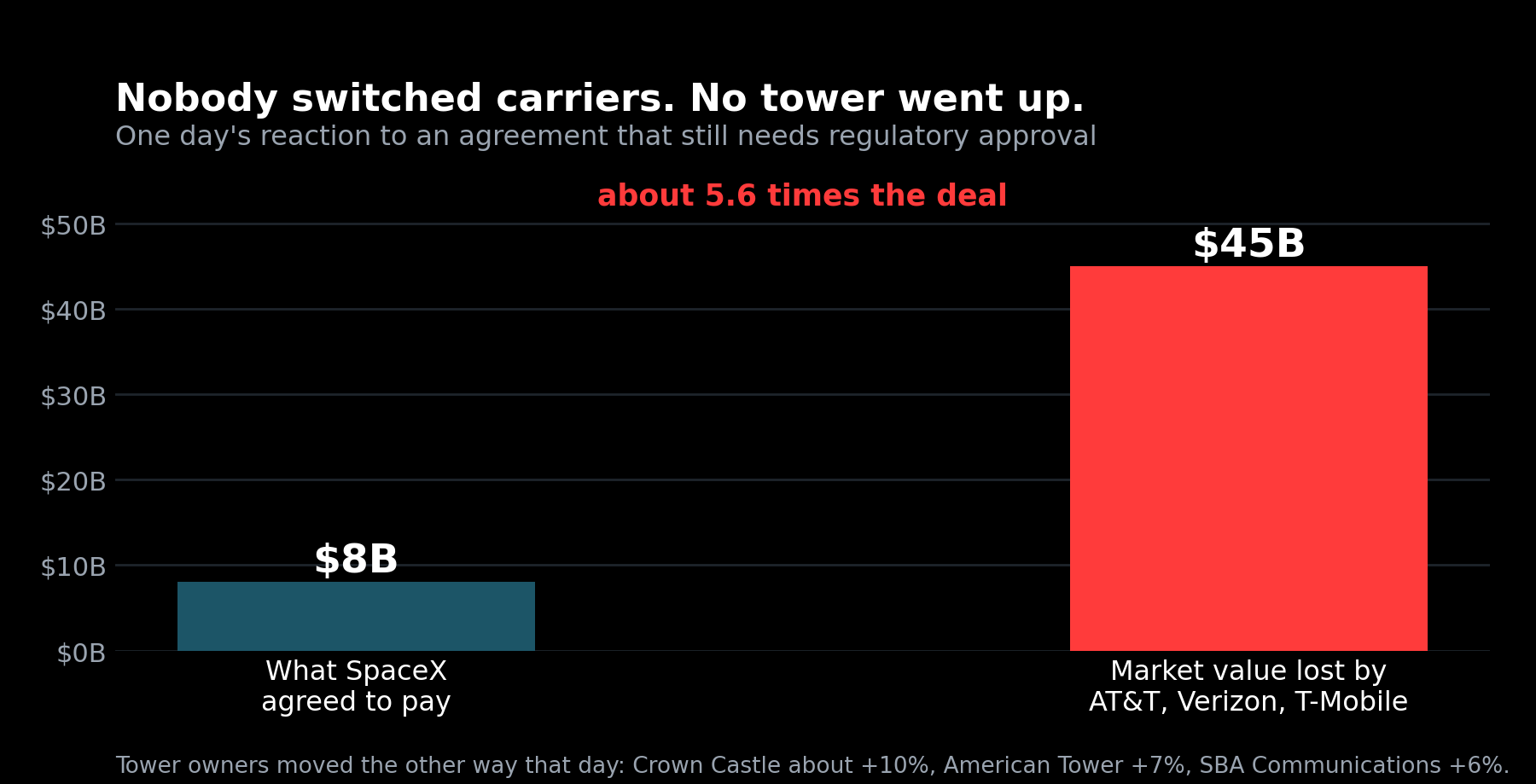
SpaceX agreed to pay about $8 billion for a slice of radio airwaves.
By the end of Friday, AT&T, Verizon and T-Mobile had lost somewhere around $45 billion in combined market value.
Nobody changed phone carriers. No tower went up. No new service launched. One company agreed to purchase something, and four times that amount evaporated from three other companies.
Worth understanding why, because it is one of the clearest examples of what a stock price actually is.
First, what spectrum is
This is the part most coverage skips.
Radio spectrum is airwaves. Specific frequencies that signals travel on. There is a fixed amount of it, it cannot be manufactured, and in the US the federal government licenses the exclusive right to transmit on a given frequency in a given place.
That license is the asset. When a phone company says it has spectrum, it means it holds government permission to use particular frequencies, and nobody else may use them there.
Frequencies are not interchangeable, which is the part that matters here.
Low frequencies travel far and pass through things. Walls, buildings, trees, hills. The signal goes a long way from each tower and still reaches you in a basement. The tradeoff is that it carries less data.
High frequencies carry much more data and travel badly. Great in a stadium, useless through a brick wall.
So a real phone network needs both. High-band for capacity where people crowd together, low-band for coverage everywhere else, especially indoors.
What SpaceX agreed to acquire
Fourteen megahertz of paired low-band spectrum in the 800 MHz range, covering the whole country, from an investment firm called Grain Management. Announced Thursday, pending approval from the Federal Communications Commission.
The 800 MHz band has a useful property: most phones already in people's pockets support it. There is no new handset required.
SpaceX already runs satellites that connect directly to ordinary phones. The weakness of that service has always been the same one every satellite service has. A signal from orbit struggles to reach you indoors.
Low-band airwaves are the standard fix for exactly that problem. So the market read this as SpaceX acquiring the missing piece.
The part that stings
Here is the detail almost nobody put in the story.
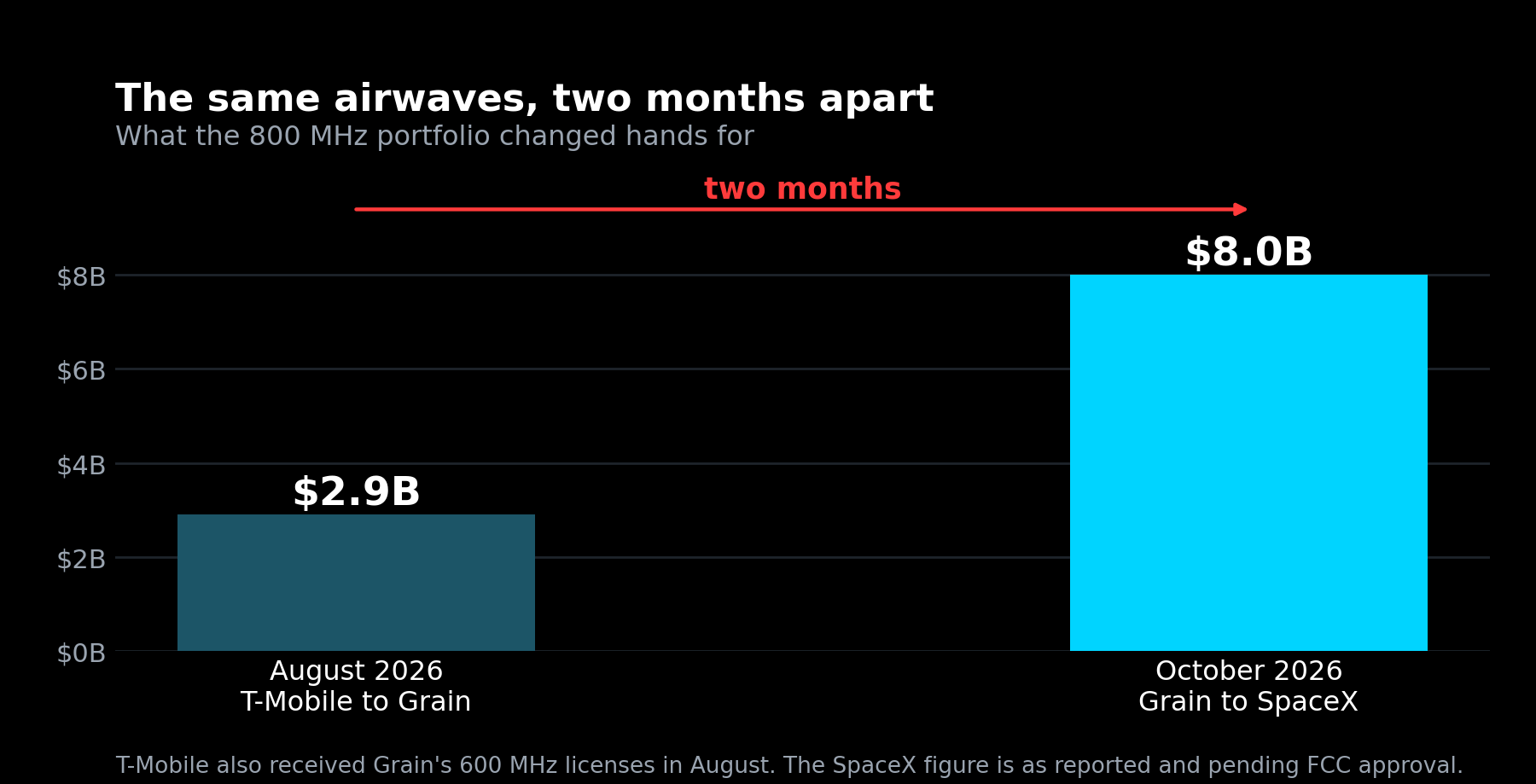
Grain Management did not have this spectrum for long. It received the portfolio from T-Mobile, in a transaction the FCC approved on July 1 and that completed around the middle of August. T-Mobile received $2.9 billion in cash plus Grain's 600 MHz licenses, which it planned to deploy across its own network.
Two months later, the same portfolio is changing hands for roughly $8 billion.
And on Friday, T-Mobile fell further than either of its two rivals.
That is not a comment on anyone's judgment. T-Mobile made a reasonable trade for spectrum it could use immediately, and nobody knew who the eventual holder would be. But it is a useful reminder of how fast an asset can reprice when a new kind of competitor appears, and of how differently two parties can value the identical thing.
Why the rivals fell and the tower companies rose
The three carriers dropped in a range of roughly 7 to 12% across the day.
Meanwhile Crown Castle rose about 10%, American Tower about 7%, SBA Communications about 6%.
Those two reactions are the same reaction.
Tower companies own the physical structures that carry antennas and rent space on them. If SpaceX ever wants reliable coverage inside buildings in dense cities, satellites alone will not do it. It needs equipment on the ground, which means towers, which means somebody renting space.
So the market priced one story across both groups. More competition for the carriers, more customers for the landlords.
Notice that neither of those things has happened.
So why did $8 billion erase $45 billion?
Because a share price is not a measure of what a company earned. It is a claim on what it will earn, and that claim gets repriced the moment the expectation changes.
Think about what a phone company is. It has enormous fixed costs, towers and spectrum and equipment, and it recovers them from a customer base that mostly does not switch. That combination is why the business has been stable for so long. Three large players, high barriers, predictable bills.
A credible new entrant threatens the predictable part, and the predictable part is what the valuation rested on.
It does not require SpaceX to win. It requires investors to believe the next decade is less certain than the last one. Prices come down a little, switching happens a little more, and spectrum at the auction scheduled for next April costs more because there is one more serious bidder in the room.
None of that shows up in a quarterly report for years. All of it shows up in the price today.
That is the mechanism, and it is the same one we went through with the Intel issue: Intel's shares rose the day it announced it had handed over a tenth of the company below market price, because the market was pricing what the deal meant rather than what it cost. Expectations move first. The business follows later, or doesn't.
What this doesn't tell you
The case against the market's reaction is strong and deserves saying plainly.
Spectrum is not a network. Analysts at Bernstein put the cost of building a competitive nationwide one at somewhere between $50 billion and $130 billion, and described this purchase as an option rather than a commitment. Another firm put the figure above $80 billion. Agreeing to pay $8 billion for airwaves is a long way from any of that.
There is also a technical problem. According to New Street Research, the 800 MHz band is not compatible with the direct-to-phone satellites SpaceX currently has in orbit, which are built around a different frequency. The capability being priced today does not exist yet in the hardware flying overhead.
And one analyst made the point that matters most: do not confuse acquiring spectrum with having a competitive mobile network. The three carriers hold far more spectrum than this, along with decades of ground infrastructure.
Against all of that sits one uncomfortable fact for the incumbents. A new entrant does not have to take many customers to damage the economics of a business built on everybody staying put.
Which is the honest summary. The market did not decide SpaceX will win. It decided the next ten years are less predictable than they looked on Wednesday, and it took $45 billion off the price of that uncertainty in a single day.
The habit worth keeping is the one underneath. A price moves on expectations, and expectations are not results. Techdamentals shows every input behind a fair value so you can see which assumptions a number is resting on, because when the price moves this fast, it is the assumptions that changed and not the business.