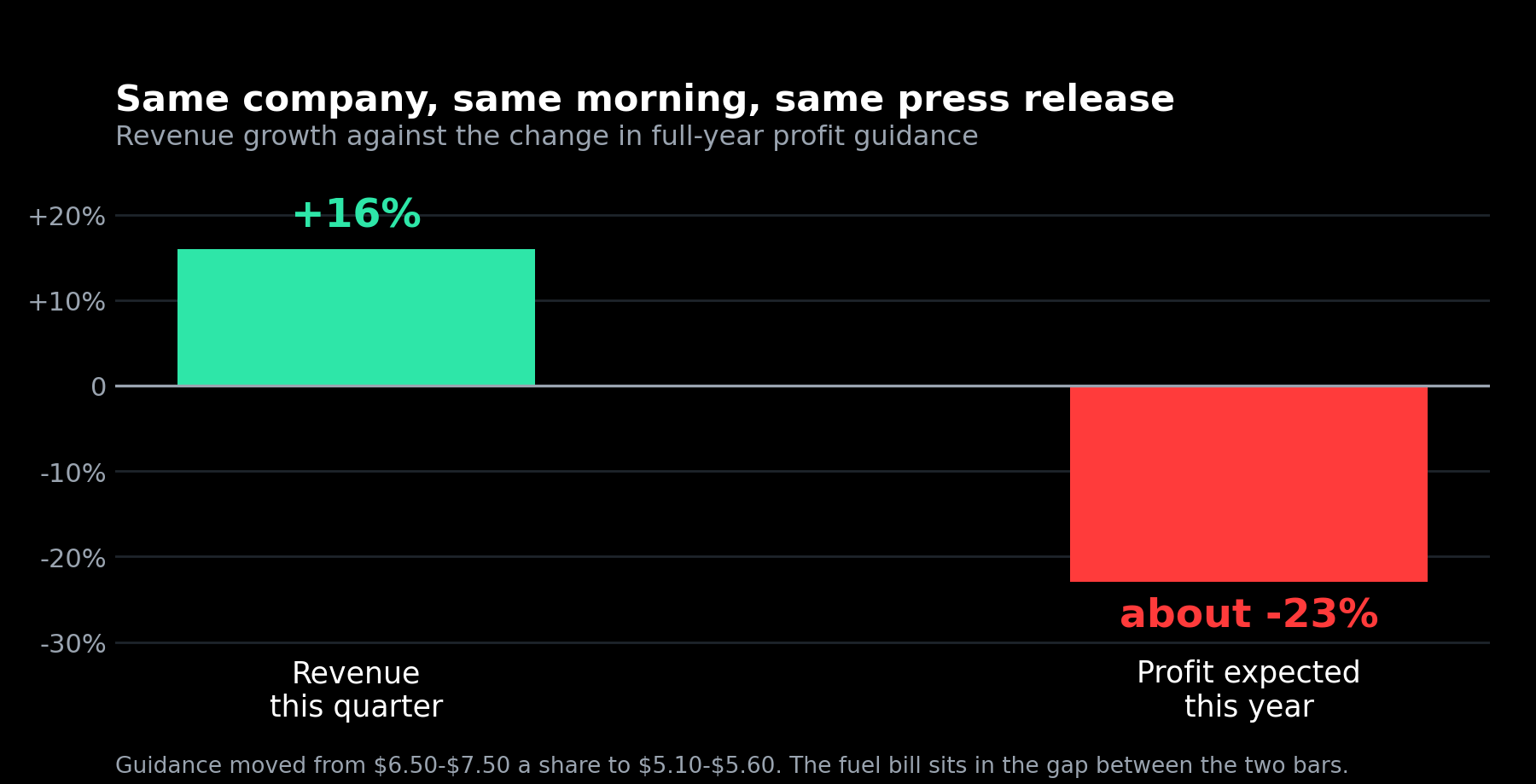
Delta reported this morning. Revenue rose 16% to $17.59 billion. Premium cabins were up 18%. Every region improved. The December quarter is already almost 60% booked and expected up around 20%.
In the same release, Delta cut what it expects to earn this year from a range of $6.50 to $7.50 a share down to $5.10 to $5.60.
More customers, more revenue, roughly a quarter less profit. The thing that did it is the subject of the issue we published on Tuesday.
The number
Delta expects to absorb about $6 billion in additional fuel costs this year.
Its fuel bill for the quarter alone was 62% higher than a year ago.
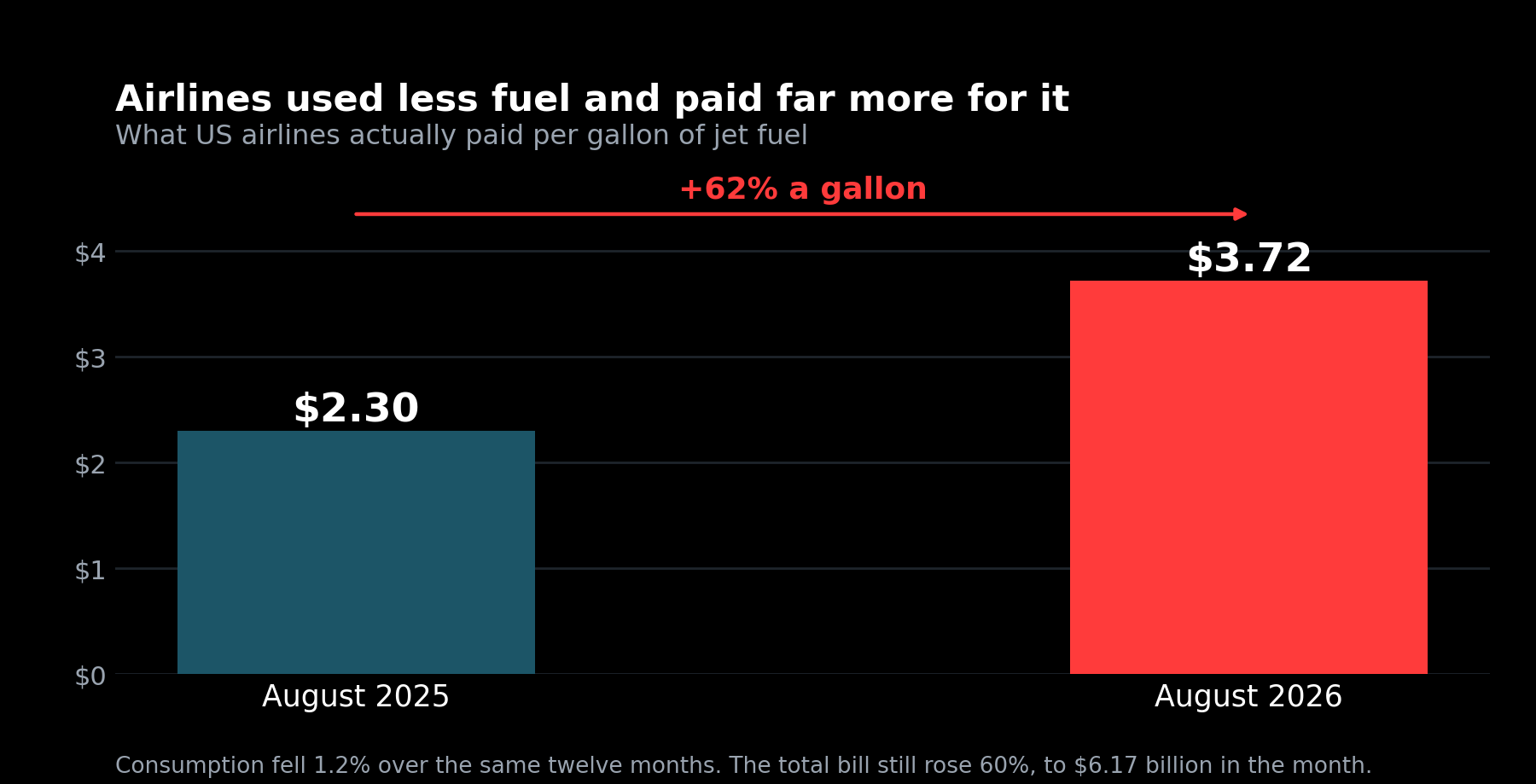
That is not a Delta problem. The Bureau of Transportation Statistics tracks what every US airline actually pays, and in August 2026 the industry paid $3.72 a gallon, against $2.30 a year earlier. That is $1.43 more per gallon, a 62% jump.
Here is the part that should stop you. Over the same twelve months, US airlines burned slightly less fuel, down 1.2%. They used less and paid 60% more.
If that pattern sounds familiar, it is the same one from the diesel issue: America produced more diesel than it had since 2019 and the price still hit a record. Volume was never the problem.
Why this is a refining story
Delta's own finance chief said the quiet part out loud. He explained the forecast cut by pointing at two things: crude oil, and crack spreads.
Worth being clear on what a crack spread is, because it is the whole argument. Crude oil is the raw material. Jet fuel is one of the things a refinery makes out of it, along with diesel and heating oil. The crack spread is the gap between what the crude costs and what the finished fuel fetches, which tells you how much of the price is the oil and how much is the refining.
When a CFO says crude and crack spreads are both up, he is saying the oil got more expensive and the step that turns oil into jet fuel got more expensive on top of it.
And jet fuel is not a separate product from the one we wrote about on Tuesday. Jet fuel and diesel come out of the same cut of the barrel, the middle, which refiners call distillate. Three of the world's refining regions stopped supplying that cut inside seven months. Russia banned diesel exports in July after eighteen months of drone strikes on its refineries. The Strait of Hormuz closed in March. China suspended fuel exports twice.
Everything downstream of those events is competing for the same shrinking pool. Trucks. Trains. Ships. And planes.
Who sets the price of oil, and who collects the difference
Two questions worth answering, because the whole thing rests on them.
Nobody sets the price of crude. It is discovered on futures exchanges, where contracts to deliver oil later are traded continuously. Two of them matter. Brent, a North Sea crude traded on an exchange in London, and West Texas Intermediate, an American crude delivered at a storage hub in Cushing, Oklahoma, traded in New York.
When a news story says oil is at $91, it means the nearest of those contracts.
Here is the detail that surprises people. Brent is the reference used to price something like 60 to 70% of the crude traded worldwide, and the Brent fields themselves produce under 1% of the world's oil. A small patch of the North Sea sets the yardstick for most of the planet.
Most of those contracts never move a barrel. Traders close their positions before the delivery date arrives, so the price is largely settled by people who will never see oil. Real cargoes are then priced off that benchmark, plus or minus an adjustment for quality and for how far the oil has to travel.
OPEC and its partners, which together account for roughly half of world production counting Russia, influence the price by changing how much they pump. They do not announce a price. They change the supply and let the exchange do the rest.
So where does the crack spread go? To the refinery, first. But it is a gross margin, not profit. The plant has to pay for the energy to run itself, which is expensive in exactly the moments fuel is expensive, plus labor, maintenance and environmental compliance. What survives all that becomes operating profit, and then splits the usual ways: taxes, debt payments, keeping the plant running, and whatever is left for shareholders.
The refiner is also not the only one taking a slice of what you pay. A gallon of diesel at the pump divides four ways: the crude oil, the refining, the cost of moving and retailing it, and taxes. Across the past two decades crude has been about half of that pump price, with the federal diesel tax running about 24 cents a gallon on top and state taxes stacked on that.
Which brings it back to this year. When the crack spread widens, the refining slice of your pump price grows and the crude slice shrinks. That is not a theory about 2026, it is a description of it: crude fell roughly 16% from its September high while diesel set a record. The oil got less expensive and the fuel got more expensive, because the money moved from one part of the chain to another.
The airline that owns a refinery
This is the detail that tells you how big the squeeze actually is.
In 2012 Delta did something no other major US airline has done. It purchased an oil refinery, the Trainer plant outside Philadelphia, through a subsidiary called Monroe Energy. The commitment was roughly $150 million.
The logic was simple. If the cost that hurts you most is refining, own a refinery. Then when refining margins blow out, you are on both sides of the trade. You pay more for fuel and you earn more making it.
For most of fourteen years it was a marginal business with a modest return. Plenty of people called it a mistake.
This is the year it stopped being marginal. The plant runs about 185,000 barrels a day, produces roughly 52,000 barrels of jet fuel, and offsets somewhere between 40 and 50% of Delta's domestic fuel costs.
Now hold those two facts next to each other.
Delta is the one airline with a refinery, covering up to half its domestic fuel, in the year that bet finally paid. And it still absorbed $6 billion in extra fuel costs and cut its profit forecast by about a quarter.
That is the measure of this shortage. The best-protected airline in the country took a hit that size with the protection working.
So why did revenue rise and profit fall?
Because they answer two different questions.
Revenue is what customers paid Delta. That went up 16%, because people kept flying and kept purchasing the expensive seats. Demand is fine. Nothing in this report says otherwise.
Profit is what is left after the costs. And one cost, fuel, rose 62% in a single year on a bill measured in billions.
An airline cannot avoid it. It cannot fly fewer miles without losing the revenue. It cannot switch to a different fuel, because planes run on jet fuel and nothing else. It can raise fares, but not instantly and not without losing passengers, and fares did not rise 62%.
So the gap between a 16% revenue increase and a 23% profit cut is the fuel bill, sitting in between, absorbing the difference.
One more piece. The crack spread is set in a global market by refining capacity nobody can add quickly, since the newest US refinery with meaningful processing opened in 1977. That means an airline's profit this year depended on something happening in refineries thousands of miles away, which no amount of good management changes.
What this doesn't tell you
One quarter and one company. United and American moved far less on the day, and the airlines differ enormously in how they handle fuel. Reading Delta's number as the whole industry's number would be wrong.
The refinery cuts both ways too. It offsets fuel costs when refining margins are wide, and it is an ordinary, thin-margin business when they are not. Fourteen marginal years is part of that story and should not be left out because this year looks different.
Conditions this good for refining tend not to hold. Whenever the shortage eases, the comparisons get ugly for anything that earned from it, Delta's plant included. None of this is a forecast, it is a description of why one year looks the way it does.
And demand can change faster than fuel costs. A report showing strong bookings describes the past and the next few weeks, not next year.
The habit underneath it is the one we keep returning to. A headline number is an answer to one specific question, and the useful work is knowing which question. Revenue answers what customers paid. Profit answers what was left. Techdamentals shows every input behind a fair value for the same reason: the total hides which part moved.