The average 30-year mortgage rate was 7.28% last Wednesday, according to Freddie Mac's weekly survey. A year ago it was 6.34%.
On a $400,000 loan that is $2,737 a month instead of $2,486. Same house, same loan, $251 more every month. Over the full thirty years it works out to about $90,000 more.
And the most common piece of advice about this is wrong.
The thing almost everyone believes
Ask around and you will hear some version of it: the Fed sets interest rates, so when the Fed cuts, mortgages get less expensive. Wait for the cut, then refinance.
The Federal Reserve does not set mortgage rates. It sets one rate, called the federal funds rate, which is what banks charge each other to lend money overnight. That rate is currently 3.75% to 4.00%, after the Fed raised it at its September meeting.
Overnight. As in, borrowed tonight and repaid tomorrow.
Your mortgage lasts thirty years. Those are not the same product and they are not priced by the same people.
The overnight rate does drive things that reprice quickly: credit cards, home equity lines, car loans, savings account yields. If you carry a credit card balance, the Fed matters to you directly. A thirty-year fixed mortgage is a different animal.
What actually sets your mortgage rate
Two things added together.
First, the 10-year Treasury yield. A Treasury is a loan to the US government. The 10-year is the ten-year version, and its yield is what investors demand to hold it. Today that yield touched 5.35%, the highest since 2002, before settling near 5.29%.
Why ten years and not thirty? Because almost nobody keeps a thirty-year mortgage for thirty years. People move, or they refinance. The Federal Reserve Bank of Atlanta puts the average life of a mortgage at roughly seven to ten years, so the ten-year Treasury is the closest comparison an investor has.
That matters because of who actually owns your loan. Your lender does not usually keep it. It gets bundled with thousands of others and the bundle is purchased by investors, who are choosing between that bundle and a Treasury. The Treasury yield is the floor they will not go below.
Second, the spread. That is the gap between the Treasury yield and what you are charged, and right now it is about two percentage points.
The spread has two parts and both of them are somebody getting paid.
The lender's part covers originating the loan, servicing it, and their margin. Fannie Mae's research puts that at about half a percentage point in the decade before the 2008 crisis, and roughly double that afterward.
The investor's part is compensation for two risks. One is that you stop paying. The other is subtler and larger: that you refinance. If an investor holds your 7% loan and rates drop, you refinance and they get their money back early, right when there is nothing good to put it into. So when rates are high, investors expect that to happen and charge extra for the privilege. Fannie Mae's figures put the investor's part at about 1.2 percentage points before the crisis, 0.7 in the 2010s, and 1.4 in recent years.
Add the two pieces together and the historical range runs from roughly 1.7 points in the pre-crisis era to roughly 2.4 recently.
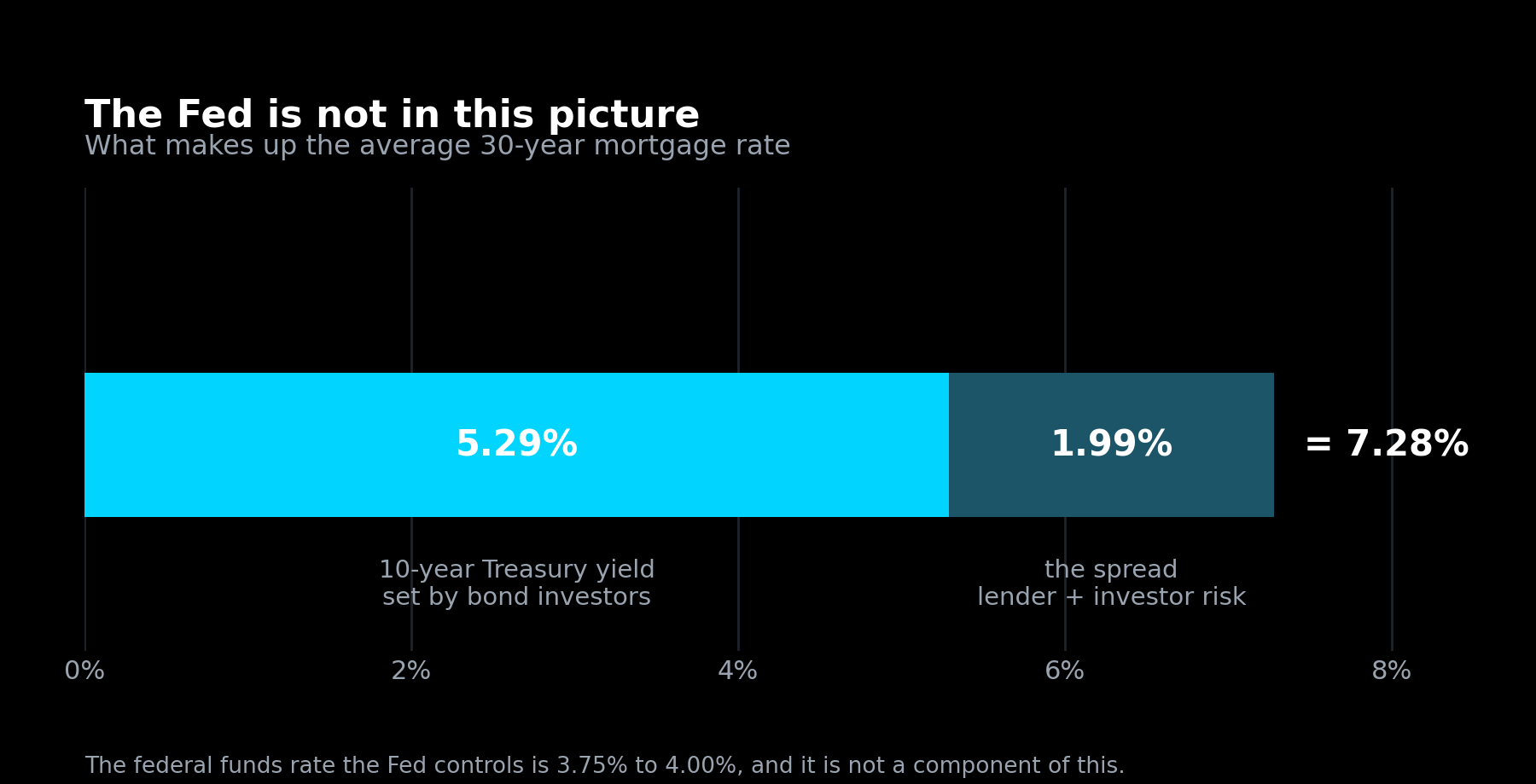
So your mortgage rate is a Treasury yield you do not control plus a spread you do not control. The Fed is not in that sentence.
The proof, and it is not theoretical
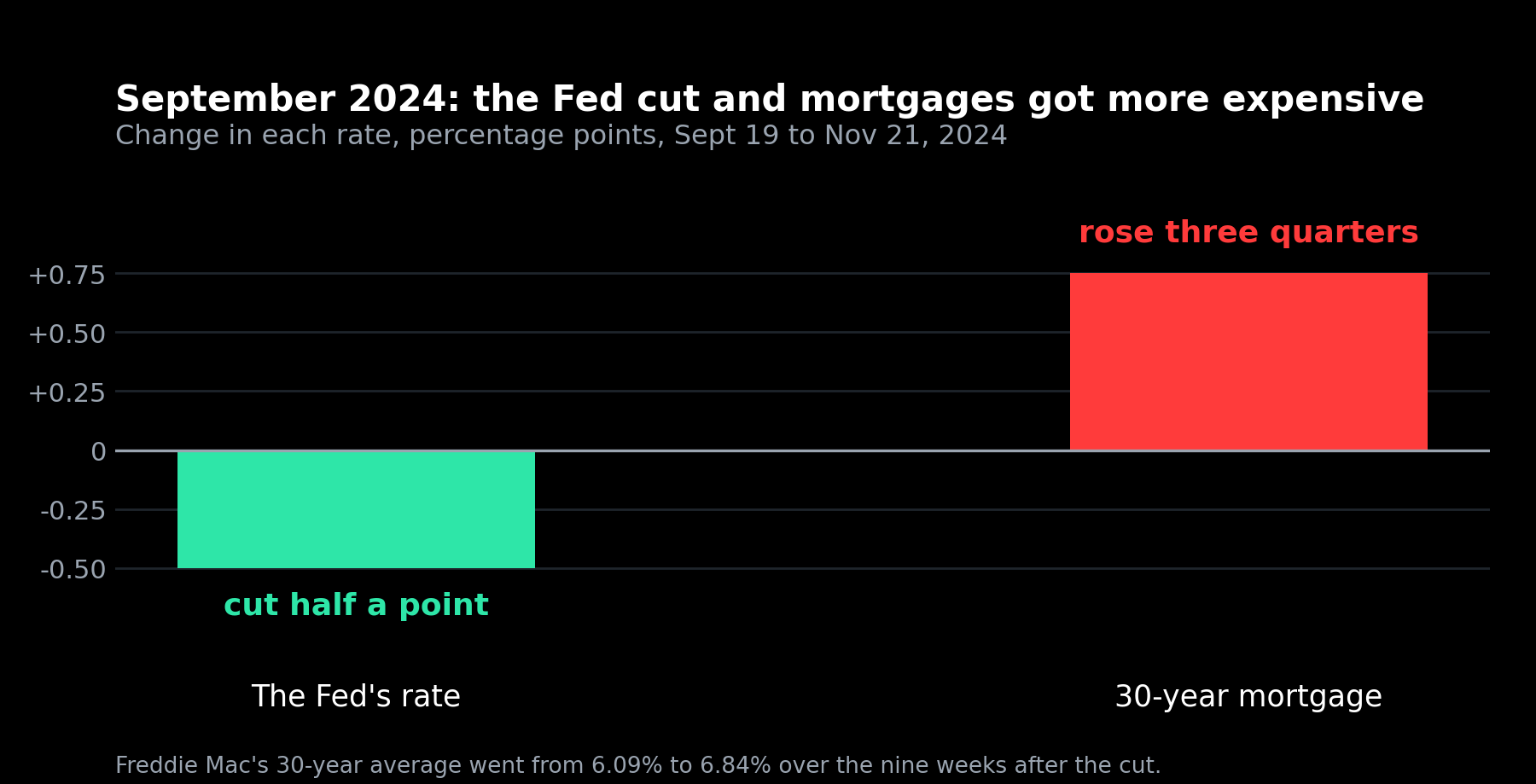
In September 2024 the Fed cut by half a percentage point, which was a large move.
Mortgage rates went up.
Freddie Mac's average was 6.09% on September 19, 2024, just after the cut. By November 21 it was 6.84%. The Fed had made borrowing overnight less expensive, and a thirty-year mortgage got three quarters of a point more expensive in nine weeks.
It was not noise either. Between September 2024 and January 2025 the Fed's rate fell about 0.8 of a percentage point while the 10-year Treasury yield rose about 0.9. They moved in opposite directions, by similar amounts, at the same time.
It happened again the following year. The Fed cut a quarter point in September 2025, and Freddie Mac's average went from 6.26% on September 18 to 6.34% on October 2, then eased.
Twice in two years, the thing everyone was waiting for arrived and the number they cared about went the wrong way.
Then why do they usually move together?
This is the fair objection, and it has a real answer.
Most of the time mortgage rates and the Fed's rate do drift in the same direction, which is why the belief survives. But that is not because one causes the other. It is because both are responding to the same thing.
Inflation runs hot, so the Fed raises its rate. Inflation runs hot, so bond investors demand more to lend for ten years. Two different groups reacting to the same news, usually at the same time.
They are cousins, not parent and child. And cousins can disagree, which is exactly what happened in 2024 and what is happening now. The Fed's own minutes released today show a committee split between officials who want one or two more increases and officials who want to stop and wait. Meanwhile the bond market has pushed the 30-year Treasury to 5.724%, a 24-year high, without waiting for anyone to decide anything.
So why is a mortgage 7.28% when the Fed's rate is 4%?
Because they are two different prices for two different things, set by two different groups.
The 4% is what banks charge each other to borrow overnight, and the Fed decides it.
The 7.28% is the ten-year Treasury yield, which is around 5.3% and set by investors worldwide, plus about two percentage points of spread that pays your lender for making the loan and pays investors for the risk that you will refinance out of it.
The gap between those two numbers is not a mistake or a markup you can argue down. It is the term and the risk, priced by people who have never heard of you.
Which is why the advice to wait for a Fed cut is backwards. What would actually lower your rate is the ten-year Treasury yield falling, or the spread narrowing. The Fed influences both indirectly and controls neither.
What this doesn't tell you
Freddie Mac's 7.28% is a weekly survey published every Thursday, and it is an average. Daily lender quotes have run higher this week, and the number you are personally quoted depends on your credit, your down payment, your location and the lender. Treat any national average as a reference point rather than your rate.
Falling rates are not automatically good news for a house hunter either. Rates usually fall because the economy is weakening, and a lower payment is worth less if you are worried about your job. The two tend to arrive together.
And none of this says where rates go next. The point is narrower: if they do move, the thing to watch is the 10-year Treasury, not the Fed's announcement.
The habit underneath it is one we keep coming back to. A headline number and the number that actually reaches you are rarely the same, and the difference is made of inputs somebody chose. We went through a version of this with the diesel issue, where a crude oil price and a pump price stopped agreeing. Techdamentals shows every input behind a fair value for the same reason: the total tells you less than its parts do.