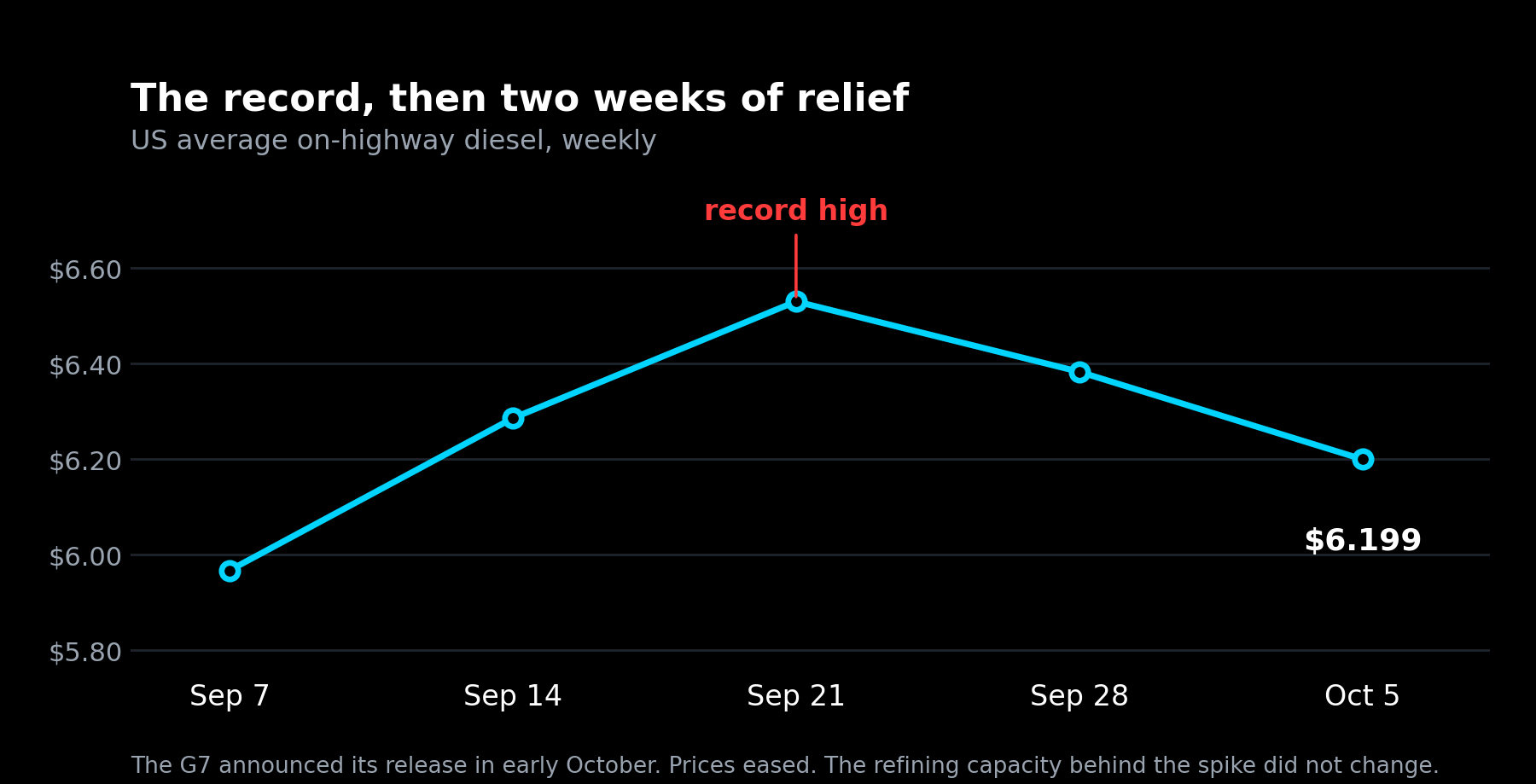
Diesel hit $6.529 a gallon on September 21, the highest on record.
Crude oil peaked about a week earlier and fell roughly 16% from its high.
Those two are supposed to move together. For most of September they moved apart, and today the White House signed an emergency order about it. Here's what's actually going on.
America is making more diesel than it has since 2019
US refineries turned out 5.1 million barrels a day of distillate from January through August, the most since 2019. By September 11 they were running at 97% of capacity.
Record output. Record price.
The explanation: the country isn't running out of diesel. Somebody else is outbidding you for it.
Diesel belongs to a category refiners call distillate, the middle of the barrel, which also covers heating oil and the fuel that moves ships and trains. The US both ships distillate out and brings it in. Subtract the imports from the exports and you get net exports, and since February that figure has run at or above the top of its five year range. More is leaving the country than at almost any point since 2021.
It's leaving because three of the world's refining regions stopped supplying the market, each for its own reason, over the past seven months.
Russia came first and hit hardest. Ukrainian drones have been striking Russian refineries for about eighteen months, and through the first eight months of 2026 one was hit on average every three days. On July 8 Russia banned diesel exports outright, which is a remarkable thing for a country that had been shipping out roughly half of what it made.
The Iran war closed the Strait of Hormuz in early March, choking off Gulf fuel headed for Europe. A ceasefire came on April 8 and traffic never recovered to pre-war levels.
Then China. Beijing ordered its largest refiners to suspend diesel and gasoline exports in March, and last week halted fuel exports again for October.
Put Russia and the Middle East together and the number is stark. Their combined diesel exports fell to 520,000 barrels a day in August, down 75% from August 2025.
Every one of those is lost refining capacity. Not one is lost oil.
US distillate inventories now run about 13% under the five year seasonal average. Worldwide, stocks hit their lowest August level since 1951.
Crude and diesel are not the same thing
This is the distinction the whole story rests on, so it's worth being concrete.
Crude oil is the raw material. It comes out of the ground, and most of what the US uses comes out of American ground, with the rest imported. The biggest outside supplier is not Saudi Arabia, which is the common assumption. It's Canada, at roughly half of US petroleum imports, then Mexico around 11%. Saudi Arabia is about 5%.
A refinery takes that crude and splits it into different fuels. Gasoline goes into passenger cars. Jet fuel goes into planes. Diesel goes into the heavy stuff: long haul trucks, freight trains, cargo ships, tractors, construction equipment, and the backup generators under hospitals and data centers.
That matters, because the people who need diesel cannot switch. A trucking company cannot put gasoline in a semi. A farmer cannot harvest with a jet.
The gap between what the crude costs and the price the finished fuel fetches is called the crack spread. It tells you how much of a fuel's price is the oil and how much is the refining. On August 17 the US Gulf Coast diesel crack passed $100 a barrel for the first time ever, above even 2022.
Here is the cleanest way to see it. Diesel almost always costs more than gasoline, every year since 2005, because stripping the sulfur out of it takes extra processing and the federal tax on it is higher. The normal premium runs somewhere around 20 to 50 cents a gallon.
Yesterday gasoline averaged $4.354 and diesel averaged $6.199. That gap is $1.85, roughly four times the usual.
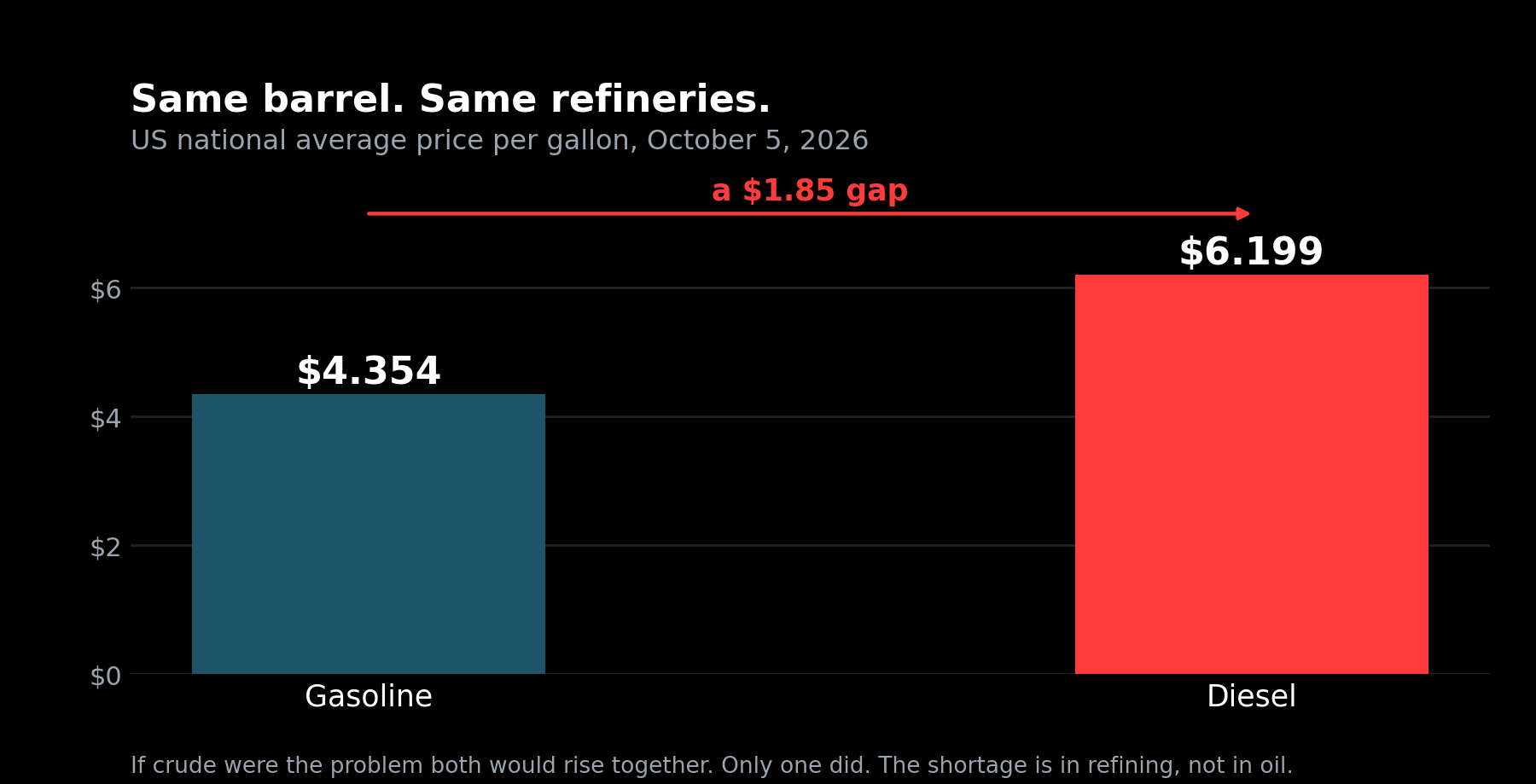
Same crude. Same refineries. One fuel up, the other not. If the shortage were in the oil, both would have risen together, because both come out of the same barrel.
So the squeeze isn't in the oil. It's in the refineries themselves, the plants that turn crude into finished fuel.
Nobody is building another one
There are 130 operable refineries in the United States. The newest one with meaningful downstream processing came online in 1977.
Several shut permanently during the COVID years and nothing replaced them. So when a war and a drone campaign take capacity off the board overseas, there is no slack anywhere to pick it up.
That is why this lands in prices instead of volumes.
Two responses, neither of which adds a refinery
Last week the G7 agreed to release up to 100 million barrels of oil and diesel over four months, with the US contributing 40 million from its strategic reserve. A strategic reserve is a government owned emergency stockpile, fuel already produced and sitting in storage for exactly this kind of moment.
Note that it covers oil and diesel, and that the diesel is scheduled to arrive first, within the opening twenty days.
That detail is the whole thing. Releasing crude into a world short of refining capacity does not help much, because the bottleneck is the step that turns crude into fuel. Releasing finished diesel skips that step entirely. It is fuel that was refined months ago going straight to the people who need it now.
So it is working, for the reason that it bypasses the problem rather than fixes it. Diesel peaked at $6.529 and the most recent weekly reading was $6.199, two weeks later.
There is a second clause in that G7 agreement that says more than the headline does.
Refineries shut down on purpose a few times a year for maintenance. It is routine and planned, like a factory closing for two weeks to service its machines. Normally each country schedules its own whenever it suits them, because if one plant goes quiet for a while, the others cover the gap.
The G7 just agreed to coordinate those calendars so member countries stop going offline at the same time.
Sit with what that admits. You only need to coordinate if there is no spare capacity left anywhere. If the world had enough refining, one plant pausing for maintenance would be a non-event, the way one gas station closing for repairs is a non-event. The G7 is saying in the fine print that it isn't.
Then today. The White House signed an order temporarily allowing dyed diesel on public highways through December 31.
Dyed diesel is the same fuel, marked with red dye so inspectors can tell it apart. The dye signals that the federal highway tax of about 24 cents a gallon was never paid, because that fuel is meant for tractors and construction equipment that stay off public roads. The order waives the rule.
A trucker filling 250 gallons saves around $60 on the federal tax alone, more where states follow. That is real money for a freight company.
It also does not produce one additional gallon of diesel. It changes who pays a tax. And analysts have flagged the obvious risk, which is that highway demand now competes for the dyed supply farmers are drawing down during harvest.
Here is why all of this reaches you even if you have never put diesel in a vehicle.
Almost everything on a store shelf got there on a truck. The food in your grocery aisle, the package on your doorstep, the lumber at the hardware store. Trucking companies pay for the diesel that moves it, and when diesel costs more, hauling costs more. That extra cost gets added to the price of whatever was in the trailer.
It does not happen overnight. Freight contracts and warehouse inventory take weeks or months to turn over, so the pump price today shows up in store prices later. When it does, it lands in the government's inflation figures as higher goods prices, which is the side of inflation we walked through in the PCE issue.
So why is diesel $6 and gasoline $4?
Short version, in order.
About 20 to 50 cents of the gap is normal and always there. Diesel takes extra processing to strip the sulfur out, and the federal tax on it is higher.
The rest, more than a dollar of it, is new. It comes from refining capacity disappearing overseas. Russia's refineries have been under drone attack for eighteen months and it banned diesel exports in July. The Strait of Hormuz closed in March. China stopped exporting in March and again last week. Three large sources of the world's diesel went off the market inside seven months.
Gasoline did not move the same way because gasoline is not what went missing. The capacity that vanished was supplying diesel to Europe and Asia.
America producing near-record amounts does not rescue you, because US refineries are running at 97% and the output goes to whoever pays most. Your local pump is competing with Rotterdam and Singapore.
And nobody can add capacity quickly, because the newest US refinery with real processing opened in 1977.
So you are paying a world price for a product the world is short of, and the shortage is in refining rather than in oil. Gasoline comes out of the same barrel, but it is not the thing in short supply.
What this doesn't tell you
Prices are falling right now. Two weeks of relief is not a trend, and it also isn't nothing. Both can be true.
Both responses have end dates. The release runs four months. The dyed diesel order expires December 31. Stored fuel is finite by definition, and neither measure builds anything.
Refining margins have been unusually strong this year, so be careful with any single quarter's numbers from companies in that business.
And the shocks could reverse. If Russian refineries come back, or China resumes exporting, the math changes quickly the other way. None of this is a forecast.
The habit underneath it is the usual one. A price is a specific supply meeting a specific demand, and "oil" is not specific enough to explain a diesel pump. Techdamentals breaks a company into every input behind a fair value for the same reason: the aggregate hides the part that is moving.