JPMorgan earned $15.3 billion last quarter, up 6% from a year ago, and it was not enough.
The number analysts wanted was around $5.90 a share. The bank delivered $5.57.
Three hours later Goldman Sachs reported $17.01 a share against an expectation of $13.65, which is not a small difference.
Same quarter. Same interest rates. Same economy. Two of the most similar companies in the country, and the results went opposite directions.
That is worth explaining, because the reason is the same one we went through in yesterday's issue: a large bank is not one business, and a rate move does not do one thing to it.
What the four of them actually reported
All four reported Tuesday morning.
JPMorgan. Profit $15.3 billion, or $5.57 a share, against $5.07 a year earlier. Revenue and profit both came in under what analysts expected.
Goldman Sachs. Profit $5.29 billion, or $17.01 a share, against $12.25 a year earlier. Revenue $18.68 billion against an expected $17.03 billion.
Citigroup. Profit up 40% from a year ago, ahead of expectations.
Wells Fargo. Profit $5.95 billion, or $1.87 a share, ahead of expectations.
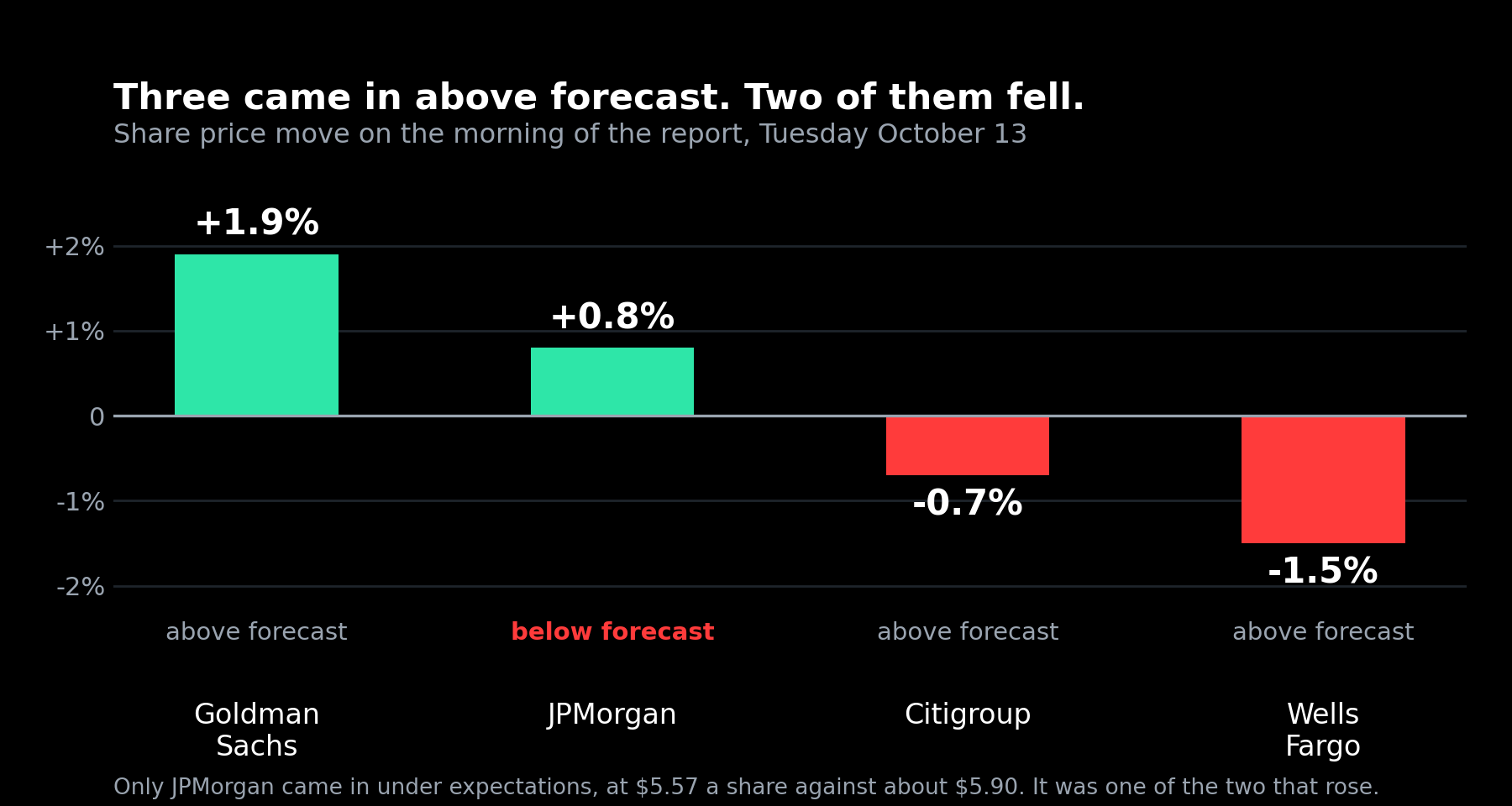
So three of four came in above the forecast and one came in under.
Now the share prices that morning. Goldman up about 1.9%. JPMorgan up about 0.8%. Citigroup down about 0.7%. Wells Fargo down about 1.5%.
Three companies exceeded expectations and two of them fell. That is the thing to explain, and it needs the engine room rather than the headline.
The engine that worked
Start with lending, because it worked almost everywhere and almost nobody wrote about it.
Net interest income is the plain version of what a bank earns from lending: the money it collects from borrowers minus the money it pays depositors.
JPMorgan's came in at about $27.04 billion, up 12.8% from a year ago, with average loans up 10%. Citigroup's was $16.98 billion, up 13.7%, ahead of expectations.
Those are large numbers moving in the right direction, and they are exactly what the textbook promises when rates rise. The lending engine did its job.
One exception, and it matters. Wells Fargo's net interest income came in at $12.52 billion, slightly under what analysts expected, with corporate and investment banking loans down 2% from the prior quarter. Wells is the most lending-heavy of the four. When the engine you depend on most misses by a little, there is less elsewhere to cover it.
Wells exceeded the profit forecast and the stock still fell about 1.5%.
The engine that stalled
Now the other side, and here the pattern across all four is remarkably consistent.
Bond trading was weak everywhere.
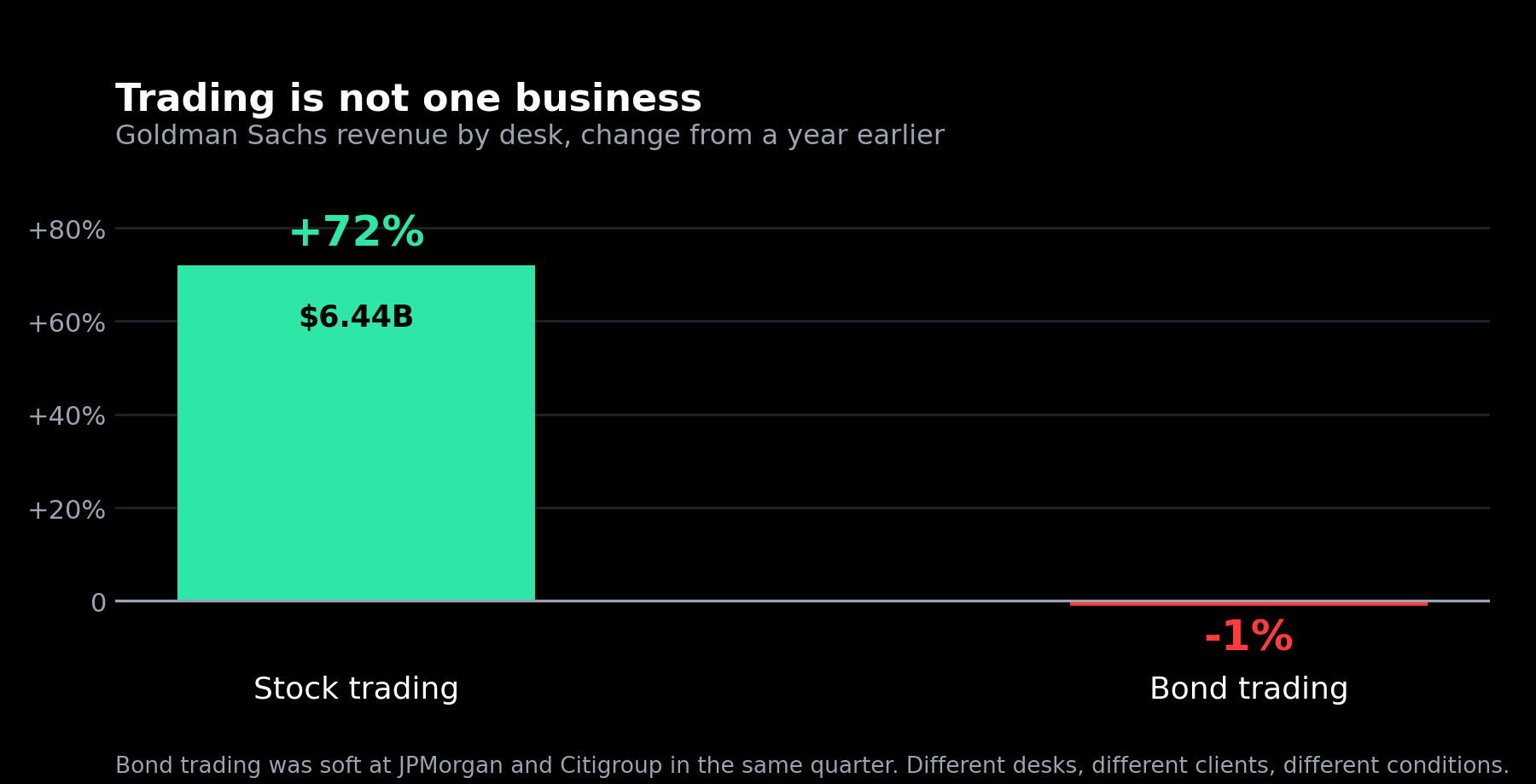
Goldman's fixed income revenue was $3.47 billion, down 1% from a year ago. Citigroup's markets revenue fell 13% from the prior quarter. JPMorgan specifically pointed at weaker fixed income trading as one reason it fell short.
Three different banks, three different management teams, same direction.
Meanwhile stock trading went the other way, and violently. Goldman's equities revenue was $6.44 billion, up 72% from a year ago, driven by lending against client portfolios and by derivatives.
Worth pausing on that, because "trading" gets treated as one activity in most coverage and it is not. Trading bonds and trading stocks are different desks, different clients, different conditions. This quarter one of them had a record and the other one shrank.
Dealmaking is the third piece, and it tells a more careful story. Goldman's investment banking fees were $3.22 billion, up 21% from a year ago, with advisory fees at a record. JPMorgan's were about $3 billion, up 14%.
Both up. But JPMorgan's fees fell 8% from the prior quarter, Citigroup's fell 13% from the prior quarter, and Goldman said its backlog of upcoming deals had shrunk since the second quarter.
Up against last year, down against three months ago. That is the shape of something that was recovering and has started to roll over, which is what the collapse in merger activity we covered yesterday would predict. JPMorgan's framing was that deals are "delayed rather than canceled," which is the optimistic reading of the same fact.
So why did JPMorgan miss and Goldman didn't?
Because of what each one is mostly made of.
Goldman is weighted toward markets and dealmaking. Its global banking and markets division brought in $13.46 billion, up 32%. In a quarter where stock trading had a record and advisory fees hit a high, the business Goldman is built around was the business that worked.
JPMorgan is the broader institution, and its lending side genuinely performed. But it also carries a large investment bank, and that is where it fell short, on softer fixed income trading and on losses in its securities portfolio.
That second item deserves a sentence, because it is the thing we explained yesterday showing up as a real number. Banks park deposits in bonds. Bond prices fall when rates rise. JPMorgan took losses on securities this quarter, and the ten-year Treasury yield is sitting at 5.23%.
So the answer is not that one bank is run better than the other. It is that the same rate environment hit a trading-weighted firm and a lending-weighted firm in different places, and this quarter the trading-weighted firm happened to be standing where the good news landed.
Next quarter that can reverse, and the reason it can reverse is the reason it is worth understanding at all.
The line nobody put in the headline
Here is the number I would read before any of the others.
A provision is money a bank sets aside in advance against loans it expects will go bad. It comes out of this quarter's profit, before anyone has actually missed a payment. It is the bank's own estimate of trouble ahead, in cash, taken now.
Wells Fargo set aside $1.03 billion, against $914 million the previous quarter and $681 million a year ago. Its commercial charge-offs, meaning loans actually written off as uncollectible, rose to 0.22% of average loans even as consumer charge-offs improved to 0.90%.
Citigroup's credit card profit fell 8%, which it attributed partly to higher rewards costs and partly to setting more money aside against card loans.
Goldman's provisions in its banking and markets division rose sharply from a year ago, driven by losses on loans to companies.
None of those are large enough to call a credit problem. The overall charge-off rate at Wells was 0.38%, which is low by any historical standard. But the direction is the same at three institutions, and provisions are forward-looking by design. They are what the bank thinks is coming.
What this doesn't tell you
One quarter, and a quarter is a short window to judge anything.
The comparisons are also messier than they look. JPMorgan's overall provision figure actually fell from last year, but last year included a $2.2 billion item tied to a credit card portfolio transaction, so the headline comparison is distorted in JPMorgan's favor. Goldman's profit was reduced by roughly $450 million in charitable contributions, which flatters next year's comparison and hurts this one. A clean number is rarer than it looks.
The missing data matters too. Morgan Stanley and Bank of America report Wednesday, and Truist and Regions Financial on Friday. Four banks is not a banking system, and the regional banks face a different mix of pressures than the two Wall Street firms do.
And nothing here settles yesterday's question. The group's shares are still well below their August level, three of four exceeded expectations, and the prices barely moved. That is consistent with a market pricing a harder year ahead, and it is also consistent with a market that is simply wrong. One quarter of results cannot distinguish between those two, and anyone telling you otherwise is guessing.
What it does tell you is narrower and more useful. The same rate move produced opposite outcomes at two similar companies in the same week, and business mix explains it. Techdamentals shows every input behind a fair value for that reason: a single headline figure hides which part of a company actually moved.