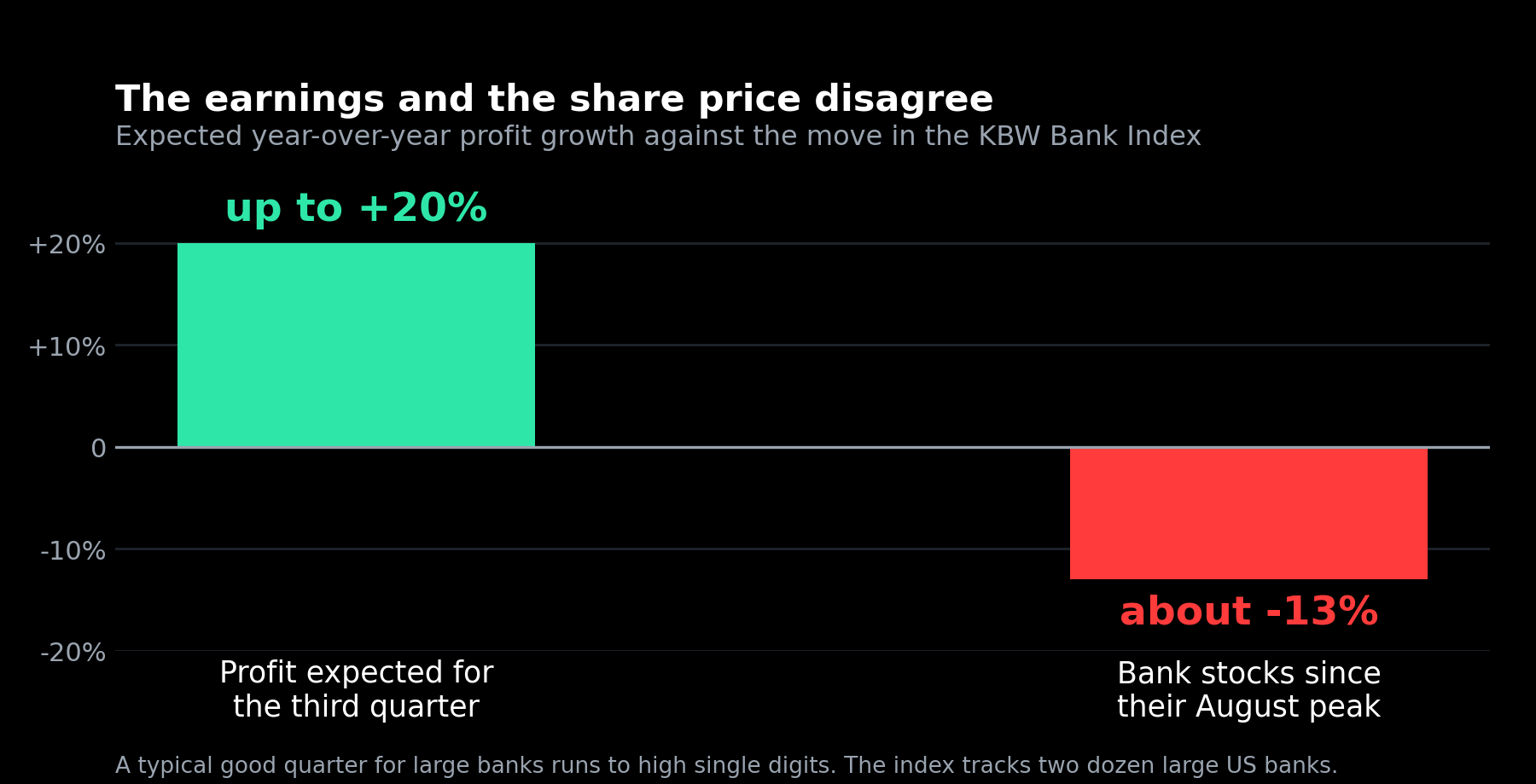
The four largest US banks report tomorrow morning, and they are expected to show profits up as much as 20% from a year ago.
Their stocks have been falling for two months.
The KBW Bank Index, which tracks two dozen large US banks, sits about 13% below the peak it hit in August. Over the past month Bank of America fell around 13%, Goldman Sachs around 12%, Morgan Stanley around 11%. Goldman is more than 20% below its July high.
All of that happened while interest rates were going up, which is supposed to be the good news for a bank.
Something in that chain is wrong, and it is worth finding out which part.
The thing almost everyone believes
Here is the version you hear: banks make money from interest, so when interest rates rise, banks make more money. Rates up, bank profits up, bank stocks up.
That is not a myth. It is genuinely how the biggest piece of a bank works, and it is why the first part of a rate rise is usually good for them.
A bank takes in money from depositors and pays them a little. It lends that money out and charges a lot more. The difference between those two numbers is where most of a traditional bank's profit comes from. In the industry it gets called net interest margin, which just means the gap between what the bank pays for money and what it charges for money.
When rates rise, the rate on loans usually moves up faster than the rate the bank pays on checking and savings accounts. The gap widens. The bank earns more on the same balance sheet.
So the belief is correct about that one business. The problem is that it is only one of three.
What a large bank actually does
A bank the size of JPMorgan or Goldman Sachs is really several companies sharing a lobby.
Lending. Mortgages, car loans, credit cards, business loans. This is the part that benefits from higher rates, as long as the borrowers keep paying and keep borrowing.
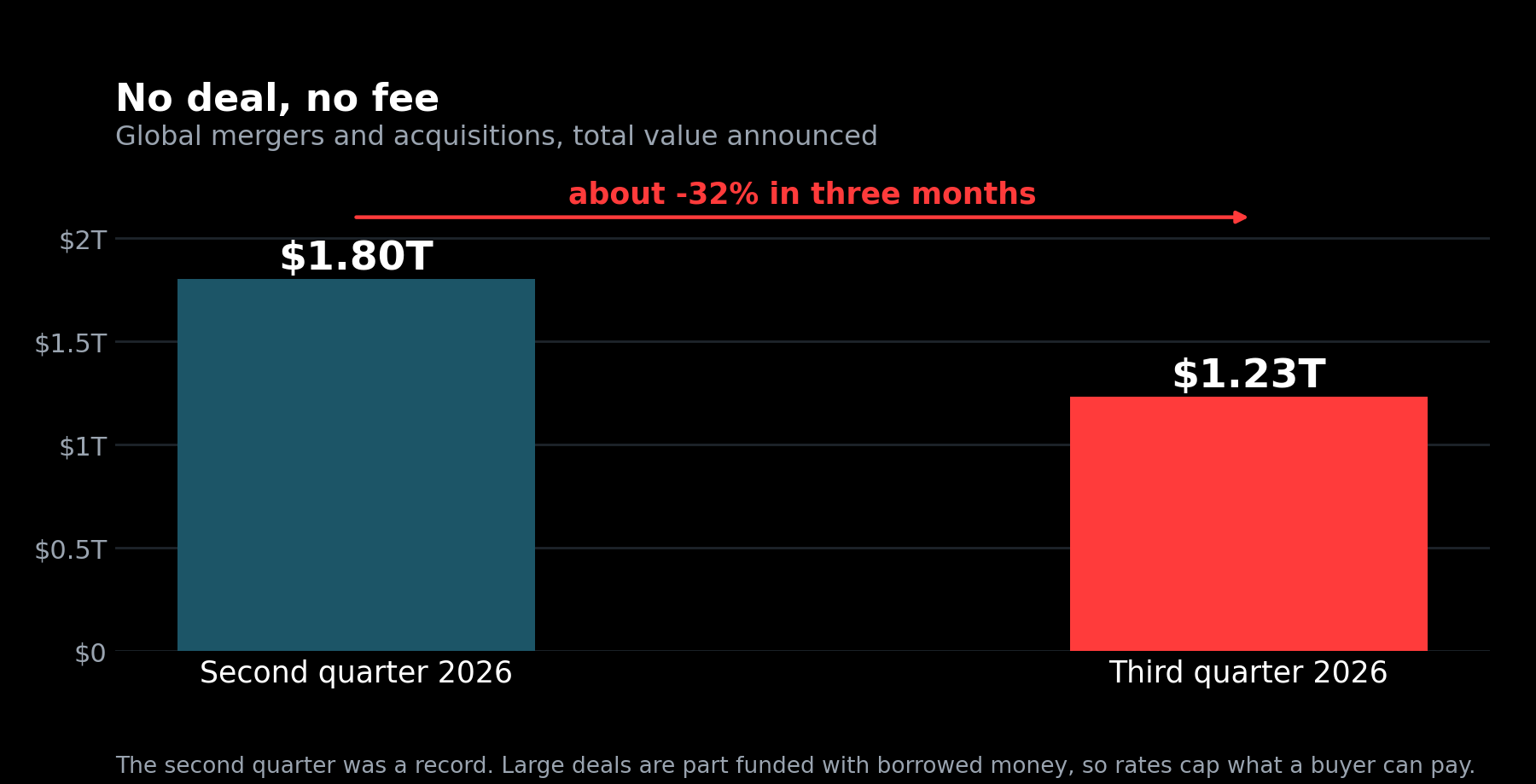
Dealmaking. When one company acquires another, or a company lists its shares publicly for the first time, or borrows a billion dollars by issuing bonds, a bank arranges it and charges a fee. These are called investment banking fees. No deal, no fee.
Trading. Taking positions in stocks, bonds and currencies for clients and for the bank's own account, and earning a cut on the flow.
Rates going up helps the first business. It does the opposite to the second one, and this is the part the simple story leaves out.
What actually happened since August
Three things, all pointing the same direction.
Dealmaking dried up. Global mergers and acquisitions totaled about $1.23 trillion in the third quarter, according to Mergermarket, down from a record $1.8 trillion in the second quarter. That is a drop of roughly 32% in three months.
The reason is mechanical. Most large acquisitions are paid for partly with borrowed money. When borrowing costs jump, the price a buyer can justify paying falls, and deals that penciled out in June stop penciling out in September. Bank of America's chief executive, Brian Moynihan, said he expects his bank's investment banking fees to be down more than 10% from a year ago.
Trading got quieter. Jefferies, which reports earlier than the big banks and is often read as a preview, pointed to a softer quarter in bond trading. Moynihan said his bank's trading revenue should come in roughly flat.
And the bonds banks already own lost value. This one takes a minute, and it is the most important.
Banks do not lend out every dollar they take in. They park a large chunk in Treasury bonds and mortgage bonds, which are safe and pay interest. The catch is that a bond's price falls when interest rates rise. If you own a bond paying 3% and new bonds are paying 5%, nobody wants yours at full price anymore.
The bank does not have to part with it, so the loss is never booked as a loss. It is called an unrealized loss, which means the asset is worth less than the bank paid but the bank is still holding it. The FDIC tracks this across the whole banking system. It peaked above $600 billion, fell for four straight quarters as rates eased, got down to about $306 billion at the end of 2025, and then turned back up to roughly $325 billion in the first quarter of 2026 as long-term rates climbed again.
Long-term rates have climbed a great deal more since then. The ten-year Treasury yield is 5.24% today, which is around the highest it has been in about two decades.
That buried loss matters even though nobody has to realize it, because it limits what the bank can do. Moving that money into something better paying would mean taking the loss for real, so it sits there instead, stuck in old low-yielding bonds.
So why are bank stocks falling when rates are rising?
Because the market is not paying for last quarter. It is paying for the next several.
Tomorrow's numbers describe July through September, and they are expected to be strong. Analysts have JPMorgan earning $5.94 a share against $5.07 a year earlier. Up to 20% profit growth across the largest banks would be a good quarter by any standard, against a more typical high single digits.
But a share price is a claim on future earnings, not a receipt for past ones. And the things that set future earnings all got worse in the last two months.
The Fed raised its benchmark rate on September 16, the first increase since 2023, to a range of 3.75% to 4.00%. The vote was unanimous. In the projections released with that decision, 16 of the 18 officials expected at least one more increase before the end of the year, and four expected two. The next meeting is October 28.
Rates are not drifting up. They are being pushed up on purpose, and the people pushing have said they are not finished.
Keep going up and the helpful part of the story runs out. Depositors stop accepting almost nothing on their savings and start demanding more, which closes the gap the bank was earning. Borrowers stop borrowing, so there are fewer loans to earn it on. Some existing borrowers struggle, which costs the bank money. Deals stay frozen. The bond portfolio sinks further.
There is one more sign worth mentioning, because it is unusual. Insider activity in the US financial sector, meaning the executives and directors of these companies putting their own money into their own company's shares, fell to a 23-year low in the third quarter. That is not a prediction about anything. It is just a group of people who know these businesses better than anyone choosing not to add to their stakes.
Put it together and the answer is this. Bank stocks are falling while rates rise because rising rates are good for banks in the short run and ambiguous in the long run, and the stock is priced on the long run. The market has looked past a strong quarter to a harder year.
How unusual is that? Truist calculated that financial stocks just had their worst month relative to the S&P 500 since 1990. One of their analysts, Brian Foran, said the relative performance "today looks a lot like the Dot Com era." That is a comparison about how far one sector has fallen behind the index, not a forecast.
What this doesn't tell you
The case against all of this is real.
The banks might just be cheap now. A sector that has fallen 13% while its profits grew 20% is, arithmetically, a less expensive claim on the same earnings than it was in August. Whether that is an opportunity or a warning depends entirely on whether the harder year actually arrives, and nobody in this story knows that, including the people who moved the price.
The group also is not one thing. Goldman Sachs earns a much larger share of its money from dealmaking and trading than Wells Fargo does, so a frozen deal market hurts them very differently. Reading a sector average as a statement about any one bank would be a mistake.
A good quarter tomorrow could change the mood quickly. Expectations have come down, which is exactly the setup where a decent report lands well. That cuts both ways, and the reporting dates are close together: JPMorgan, Goldman Sachs, Citigroup and Wells Fargo on Tuesday, Morgan Stanley and Bank of America on Wednesday, with the regional banks later in the week.
And the unrealized loss figure is a system-wide number from the first quarter, not from today. It is almost certainly larger now given where long-term rates have gone, but that is an inference rather than a reported fact, and a bank that simply holds those bonds until they mature never books the loss at all.
The habit underneath this one is the same one that came up in the mortgage issue: the famous number and the number that affects you are often two different numbers, priced by different people, moving on different schedules. Techdamentals shows every input behind a fair value for the same reason, because a single figure never tells you which assumption is doing the work.