Inflation came in hotter than expected this morning. Prices rose 3.7% over the past year, against the 3.6% economists had forecast.
Gold fell.
Not a little. Spot gold dropped more than 1% to about $4,107 an ounce, and silver fell nearly 2%.
If you have ever heard that gold protects you from inflation, and almost everyone has, that should stop you. The thing that gold supposedly protects against got worse, and gold went down.
There is a reason, it is not complicated, and once you have it you will understand something about every investment you own.
First, what gold actually is as an investment
A share of a company earns money. The company earns revenue, pays its costs, and whatever is left belongs to the shareholders. A bond pays interest on a schedule. A savings account pays interest too, usually less.
Gold does none of that. A gold bar sits in a vault and stays a gold bar. It does not pay you anything for holding it, and it never will. The only way it makes you money is if someone later pays more for it than you did.
In the language people use for this, gold has no yield. Yield just means the income something pays you for owning it, expressed as a percentage. A savings account paying $5 a year on $100 has a 5% yield. Gold's yield is zero, permanently, by its nature.
Hold onto that, because everything below comes from it.
The thing almost everyone believes
The belief goes like this. Paper money loses value when prices rise. Gold is real, there is a limited amount of it, and governments cannot print more. So when inflation shows up, people move into gold and the price goes up.
That is not wrong. It is just never explained, so let me actually explain it, because the real mechanism is more interesting than the slogan.
Start with how much gold exists. Every ounce ever pulled out of the ground, across all of human history, comes to roughly 220,000 tonnes. That is a cube about 22 metres on each side. All of it, from every civilisation that ever mined any.
Mining adds about 3,672 tonnes a year, which was a record last year. Against the existing pile, that is roughly 1.7% a year.
So the amount of gold in the world grows slowly, predictably, and nobody can decide to speed it up. Not a government, not a bank, not anyone. Finding and digging gold is physical work, and it goes at the pace physical work goes.
Now compare that to dollars. There is no equivalent limit. A central bank can create more, and over the past century they generally have. The number of dollars in existence has grown far faster than 1.7% a year.
Here is the part that reframes everything. When the number of dollars grows faster than the number of ounces, it takes more dollars to get one ounce. The gold price goes up.
But notice what actually happened there. Gold did not become more valuable. The ounce is the same ounce. What changed is the thing we are measuring it with. We quote gold in dollars, so when a dollar shrinks, the number next to the gold gets bigger.
That is the whole mechanism, and it is why the hedge is real. Gold does not fight inflation. It just sits there being the same quantity of metal while the measuring stick shortens around it.
And that explains the timescale too. The supply of money grows over years and decades, not over mornings.
Which brings us to the problem. People hear "gold is an inflation hedge" and assume it means gold rises on the day a bad inflation number comes out. It does not mean that, and today is a clean demonstration of why.
What actually happened this morning
Three things, and they happened in order within about ten minutes.
One: the inflation number landed hot. Headline inflation came in at 3.7% instead of the expected 3.6%. The underlying measure that strips out food and fuel, which is the one the Federal Reserve pays most attention to, came in at 2.6% instead of 2.5%.
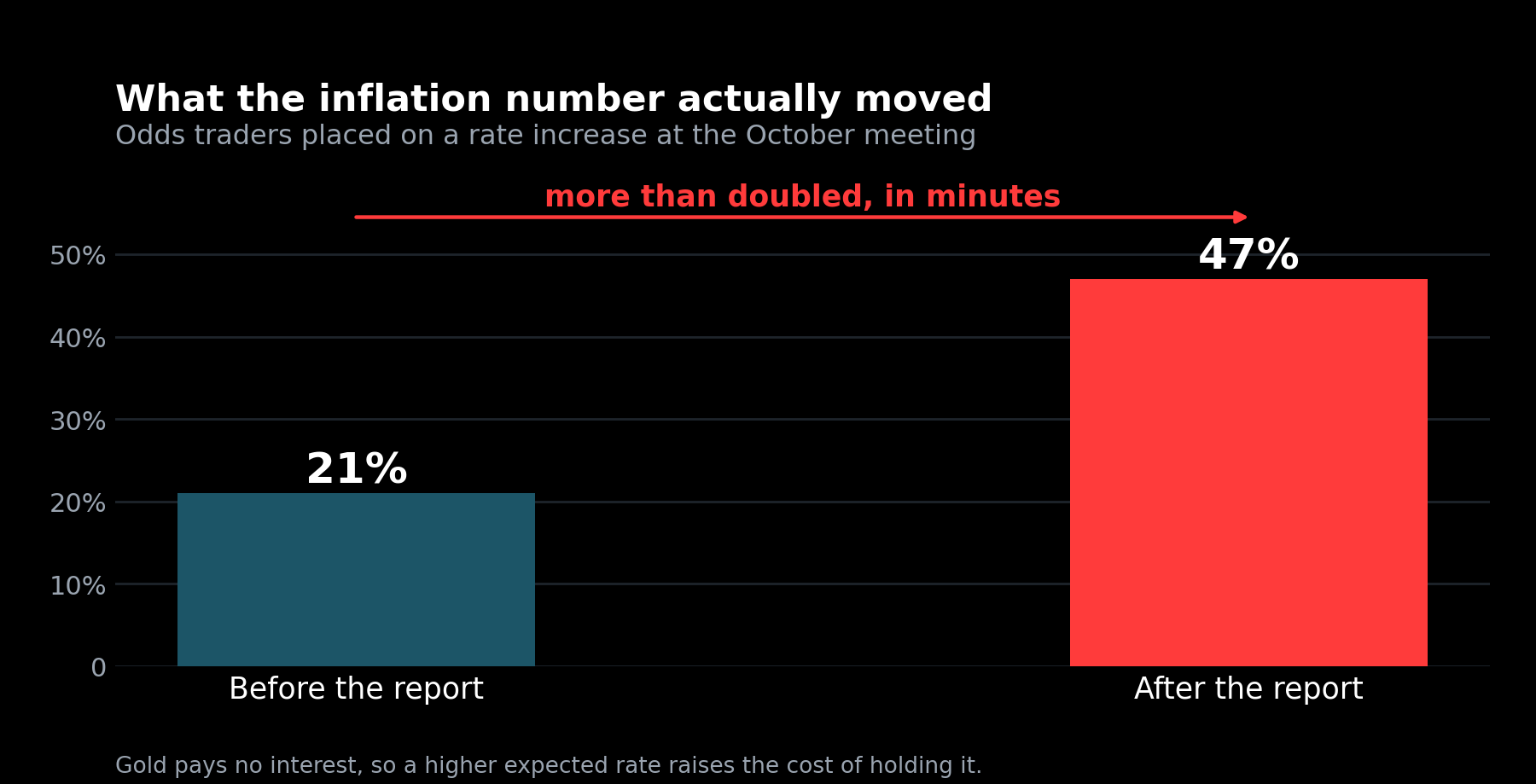
Two: traders immediately raised the odds the Fed will lift interest rates again. Before the report, markets put the chance of an increase at the October meeting at about 21%. After it, 47%. More than double, in minutes.
Three: gold fell.
The middle step is where the whole thing happens.
Why higher rates push gold down
Here is the piece most coverage leaves out, and it is the entire explanation.
Think about what it costs you to own gold.
If a savings account pays nothing, then keeping your money in a gold bar costs you nothing. You give up no income, because there was no income to give up.
Now suppose that same account pays 5%. Holding the gold bar now costs you 5% a year. Not in fees. In income you could have had and chose not to take. Economists call this an opportunity cost, which is a formal way of saying the price of a choice is whatever you gave up to make it.
Gold's problem is that this cost rises every time interest rates do, and gold cannot respond. A bond can pay more. A savings account can pay more. A gold bar cannot, because paying nothing is the only thing it knows how to do.
So a hot inflation report is bad for gold through a route that has nothing to do with inflation itself. Hot inflation raises the chance the Fed pushes rates higher. Higher rates make everything that pays interest more attractive. Gold, which pays none, becomes the worst-looking option in the room by comparison, and its price falls until it looks reasonable again.
One analyst put it directly this morning. Artem Bakushev at Monaxa said gold was falling as the dollar, Treasury yields and real yields rose.
That last phrase is worth unpacking, because it is the sharpest version of the idea.
When a bond pays 5%, that 5% is the nominal yield. It is the number printed on the thing.
But if prices are rising 3% a year while you hold it, you are not really 5% better off. Your money goes 3% less far than it used to. What you actually gained is closer to 2%. That 2% is the real yield, meaning the return after inflation has taken its cut.
Real yield is what gold competes against. Not the headline number on a bond, the leftover after inflation.
Now watch what happens when inflation rises, because it can go two completely different ways and the difference is the entire article.
Set the starting point. A bond pays 5%. Inflation is 3%. So the real yield is 5 minus 3, which is 2%. Gold pays nothing, as always. Gold is running 2 points behind.
Case one: inflation rises and the Fed leaves rates alone.
Inflation goes from 3% to 4%. The bond still pays 5%, because nothing made it pay more. The real yield is now 5 minus 4, which is 1%.
The bond got worse. Gold did not get worse, because gold was already paying nothing and nothing is nothing regardless of inflation. The gap between them narrowed from 2 points to 1.
Gold just became relatively more attractive without doing anything at all, and the price tends to rise. This is the version of the story people have in their heads, and it is a real thing that happens.
Case two: inflation rises and the Fed is expected to chase it.
Inflation goes from 3% to 4% again. But now traders expect rate increases, and the bond's payout climbs to 7%. The real yield is 7 minus 4, which is 3%.
The bond got better. Gold still pays nothing. The gap widened from 2 points to 3.
Gold just became relatively less attractive, and the price tends to fall.
Same inflation increase. Opposite result.
In case one the real yield fell from 2% to 1%. In case two it rose from 2% to 3%. Inflation went up by exactly one point in both. What decided gold's direction was not the inflation at all. It was whether the Fed was expected to raise rates by more than inflation rose.
This morning the market decided it was case two. That is what the jump from 21% to 47% was measuring.
There is a third, smaller piece. Gold is priced in dollars everywhere in the world. The same report pushed the dollar up, and a stronger dollar means a buyer in Tokyo or Frankfurt pays more for the identical ounce. That softens demand outside the US and leans on the price from a different direction.
So is gold an inflation hedge or not?
Both, depending on the question you are actually asking.
Over decades, yes. If you are asking whether an ounce of gold will still be worth a decent suit in thirty years while a hundred dollar bill will not, history is on gold's side. That is the claim the phrase was built for.
Over a morning, no, and it is not even close. On the day an inflation number comes out, gold trades on what that number does to interest rate expectations, not on the number itself. A hot print that makes the Fed more likely to move will usually push gold down, and a cool print that takes pressure off will usually push it up. Which is the opposite of what the slogan suggests.
So the phrase is not false. It is answering a question about decades while being used to explain a Wednesday.
What one day hides
Now the context that makes today smaller than it looks, and the year bigger.
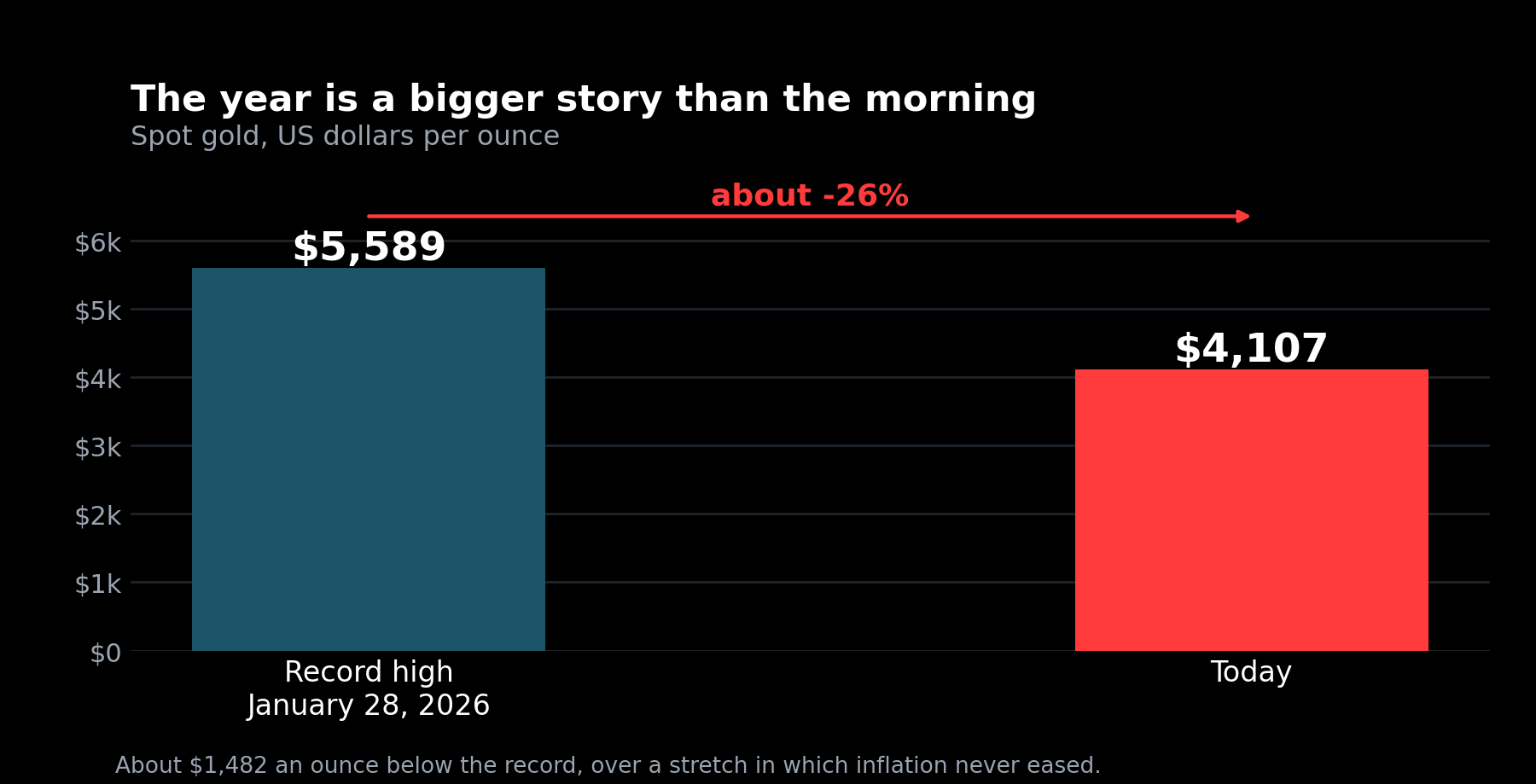
Gold set an all-time high of $5,589 an ounce on January 28 of this year. This morning it traded near $4,107.
That is about 26% below the record, roughly $1,482 an ounce, and it happened across a year in which inflation never went away. If today seems strange, the past nine months are stranger, and they point at the same mechanism running continuously rather than once.
A 1% move on a Wednesday is noise. A 26% move from a record while the thing gold supposedly hedges against kept running hot is the actual story, and it is the same explanation stretched over nine months instead of ten minutes.
What this doesn't tell you
One print, one morning, one reaction. Markets reverse these constantly, and a 1% move is small enough that it could be gone by Friday.
The rate path is a guess, not a fact. Traders moved the October odds from 21% to 47%, which means they are closer to a coin flip than to a conclusion. The president of the New York Fed said separately this morning that he sees one more increase as appropriate this year. That is one official's stated view, not a decision, and the people who set the rate have not met yet.
The opposite forces are real and this issue underweights them. Gold has genuine support from central banks adding to reserves and from the geopolitical backdrop, which is why several analysts described the setup as constructive even while the price fell. Today one force overwhelmed the others. That is not a permanent ranking.
And the bigger caution. Nothing here says what gold is worth. It explains why it moved, which is a different and much smaller claim than knowing where it goes.
The habit underneath is the one this newsletter keeps landing on. Tuesday's issue on headline and core inflation made the point that a single figure answers one specific question and the work is knowing which. Today is that again, from the other side: the number that moved gold was not the inflation number, it was what the inflation number did to the expected cost of money.
Which is why, when Techdamentals values a company, it shows the discount rate it used right next to every other input. The cost of money is an assumption inside any valuation, and an assumption you cannot see is one you cannot argue with.