In the government's most recent inflation report, covering September 2026 and published on October 14, one line stands out from everything around it.
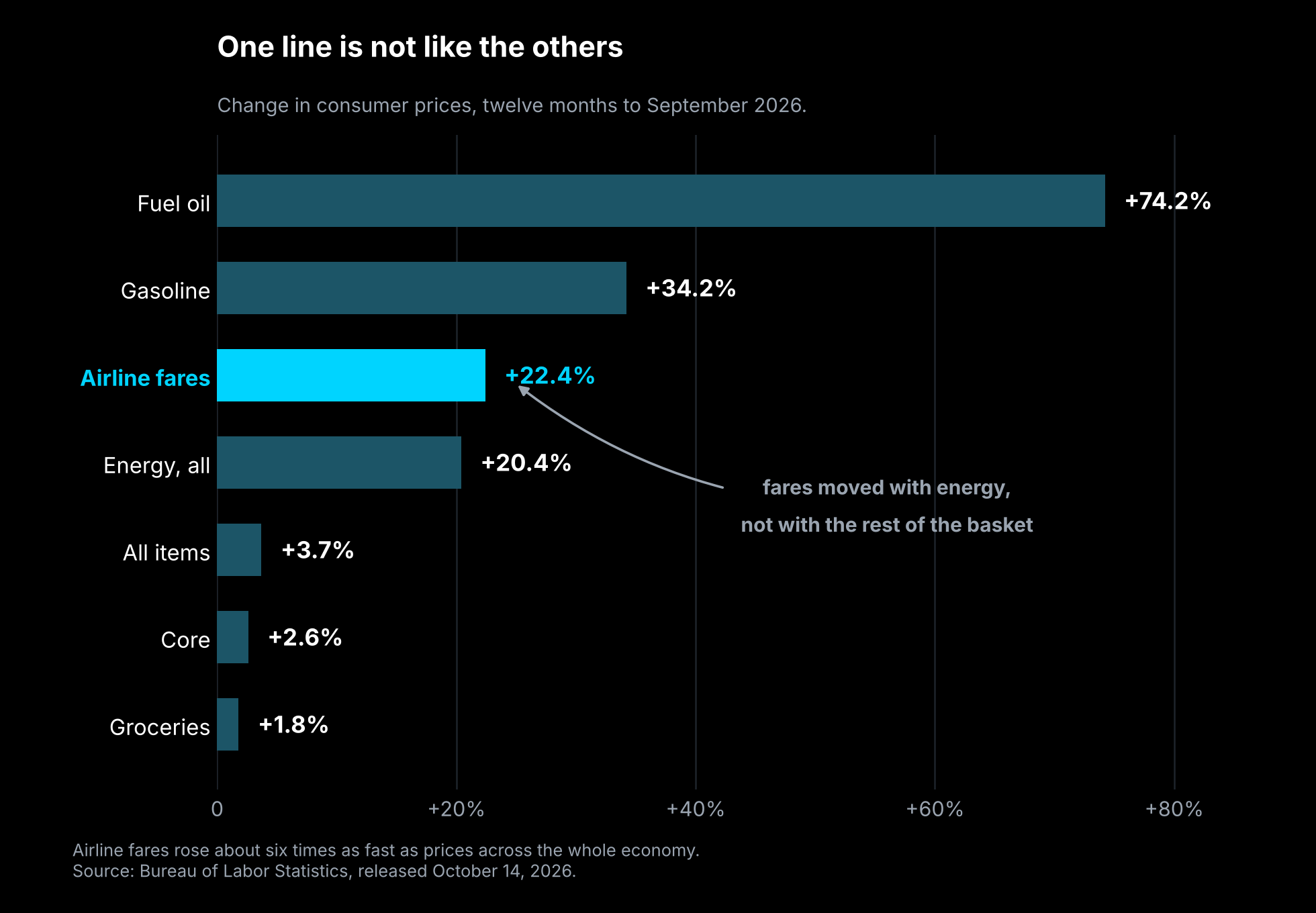
Airline fares were up 22.4% from a year earlier.
For scale, prices across the whole economy rose 3.7% over the same twelve months. Groceries rose 1.8%.
So flying did not get mildly costlier along with everything else. It went up roughly six times as fast as the economy, and twelve times as fast as food.
That figure is not an artifact of how the government samples tickets, either, and it is worth confirming because a single index can mislead. The Bureau of Transportation Statistics, which collects actual ticket data rather than a price survey, put the average domestic fare at $445 in the second quarter of 2026, up 11.2% from a year earlier. Southwest reported its own average passenger fare at $231.69 in the third quarter, up 26.9%, excluding bag and seat fees. Three different methods, same direction.
One honest note on that middle figure. The transportation agency widened its ticket sample from 10% to 40% of tickets starting in late 2025, so its year-over-year comparison spans a methodology change and should be read as directional rather than precise.
And on Tuesday, November 3, 2026, Booking Holdings became the first large travel company to show what that is doing to actual bookings. The stock fell after hours and guided the current quarter to room night growth of 1 to 3%, down from 7% in the quarter it had just finished.
This issue is about why the number is 22.4%, and about what it means that hotels are raising their forecasts at the same moment.
Three terms before anything else
CPI is the Consumer Price Index, the government's measure of what a typical basket of household purchases costs. It is published monthly and broken into categories, which is why we can look at airline fares separately from everything else. The airline fares line tracks what travelers actually paid, collected from airline ticket samples.
Capacity, in an airline's language, means seats. Not planes, not flights. The total number of seats the airline is offering over a period, usually measured in seat-miles so that a long route counts for more than a short one. When an airline says it is holding capacity flat, it means it is not adding seats.
RevPAR is how hotels measure themselves. It stands for revenue per available room, and it combines two things at once: how full the hotel is, and what it charges. A rising RevPAR means the hotel is either busier, pricier, or both.
Those three let you read the rest of this without anyone's spin.
The first cause is fuel, and it is enormous
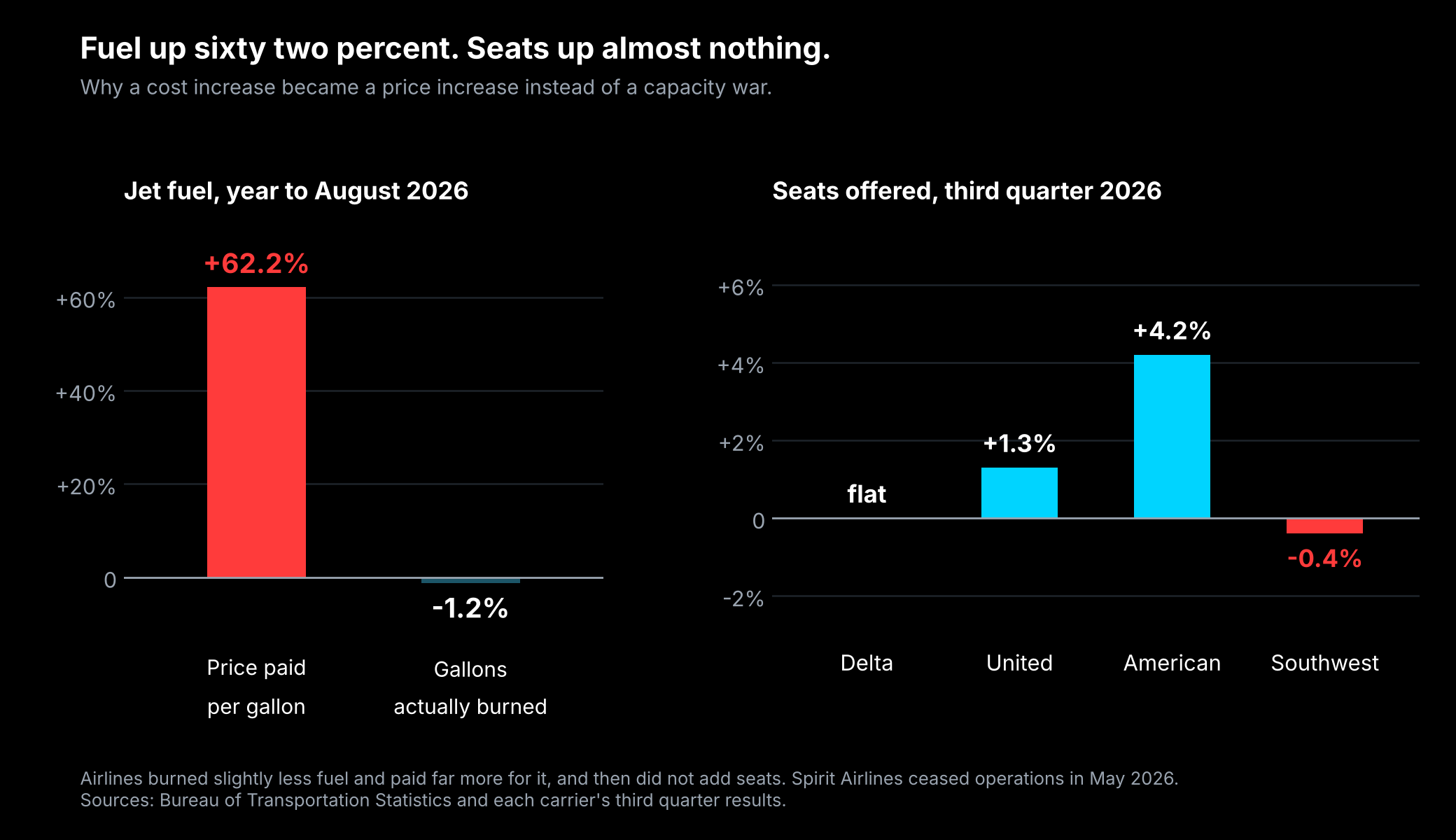
Jet fuel cost 62.2% more per gallon in August 2026 than a year earlier, reaching $3.72.
Read the next part slowly, because it is the whole point. Over that same period, the amount of fuel US airlines actually consumed fell 1.2%.
So airlines burned slightly less fuel and paid dramatically more for it. This was not a case of flying more and therefore spending more. The price of the input moved on its own.
That traces back to something this newsletter has covered repeatedly this autumn. Crude has been elevated all year on conflict risk, with Brent trading around $106 on November 3. Jet fuel is refined from crude, and it is typically the single largest or second largest cost an airline carries, behind labor.
The individual numbers are brutal. American Airlines' fuel bill rose 67.5% in its third quarter, adding roughly $1.9 billion of cost to a single three-month period. Delta's chief executive, Ed Bastian, put it plainly on his earnings call: it is "really hard to show margin improvement when fuel prices are doubling on you."
And it is not finished. For the current quarter, the major carriers are assuming fuel costs somewhere between four and a quarter and four and eighty five cents a gallon, above what they actually paid in the third quarter.
The second cause is that nobody added seats
A cost increase does not automatically become a price increase. Normally a competitor undercuts you, or somebody adds flights on your profitable route, and the price comes back down.
That did not happen, and the reason is on the record.
US airlines did not grow capacity in any meaningful way. In the third quarter of 2026, Delta's seats were roughly flat. United added 1.3%. American added 4.2%. Southwest actually shrank by 0.4%. For the current quarter, Delta guided to seat growth of less than 2%.
There is also one fewer competitor than there was in the spring. Spirit Airlines shut down in May 2026. Whatever you thought of flying Spirit, it functioned as the price anchor at the bottom of the market. When the carrier whose entire business was being the lowest fare disappears, every fare above it has more room.
Delta's president, Joe Esposito, described the industry-wide version directly: "quite a bit of capacity has come out as carriers have worked to improve their own margins and operations."
They are telling you they are not discounting
This is the part most coverage leaves out, and it is said openly on earnings calls that anyone can listen to.
Esposito again, on whether Delta cut prices to fill seats: "We were not discounting fares. So fares continue to move in the right direction."
United's chief executive, Scott Kirby: "I'm pretty confident that we're not going to take steps backwards in pricing."
And American's chief executive, Robert Isom, described the fuel surge as "a catalyst to allow us to realize that there is value."
Bastian at Delta argued the result is still reasonable, saying airfare is "reasonably affordable even at a 20% price increase," which he acknowledged Delta largely took this year.
Put the two causes together and you have the entire explanation. The cost of flying a plane went up enormously. The number of seats did not. And the airlines, having spent a decade being punished for adding capacity into weak pricing, chose this time not to.
So is travel demand weak? No
This is where the obvious story falls apart, and it is worth being clear because the obvious story is what you will read everywhere else.
If people had stopped wanting to travel, hotels would be cutting their forecasts. They are doing the opposite.
Marriott reported global RevPAR up 6.5%, with the United States and Canada up 7.4%, and raised its full-year outlook to growth of 4.5 to 5%, having started the year guiding to 1.5 to 2.5%. Its chief executive, Tony Capuano, said travel demand "has been remarkably robust this year despite geopolitical uncertainty."
Hyatt reported system-wide RevPAR up 7.2%, with the US up 8.2%, and also raised its full-year guidance.
The airlines agree. Delta guided current-quarter revenue to grow roughly 20% on about 3% more seats, which is only possible if people are paying more and still turning up. Delta's premium cabin revenue rose 18% on 6% more premium seats. United's contracted business revenue rose 26%. American's managed corporate revenue rose 27.6%.
And the broader picture is not of a consumer in retreat. Job openings held at about 7.5 million in September. Spending at restaurants and bars rose 7.0% from a year earlier.
People want to go. The seats are the constraint.
The single clearest statement of this came from Hyatt's chief financial officer, Joan Bottarini, explaining weakness in Mexico. She attributed it to flight capacity rather than demand, saying the "reduction in flight capacity was more pronounced than anticipated." Over the same period, US travelers going to Hyatt's international hotels were up over 10%.
That is not a demand problem. That is people wanting to travel and not finding an affordable way to get there.
Where it finally shows up
Which brings us back to Tuesday.
Booking Holdings had a perfectly solid quarter. Gross bookings, meaning the total value of travel reserved through its sites, rose 10% to $54.5 billion. Room nights rose 7%. Adjusted revenue rose 9% to $9.8 billion, ahead of the roughly $9.5 billion analysts expected.
Then it guided the current quarter to room night growth of 1 to 3% and adjusted revenue growth of 0 to 2%, and told investors the forecast assumes Middle East disruption continues through year end.
The company named three things weighing on international travel: conflict in the Middle East, localized unrest in some European cities, and elevated airfares.
Not weak consumers. Not people trading down. The price of the flight.
Booking is the first large company where costly seats show up as fewer bookings, and the reason it lands there first is structural. A hotel chain fills rooms for whoever arrives. A global booking platform depends on people completing a whole trip, and the flight is the part that has repriced.
One number you should not misread. Headlines will say Booking's revenue missed badly, at $8.9 billion against about $9.5 billion expected. That gap is almost entirely a $900 million reduction in revenue plus a $100 million charge the company recorded in connection with a potential Federal Trade Commission complaint against its Priceline subsidiary over hotel advertising. Strip that out and revenue grew. The company's filing notes the FTC may seek more than a billion dollars and that no settlement has been reached.
That is a real and serious item. It is not evidence about travel demand, and anyone presenting it as a demand miss is reading the wrong line.
What this does not tell you
It does not tell you fares keep rising. The 22.4% is the twelve months to September. Fuel is the dominant input and oil prices move on events nobody can forecast, including the conflict that has driven them this year. If crude falls, this unwinds, though airlines have said plainly they intend to hold pricing.
It does not tell you the airlines are gouging. They are not discounting, which they have said out loud, and that is a choice. But their costs genuinely rose, and in American's case by nearly two billion dollars in one quarter. Both things are true and the article would be dishonest to print only the second.
It does not tell you travel is in trouble. Two large hotel groups raised guidance in the same week. The weakness in the data is concentrated and geographic, centered on the Middle East, where Marriott's RevPAR fell 12% and inbound travel to the region dropped sharply.
It does not tell you Booking had a bad quarter. It had a decent quarter and a cautious forecast, and its stock was already down roughly a third this year before any of this. Most of the move happened before Tuesday.
And it does not tell you what any of this is worth. A guidance cut on a stock that already fell by a third prices in something quite different than the same cut on a stock at its highs.
The thing worth keeping is the shape. A fuel shock became a fare increase, and a fare increase is now rationing who flies, while demand for the trip itself has barely moved. The constraint is not that people stopped wanting to go. It is the price of getting there, and that price was set by the cost of a gallon of jet fuel and by a decision not to add seats.
One caution on timing. Two more large travel companies report within days of this issue, and either could change the international picture.
That is why we show the workings instead of a single figure. Techdamentals runs four separate valuation methods and displays the full range, because one number tells you where somebody landed and nothing about what it rests on.