On Tuesday, November 3, 2026, after the market closed, Super Micro Computer reported net sales of $19.95 billion for the September quarter. A year earlier the same quarter was $5.02 billion.
That is an increase of 297.5%. The company nearly quadrupled in twelve months.
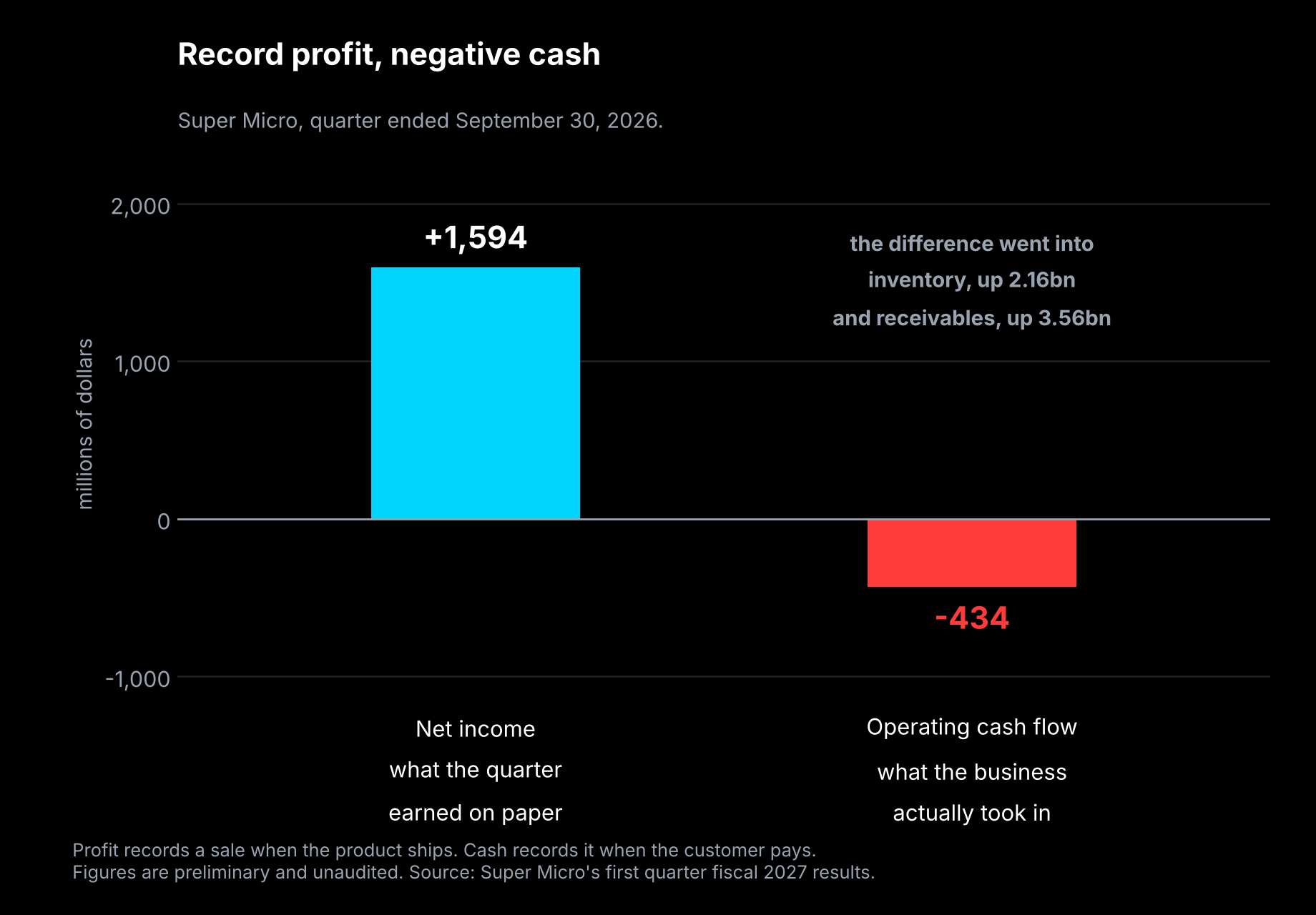
It also reported net income of $1.594 billion, which is a record.
And over the same three months, the cash the business actually generated from operations was negative $434 million.
Both of those things are true at once, and the gap between them is the most useful thing in the release.
Four terms, and the article needs all of them
Gross margin is what a company keeps from each dollar of sales after paying only the physical cost of making the thing. Not salaries, not research, not tax. Just the parts, the assembly and the shipping. If Super Micro collects a hundred dollars for a server and the components and labor cost eighty seven dollars, the gross margin is thirteen percent.
Operating cash flow is the cash the business took in from running itself, minus the cash it paid out, over the period. Profit and cash are not the same thing, and the difference is the subject of this issue. A company can record a sale the moment it ships a product, long before the customer pays, and it can pay its own suppliers long before that. Profit says the sale happened. Cash says the money arrived.
Accounts receivable is money customers owe but have not yet paid. It counts as revenue and as profit. It is not cash.
Inventory is finished goods and parts the company has paid for and not yet sold. It is an asset on paper. It is also cash that has left the building.
Hold those last two, because together they explain the entire gap above.
Why a fast-growing company runs out of money
Here is the sequence, and once you see it the rest of this article is obvious.
To build a server, Super Micro first purchases the chips, the memory and the boards. Cash leaves immediately, and those are the most costly components on earth at the moment. It assembles the machine and ships it. The moment it ships, the sale is recorded as revenue and the profit is booked. Then the customer pays, somewhere between a month and a quarter later.
So three things happen at three different times. Cash out, profit recorded, cash in. The last one can arrive ninety days after the first.
Now make the company grow nearly 300% and that gap stops being a technicality.
Every quarter it is purchasing parts for a quarter far larger than the one it is collecting payment for. It is paying for September's components while still waiting on June's invoices. The faster it grows, the further the cash falls behind the profit. That is arithmetic, not mismanagement.
A version you can picture. You run a catering company. A client books a five hundred person wedding. You purchase all the food up front, you record the sale the night you serve it, and the client pays you sixty days later. One wedding a month and this is fine. Double your bookings every month and you will always be paying for a bigger event than the one you are collecting on. You can be extremely profitable and still run out of money.
So you start asking for a deposit large enough to cover the food. Now you can keep growing. But you are growing on your clients' money, and if the bookings pause you are holding a walk-in freezer you have already paid for.
That is roughly where Super Micro is.
What the quarter looked like
Revenue was $19.95 billion, up 297.5% from a year earlier and roughly 80% from the previous quarter.
Gross margin was 12.7%, against 9.3% in the same quarter last year and 17.5% in the quarter immediately before.
Reported profit per share was $1.75 on the standard accounting measure and $1.81 on the company's adjusted measure.
And the company guided the current quarter to revenue between 19.5 and 21.5 billion dollars, and raised its full-year outlook to a range of 72 to 82 billion dollars, up from the 65 to 72 billion it had given in August.
That full-year raise is real and it is large. Hold onto it, because it is the strongest fact in the company's favor and the rest of this issue is going to be harder on them.
The beat that mostly already happened
Most coverage this week will say Super Micro beat expectations by somewhere near nineteen percent. That number is technically defensible and it badly misdescribes what happened.
On October 20, 2026, the company pre-announced. It told investors to expect revenue between 18.5 and 19.5 billion dollars, up from original guidance in the 14.5 to 15.5 billion range, and gross margin of 12.0 to 12.5%, up from 10.4 to 10.8%.
The stock rose 9.55% the following session on that news.
So by November 3, the surprise was not three billion dollars above what analysts thought. It was about $445 million above the company's own raised ceiling, announced two weeks earlier. The published analyst estimates still floating around had been overtaken by the company itself.
Here is the fact that puts it in proportion. The stock is lower today than it was on October 21, the day after the pre-announcement. The good news was already in the price, and then some of it came back out.
Twelve cents on the dollar
Now the question in the title, and the answer is a single number that tells you what kind of business this is.
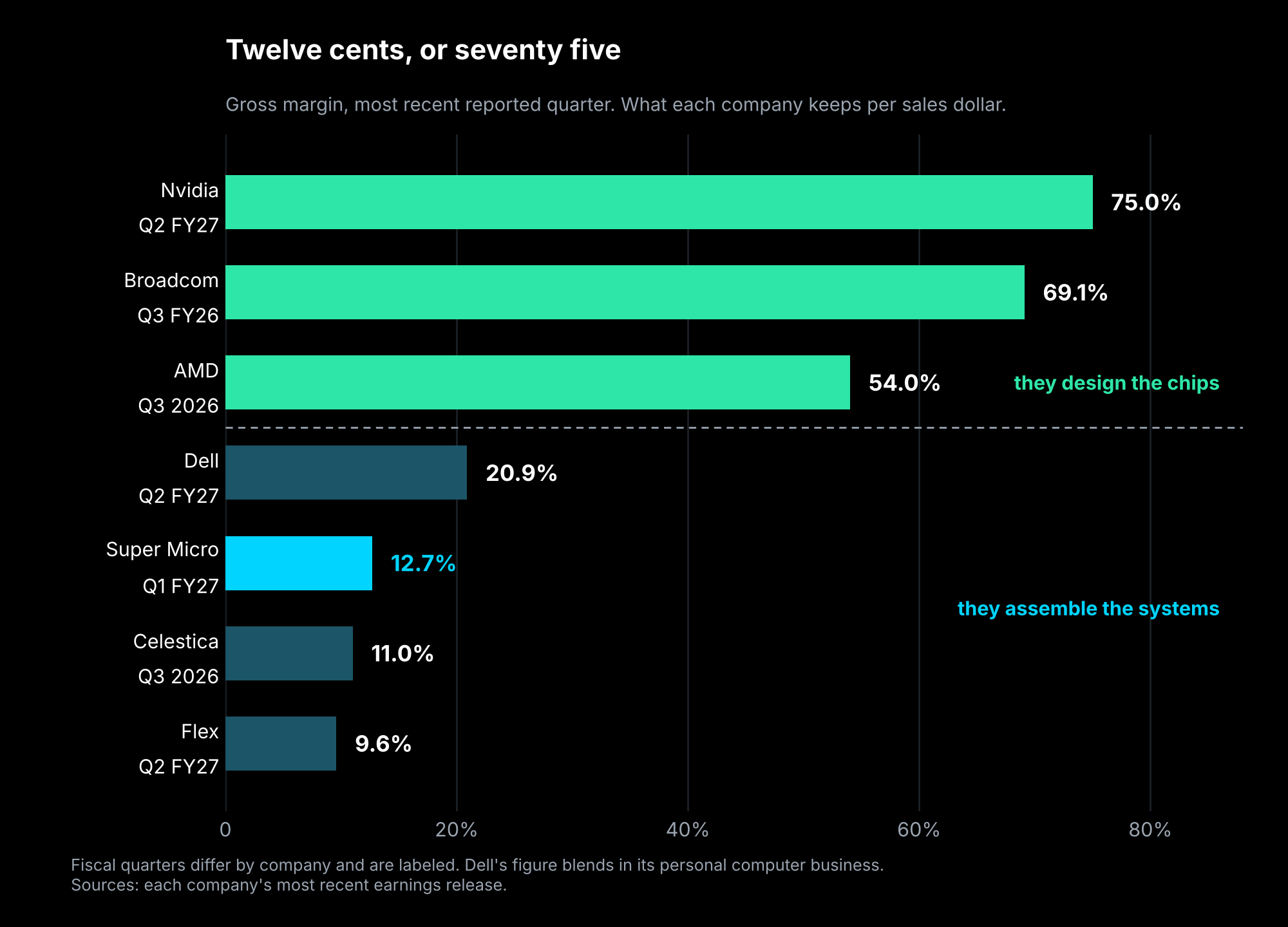
For every dollar of sales, Super Micro keeps 12.7 cents before paying for anything else at all. No engineers, no buildings, no taxes.
Compare that with the companies whose chips go inside those servers.
Nvidia keeps 75.0 cents of every sales dollar. Broadcom keeps 69.1. AMD keeps 54. And in the quarter AMD reported the same night as Super Micro, its data center business ran a 33.7% operating margin, which is to say AMD's profit after all its costs was more than double what Super Micro keeps before any of its own.
This is not a criticism of Super Micro's management. It is a description of two different businesses that happen to sit next to each other.
Designing a chip costs an enormous amount once and then almost nothing to repeat. The hard part is the years of engineering, and once that is finished every additional unit costs a fraction of what it is worth. Assembling a system is the opposite. You purchase costly components from somebody else, put them together, and your own cost rises almost in step with every machine you ship.
The companies doing the same work as Super Micro confirm the pattern. Celestica's gross margin was 11.0% in its most recent quarter. Flex came in at 9.6%. Super Micro sits right between them.
One honest complication, because it cuts against the neat version. Dell ran 20.9%, well above the others, and its infrastructure business that competes most directly with Super Micro produced a 15.0% operating margin, which is better than Super Micro manages. Scale and a services attachment can widen the gap. The assembler's position is difficult, not hopeless.
Where the cash actually went
Return to the gap. Net income of $1.594 billion, operating cash flow of negative $434 million. A swing of roughly two billion dollars between what the company earned and what it collected.
Two lines on the balance sheet account for nearly all of it.
Inventory rose by $2.16 billion, to $15.05 billion. That is parts and finished machines the company has paid for and not yet delivered.
Accounts receivable rose by $3.56 billion, up 58% in a single quarter, to $9.69 billion. That is product already delivered and recorded as revenue, where the money has not arrived.
Add those together and you have almost six billion dollars of growth sitting in things that are not cash.
Now the part that reframes the whole quarter. The chief financial officer said roughly $2.5 billion of that inventory build was funded by customer prepayments, and deferred revenue, which is money collected before the work is delivered, rose from about $1.58 billion to $4.33 billion.
So a meaningful share of the inventory is being paid for in advance by the people who ordered it.
That is genuinely reassuring and genuinely uncomfortable at the same time, and a reader deserves both halves. Reassuring, because prepayment is the strongest possible evidence that the orders are real. Uncomfortable, because it means the growth is not being financed out of profits. It is being financed by customers, by suppliers waiting to be paid, and by $8.6 billion of total borrowings and convertible notes.
To the company's credit, it is getting faster at this. Inventory turn days fell from roughly a hundred to seventy four, and the cash conversion cycle, which measures how long money is tied up between paying for parts and collecting from customers, improved from 149 days to 97.
One customer, one supplier
Two disclosures make the rest of this harder to assess, and neither is in the headlines.
A single data center customer accounted for 44% of revenue this quarter. For all of fiscal 2026 the largest customer was 28%. So as the company grew, its dependence on a single customer went up rather than down. The finance chief said concentration at that level is a consequence of the scale at which these facilities are now being built, and that he expects it to ease as other business grows.
And one supplier accounted for 63.1% of total purchases in fiscal 2026, per the company's annual report.
One customer at nearly half of sales and one supplier at nearly two thirds of purchases leaves a company with very little leverage at either end of its own transaction. That explains a 12.7% gross margin more completely than anything said on the call.
What the margin does next
The company guided full-year gross margin to 11.8% to 12.2%, which is below the 12.7% it just reported.
The explanation given was mix. Systems built for large data center customers rose from 59% to 71% of revenue, and those carry lower margins than the rest. The finance chief was careful to say the sequential decline is not evidence that those systems lack margin, and that the second half of the year sits below the first.
Worth noting that this was Mark Long's first earnings call. He was appointed chief financial officer on October 15, 2026, after a search that ran close to two years.
Two things to know before you treat any of this as settled
These results are preliminary and unaudited. That is the company's own language, repeated three times in its release, and it says its closing procedures for the quarter are not yet complete and that its auditor has performed no procedures on the figures. The quarterly report has not been filed.
And the company's accounting history is specific and still partly open. Super Micro filed its delinquent reports in February 2025 with no restatement of prior financials, and it is current on its filings today. Its auditor did issue an adverse opinion on the company's internal controls over financial reporting as of June 2024. Separately, a cofounder was indicted in March 2026 over an alleged scheme to divert export-controlled hardware to China, with trial now set for March 2027. The company is not a defendant, an internal board investigation found no evidence current management knew of it and no evidence prior financial statements were unreliable, and grand jury and regulatory subpoenas remain outstanding.
None of that means the numbers above are wrong. It means preliminary figures from this particular company earn a little more patience than preliminary figures from most.
What this does not tell you
It does not tell you Super Micro is in trouble. It raised full-year revenue guidance by roughly nine billion dollars, its gross margin is higher than it was a year ago, its customers are paying in advance, and it says it has never held more cash.
It does not tell you negative cash flow is a problem. A company growing this fast consumes cash almost by definition, because it has to pay for parts long before it collects. That is arithmetic, not mismanagement. The question is whether the collections arrive, and this quarter cannot answer it.
It does not tell you assembling is a bad business. It is a different business. Low margins on enormous volume can produce excellent returns, which is the entire contract manufacturing industry. What it does tell you is that comparing Super Micro to a chip designer on revenue growth alone is comparing two things that convert a sale into profit at completely different rates.
It does not tell you 297% growth continues. The year-ago quarter was unusually small. The more honest frame is the company's own: fiscal 2026 revenue was about $39 billion and the new full-year guide is roughly double that, not four times.
And it does not tell you what the company is worth. The stock closed up about 3% in the regular session and traded up somewhere between 6% and 8% after hours, depending on when you looked. It is still below where it closed on October 21. Whether a business that keeps twelve cents on the dollar and finances its growth from its customers deserves more or less than that is a judgment about the next five years, not this quarter.
The question in the title has a short answer. Super Micro earns about twelve and a half cents on every dollar of sales before any other cost, and this quarter it collected none of it.
That is why we show the workings instead of a single figure. Techdamentals runs four separate valuation methods and displays the full range, because one number tells you where somebody landed and nothing about what it rests on.