
On Wednesday, November 25, 2026, after the market closed, Vertex Pharmaceuticals said the FDA had extended its review of povetacicept, an experimental drug for a kidney disease. The decision that was due on Monday, November 30, 2026 can now come as late as Sunday, February 28, 2027. Vertex's shares fell about 7% in after-hours trading that evening. Markets were closed on Thursday, November 26, 2026 for Thanksgiving, so the first full reaction came on Friday, November 27, 2026, when Vertex closed at 534.52 dollars, down 5.25%, a loss of about 7.5 billion dollars in market value according to one report.
So did the FDA find a problem with the drug? The obvious answer is yes, because a delay sounds like bad news about the medicine. Hold that thought, because the FDA has not said no to anything, and nothing in the drug's published results changed that week.
My question is this: why did Vertex stock fall on a delay? I will take it in three stops. First, what happened and in what order. Second, what an extension like this actually means under FDA rules. Third, what the market was weighing, which turns out to be time, a possible condition on the label, and rivals who are already approved.
Why should your own money care? Drug approval dates are some of the largest single-day moves in individual stocks, and the same pattern of delay, uncertainty and competition shows up across the whole drug industry. If you own a broad fund or a health care fund, you own some of it.
What happened, and in what order?
Povetacicept is a drug for IgA nephropathy, a chronic kidney disease in which an antibody called IgA builds up in the kidneys and damages them. Vertex is best known for treating cystic fibrosis, and investors see this drug as central to its move into kidney disease and away from relying on cystic fibrosis and pain. Vertex asked the FDA for an accelerated approval. That is a path that lets the FDA approve a drug based on an early measure that is expected to predict a real benefit, while the company continues a longer study to confirm it. Here the early measure is protein in the urine, which signals kidney damage.
The FDA had set Monday, November 30, 2026 as the target date for its decision. That is called a PDUFA date, after the law that lets the FDA charge companies fees in return for meeting review deadlines. On Wednesday, November 25, 2026, Vertex said the FDA had pushed the date back by up to three months. The cause, according to Vertex, was a late request for information from the FDA. Vertex responded, and the FDA treated the response as a major amendment, which is a category that triggers more review time.
Here are the prices. Vertex closed at 564.12 dollars on November 25. On Friday, November 27, 2026, a shortened trading day, it opened at 517.37 dollars, fell as low as 502.90, and closed at 534.52.
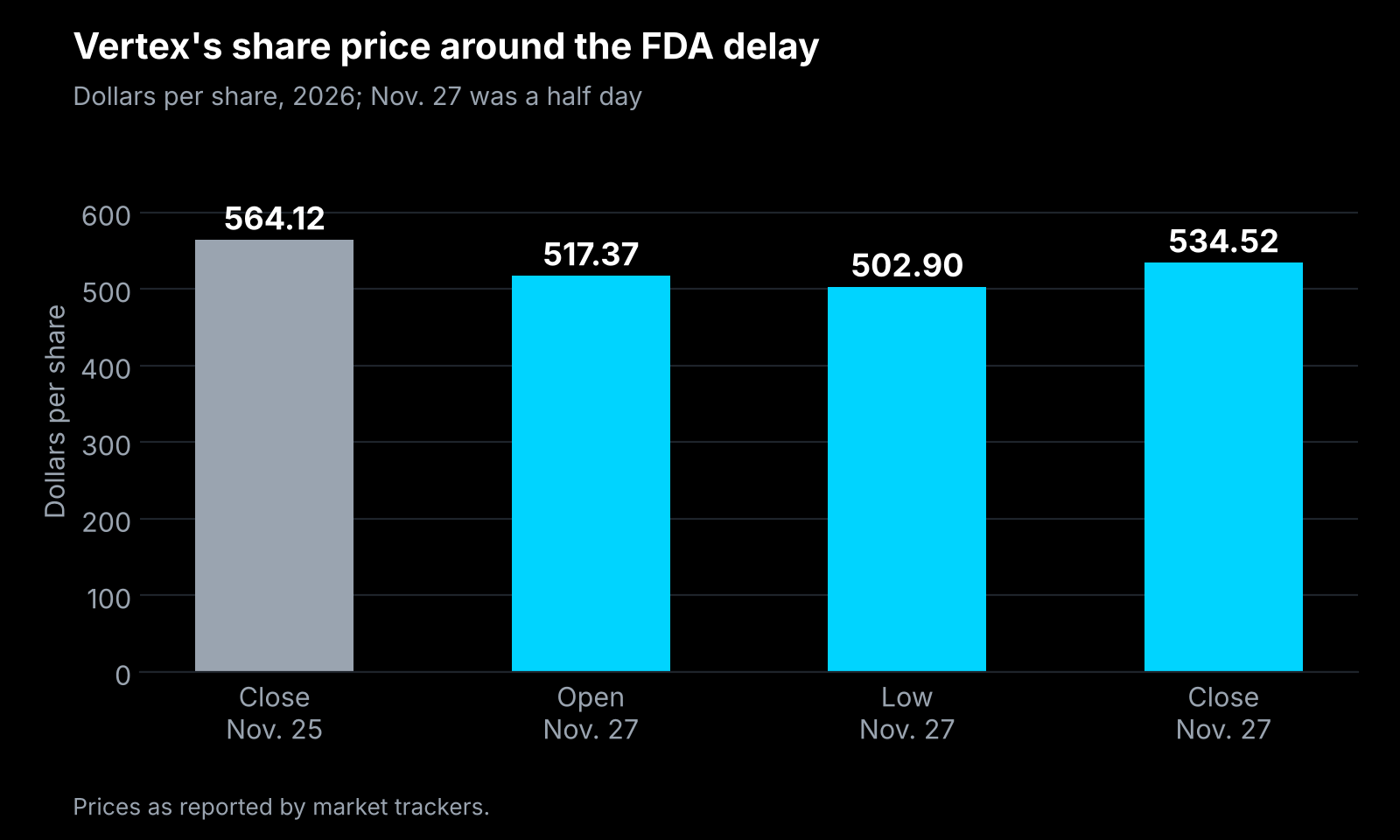
Notice the shape of that session. The stock opened more than 8% lower, then recovered about half of the drop by the close. A one-day move like that suggests that investors were still working out how much the news mattered.
BUT to say what the delay cost, I first need to look at what the FDA actually did.
What does an FDA delay actually mean?
A major amendment is a submission of information that is large enough to change the review. According to one FDA procedures document for its biologics center, that can mean a substantial amount of new data, a major reanalysis of studies already submitted, or a new analysis of studies not previously submitted. When the FDA designates one, the decision date moves back three months. Only one major amendment is allowed in a review cycle.
It is also not a rejection. A rejection is called a complete response letter, and the FDA has not issued one. One summary stresses that the FDA can still act before the new date and can still issue a complete response letter by it. An extension is not an approval either.
Vertex said it "is confident in the data supporting the povetacicept BLA," where BLA means biologics license application, and said it wants to work closely with the FDA "to make the treatment available quickly to IgA nephropathy patients." Vertex has not said what the FDA asked about. I found no statement from the FDA.
Several analysts read the extension as milder than a rejection. William Blair's Myles Minter wrote that an extension and not a complete response letter "bodes well for likely approval." JPMorgan said extensions "tend to be associated with eventual approval." An industry analysis from 2023 said that extensions caused by major amendments with new clinical data were followed, in its word, "overwhelmingly" by approval, though the part of it I could read gave no percentage. Those are views and a general pattern, and neither is a promise about this drug.
BUT the delay still raises a question that is specific to this drug, which is what the FDA asked about.
What was the market weighing?
Nobody has said what the FDA asked, so what follows is a hypothesis and not a finding. On Wednesday, October 21, 2026, the law firm Foley & Lardner filed a citizen petition, which is a formal request that anyone can make to the FDA. It asked that the label require blood tests every four weeks for IgG, the most common antibody in the blood, and that doses be paused when IgG falls below a set level. The petition did not name its client. The worry behind it is hypogammaglobulinemia, a condition in which antibody levels are low, which raises the risk of serious infections. Povetacicept works by blocking two immune proteins, which is why people ask about it.
David Risinger of Leerink Partners said he assumed the extra time related to the petition, and called the delay "quite disappointing." He hoped any monitoring requirement would be infrequent enough to leave the drug's commercial prospects mostly intact, and he noted that he could not predict the label. At a conference on Tuesday, November 17, 2026, Vertex said it expected a label without an IgG monitoring requirement. Neither the FDA nor Vertex has said the petition is the reason for the extension, and one summary calls the link unproven.
The results themselves did not change. In the trial's 36-week interim analysis, which Vertex published on Friday, October 23, 2026, urine protein fell 52.0% from where patients started, and 49.8% compared with placebo, which is a pill or injection with no active drug. Vertex reported no related serious adverse events and no deaths in that analysis. The trial enrolled 605 adults, and its final analysis of kidney function comes at two years.
So what did the market lose? Three things, as far as I can tell.
The first is time. A three-month delay pushes back the date on which the drug can start earning money. William Blair said it would now model a launch in March 2027.
The second is label risk. A condition like regular blood testing could make the drug harder to prescribe, and the stock's reaction may be pricing some chance of that. I cannot tell you how much.
The third is competition. Otsuka's Voyxact and Vera Therapeutics' Trutakna are already approved for the same disease. Vera's shares rose about 17% after hours on November 25 and about 14% in morning trading on November 27. The delay gives those drugs more time on the market alone.
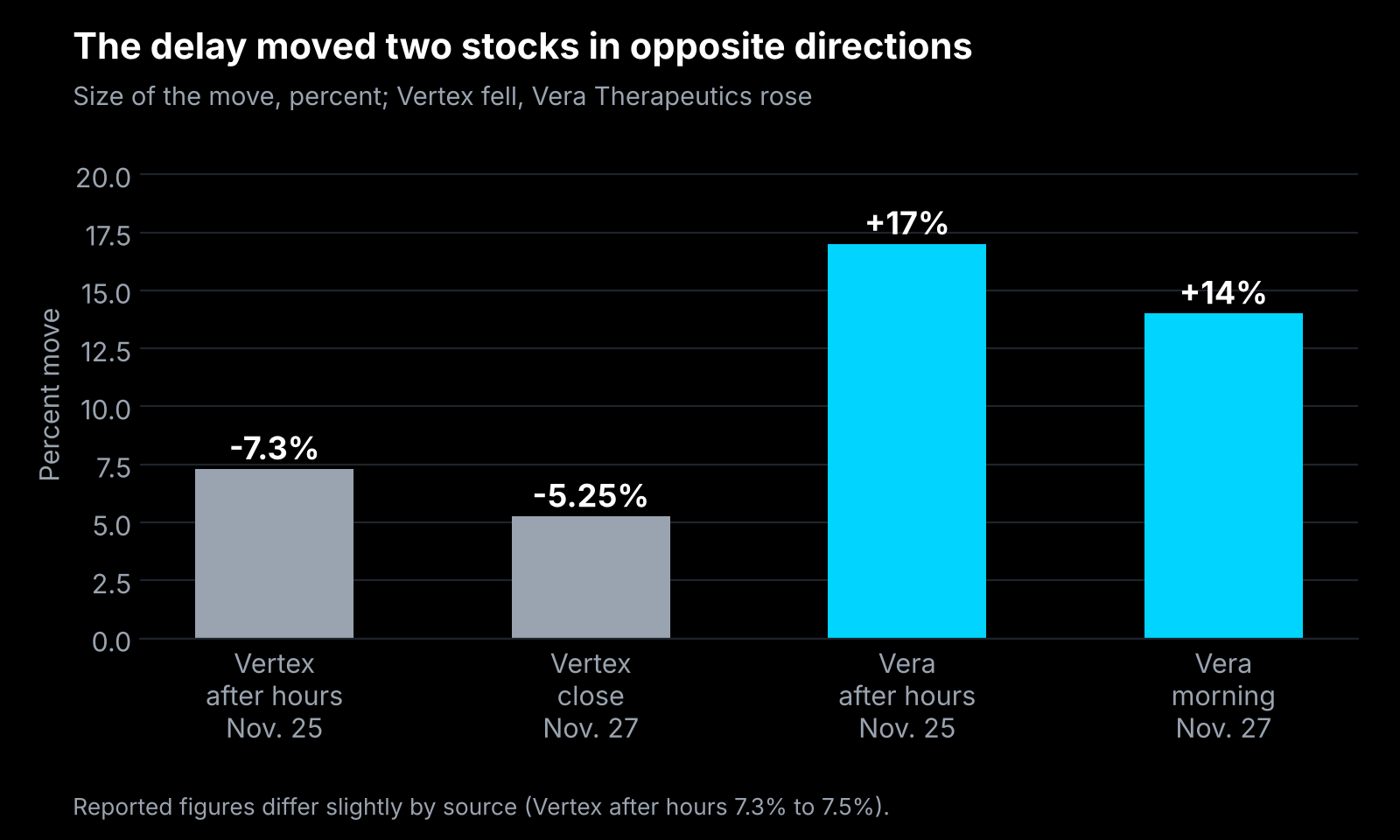
THEREFORE the stock's fall is consistent with the market pricing in time, uncertainty and rivals, and not with the FDA having found a flaw in the data. I should be clear that this is my reading of the reports and no source stated it that way.
One more number puts the size of the drop in context, with a caution. JPMorgan estimated, according to one report, that povetacicept could reach 3.4 billion dollars in sales for IgA nephropathy by 2035, and gave it a 95% chance of approval. A one-day loss of about 7.5 billion dollars in market value is a different kind of number. It reflects the whole company and what investors expect from it, and the two should not be set against each other.
What this does not tell you
I do not know what the FDA asked about, and neither does anyone outside the FDA and Vertex. The citizen petition is a hypothesis from one analyst. I do not know whether the drug will be approved, when, or with what label.
I also did not read the original FDA letter, which is not public, or Vertex's full press release. Several of the price details come from one report each, and the sources disagree slightly on the after-hours drop (7.3% to 7.5%) and on Vera's gain.
An extension that ends in approval is common, according to what analysts say, and extensions have also ended differently. This does not tell you which way this one goes.
Why did Vertex stock fall?
According to what I found, Vertex fell because the FDA moved its decision date back by up to three months and gave no reason. A delay costs time, leaves open a question about whether the label will carry a blood-testing requirement, and gives two approved rivals more time on their own. The drug's trial results did not change, and the FDA has not rejected it.
That brings me back to the first answer, that the FDA found a problem. So far nobody has said that. What the market did was put a price on not knowing. A drop of 5.25% by the close, after an after-hours drop of about 7%, says the uncertainty was real and it was not large enough to erase the drug's expected value.
Where to look next
Watch for Vertex or the FDA to say what the request covered. Watch the decision on or before Sunday, February 28, 2027. Watch the label, in particular whether it includes IgG monitoring, and the FDA's response to the citizen petition. And watch the two-year kidney function results from the trial, which are the confirmation step for an accelerated approval.
If you want to see what any stock you follow is worth, its fair value range, sign up at techdamentals.com. It also shows a company's fundamentals alongside technical analysis of its chart. After each earnings report, it reads the company's own filing and compares the financials with what analysts expected, line by line, so you can see the real reason a stock moved. Try Techdamentals for 3 days, no card needed
This is educational content, not financial advice. Techdamentals is an educational tool and does not recommend any security.