
On Tuesday, November 24, 2026, after the market closed, Dell reported record revenue of 54.9 billion dollars for its third quarter, up 103% from a year earlier. It also reported a backlog of 132.3 billion dollars in orders for servers built for artificial intelligence, up from 95.0 billion dollars three months earlier. It raised its forecast for the year.
So does a backlog that size mean 132.3 billion dollars of revenue is on the way? The obvious answer is yes. Hold that thought, because the details in the report, and in the filings around it, say the backlog is a promise to deliver and not money in the bank.
My question is this: what does Dell's record backlog actually tell you? I will take it in three stops. First, what Dell reported and how it compared with expectations. Second, what a backlog is, how fast it turns into revenue, and how solid it is. Third, what it costs Dell to deliver it, and how the stock reacted.
Why should your own money care? Dell turns the spending on artificial intelligence into physical machines, so its report is a direct look at whether that spending is real. If you own a broad fund, you own a slice of that demand and of the worry about it.
What did Dell report?
The quarter ended Friday, October 30, 2026. These figures come from the release Dell filed with the government.
Revenue was 54.9 billion dollars. Analysts had expected about 49.3 billion. Earnings per share, which is profit divided by the number of shares and adjusted to leave out some accounting items, were 9.45 dollars against about 6.60 expected. Operating income, meaning profit from running the business before interest and taxes, was 7.4 billion dollars.
Most of it came from the part of Dell that serves businesses and data centers. That division had 42.0 billion dollars in revenue, up 198%. Within it, servers built for artificial intelligence brought in 22.0 billion dollars, up 291%. Servers are the powerful computers that run in data centers.
Dell also raised its forecast. For the full fiscal year ending in January 2027, it now expects revenue of 202.0 billion dollars, up from 192.0 billion, and revenue from servers for artificial intelligence of 78.0 billion, up from 74.0 billion. Its forecast for adjusted earnings per share rose to 29.68 dollars from 25.50. For the current quarter, it guided to revenue of 56.3 billion and adjusted earnings per share of 8.40, both above what analysts had expected, according to one report. Dell also added 25 billion dollars to its authorization for repurchasing its own shares.
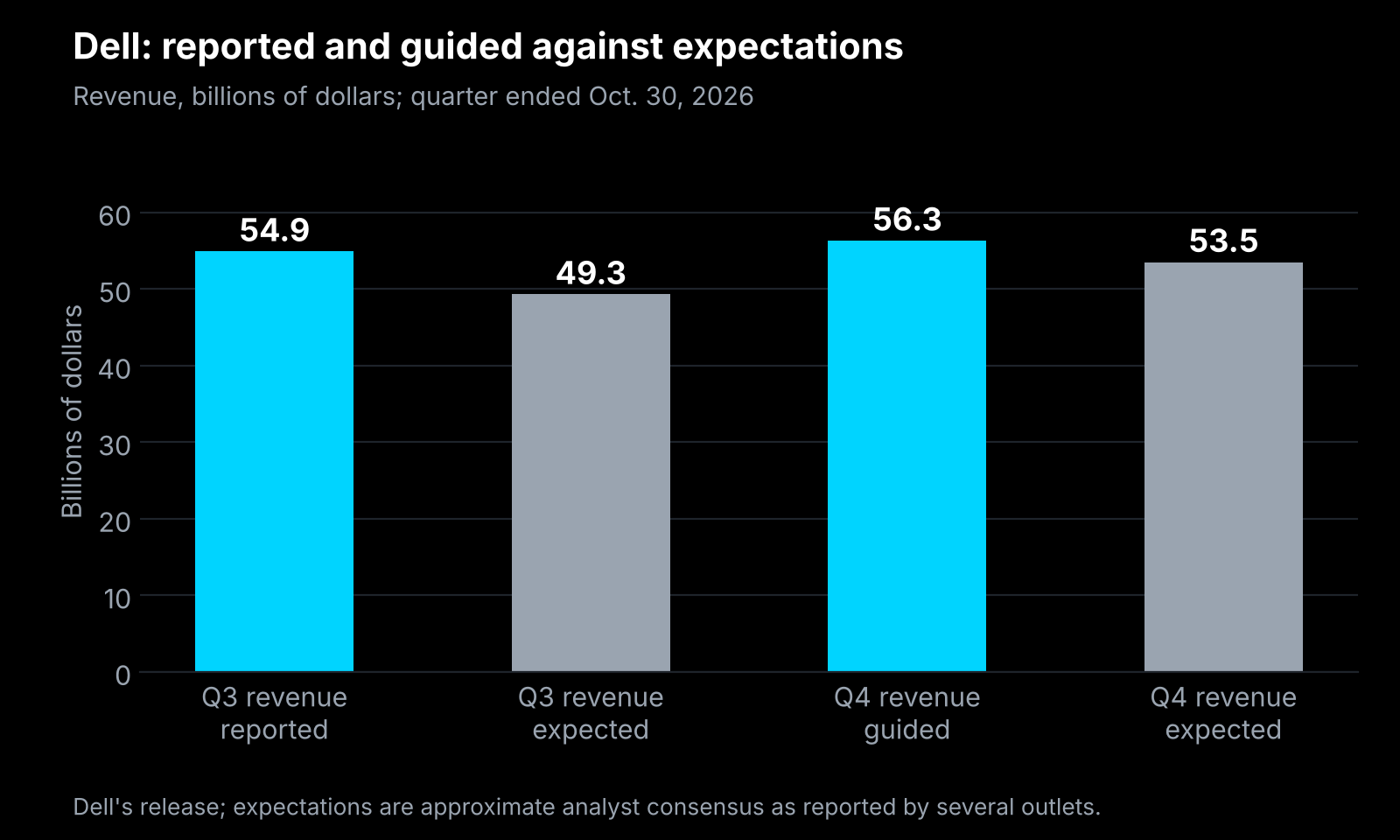
By these measures the report was a beat on every line I could find. The questions came from the rest of the report.
What is a backlog, and how solid is it?
A backlog is the value of orders a company has accepted but not yet delivered. Dell took 60.2 billion dollars of new orders for artificial intelligence servers in the quarter and delivered 22.0 billion dollars worth. That is about 2.7 times as many orders as deliveries. The backlog ended at 132.3 billion dollars. At the pace of 22.0 billion dollars a quarter, my arithmetic says that is about six quarters of deliveries. That comparison is mine and not Dell's.
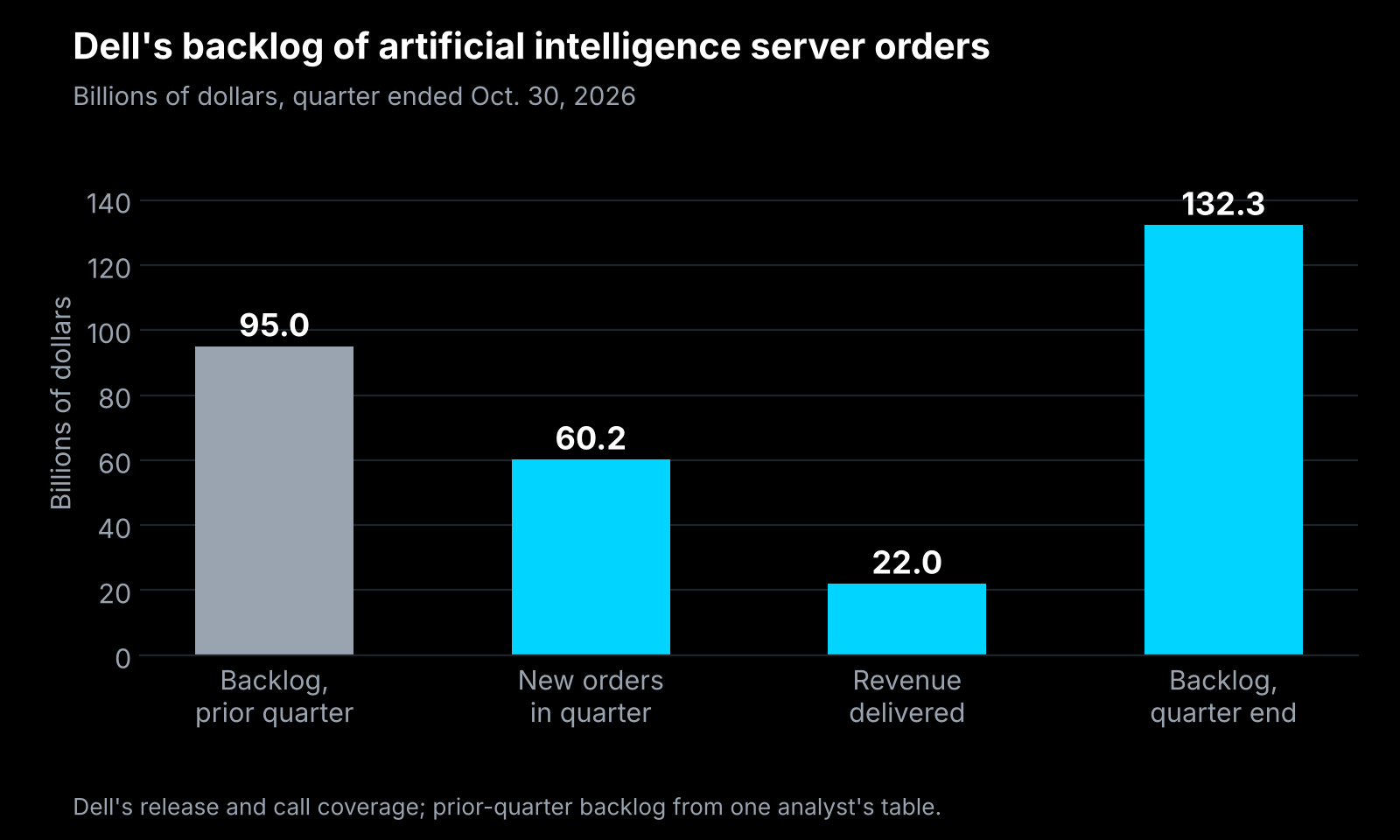
A report that summarized the call said management said demand exceeds supply into fiscal 2028. That means the limit is how fast Dell can build and ship, and the report I read did not give a delivery schedule.
It helps to see why a backlog is a different thing from revenue. A company counts revenue when it delivers the product to the customer, so an order sitting in the backlog has not yet appeared in any profit report. Between the order and the delivery, several things can change. The customer can cancel, if the contract allows it. The customer can ask for a different configuration. Or the customer can run short of the money, power or land it needs to take the machines. That is why a backlog is usually read as a measure of how long the line is, and not as a promise of what will be paid.
BUT how much of the backlog is certain? One analyst who read Dell's filings writes that an order counts in the backlog only to the extent Dell determines the manufacturing orders cannot be cancelled. That is one analyst's reading, and I did not check it in the full filing. A firm called Melius, according to one summary, is skeptical of the backlog because the demand is concentrated among neoclouds, which are newer cloud companies built to rent out chips. I am reporting that view and cannot weigh it for you.
THEREFORE the backlog tells you a lot about demand and less about timing and certainty. Orders pile up faster than Dell delivers, and the gap is widening.
What does it cost to deliver, and how did the stock react?
The answer starts with margins. Gross margin is the share of each dollar of sales left after the direct cost of making the product. Dell's was 21.2%. One analyst at Evercore ISI said that was about 2 percentage points above the consensus, even with higher memory costs. Operating margin is the same idea after running costs. The business division's was 17.0%, up from 12.4% a year earlier.
BUT Dell guided that division's operating margin to about 15% next quarter, down from 17%, and it pointed to higher memory costs. Memory chips are the components that hold data for the processor, and when they cost more, a server costs more to build. Dell's forecast for adjusted earnings per share next quarter, 8.40, is below this quarter's 9.45 even though revenue is expected to rise. That is why some of the coverage read a record report as a warning, though the forecast was above what analysts had expected. One report describes the margin on servers built for artificial intelligence as "mid-single digits." I could not confirm that in the release, which did not break out that margin.
Then there is the balance sheet. One analysis of Dell's filings says inventory, which is goods held before they are delivered, rose from 10.4 billion dollars to 29.4 billion since the start of the fiscal year. Accounts receivable, which is money customers owe, rose from 17.6 billion to 28.9 billion. Total debt rose from 31.5 billion to 37.7 billion. Dell's cash from operations was 4.5 billion dollars in the quarter and 10.8 billion for the year so far, according to the release. Those numbers are one analyst's reading, and I did not check them against the full filing, which a different analyst says had not been filed yet.
Now the stock. Dell closed at 334.91 dollars on Monday, November 23, 2026, after a rise of about 20.5% that day. On Tuesday, November 24, 2026 it fell 11.83% to 295.28 dollars, before the report came out, along with the chip and server group. On Wednesday, November 25, 2026, the first session after the numbers, it swung widely. One source had it down about 8.5% before the open, and it was about 272.57 dollars at 11:01 a.m. Eastern time. It closed at 297.06 dollars, up 0.6%.
So the market's first answer was mixed. A stock that swings that far and ends flat is telling you the report held two messages: very large demand, and open questions about margins and cash. Several brokerages lowered their estimates of what the shares could be worth after the report, mostly citing margins and the weak personal computer business. One article described that as a reassessment of valuation and not a collapse in demand. That is the article's reading, and I do not have the notes.
What this does not tell you
I do not know whether the backlog will turn into revenue, or how fast. Dell has not given a delivery schedule that I could find, and I did not read the call transcript or the full quarterly filing. Several of the figures on margins and the balance sheet come from one analyst or one article.
I also do not know why the stock moved as it did on any one day. The 11.83% fall on November 24 came before the report, with a group-wide decline, so I would not link it to the numbers.
And this does not tell you where the stock goes from here. Dell closed on November 25 at about half of its September 2026 high of roughly 590 dollars, and two sources differ slightly on the exact high. That history is context and not a forecast.
What does Dell's record backlog mean?
According to what I found, it means demand for Dell's artificial intelligence servers is very large. Orders ran about 2.7 times deliveries in the quarter, and Dell raised its forecast. It does not mean all 132.3 billion dollars will be delivered, because an order counts only to the extent it cannot be cancelled, and it does not mean the work is as profitable as the work Dell does today, because Dell guided margins lower and its inventory, receivables and debt all grew.
That brings me back to the first answer, that the backlog is 132.3 billion dollars on the way. It is closer to a queue. How fast it moves, and what Dell earns on each order, are the figures I would watch.
Where to look next
Watch the full quarterly filing for the backlog definition and the inventory and receivables figures. Watch memory prices, which management tied to the lower margin forecast. Watch the next report for the quarter ending Friday, January 29, 2027, tentatively due in early March 2027 according to one source. Watch whether the big cloud companies keep their spending plans. And watch the Fed decision on Wednesday, December 9, 2026.
If you want to see what any stock you follow is worth, its fair value range, sign up at techdamentals.com. It also shows a company's fundamentals alongside technical analysis of its chart. After each earnings report, it reads the company's own filing and compares the financials with what analysts expected, line by line, so you can see the real reason a stock moved. Try Techdamentals for 3 days, no card needed
This is educational content, not financial advice. Techdamentals is an educational tool and does not recommend any security.