On Tuesday, November 24, 2026, after the US market closed, a chip designer called Ambarella put two numbers in the same press release, and the two of them do not look like they belong to the same company.
The first was $115.2 million. That was revenue for its fiscal third quarter, the three months that ended October 31, 2026, and it is the most money Ambarella has ever collected in a single quarter. The previous high was $100.5 million, from the quarter that ended October 31, 2016, ten years earlier.
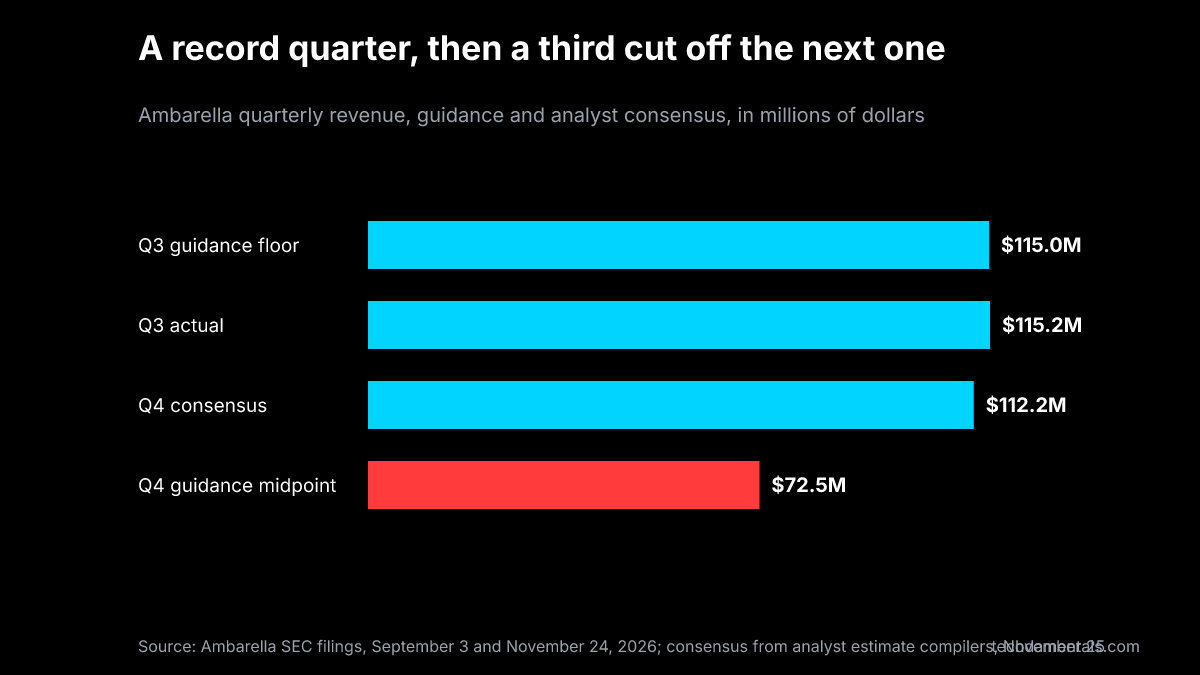
The second was this sentence about the quarter that ends January 31, 2027: "Revenue is expected to be between $70.0 million and $75.0 million." The analysts who publish estimates for Ambarella were carrying about $112 million for that quarter. The middle of the company's own range, $72.5 million, is roughly 35% below that figure (my own math).
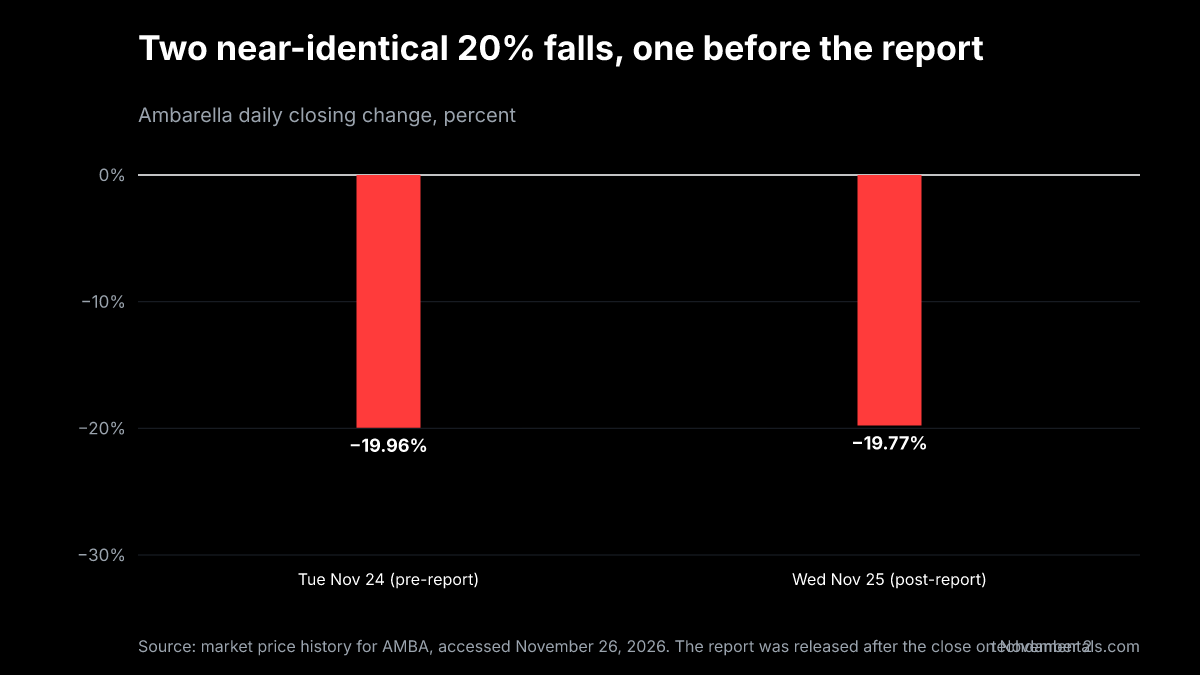
So a record, then a forecast about a third smaller than what the people watching the company expected. By the close on Wednesday, November 25, 2026, the stock had fallen 19.77% that day, after already falling 19.96% on Tuesday, November 24, 2026 during normal trading hours, before anybody had seen the report.
How does a company set an all-time revenue record and then tell the market that its next three months will land about a third below what everyone expected? The quick answer is that demand for its chips fell apart. That is the first thing I checked, and the company's own numbers do not support it.
I want to go through three things. What was inside the record quarter, including a profit figure the headlines got wrong. What the guidance and the gross margin say about whether this is a demand problem at all. And then the part Ambarella does not make, does not ship and earns nothing on, which is where this story ends up.
Who Ambarella is, in plain terms
Ambarella designs the chip that sees. If you have a security camera on your porch, a dashcam, a video doorbell, or a camera system in a car that reads lane markings, there is a processor inside it that takes the raw signal from the lens and turns it into usable video and into decisions, like "that is a person" or "that is a parked truck." Ambarella designs that processor. It calls them edge AI chips, because the computing happens in the device itself rather than in a data center far away.
It does not manufacture anything. In the industry that is called fabless: you do the design, and you pay somebody else who owns the factories to make the silicon. Ambarella's annual filing says a substantial majority of its chips come from Samsung Electronics, built in Austin, Texas and in South Korea. At the close on Wednesday, November 25, 2026, the whole business was worth about $1.6 billion.
What was inside the record quarter?
Revenue of $115.2 million was up 6.2% from $108.5 million in the same quarter a year earlier, and up 6.6% from the $108.1 million it reported for the quarter that ended July 31, 2026.
That record hides something. Back on Thursday, September 3, 2026, Ambarella told investors to expect $115.0 million to $124.0 million for this quarter, a range with a midpoint of $119.5 million. It came in at $115.2 million, which is 0.2% above the floor. So the all-time record was simultaneously the bottom of the company's own forecast, and the chief executive, Fermi Wang, said so in the release: total revenue "was at the low end of our guidance range as our consumer IoT revenue was below our expectations."
On profit you need two sets of books. GAAP is the standardised accounting that every US public company must report. Non-GAAP is the company's own version, where it removes costs it considers not part of day-to-day operations. On a GAAP basis Ambarella lost $12.703 million in the quarter, or 29 cents per share, a smaller loss than the $15.1 million, or 35 cents, a year earlier. On a non-GAAP basis it earned $12.696 million, or 28 cents per share, against $11.9 million and 27 cents a year earlier. The gap between those two figures is almost entirely one item: $24.172 million of stock-based compensation, which is the value of shares and share awards handed to employees as pay. Add acquisition-related costs of $1.213 million and a small tax effect, and the total removed is $25.399 million.
One widely republished story said Ambarella "beat" on earnings with adjusted earnings of 58 cents per share. That 58 cents is the nine-month figure, not the quarter. The quarter was 28 cents, and estimates sat in the 31 to 32 cent range, so it was a miss on either estimate, even though the figure grew from 27 cents a year ago.
[[ CHART 1 HERE: Ambarella hit the floor of its third-quarter range, then guided the fourth quarter about a third below analyst estimates | Bar chart in millions of dollars: third-quarter guidance floor $115.0M, third-quarter actual revenue $115.2M, fourth-quarter analyst consensus about $112.2M, fourth-quarter guidance midpoint $72.5M ]]
Was this demand for Ambarella's chips falling apart?
That is the normal explanation when a company cuts a quarter by a third, so I went looking for its fingerprints. There are three I would expect, and none of them are in the release or the call.
The first is price pressure. When customers stop wanting your product, you usually have to discount it, and gross margin falls. Gross margin is the share of each dollar of revenue left after the direct cost of making the thing. Ambarella guided non-GAAP gross margin for the January quarter to 59.0% to 60.25%. Its actual non-GAAP gross margin in the record quarter was 59.5%. So the guided range straddles and tops what it just delivered: revenue cut by a third, profitability per dollar guided flat to slightly higher.
The second is inventory piling up. Days of inventory fell from 157 to 130 in the quarter, the opposite of what demand destruction usually looks like. Days sales outstanding, which measures how long customers take to pay, went the other way, from 32 to 47, and that is worth keeping an eye on.
The third would be cancellations. On the earnings call on Tuesday, November 24, 2026, Wang said "the majority of the revenue reduction is pushed out, and there are some cancellations too." Pushed out means the order still exists on paper, later.
Year over year the margins did slip, and that is real: GAAP gross margin was 57.8% against 59.6% a year earlier, and non-GAAP was 59.5% against 60.9%. But against its own forecast, margin came in mid-range. So if the chip is not being discounted, and the orders are mostly being delayed rather than killed, what is shrinking the quarter by 37% from the one before it?
The part Ambarella does not make
Memory.
A chip like Ambarella's cannot work alone. It needs memory next to it on the circuit board, the working scratchpad that holds video frames while the processor does something with them. That memory is DRAM, and it is made by a small group of companies. Ambarella does not make it, does not supply it, and earns nothing from it. Its customer purchases it separately and puts it on the same board.
And DRAM prices have gone somewhere extraordinary. Take the commodity part that goes in consumer gear rather than the exotic stuff going into AI data centers, a DDR4 8-gigabit chip. Its contract price was seven dollars in October 2025, already the highest in roughly seven years. In October 2026 it was twenty-seven dollars and fifty cents, the nineteenth consecutive monthly increase. That is 3.93 times the price in twelve months, up 293% (my math from those two prices). The quarterly increases have been slowing, from around +95% in the first quarter of 2026 to around +40% in the third and +10% to +15% in the fourth, from an enormous base.
Ambarella itself never put a number on it. The release says only "the unprecedented rise in memory prices and the scarcity of memory supply we previously highlighted has intensified and is causing many customers to reduce their outlooks."
Now the mechanism. On a consumer product, memory is a huge share of the bill of materials, which is the parts list and cost sheet for building the device, and Wang said "our customer has a limited flexibility to increase price because, on a consumer product, by definition, if you raise too much price, the end market might not accept it." A camera maker cannot put a $150 price tag on a doorbell shoppers expect to cost $90. So it builds fewer units. Louis Gerhardy, Ambarella's VP of corporate development, said customers are "allocating their very scarce memory supply to their highest value products... their newer chips." Ambarella's chip did not get more expensive. Its customers simply cannot assemble as many finished products, so they order fewer of the part that sees.
And the arithmetic shows this is no longer confined to doorbells. Gerhardy said the quarter's mix was "a little more than 70%" IoT and "close to 30%" automotive, and within IoT roughly half is consumer, so consumer IoT is about 35% of revenue. But the January quarter is guided down about 37% from the one just reported, and a 35% slice cannot produce that on its own. Wang confirmed it on the call: "the memory induced weakness we began to see in the consumer market in Q3 was spreading into all of our markets to various degrees."
One structural fact makes a swing this size mechanically possible. Ambarella's annual filing for the year ended January 31, 2026 says WT Microelectronics, its non-exclusive sales representative and fulfilment partner in Asia outside Japan, accounted for approximately 70% of total revenue. So "customers reduced their orders" is, in the plumbing, largely one Asian distribution partner revising one order book, easier to swing by a third than thousands of separate end customers, and in principle easier to swing back.
Did anybody see this coming?
This is the part that surprised me most, and it is on the record.
On the September 3, 2026 call, Wang described this exact mechanism, in these words: "Memory price does not impact our gross margin." He went on to say the only thing it can affect is how many chips his customers are able to order. Management said memory supply remained a key uncertainty for the fiscal fourth quarter, and the full-year revenue growth target of 10% to 15% was reaffirmed with a condition attached, assuming memory supply did not materially affect the fourth quarter. That was 82 days before the stock fell. The mechanism, and the quarter.
Now measure the company against its own words. Growth of 10% to 15% on fiscal 2026 revenue of $390.7 million means $429.8 million to $449.3 million. Nine months in, Ambarella had $323.7 million, up 11.7% from $289.8 million, right on track. Add the midpoint of the new guidance and the full year lands at $396.2 million, up 1.4%. One quarter takes a year that was tracking at about 12% growth down to roughly flat, and the shortfall against the low end of its own target is about $33.6 million, essentially the whole gap in the fourth quarter.
Profit flips with it. At the guidance midpoints, $72.5 million of revenue at about 59.6% gross margin produces roughly $43.2 million of gross profit, against guided non-GAAP operating expenses of $57.5 million to $59.5 million. That is a non-GAAP operating loss of roughly $15 million, against non-GAAP operating income of about $12.9 million in the quarter just reported (my own math from the guided ranges).
The same memory bill, three different outcomes
If high memory prices were simply fatal to anyone who puts memory in a product, every company in this chain would look like Ambarella. They do not.
Mobileye, which makes driver-assistance systems for carmakers, reported its third quarter on Thursday, October 29, 2026. Its release says the pass-through of higher memory costs added approximately $7 million to third-quarter revenue at zero gross margin. It handed the cost increase straight to the automakers, dollar for dollar, kept nothing, and raised its full-year 2026 revenue guidance to $1.995 billion to $2.020 billion. Its margins took about a 100 basis point hit, a basis point being one hundredth of a percentage point.
Logitech, on Sunday, November 22, 2026, two days before Ambarella reported, put its own semiconductor supply hit at $70 million to $80 million, down from an initial estimate of up to $200 million, and said it expected the disruption resolved by the end of its third quarter. It had purchased memory ahead of the increases and had raised video collaboration prices by about 13% in May.
Then the other end. GoPro's quarterly filing describes "unprecedented increases and volatility in memory costs," with unexpected increases of 80% to 115% at the end of March 2026, and GoPro has since issued a going-concern warning, the formal accounting flag that a company may not be able to continue operating. Sonos absorbed $56 million of higher memory costs in its fiscal 2026.
Same input. Mobileye passes it to carmakers under contract and raises guidance. Logitech purchased early and cut its own damage estimate by more than half. Ambarella's consumer camera customers have a shelf price they cannot exceed, so they build fewer boxes. The variable is not the price of memory. It is who in the chain can hand the cost to somebody else.
Two nearly identical 20% days, and only one of them is explainable
The full sequence, measured at the closing price, goes like this.
On Monday, November 23, 2026, Ambarella closed up 4.69%. That was the day Nvidia's board announced it had reinstated Jensen Huang as president and chief executive, effective immediately, and the Philadelphia semiconductor index rose 14.03%. So Ambarella gained less than 5% on a day its sector gained more than 14%.
On Tuesday, November 24, 2026, before the report, it closed down 19.96% on 8.8 million shares. The semiconductor index fell 7.88% that day, giving back most of the jump from the day before. Ambarella fell about two and a half times as much as its sector.
Then the report landed after the close, and the stock traded somewhere between 37% and 44% lower in after-hours trading, the thin session that runs after the official close. Those prints are not a close, so I would not build anything on them.
On Wednesday, November 25, 2026, it closed down 19.77% on 14.8 million shares, about 7.5 times the volume on Monday, November 23, 2026. That day the broad market barely moved at the close: the S&P 500 tracker was down 0.29%, the Nasdaq-100 tracker down 0.65%, the Dow tracker up 0.31%. The semiconductor index closed down 0.65% after being down about 8% intraday.
So the decline on Wednesday, November 25, 2026 is about as cleanly attributable to the report as these things get, at least measured close to close. The one on Tuesday, November 24, 2026 is not. Three documented things were happening at once: the sector was unwinding a 14% melt-up, the market was rotating out of technology that day, and one large bank's analyst had cut his valuation estimate on Ambarella within the previous 24 hours while keeping a positive rating, citing memory cost pressure lasting through 2027. A fourth possibility, that the market was positioning for a bad forecast, is suggested by the relative arithmetic and stated by no source I can find. Nobody can apportion that session between them.
Measured from the close on Monday, November 23, 2026 to the close on Wednesday, November 25, 2026, the two sessions cost 35.78%. Against its close on Wednesday, December 31, 2025, Ambarella is down 49.6% in 2026, and it sits 61.9% below its highest close of the past year, which came on Tuesday, May 26, 2026.
Has Ambarella had a quarter this bad before?
Yes, and worse. At the guidance midpoint, the January 2027 quarter would be down about 28% from the $100.9 million of the same quarter a year earlier. For the quarter ended January 31, 2024, Ambarella reported $51.6 million, down 38.1% from $83.3 million, and full-year fiscal 2024 revenue fell 32.9%, from $337.6 million to $226.5 million, with a $154.6 million operating loss.
The contrast that struck me hardest is the same fiscal quarter one year earlier, reported on Tuesday, November 25, 2025: non-GAAP earnings of 27 cents against 21 cents expected, revenue of $108.5 million against $104.07 million expected, and full-year growth guidance raised to 36% to 38% from 31% to 35%. Twelve months later the same fiscal quarter missed on both lines, and the close on Wednesday, November 25, 2026 was about 60% below the close on the day of that beat-and-raise report.
The balance sheet is not the pressure point: $282.8 million of cash and marketable debt securities at quarter end, $13.4 million of free cash flow in the quarter, and a $50 million share repurchase authorization running through June 30, 2027 that was not used in the quarter.
What this does not tell you
Ambarella never quantified the memory increase its customers face. The DDR4 prices above come from market research reporting, not from Ambarella, and the 3.93 times figure is my arithmetic on those two monthly prices.
The release's single use of the word "record" is "record edge AI revenue," not record total revenue. Wang said "record total revenue" on the call, and the $115.2 million figure does check out as an all-time high against the filings. But Ambarella has never disclosed edge AI revenue in dollars in any quarter I could check.
I could not read the risk factor section of the quarterly filing for the period ended July 31, 2026 directly, so I am not going to tell you what the filings warned and when, beyond what Wang said out loud on the September 3, 2026 call. The semiconductor index levels come from market summaries rather than the index provider, and the after-hours prints disagree with each other by seven percentage points. Nothing I found says whether the pre-report fall on Tuesday, November 24, 2026 was anticipation. And nobody alleges Ambarella lost business to a rival: the analyst who downgraded it after the report cited slow automotive development and limited scale alongside memory, which is about growth rate, not lost share.
So why did Ambarella guide down a third?
Because the cost that broke the quarter sits on the other side of the circuit board. Ambarella's own chip is not being discounted, which is why gross margin is guided flat to higher, and its customers' orders are mostly delayed rather than cancelled. What changed is that memory, a part Ambarella does not make or supply, became expensive and scarce enough that its customers cannot build as many finished cameras at a price shoppers will accept, so they are rationing the memory they have toward their highest value products and ordering fewer of everything else, across consumer, enterprise and automotive. Wang described that exact mechanism on September 3, 2026 and named the January quarter as the uncertain one, and estimates stayed near $112 million anyway.
Which brings me back to the two numbers in the November 24, 2026 release. The record was real, and so was the $70 million to $75 million. They are the same business, two steps apart in a supply chain, in two different quarters.
The thing I will be watching is whether the next memory maker to report and the next camera chip supplier to report show the same split that Mobileye, Logitech and Ambarella just showed, between the companies that can hand a cost increase to their customers and the companies that cannot.
If you want to see what Ambarella is worth, its fair value range, sign up at techdamentals.com. It works that range out four different ways, then shows the company's fundamentals and explains what each one means. After each earnings report, it reads the company's own filing and shows what the headline left out: the numbers that came in different from what analysts expected. You can also set a value alert, so you hear when a stock moves into the part of its range you pick: undervalued, fair value or overvalued. You decide what that means for your plan; the alert only tells you when it gets there. And on the technical side, you can paste a screenshot of any stock chart, any timeframe, and it reads whether the chart has a bullish or bearish bias. That is 7 days free, with 3 analyses in each app. Try Techdamentals for seven days, no card needed
This is educational content, not financial advice. Techdamentals is an educational tool and does not recommend any security.